
Things to Do in Oaxaca: Culture, Food and Day Trips
A practical guide to Oaxaca de Juárez: connect museums with food and living craft traditions, and choose a valley excursion that deserves your time.
The most rewarding things to do in Oaxaca connect what you see in a museum with what people make, cook and sell today. A textile exhibition becomes more interesting before a weaving workshop; the objects from Monte Albán make more sense alongside the archaeological landscape.
This guide focuses on Oaxaca de Juárez and excursions into its surrounding valleys. The state also includes mountains and a Pacific coast, but those are separate travel decisions. Start with your strongest interest—archaeology, food, craft or landscape—then decide how much of your stay should happen outside the city.
Choose your Oaxaca experiences
| Experience | Where it fits | Main appeal | Planning effort |
|---|---|---|---|
| Santo Domingo and Museo de las Culturas | Historic centre | Architecture and archaeological context | Confirm museum opening directly |
| Museo Textil and a market meal | Historic centre | Textiles and everyday food | Flexible city visit |
| Monte Albán | Hilltop southwest of the centre | Large-scale archaeological landscape | Separate transport and exposed walking |
| Teotitlán del Valle | Eastern valley | Weaving and conversations with makers | Arrange a workshop visit |
| Mitla | Farther east | Geometric stonework within a living town | Dedicated archaeological outing |
| San Bartolo Coyotepec | Southern valley | Black pottery | Separate craft excursion |
| Hierve el Agua | Beyond Mitla in the eastern mountains | Mineral formations and landscape | Greatest logistical commitment here |
The half-day and full-day suggestions below are editorial planning allowances, not verified journey times. Traffic, collection points, stops and the pace of your group change the day considerably.
Read the city through Santo Domingo
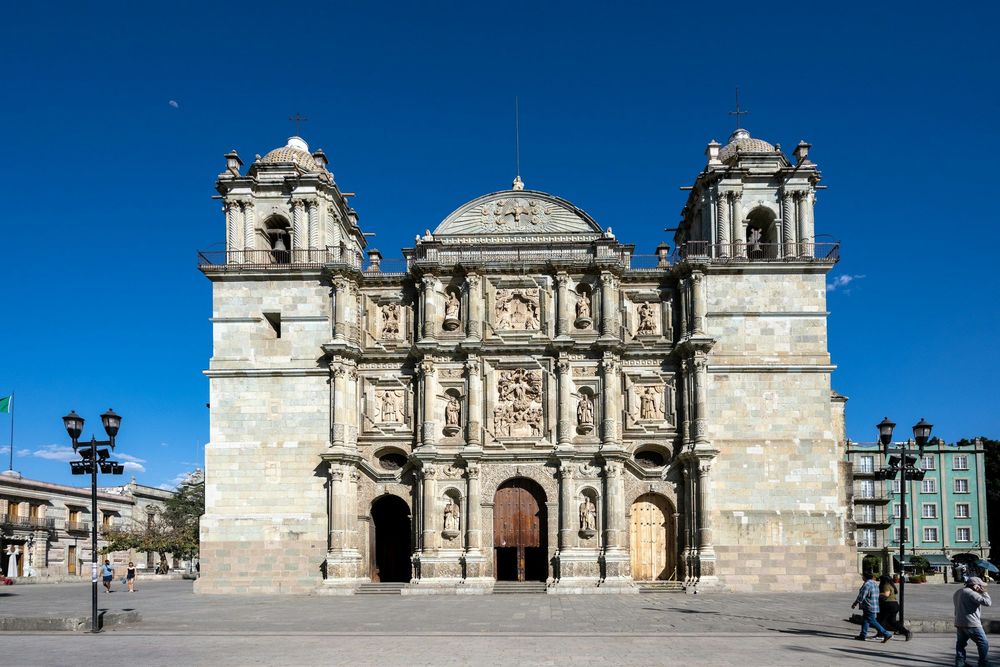
Begin around Santo Domingo, then follow the central streets toward the Zócalo. This provides a useful orientation before going into individual collections: church, museum, gardens and public squares serve different purposes and deserve separate attention.
The Museo de las Culturas de Oaxaca occupies the former Dominican convent. Its archaeological collections include the Mixtec objects recovered from Tomb 7 at Monte Albán. Choose it when you want context before visiting the ruins, or when an outdoor excursion would be uncomfortable.
Look at the distinction between the objects and the building containing them. A colonial convent presenting Indigenous history is itself a reason to ask how that history has been collected and interpreted. You do not need to read every label to benefit: select the archaeological galleries that relate to your planned excursion, then leave time for the architecture.
Opening information needs care. On 3 October 2026, INAH's visitor portal and its separate museum listing displayed different hours. Confirm the day's opening and last admission directly; do not build a Sunday visit around an assumed timetable. The church and museum are separate visits, and access to one does not establish access to the other.
The nearby garden is another distinct experience. Its official website now uses the name Jardín Etnobiológico de Oaxaca and explains its focus on the relationship between plants and local cultures. Consult its visits section for the current entry arrangements and language options. A view into the garden from elsewhere in the complex is not the same as visiting it.
Make the textile museum your craft starting point
At Hidalgo 917, the Museo Textil de Oaxaca has free admission. Its published hours, checked on 3 October 2026, are Monday–Friday 10:00–20:00, Saturday 11:00–20:00 and Sunday 11:00–18:00. This makes it a useful option when a longer museum visit or valley excursion does not fit.
Treat the displays as an introduction to questions you can later ask a maker. What is woven into the cloth, and what is embroidered afterward? Which materials give a piece its structure? How does the maker describe the design? Read the labels for the origin of each piece instead of assuming everything represents a single Oaxacan tradition.
This is a different experience from shopping. If you want to buy textiles but are unsure what you are looking at, visit the museum first and compare pieces afterward. If your main interest is contemporary textile art, allow the exhibition itself to be the point rather than treating it merely as preparation for a village trip.
Eat through the markets with a little structure
The state tourism guide to Mercado Benito Juárez places it just south of the Zócalo and identifies foods including chapulines, tejate and tlayudas. The neighbouring Mercado 20 de Noviembre gives you another place to explore around a meal.
Use the market visit to make choices rather than order everything at once. Start by walking through and reading menus; then decide whether you want a snack, a cooked meal or ingredients to take away. Ask how a dish is prepared and what accompanies it. That conversation is more useful than assuming a familiar name means the same portion or preparation everywhere.
A tlayuda can be a good place to start asking about toppings, while chocolate and a small snack offer a lighter stop. For mole, ask which version is being served rather than treating the word as a single recipe. Compare distinct preparations across your stay; there is no need to turn lunch into a checklist of regional dishes.
If you avoid meat or other ingredients, ask about the preparation as well as the visible topping. Describe what you cannot eat before ordering. For purchases, clarify the quantity and total price, particularly when a product is sold by weight. This guide does not quote stall prices because there is no single market tariff.
A cooking session suits travellers who want to understand technique. Ask for the actual menu, teaching language and whether participants cook or mostly watch. A market walk plus a cooking lesson can occupy your main activity slot; do not book it as an incidental gap between museum visits.
Choose Monte Albán for the archaeological landscape
Monte Albán is the strongest first choice if your priority is to understand the scale and setting of an ancient city. It is a hilltop outing southwest of central Oaxaca, not another stop on a walking circuit through town.
INAH's Monte Albán page lists daily opening from 08:00–17:00, with last admission at 16:00, checked on 3 October 2026. It identifies the main plaza, monumental platforms and carved stone monuments. Leave room to look across the site as well as at individual structures.
Allow roughly half a day including transport as an editorial estimate. A shorter visit may suit someone interested mainly in the setting, while a guided visit and careful examination of the carvings need more room. Before paying for transport, establish the exact departure point, return arrangement and whether guide services and admission are included.
Expect a more physically demanding outing than the central museums: outdoor distances, uneven surfaces and exposed areas change the experience. Ask specifically about the route if steps or prolonged walking are a concern. Take water and sun protection, and plan around the day's conditions rather than assuming an early start removes every difficulty.
Pair the site intellectually with Museo de las Culturas, without requiring both on the same day. The museum gives objects a setting in history; Monte Albán gives that history a setting in the landscape.
Pick a craft village by what you want to learn
For textiles, choose Teotitlán del Valle, east of Oaxaca. The state tourism board describes family workshops producing wool textiles and demonstrating natural dyes. The value of the trip is time with a maker, not simply access to another sales floor.
Arrange a visit where you can ask about fibre, dyeing, weaving and the specific piece in front of you. Do not assume every item uses the same materials or that a demonstration will happen whenever you arrive. Ask whether the visit has a fee, whether interpretation is available and how long the host recommends allowing.
For pottery, San Bartolo Coyotepec lies on the southern craft route and is associated with barro negro. It offers a different set of questions: shaping, surface treatment and firing. Ask the maker how a purchased piece should be used and packed rather than assuming decorative pottery is suitable for food.
These villages lie in different directions. For a focused craft half-day, choose the material that interests you most and protect time for a substantial visit. If you want to buy something, record the maker's name and care instructions; knowing who made it is more meaningful than collecting an anonymous souvenir.
Mitla or Hierve el Agua: detail or landscape?
Mitla and Hierve el Agua are both associated with excursions east of the city, but they answer different interests. Combining them is an option to evaluate with an operator, not a reason to accept every additional stop offered along the way.
Mitla's INAH listing highlights geometric stone mosaics and the archaeological remains within a present-day Zapotec town. Choose Mitla if fine architectural detail interests you more than the broad hilltop setting of Monte Albán. The listed schedule, checked on 3 October 2026, is daily 08:00–17:00, last entry 16:30.
A visit here rewards looking closely. Compare the arrangements of the stone patterns and how the surviving spaces relate to the surrounding town. If your day also includes a weaving workshop, ask the operator how much uninterrupted time each visit receives; a list of stops says little about the quality of the day.
Hierve el Agua is a landscape excursion farther into the mountains. Its apparent waterfalls are mineral formations created by water depositing material over time. Choose it for the setting and the outdoor experience, rather than as a substitute for the archaeological explanation you would get at Mitla.
Reserve a full day as an editorial allowance when this is your main excursion. Ask about the current access route, walking involved, local charges, time on site and return arrangements. The tourism description is not a live operating bulletin, so confirm access near your departure date. Do not assume pools, paths or every viewpoint will be available exactly as pictured.
The crucial comparison is how you want to spend your time: Mitla puts attention on buildings and detail; Hierve el Agua asks for a larger travel commitment to reach a natural setting. Neither requires adding pottery villages on the opposite side of Oaxaca.
Put your choices together
For a short stay, give the city a complete activity day before deciding how many excursions to add. Someone drawn to food can build around markets and a cooking session; an archaeology enthusiast can prioritise Museo de las Culturas and Monte Albán; a craft-focused visitor can connect Museo Textil with a prearranged village workshop.
Reserve the activity with the least flexibility first—a particular workshop or guided session—then fit flexible museum and market visits around it. Check opening information again shortly before travel. Oaxaca rewards time spent understanding a few places, especially when that leaves room to ask questions and follow your interests.
Plan the next part of your trip
Use these related guides to compare where to stay, what to visit or another destination in the same region. Each guide covers a separate decision; this is not a combined itinerary.
- Things to Do in Mexico City: Choose Your Highlights
- Where to Stay in Mexico City: Neighborhood Guide
More guides for planning your visit
To choose dates for Oaxaca city and the central valleys, compare seasonal conditions and festival planning in our guide to when to visit Oaxaca.
Cover photograph: Stone church facade with two bell towers and a plaza in Oaxaca. Photo by Krzysztof on Unsplash. (Unsplash).
Frequently Asked Questions
What should I prioritise on a first visit to Oaxaca?
Start with the historic centre, a museum and a market meal. Add Monte Albán for archaeology, Teotitlán del Valle for weaving or Hierve el Agua for landscape, according to your interests.
Can I enjoy Oaxaca without a car?
You can build city visits around the historic centre. Excursions require separate transport planning: confirm both the outward journey and the return before committing to a tour, driver or other service.
Is the Museo Textil de Oaxaca free?
Yes. Its official visitor page lists free admission, checked on 3 October 2026. It is a useful starting point for understanding textiles before a workshop visit.
Should I choose Monte Albán or Mitla?
Choose Monte Albán for a broad hilltop archaeological landscape and Mitla for geometric stonework within a living town. Both involve outdoor walking; consider your interest and the practical route rather than treating them as interchangeable.

Keep Exploring

Things to Do in Melbourne: Culture and Neighbourhoods
Build a Melbourne visit around the culture you enjoy: Australian art, screen culture, First Peoples' stories, market food and distinctive neighbourhoods.

Things to Do in Sydney: Harbour, Culture and Coast
A practical guide to choosing Sydney experiences, with harbour and coastal alternatives, museum comparisons and realistic time allowances.
Things to Do in Buenos Aires: Culture and Neighborhoods
Find your cultural starting point in Buenos Aires: compare neighborhoods, choose between museums and decide when a theater visit or tango evening deserves priority.