
Plan a thoughtful textile museum visit, with current hours, guided tours, workshop checks and a useful link to Oaxaca’s weaving communities.
The Museo Textil de Oaxaca is a good first stop when you want to understand textiles before buying them or visiting a weaving community. Choose a self-guided gallery visit for a flexible city morning; choose a scheduled tour or workshop when conversation or making something matters more. These are different visits, with different time commitments, even though they happen at the same address.
The museum is at Hidalgo 917 in Oaxaca de Juárez's historic centre. It fits into a walking day without the transport needed for a village excursion. Its changing exhibitions also mean that a garment photographed years ago is not a promise of what will be hanging when you arrive. Start with the current programme, then decide how much attention you want to give it.
Choose the visit that matches your interest
| Your priority | Choose | What to check |
|---|---|---|
| An introduction to textile art | Independent exhibition visit | Current rooms and themes |
| Discussion and interpretation | Wednesday guided tour | Language, capacity and any date exception |
| Learning a technique | A booked workshop | Dates, age requirements, materials and fee |
| Meeting weavers in their working setting | Separate Teotitlán excursion | An actual appointment and transport |
| Seeing an object from an old photograph | Ask before travelling | Whether it is currently exhibited |
Allow 60–90 minutes for a first independent visit, as an editorial planning estimate. Someone interested in individual stitches or garment construction may want longer. A workshop can occupy several sessions, so do not assume it can be fitted into the same short window. Our broader Oaxaca culture and day-trip guide helps place this museum within a stay that also includes food, archaeology or craft villages.
Opening hours and admission
The museum's current visitor-information page lists free admission and the following hours: Monday–Friday 10:00–20:00, Saturday 11:00–20:00 and Sunday 11:00–18:00. These details were checked on 13 November 2026. Confirm holiday arrangements and temporary closures shortly before visiting, particularly if the museum is the main reason for your journey into the centre.
Older pages on the museum's legacy .org.mx website still show different weekend opening times. Use the current .org visitor page rather than combining those versions. For a relaxed arrival, a weekend visit after 11:00 avoids relying on the earlier opening advertised in the old material. Do not leave all the galleries to the final few minutes before closing.
Free admission makes the museum easy to try, but it does not mean every activity costs nothing. Exhibition access, guided visits and practical workshops have separate arrangements. If you are travelling with someone who only wants a short look, agree a meeting point and a time to regroup rather than treating the whole museum as a compulsory shared pace.
How to look at a textile without specialist knowledge
Begin with one object rather than photographing the whole room. Read its label for the place, maker or community, material and technique where these are supplied. Look at how the design relates to the construction: a decorated edge, a repeated band, a change in density or the relationship between the front and back. You do not need to identify every stitch to notice the decisions involved.
Then compare a second piece. Ask what changed: the fibre, the scale, the colours, the way the object would be worn, or the purpose for which it was made. This makes the visit more specific than collecting a general impression of colourful fabric. If the label does not identify something, leave that question open rather than assuming that every object comes from the same community or period.
Keep makers' names when you take notes. A photograph of a label can be more useful later than another close-up whose origin you have forgotten, provided photography is allowed for that display. If a guide is available, ask one focused question about a piece you have already examined. It gives the conversation a starting point and helps you remember the answer.
Why the displays change
The museum's collection-care explanation describes textiles as delicate materials requiring controlled storage and careful handling. The practical consequence is that the collection and the public exhibition are different things. An object can belong to the museum without being available to see on an ordinary visit.
Use the current exhibition and activity programme to understand the themes on offer. This guide deliberately does not promise a named temporary show for future travel dates. Read the exhibition dates as carefully as the title, and distinguish an online project from something installed in a gallery. An attractive archived page is useful background but weak evidence of present access.
Nor is the collection store a general visitor attraction. The museum describes a separate consultation process for originating communities, researchers and postgraduate students. If you have a serious study request, follow that process rather than assuming a standard ticket or tour includes handling objects or entering storage areas. For most visitors, thoughtful time in the public rooms is the appropriate starting point.
Guided visit or workshop?
The current visitor page advertises a free Spanish-language tour on Wednesdays at 17:00, lasting about one hour, with capacity limited to 15 people. Confirm the arrangements for your date, especially for a group. The older website mentions other languages and days; this guide does not treat those older details as a current promise.
If you do not follow Spanish comfortably, ask about a separately arranged visit and the available language before committing. Do not assume that a bilingual member of staff will be able to interpret an entire tour spontaneously. An independent visit remains worthwhile: read what you can, choose fewer objects and use the museum's online material to prepare questions.
Workshops are another category. The official events calendar lists dated activities, sometimes over several consecutive sessions. Check the full description for skill level, minimum age, cost, materials and registration. A calendar listing shows that an activity is advertised, not that places remain available. Obtain a confirmation before arranging other travel around it.
A technique workshop suits someone who wants to spend time making mistakes and learning, not merely take a quick demonstration photograph. Consider the language in which instructions will be given and whether you can attend every required session. If your itinerary cannot accommodate the course, choose the exhibition and save practical learning for a future visit.
Pair the museum with a manageable city day
For a first morning, arrive after opening, spend time in the galleries and leave lunch flexible. A meal near the centre gives you room to discuss what you noticed without adding another ticket deadline. If the afternoon is already committed to a major museum, keep this visit focused on one exhibition rather than trying to read every label.
For a Wednesday tour, reverse that rhythm: do your other central sightseeing earlier, allow a break and return in good time for 17:00. Ask about joining arrangements before building a tightly timed afternoon around the advertised start. A guided visit is easier to enjoy when you are not carrying the fatigue and shopping bags of an entire uninterrupted day.
The museum is also a useful introduction before a separate village outing. Our Teotitlán del Valle textile guide explains the different decision involved in meeting makers and arranging a workshop visit. The city museum offers interpretation across exhibitions; a village appointment centres on a particular workshop and its people. Neither should be reduced to a compulsory sales stop on the way to the other.
Buying with better questions
After looking closely at textiles, you may have more precise questions for a shop or maker. Ask who produced an item, where it was made, which materials were used and how to care for it. If a seller describes a technique or dye, ask them to explain what that means for this particular piece. Price alone cannot establish its origin or the amount of work involved.
Set your budget before browsing and leave room for a considered decision. You can appreciate a demonstration without purchasing something, provided any agreed visit or teaching fee is honoured. Avoid asking someone to reproduce a museum design from a photograph without discussing authorship and context. The useful outcome of the museum visit is greater attention to individual work, not a checklist of motifs to collect.
Families, photography and access
For children, try a small observation game: find two different repeated patterns, compare their shapes, then choose a favourite object and explain why. Keep the visit short enough that looking remains enjoyable. A family workshop may be a better fit for active participation, but its published age requirements and registration still apply.
The museum's visitor rules prohibit touching textiles, flash, tripods and additional photographic lighting. Follow any further instructions beside individual works. Keep bags away from displays and ask staff about storage; the published rules direct visitors to leave belongings at the entrance service and warn against leaving valuables. Eat and drink outside the galleries.
If steps, a wheelchair, sensory needs or a stroller affect your visit, contact the museum about the precise route and facilities you require. This guide has not independently verified a completely step-free circuit. A historic-centre address or a photograph of a courtyard is not enough to establish access to every exhibition room.
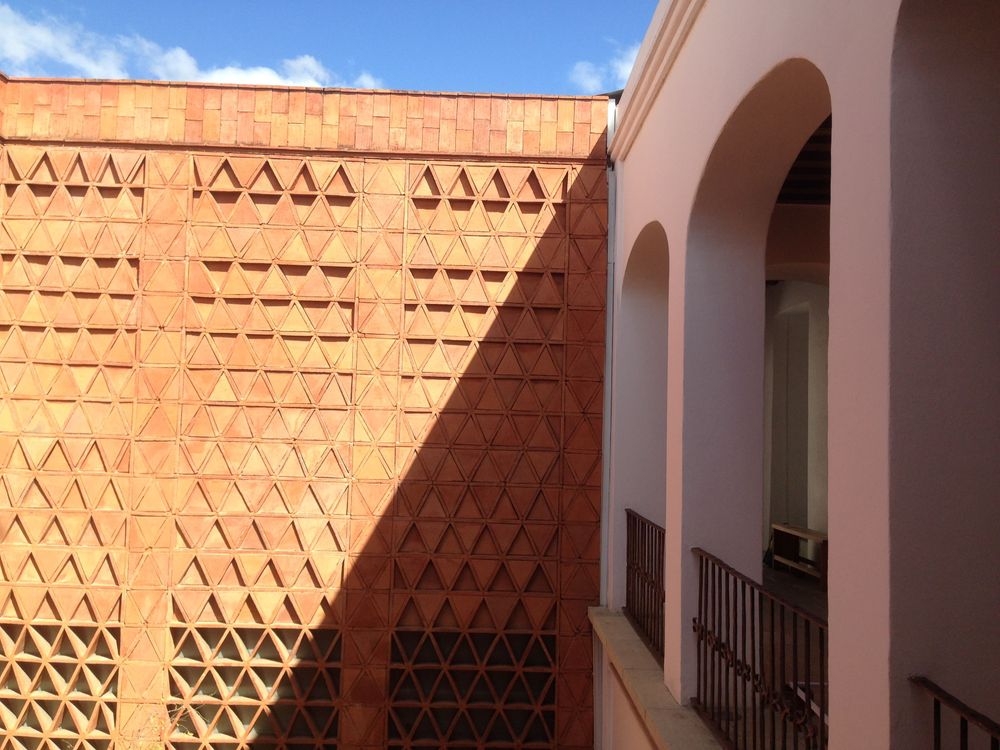
Cover photograph: Terracotta lattice wall and arches inside Oaxaca’s Textile Museum — ArribalaLuna, CC BY-SA 4.0.
Frequently Asked Questions
Is the Oaxaca Textile Museum free?
General exhibition admission is listed as free. Workshops have their own terms and may charge; check the specific activity before registering.
How long should I allow?
Allow 60–90 minutes for an independent first visit as a planning estimate. The advertised Wednesday guided tour lasts about one hour; practical courses may require several sessions.
Can I join an English-language tour?
The current visitor page advertises the regular Wednesday tour in Spanish. Ask directly about a specially arranged visit in another language; older bilingual listings are not a guarantee.
Will the textiles in older photographs still be displayed?
Not necessarily. Exhibitions change and collection objects require conservation. Check the current programme or ask about a specific object before travelling.


Keep Exploring
Academy Museum Los Angeles: Plan Your Visit
Plan an Academy Museum visit with gallery tickets, separate screenings and Oscars Experience, current closures and a realistic afternoon route.
Dainzú from Oaxaca: Plan Your Archaeology Visit
Plan Dainzú from Oaxaca: ballplayer reliefs, current admission, opening hours, the final road approach and a realistic half-day archaeology visit.

Niterói Contemporary Art Museum: Plan Your Visit
Plan a MAC Niterói visit from Rio: Niemeyer architecture, galleries, tickets, Wednesday admission, ferry connections and a realistic half-day outing.