
Dainzú from Oaxaca: Plan Your Archaeology Visit
Plan Dainzú from Oaxaca: ballplayer reliefs, current admission, opening hours, the final road approach and a realistic half-day archaeology visit.
Dainzú is a good choice for an archaeology stop in Oaxaca's eastern valley when you want to look closely at carved ballplayers and the relationship between buildings and hillside. Allow around 90 minutes to two hours on site, plus transport from Oaxaca de Juárez. The practical challenge is the final approach from Highway 190: a bus towards Mitla does not deliver you to the ticket office.
Our Oaxaca culture and day-trip guide helps choose between city museums, crafts and excursions. This guide concentrates on one smaller archaeological outing: whether Dainzú fits your interests, how to arrange the return journey, and what to observe without treating every stone platform as an interchangeable ruin.
Fast facts
| Detail | Planning information |
|---|---|
| Place | Dainzú archaeological zone, Tlacolula Valley, Oaxaca |
| Main interest | Zapotec architecture, ballplayer reliefs and ballcourt |
| Published hours | Daily 08:00–17:00; last admission 16:30 |
| Foreign visitor admission | MX$145 |
| Mexican nationals and foreign residents | MX$80; bring eligibility documents |
| Road approach | Highway 190 towards Mitla, then a separate access road |
| Suggested visit | 90 minutes–two hours; half a day including a flexible transfer |
| Conditions | Outdoor archaeological ground, steps and exposed walking |
Hours and prices were checked on 19 November 2026. The INAH visitor information gives daily hours and the two admission categories. Durations in this guide are editorial planning allowances, not operator journey guarantees. Prices are Mexican pesos; no fixed euro conversion is implied.
Decide whether Dainzú deserves your archaeology slot
Choose Dainzú for a focused look at a Zapotec settlement whose architecture follows the slope. The site rewards attention to individual carved figures, changes in level and the way ceremonial spaces relate to one another. Its appeal does not depend on a spectacular single summit or a long list of rooms to tick off.
The INAH archaeological description places Dainzú in the Tlacolula Valley and explains that its origins predate Monte Albán, although both settlements existed during overlapping periods. That makes it useful for travellers already interested in the region's history: the valley was a network of communities, rather than the backdrop to only one ancient capital.
If you have one short archaeology opportunity and want the broad scale of an ancient city, compare the larger regional sites before committing. If you have already seen Monte Albán, Dainzú offers a reason to slow down and compare architecture and imagery. It should be a deliberate choice, not an extra stop added simply because a tour vehicle passes the turn-off.
Travellers with little interest in archaeological interpretation may prefer a shorter city museum visit or a living craft tradition. Families can make Dainzú work by giving children two clear observation tasks: find how platforms respond to the hillside, and compare the positions of figures in the reliefs. Avoid promising that ancient structures can be climbed or explored inside.
Read the reliefs and the landscape together
Begin by asking the attendant which sectors are open that day and where the carved reliefs can currently be viewed. Conservation needs can change the route through an archaeological site. An image online establishes that a feature exists; it does not establish today's permission to approach it.
INAH identifies carved ballplayers among Dainzú's defining features. Look at posture, headgear and the relationship between figures before reading a modern sporting scene into the carvings. Ancient ballgames could carry ritual and political meanings. The careful approach is to use the site's interpretation, ask what is established, and distinguish that from a guide's reconstruction.
Give the reliefs a few unhurried minutes. A photograph of a whole row may record less than a close visual comparison of two figures. Observe from the permitted position, leave any barrier in place and do not touch the stone to trace an outline. Flash is prohibited by the site's visitor rules. Zooming from an allowed path is preferable to stepping onto a fragile surface.
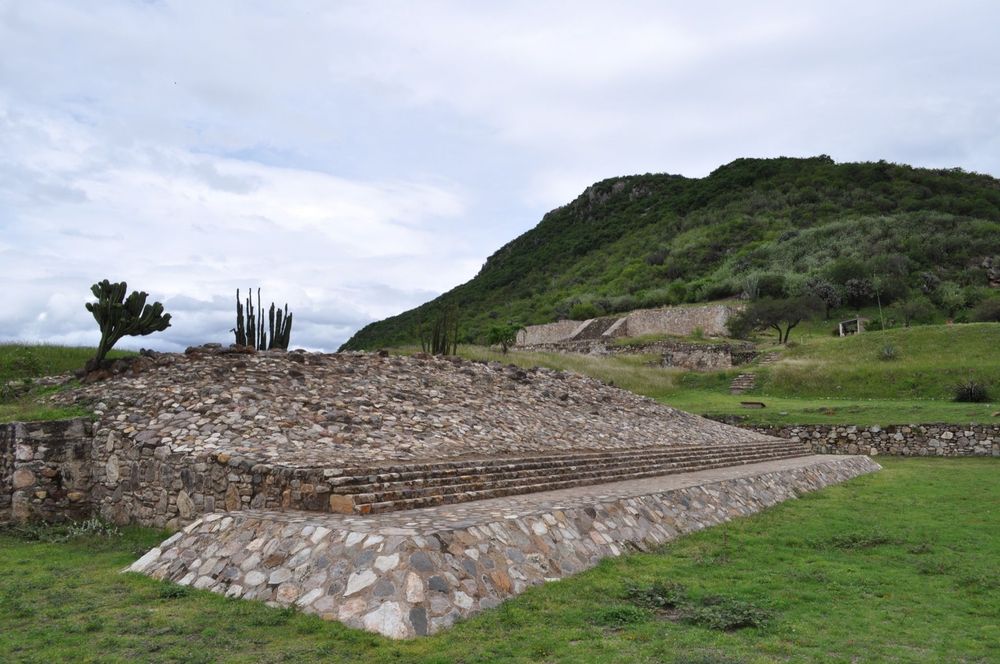
Then step back and examine the platforms. The INAH cultural overview describes the principal structure against the hillside. Notice how this changes the experience of moving through the settlement: the relationship between a platform, a slope and an open space matters as much as the height of an individual wall.
The ballcourt gives a second way to consider the site's recurring theme. Treat the court and the carvings as related evidence, without assuming every image shows exactly the same rules or period of play. A useful visit ends with clearer questions about the settlement, not necessarily with a confident answer to every symbol.
Get there with a complete return plan
INAH describes the route from Oaxaca along Highway 190 towards Mitla and an access road from the main highway. Its pages use different distance references: roughly 20 km along the route in one description, a junction at highway kilometre 23.5 in the address, and about 1.5 km for the final road. These are not interchangeable door-to-door measurements. Use the archaeological-zone pin and confirm the entrance with your driver.
A booked driver or taxi is the simplest arrangement if walking the approach road would be uncomfortable. Agree the full trip before departure: collection point, waiting time, entrance destination, number of stops, return destination and total fare. Confirm whether waiting is included. No official fixed taxi tariff was established for this guide, so a quoted local fare is more useful than a fabricated average.
Public transport is possible in principle: INAH mentions buses bound for Mitla, followed by a walk from the highway. Before boarding, ask whether that service can let you off at the correct junction and where to catch the return bus. Check the actual walking conditions and crossing arrangement rather than assuming the shortest route on a map has a pavement.
A roadside drop-off and a return pickup are separate problems. Do not let the outward journey consume your entire attention. If you need a particular return time, arrange it in advance; an infrequent connection or difficulty finding transport can undo an otherwise compact visit. Keep the destination name and entrance location available offline.
Budget for the right admission category
The current general foreign visitor rate is MX$145. INAH's main site lists MX$80 for Mexican nationals and foreigners resident in Mexico. These are admission categories, not prices to choose according to the language you speak. Bring the document that supports a resident or other qualifying concession and ask the ticket office if anything is unclear.
The INAH network's admission guidance states that Sunday free admission applies to Mexican nationals and foreign residents in Mexico. An overseas tourist should not budget for a universally free Sunday. Other exemptions have eligibility conditions; confirm the documentation relevant to your party instead of assuming an overseas student card will automatically be accepted.
For two foreign adults, admission alone totals MX$290 at the checked rate. Add the actual transport quote and food outside the archaeological zone. A low entrance price does not necessarily make a taxi outing cheap for one person, while sharing a pre-agreed vehicle can change the per-person calculation. Check current payment options before relying entirely on a card.
Build a half-day that leaves room to look
A morning visit is a practical editorial choice because it leaves more flexibility before the 16:30 last admission. Aim to arrive with enough time to ask about the route, inspect the main features and rest when needed. Reaching the gate shortly before the last-entry time allows very little of the published opening day to remain.
For a focused outing, reserve the morning for Dainzú and return to Oaxaca for lunch and a city activity. For a longer eastern-valley day, select one compatible second stop rather than combining every archaeological zone, workshop and market. The useful question is what the second visit adds to the first.
Our Yagul archaeological visit guide covers another eastern-valley option. Comparing the two may help an archaeology enthusiast choose a pairing, but each needs its own entrance arrangements and transport allowance. Do not copy one site's hours, fee or accessibility assumptions onto the other.
If your second priority is a workshop appointment or a market, work backwards from that fixed commitment. Dainzú should have a protected visit window, rather than being compressed between a late departure and a lunch reservation. Ask any tour operator how many minutes are actually allocated inside the site and whether interpretation is included.
Prepare for outdoor ground and limited assumptions
Wear footwear with reliable grip and bring sun protection. Check the day's forecast and plan water for the journey, while asking staff where drinking is permitted. The published rules prohibit food, smoking, pets and flash. Plan meals outside the site and do not assume that a picnic arrangement at another attraction applies here.
Accessibility needs require a specific conversation. Ask about the surface from parking to the first viewing point, steps on the proposed route, seating and toilet access. A description such as “small site” does not establish wheelchair access. If the answer remains unclear, select a route only after staff describe what is achievable for your group.
For children, use a short sequence of observations and breaks. For photographers, protect the visit from becoming a chase for an unobstructed angle: the carved stones and platforms deserve space, and other visitors are not part of a staged scene. Leave enough time to return to your agreed pickup point without rushing over uneven ground.
Before setting out, recheck the official visitor page for notices. The sources consulted list regular opening, but that is not a guarantee against a later operational closure. If a particular relief or sector is the main reason for your journey, confirm that feature directly before paying for a dedicated transfer.
Cover photograph: Stone platforms and ballcourt below the cactus-covered hillside at Dainzú — Photographed in September 2013; vegetation and access may differ. — Lsalgador82, CC BY-SA 3.0.
Frequently Asked Questions
How much does Dainzú cost?
The checked general rate is MX$145 for foreign visitors and MX$80 for Mexican nationals and foreign residents. Concessions depend on eligibility and documentation. Sunday is not automatically free for overseas tourists.
How long should you allow at Dainzú?
Allow approximately 90 minutes to two hours on site as an editorial estimate. Add transport and the final approach separately. A half-day with flexible transfers is more realistic than treating the visit as a roadside photo stop.
Can you reach Dainzú by bus from Oaxaca?
INAH describes taking a bus towards Mitla and walking from the highway to the site. Confirm the exact drop-off, walking conditions and return arrangement locally. There is no verified gate-to-gate public bus service or fixed fare in this guide.
What is the main reason to visit Dainzú?
The combination of ballplayer reliefs, ballcourt and Zapotec platforms adapted to the hillside makes a focused archaeological visit. Ask which sectors are open and do not assume that every tomb, structure or carved surface is accessible.


Keep Exploring
Mitla from Oaxaca: Plan Your Visit
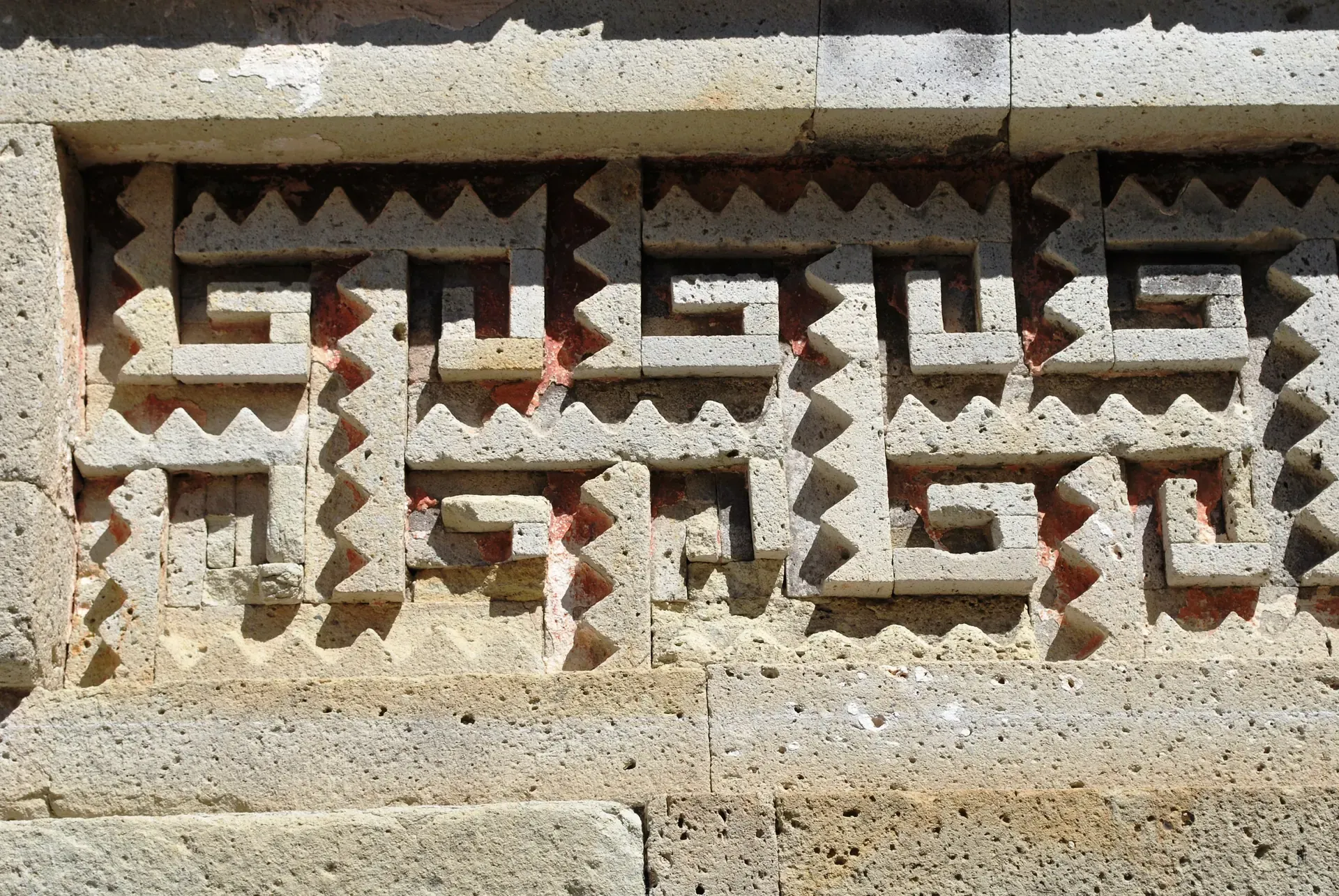
Visit Mitla for intricate stone mosaics and the relationship between archaeology and a living Zapotec town. Compare transport choices and protect time for the site.
Monte Albán from Oaxaca: Plan Your Visit
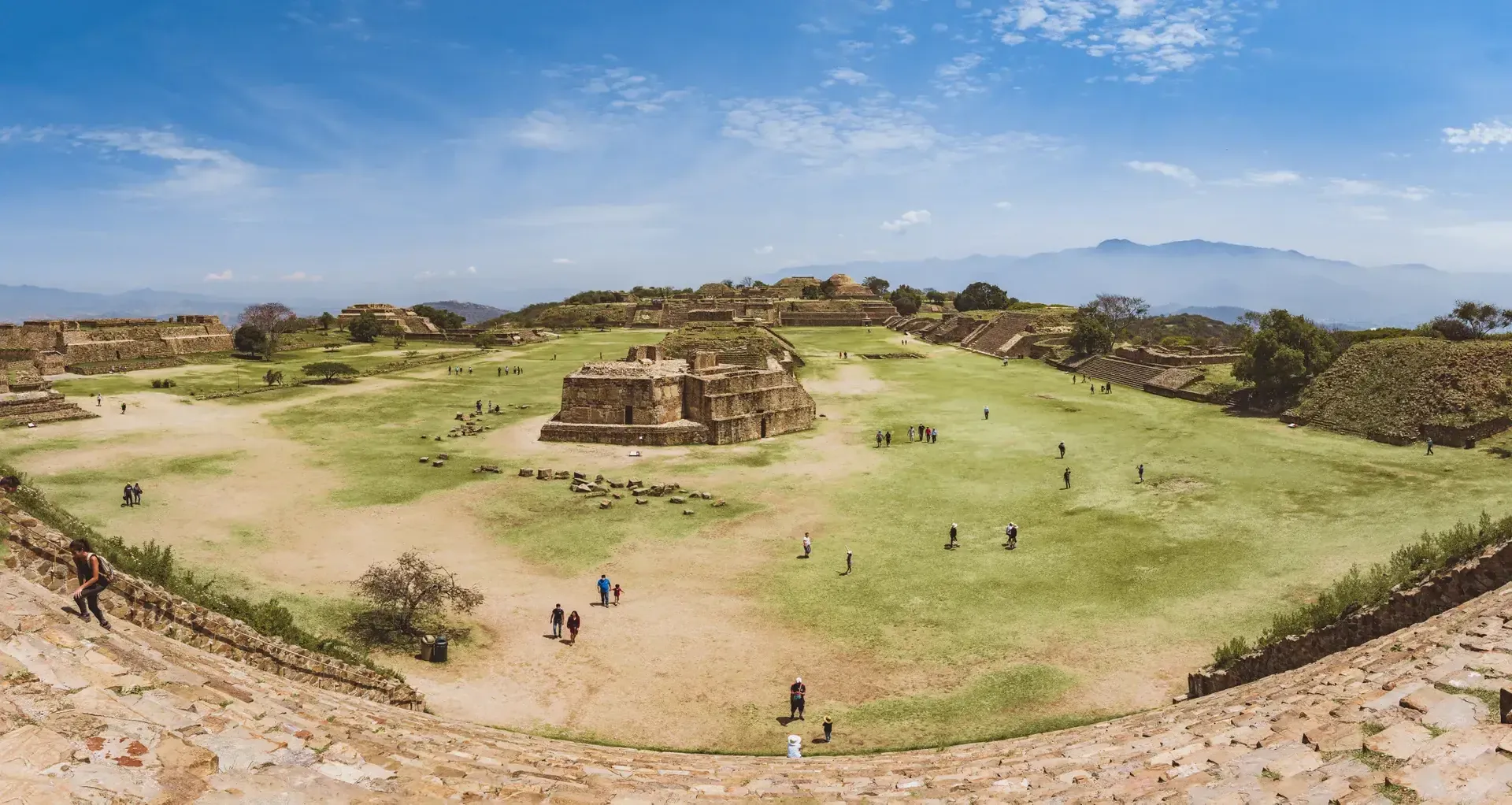
Plan Monte Albán as a focused half-day from Oaxaca: transport trade-offs, admission checks, a manageable route and the difference between its two museums.
Oaxaca Textile Museum: Plan Your Visit
Plan a thoughtful textile museum visit, with current hours, guided tours, workshop checks and a useful link to Oaxaca’s weaving communities.