
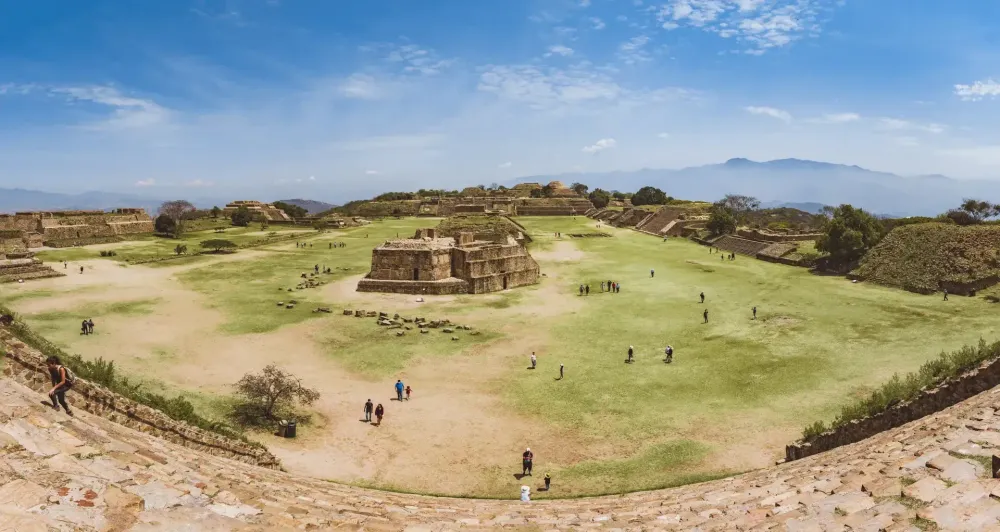
Plan Monte Albán as a focused half-day from Oaxaca: transport trade-offs, admission checks, a manageable route and the difference between its two museums.
For a first visit, give Monte Albán its own half-day from Oaxaca rather than making it a brief stop in a long circuit. The reward is the relationship between buildings, open space and the surrounding valleys. That takes time to understand, even if you do not want to inspect every structure.
Choose a return transport arrangement before setting off, then decide whether you want a guide or an independent visit. Those are separate decisions: a vehicle seat does not necessarily include interpretation, and a guided tour does not automatically include admission.
Our broader guide to things to do in Oaxaca compares Monte Albán with city museums, craft visits and other excursions. This guide focuses on making the archaeological outing work without sacrificing the time you came for.
The practical choices at a glance
| Decision | Useful starting point | What to confirm |
|---|---|---|
| Time on site | 2–3 hours for a selective visit | Your pace, museum time and transport deadline |
| Total outing | A half-day from central Oaxaca | Collection point and return arrangement |
| Published site hours | Daily 08:00–17:00; last admission 16:00 | Current notices for your date |
| Admission | National and foreign visitor categories differ | Your category and any qualifying documents |
| Site museum | Included in archaeological-zone admission according to INAH | Its own opening arrangements |
| Guide | Valuable for interpreting buildings and carved stones | Language, duration, group size and exact inclusions |
Information was checked on 20 October 2026. Time allowances are editorial estimates, not transport promises or compulsory visit lengths. The INAH archaeological-site page is the primary reference for opening and admission notices.
Choose Monte Albán for the landscape of a city
Monte Albán is more than a collection of isolated pyramids. UNESCO's description explains how terraces, platforms and ceremonial spaces reshaped the mountain. The setting helps you see how a major Zapotec centre organised space and communicated authority.
Start by noticing relationships: the broad plaza, structures facing it, the high edges and the country beyond. A guide can help explain those relationships; an independent visitor can still make them the organising theme. Either approach is stronger than simply seeking the highest viewpoint and leaving.
Choose this outing when outdoor archaeology is one of your real interests. If your priority is studying small objects or you need an indoor day, a city museum may fit better. Monte Albán and a museum complement each other, but the exposed site should not be treated as an interchangeable rainy-day alternative.
You do not need an exhaustive ancient-history lesson before arrival. Learn that the place developed over time, then look for evidence of different structures and uses. Avoid assuming that every surviving building belonged to one moment or that an evocative modern name establishes its exact original function.
Decide transport and interpretation separately
An organised excursion is convenient when you want the transport and meeting arrangements handled together. Read the itinerary for actual time inside Monte Albán. A long list of villages and shopping stops may leave less archaeological time than a shorter, more focused trip.
Before booking, ask for the pickup location, duration at the site, return point, guide language and admission inclusions. Also distinguish a guide accompanying you through the ruins from a driver providing an introduction during the journey. If the advertised package excludes entry, compare the complete cost rather than the headline price.
A private driver or taxi arrangement gives you more control over departure and return, which can help a small group with different walking speeds. Agree on waiting time, meeting place, total fare and what happens if you finish early or late. Confirm the return before leaving Oaxaca; do not make the day depend on finding an unbooked vehicle after the visit.
An independently arranged shared transfer can work if its current service suits you. Check the operator's exact meeting point and return departure, and whether you must use a particular return. We do not publish an unverified shuttle timetable or promise a fixed road journey. A transport-only booking should be judged as transport, with guiding and entry budgeted separately.
For a short stay, the useful comparison is how much control you need. A fixed return can keep the day simple but limits lingering. A flexible vehicle can protect your pace but may cost more for a small party. A genuinely guided visit can make unfamiliar architecture more legible, provided you are comfortable with the group's rhythm.
Understand tickets before paying for a package
The INAH site listing distinguishes national and foreign admission categories and links to its online ticket channel. Use the category that actually applies to each visitor, and verify the current total before payment. We avoid turning today's displayed fee into a permanent promise in an evergreen guide.
Do not assume that free-Sunday rules or a student discount apply to every international traveller. Read the requirements and carry the relevant evidence if using a concession. A discount mentioned by a tour seller does not replace the site's admission conditions.
The INAH site-museum listing states that the museum is included in archaeological-zone admission. This is useful when comparing packages: a seller describing “ruins plus museum” may be describing the ordinary combined admission rather than an extra premium service. The museum has its own schedule, so do not leave it until the last possible site-entry time.
Admission also does not mean every structure, tomb or elevated platform is open. Follow current signs and barriers; an old photograph showing someone standing on a monument is not permission to repeat it. Check separately before bringing equipment for professional photography or any activity beyond an ordinary personal visit.
Build a route around three questions
On arrival, inspect the current map and any access notices before committing to a circuit. Start with the principal plaza as an orientation point. Your first question is how the space fits together: identify the surrounding platforms and central structures rather than rushing straight towards a distant staircase.
Your second question is how the city expressed information and power. The INAH description identifies carved stones associated with the Danzantes and other inscriptions. Use the labels and, if booked, your guide's explanation to understand the evidence. The name “Danzantes” should not be treated as a literal explanation that the figures simply portray a dance.
Your third question is what differs from the regular layout. Building J is a useful focus because INAH describes its distinctive form and orientation. Look at it from permitted paths and compare it with surrounding buildings. Interpretation is more useful here than collecting one more distant viewpoint.
Then choose whether you want additional walking or the site museum. Keep stairs and higher positions optional, according to the open areas and your group. A visit can be rewarding without attempting every climb, and getting a photograph should not determine access decisions.
This is a thematic route rather than a promised one-way visitor circuit. Closures may change the order. Ask staff which areas are available, adjust the path and preserve time for a pause before you need to meet the vehicle.
Do not confuse the site museum with the city museum
The museum at Monte Albán helps connect the archaeological remains with objects and interpretation at the site. The Museo de las Culturas de Oaxaca, in the former Santo Domingo convent in the city, is a separate visit with separate admission and opening arrangements.
The city museum's INAH collection page identifies the Mixtec treasures recovered from Tomb 7 at Monte Albán. This distinction prevents a common planning mistake: travelling to the ruins expecting the famous collection to be displayed there, or assuming that the archaeological ticket covers Santo Domingo.
For an archaeology-focused stay, consider the city collection before or after the excursion. Seeing objects first can provide questions to take to the site; seeing the landscape first can make the objects more meaningful afterwards. Neither order is inherently correct, and the visits need not occupy the same day.
Check the museum's current hours and relevant gallery availability if Tomb 7 is your principal interest. Do not schedule a rushed second museum solely to use every remaining hour. The Oaxaca three-day itinerary provides a framework for separating city culture from excursions.
Plan for exposure and uneven ground
Monte Albán is an outdoor archaeological landscape. Choose footwear for uneven surfaces and check the forecast before committing to a long circuit. Bring suitable sun protection and drinking water, follow entry rules and eat before or after: the site listing prohibits bringing food into the archaeological zone.
An earlier visit may suit someone who prefers to finish the main walk before the warmer part of the day, but it is not a guarantee of empty paths or comfortable weather. Rain changes the appeal of exposed walking and the footing on stone. If conditions deteriorate, shorten the circuit and follow staff instructions rather than trying to complete a predetermined list.
The official listing shows an accessibility service, but that does not establish independent step-free access to every monument. Ask about the route from arrival to the main viewing areas, surfaces, slopes and toilets that matter to your particular needs. A transport provider's vehicle accessibility and the archaeological route are separate checks.
With children or anyone who tires easily, choose a short core visit and one optional extension. Agree where the group will pause or regroup. A manageable circuit with attention to a few features is better than reaching the final stretch too tired to enjoy it.
Keep the return to Oaxaca uncomplicated
Make lunch in Oaxaca the natural next step unless a specific excursion extension matters to you. A meal and rest give the archaeological visit a clear end and leave you free to decide how much city walking you want later.
If a combined tour interests you, inspect its geography and the time allocated to each stop. Adding craft visits can be worthwhile when you want those conversations and demonstrations, but a commercial stop should not consume the time you thought you were buying at Monte Albán. Choose a combination because both components appeal, not because more names imply more value.
Compare accommodation locations in our guide to where to stay in Oaxaca, particularly the walk to your confirmed pickup. For this outing, a clear meeting point, a reliable return and enough time inside the site matter more than a complicated transport strategy.
Cover photograph: The central plaza and archaeological structures at Monte Albán, Oaxaca. Photo by Julio Maciel — Pexels.
Frequently Asked Questions
How long should I allow for Monte Albán?
Start with 2–3 hours at the site and a half-day overall from central Oaxaca, including journeys. These are editorial allowances; a guide, museum visit or slower walking pace can require more time.
Does admission include the site museum?
INAH's site-museum listing says it is included in archaeological-zone admission. Check its own opening arrangements and distinguish it from the separate Museo de las Culturas in Oaxaca city.
Do I need a guided tour?
A guide can help interpret the layout and carved stones, but the planning decision is yours. Confirm language and time inside the site, and check whether the package includes entry and return transport.
Are the Tomb 7 treasures at Monte Albán?
The collection is identified by INAH at the Museo de las Culturas de Oaxaca in Santo Domingo. Treat that city museum as a separate visit, with its own opening, admission and gallery availability.
Can I rely on finding transport back after visiting?
Arrange the return before leaving Oaxaca. Confirm the meeting place, departure or waiting time and complete fare; this guide does not promise unbooked vehicles or a particular shuttle timetable.

Keep Exploring
Coyoacán and Frida Kahlo: Plan Your Visit
Choose a museum-led or neighbourhood-led Coyoacán outing, with Casa Azul booking advice, a practical walking sequence and clear limits on extra stops.
Ben Youssef Madrasa: Plan Your Marrakech Visit
Plan Ben Youssef Madrasa with verified ticket information, opening hours, architectural details and practical advice for your Marrakech visit.
Mexico City Anthropology Museum: Plan Your Visit
A focused Anthropology Museum visit: compare Mexica, Maya and regional galleries, make room for living cultures and understand practical admission choices.