
A realistic Oaxaca itinerary connecting the historic centre, Monte Albán and living craft traditions, with room for meals and clear alternatives when plans change.
For 3 days in Oaxaca, spend the first in the historic centre, the second at Monte Albán with an easy city afternoon, and the third on a focused weaving visit or a cooking experience. This gives you archaeology, food and living culture without spending every day on a long excursion.
The plan assumes 3 full sightseeing days, arriving beforehand and leaving afterward. Staying the night before each day and after the last means 4 nights. If arrival and departure fall within your 3 calendar days, use the shorter version below. Oaxaca here means Oaxaca de Juárez and nearby valleys; the Pacific coast is a separate stay.
Your 3 days at a glance
| Day | Morning | Afternoon | Main planning decision |
|---|---|---|---|
| 1 | Santo Domingo and Museo de las Culturas | Zócalo, market lunch and Museo Textil | Put the museum on an open day |
| 2 | Monte Albán | Late lunch and unhurried city time | Confirm transport in both directions |
| 3 | Teotitlán del Valle weaving visit | Village lunch and return to Oaxaca | Arrange the workshop before transport |
A cooking session in the city can replace the whole third-day excursion. The schedule is intentionally light after Monte Albán: a morning on an exposed archaeological site is already a substantial activity.
All visit durations below are editorial planning allowances, not official tour lengths or guaranteed travel times. Official opening hours are identified separately and were checked on 3 October 2026. For a wider comparison of the places mentioned, see our Oaxaca experiences guide.
Before choosing the day order
Start with the least flexible commitment: a particular maker, cooking class or guided visit. Then check the Museo de las Culturas opening day and place Monte Albán where the weather and transport work best. The numbered days describe an order that makes cultural sense, not a rule that should override an actual booking.
For this route, a base in the historic centre reduces repeated journeys between meals, museums and your room. Check the property's exact location against Santo Domingo and the Zócalo rather than relying on a broad “central” description. Ask about stairs, street noise and vehicle access if those affect your stay.
You do not need a rental car for the central walking day. For both excursions, compare the full arrangement: pickup location, departure time, admission, guide language, time at the main stop and return point. A low transport quote may cover only a seat; a long list of tour stops may leave little time at the place you actually want to see.
Day 1: connect Santo Domingo with the southern centre
Morning: one substantial museum visit
Begin around Santo Domingo and make the Museo de las Culturas your main morning activity. Allow 2–3 hours for the museum and immediate surroundings, including pauses. The church, museum and garden have separate access arrangements; entering one does not give access to all of them.
The INAH museum portal describes the former convent and its archaeological collections, including objects from Tomb 7 at Monte Albán. Concentrate on the galleries connected with the site you will visit tomorrow, then enjoy the building without trying to exhaust every display.
Plan around Monday closure. The INAH visitor portal currently lists Tuesday–Saturday opening; confirm your day’s opening and final admission directly. If Sunday is your only available museum day, obtain confirmation before counting on a visit. Avoid making a late museum arrival essential to the route.
If you want the adjacent garden, treat it as a substitute for some museum time. The garden's visitor page directs tour enquiries to OCCE Oaxaca. Confirm the current meeting point, language, duration and reservation or payment procedure before arranging the morning around a tour. Office opening hours on the website are not a visitor-tour timetable.
Lunch: walk south, then stop properly
Continue south along Macedonio Alcalá toward the Zócalo. This is the natural direction for lunch and the next museum, so resist filling the morning with a return trip north. Pause in the square, then continue to the market area immediately to its south.
The state tourism page for Mercado Benito Juárez identifies foods including tejate, chapulines and tlayudas, and the neighbouring Mercado 20 de Noviembre. Allow 1–2 hours for browsing and a meal across this area rather than treating both markets as quick photo stops.
Walk through before ordering. Choose a cooked lunch or a few smaller tastes according to your appetite; trying every named dish would overwhelm the rest of the day. Ask about ingredients in sauces and cooking fats as well as toppings if you have dietary restrictions. Clarify portions and the total before ordering; there is no single price for a “market lunch”.
Afternoon: textiles, then finish nearby
Head back toward the Zócalo and east to the Museo Textil de Oaxaca at Hidalgo 917. Admission is free. Its official hours are Monday–Friday 10:00–20:00, Saturday 11:00–20:00, and Sunday 11:00–18:00. Allow 1–2 hours, depending on the current exhibition and your interest.
Look closely at the labels and techniques rather than assuming all textiles share the same origin. Note a question about fibre, dye or weaving to take to your village visit. This gives the museum a place in the itinerary beyond being another building to enter.
End with coffee or dinner in the centre. There is no need to add another neighbourhood merely because a map makes it look close. Keep the evening flexible enough to confirm tomorrow's pickup and prepare water, sun protection and comfortable footwear.
Day 2: Monte Albán, then a genuinely lighter afternoon
Give Monte Albán the morning. It lies southwest of the city and belongs on its own excursion, rather than being attached to an eastern-valley workshop route. Arrange transport for an early visit that suits your group, with a clear return agreement before departure.
INAH's Monte Albán visitor page lists daily opening 08:00–17:00, with last admission at 16:00. Reserve 4–5 hours door to door as an editorial block, then adjust to the operator's pickup, travel and return arrangements. That block includes travelling and waiting; it is not a claim about time spent inside the ruins.
At the site, begin by understanding the main plaza and the position of the surrounding structures. Use a guide if explanation of the buildings and carved monuments is central to your interest; confirm whether guiding is included or separately arranged. Seeing the landscape after the museum gives context to the objects rather than requiring you to remember every historical date.
Outdoor distances, uneven surfaces and steps make this a different physical outing from the city museums. Ask about the actual route if walking or stairs are difficult. A shorter route can still offer useful views and interpretation; you need not climb every accessible structure. Follow on-site restrictions, and adjust the outing to conditions on the day.
Return to the centre for a late lunch and a rest. Use the remaining afternoon for somewhere already on your central route: a gallery you noticed, another look at the Zócalo, or a leisurely meal. Avoid a non-refundable afternoon class that depends on a precise return from the ruins.
If the museum was unavailable on Day 1, it can occupy part of this afternoon only if confirmed opening and your return leave a comfortable visit. Otherwise swap the entire city and archaeology days. Squeezing a museum into its final admission window is the weaker plan.
Day 3: give a weaving visit enough time
Choose Teotitlán del Valle for the third day if you want a conversation about how textiles are made. The Oaxaca tourism guide describes family wool-weaving workshops and natural pigments. Arrange an actual appointment with a workshop or a guide who can confirm the maker and format.
Ask whether the visit is a demonstration, a practical session or mainly shopping. Confirm the language, fee, expected duration and whether buying anything is optional. Choose transport afterward so the visit determines the day, rather than accepting a brief sales stop simply because it appears on a packaged route.
Allow 5–7 hours including transport, the workshop and lunch as an editorial day block. Teotitlán lies in the eastern valley, so this is a separate direction from Monte Albán. Leave time to ask questions, look closely at pieces and eat before returning to Oaxaca; do not assume the tourism page's general travel estimate is a reliable hotel-to-workshop duration.
The museum visit supplies useful questions, but let the maker explain their own practice. Ask about the piece in front of you: materials, dyes, time involved and care. If you buy something, agree the final amount and any packing or shipping arrangements directly. Ask permission before photographing people or workspaces.
Return for a final city evening. If a longer eastern-valley circuit is your priority, it should replace this focused day. Adding Mitla, Hierve el Agua, several workshops and a distillery changes both the pace and the time available at each stop. Choose that knowingly rather than keeping the relaxed timetable and adding every attraction to it.
Make the changes that your dates require
For a Monday in Oaxaca: use Monte Albán or the prearranged workshop day, and move Museo de las Culturas to a confirmed open day. Museo Textil's published Monday opening also makes it a useful city option. If Monday is your only full day, accept a different museum rather than promising access to a closed one.
For poor outdoor conditions: swap the archaeology outing with the central museums when their opening days allow. A garden tour is still outdoors, so it is not the automatic rain alternative. If weather remains unsuitable, retain the city day and drop the excursion; a booked transfer should not dictate every other decision.
For a food-focused third day: replace Teotitlán with a cooking experience. Confirm the location, menu, language, dietary arrangements and whether a market visit is included. Protect the duration supplied by the provider, including travel to the kitchen; this can be the day's main commitment. Keep dinner flexible after a substantial class meal.
For arrival and departure within 3 days: use the arrival afternoon for the Zócalo and an unhurried meal, give the full middle day to either Monte Albán or city museums, and keep departure morning near your accommodation. Add Museo Textil only if its actual opening and your required departure allow. Remove the village excursion first; a flight day cannot also be assumed to be a full workshop day.
If Oaxaca is one stop in a longer holiday, our Mexico itinerary for 2 weeks shows how full Oaxaca days fit between intercity transfers. Confirm those transfers before filling your first or final day with fixed activities.
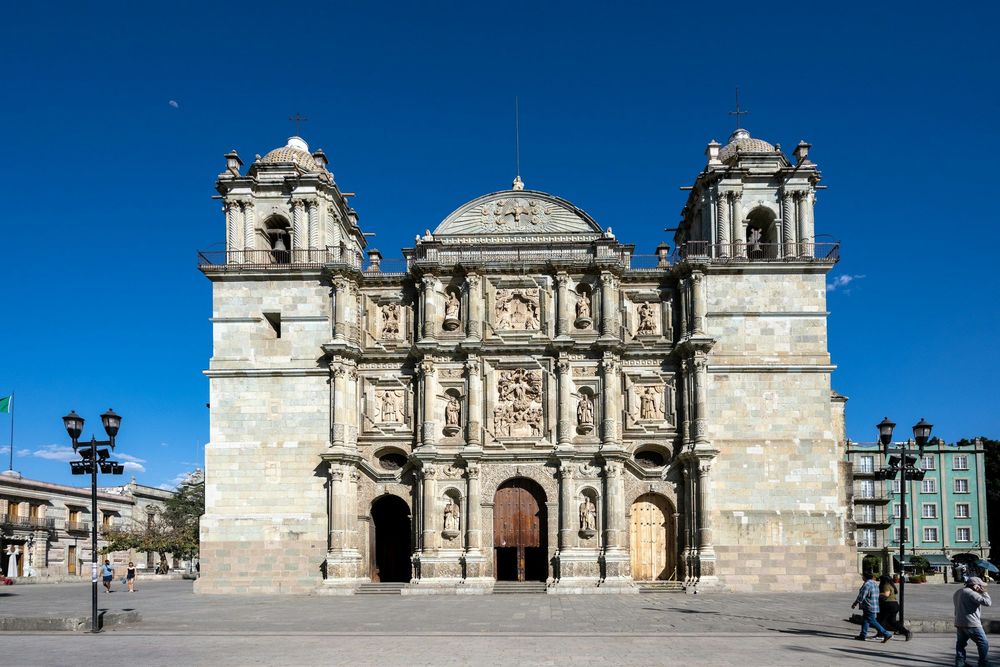
Cover photograph: Stone church facade with two bell towers and a plaza in Oaxaca. Photo by Krzysztof on Unsplash. (Unsplash).
Frequently Asked Questions
Are 3 days enough for Oaxaca?
Yes, for the historic centre, Monte Albán and a focused craft or cooking experience. This itinerary needs 3 full sightseeing days; arriving beforehand and departing afterward means 4 nights.
What should I book first?
Secure a particular workshop, cooking class or guided visit first, then arrange transport around it. Confirm the museum's opening day and any garden-tour arrangements before fixing the city schedule.
Can I follow this itinerary without a car?
Yes. The central day is arranged as a walking route, while Monte Albán and Teotitlán require separately organised transport. Confirm outward and return arrangements, pickup points and what the quoted price includes.
What if my stay includes Monday?
Put Monte Albán or an arranged workshop on Monday and move Museo de las Culturas to a confirmed open day. Museo Textil lists Monday opening and can provide a city alternative.

Keep Exploring
Mexico City in 3 Days: A Neighborhood-Based Itinerary
A practical route through Centro Histórico, Chapultepec, Condesa and Coyoacán, with one main visit each day, flexible meals and clear choices when time runs short.

Los Angeles in 3 Days: Coast, Culture and City Views
A practical Los Angeles itinerary with one main area each day, selective Hollywood time, a coastal walking plan and clear alternatives for closures or short flight days.

Sydney in 3 Days: A City and Coast Itinerary
A realistic Sydney itinerary for three full days: explore the harbour, make time for the city and devote a separate day to Bondi or Manly.