
Teotitlán del Valle: Plan a Textile Village Visit
Plan a textile-focused visit to Teotitlán del Valle: choose a workshop, ask about wool and dyes, and leave time for village history.
Teotitlán del Valle rewards a visit built around one good conversation with a weaver. Decide whether you want to understand the work, try a technique or choose a textile before arranging the journey from Oaxaca. Those are different visits, with different demands on your host’s time. A shop stop on a busy excursion does not automatically include a practical lesson.
The useful starting point is a confirmed workshop appointment, followed by time in the village. This guide explains how to choose that encounter, what to ask about wool and colour, and how to leave room for community history. For the wider trip, our Oaxaca culture and day trips guide helps you decide where a textile-focused outing fits.
Choose the visit before choosing the transport
Oaxaca’s tourism authority describes family wool workshops and a craft market in Teotitlán. That gives you several ways to approach the village; it does not mean every doorway offers the same visitor experience.
| Your priority | What to arrange | What to clarify |
|---|---|---|
| Understand weaving | A conversation and demonstration with a maker | Language, duration, fee and stages shown |
| Try a technique | A specifically booked practical session | Materials, supervision and what you can take home |
| Buy a rug | Time to examine pieces and discuss their making | Dimensions, fibre, dyes, maker and payment |
| Explore village history | A workshop plus the community museum if open | Current museum access and time between stops |
| Travel with limited time | One confirmed visit and a simple return | Pickup point, waiting time and total transport price |
As an editorial planning suggestion, reserve half a day for a workshop, a short village walk and the journeys. A longer practical class may need more. Ask the host for the actual session length before committing to an afternoon elsewhere: there is no standard village-wide demonstration timetable.
Find a host and agree what the visit includes
One workshop to contact is Isaac Vásquez Studio, whose own visitor page gives Av. Hidalgo 30 and describes its family workshop, pedal loom and natural dyes. Confirm an appointment rather than relying on walk-in access: the family’s visitor information is not consistent across its websites on that point.
A useful message includes your date, number of visitors, preferred language and interest: watching the process, discussing a purchase or taking a hands-on class. Ask who will receive you and whether the quoted price covers a demonstration, a lesson or something else. If a driver or tour company makes the arrangement, request the workshop name and the time allocated there.
Duu Nga’a presents itself as a Zapotec women’s dyeing and weaving cooperative in Teotitlán. Its members’ own accounts offer another starting point for learning about the people making textiles. Contact the cooperative about current possibilities; photographs of previous workshops are not evidence that a particular visitor class is available on your date.
Choose one main host rather than arranging several overlapping appointments. The aim is to leave space for questions without making another household wait. If your plans change, send a cancellation message. Do not interpret a family workshop as a public attraction that must operate whenever a tour vehicle arrives.
Watch the process, then ask about the actual piece
Begin with the material in front of you. Ask which fibre is being used, who prepares or spins the yarn, and which stages happen in that workshop. Then follow the thread into the loom: the lengthwise warp and the crosswise weft are easier to understand when someone can point them out. Ask permission before touching yarn, tools or an unfinished textile.
A demonstration may show selected stages rather than an entire production cycle. That is a practical limitation, not automatically a reason to dismiss it. Ask what has been prepared in advance and what you are seeing live. A short explanation can still be informative when the host is clear about the process.
Avoid making every conversation a test of whether the work is sufficiently “traditional”. Makers may develop new designs, collaborate or use contemporary imagery. Ask who designed a piece and what the pattern means to that person, rather than assigning a universal symbolic meaning to a motif from a guidebook.
If you want to sit at a loom, agree that beforehand. A weaving demonstration is not permission to operate equipment. For children, ask about suitable activities and the supervision required; do not promise them that every workshop will let them weave. A short, focused encounter may work better than a long technical lesson.
Natural colour: useful questions, not a blanket guarantee
Cochineal reds and indigo blues are good topics for a dye discussion. The studio describes both, alongside other sources of colour. Cochineal is insect-derived: “natural” does not mean that every dye comes from a plant. If materials matter to you, ask about both fibre and colouring rather than relying on a broad label.
A dye demonstration does not establish the composition of every item offered for sale. Ask about the specific textile you are considering: which dyes were used, whether colours were mixed, and whether the maker can explain how that piece was produced. Do not infer ingredients solely from how bright or muted a colour appears.
The same principle applies to claims about who made it. A shop may carry work by several people. Ask for the maker’s name and how the seller is connected to them. Direct answers about a particular piece are more useful than a sweeping promise that everything in a village follows one method.
Buying without rushing the decision
Before leaving Oaxaca, measure the space where a rug might go. Write down the maximum dimensions and consider how you would carry it. In the workshop, ask to see the whole piece laid out where the host considers appropriate, rather than judging it only while folded or hanging among many others.
Discuss the final price, accepted payment and whether any packaging or delivery is included. For a custom order, agree the dimensions, design, materials, expected completion and delivery arrangements in writing. A sample colour or an earlier photograph should not be treated as a guarantee of an identical handmade result without discussing that expectation.
Request a receipt and care advice for the particular textile. Ask about cleaning, exposure to light and what to do if something spills; do not assume that all wool rugs or all natural dyes need identical treatment. If shipping is involved, establish who handles it, what the quoted charge covers and how a problem would be reported before paying.
You can be interested without being ready to buy. Agree any visit fee at the booking stage so that a demonstration is not left dependent on an unspoken purchase expectation. If you decide against a piece, say so courteously. The time and skill you have just been shown do not require a bargaining performance.
Add community history, not just another shop
The federal cultural directory lists the Museo Comunitario Balaa Xtee Guech Gulal on Av. Hidalgo, primera sección. Its themes include archaeology, textiles and local customs. This can give a visit a broader perspective than the work displayed for sale.
Check opening and admission locally before building the day around it. A directory listing is useful for identifying the museum, but it does not confirm that every room is accessible on the day you arrive. Keep it as a planned possibility rather than promising companions a guaranteed second attraction.
Between stops, remember that you are walking through a living community. Ask before photographing people, working interiors or private spaces. An open gate is not an invitation to enter. Religious ceremonies and local celebrations are not scheduled entertainment for visitors; follow local guidance and avoid interrupting them for a photograph.
Prepare in Oaxaca, or follow up after the visit
The Museo Textil de Oaxaca at Av. Hidalgo 917 in Oaxaca’s historic centre lists free admission. It is a useful optional companion to a village visit, either before you go or after questions have emerged. Check its current opening and exhibitions rather than assuming a particular display will be present.
A museum and a workshop allow different kinds of attention. In a gallery, you can spend time looking without turning the encounter into a purchase decision. In a workshop, you can ask the person receiving you about their own practice. Neither experience should be treated as a substitute for all textile traditions in Oaxaca.
Keep a few notes from your conversation, with the maker’s permission if recording or photographing information. Names, techniques and care instructions are easy to confuse after several excursions. A concise record makes the object or encounter more meaningful later than a large collection of unlabelled photographs.
Arrange the journey around the appointment
Give your driver the exact workshop address or agreed meeting point, not simply the village name. Establish whether the quote covers waiting, a return journey and any extra stops. If booking a tour, distinguish transport from guiding and confirm how much time is actually available with the maker.
For public transport, obtain current departure information in Oaxaca and check how you will cover the last part of the journey into the village. Do not assume an intercity vehicle drops you at the workshop. Plan the return before setting out and keep enough flexibility for waiting and local transfers.
If accessibility matters, ask the host about the entrance, thresholds, seating and toilet facilities. A welcoming workshop is not automatically step-free. Explain the practical assistance you need so the host can give an informed answer, and arrange transport accordingly.
Combining Teotitlán with Mitla can make sense if the workshop slot and travel arrangements leave enough time. Use our Mitla visit guide to assess the second stop. Protect the confirmed appointment and a meal break first; a day filled with brief commercial stops is a poor fit for someone whose main interest is a detailed textile conversation.
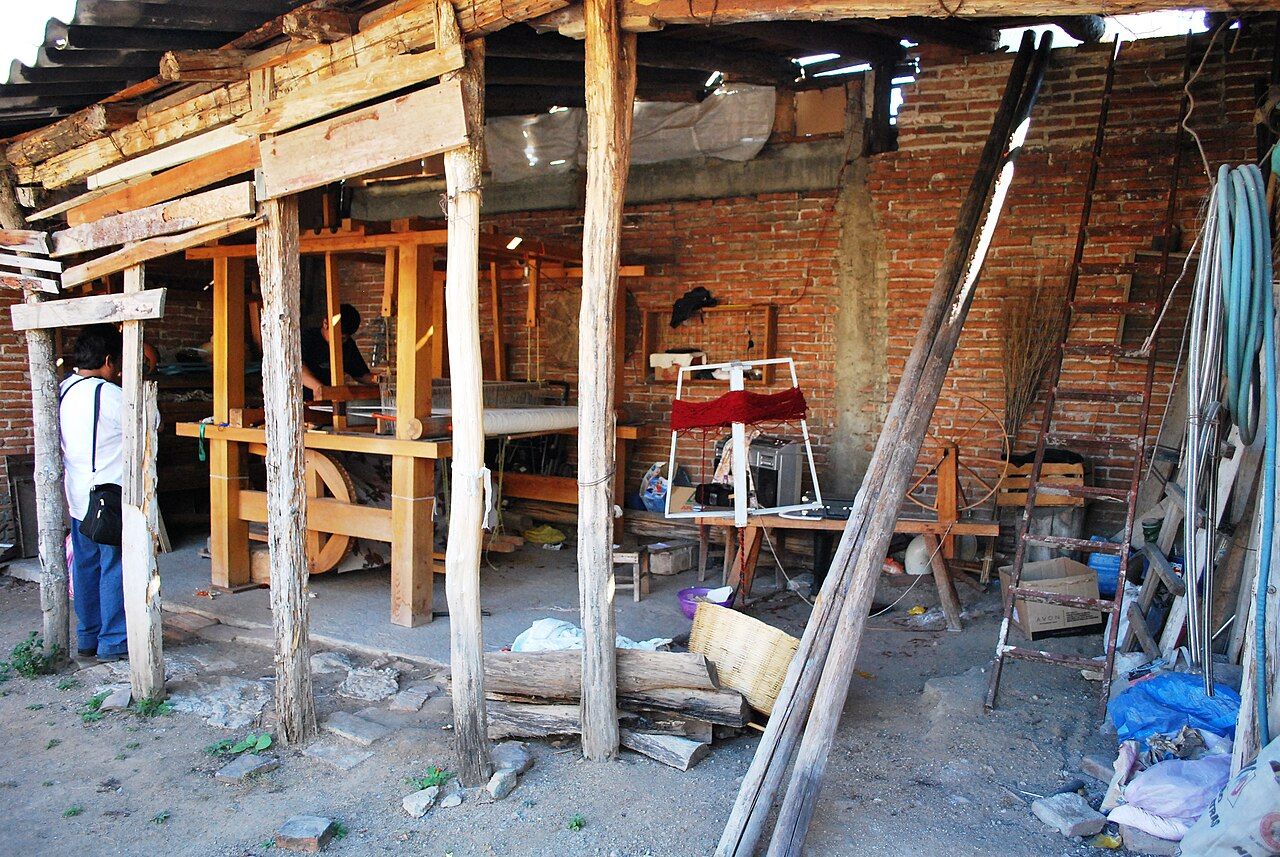
Cover photograph: Wooden loom in a family weaving space in Teotitlán del Valle — Photograph taken in 2009; historical view. — Thelmadatter, CC BY-SA 3.0.
Frequently Asked Questions
Do I need to book a workshop in Teotitlán del Valle?
Book ahead when you want a particular maker, language or practical activity. Some places may receive casual visitors, but a shop being open does not guarantee a demonstration. Confirm the time, fee and what the host has agreed to provide.
Are all textiles in Teotitlán made with natural dyes?
Do not assume so from the village’s reputation or a demonstration. Ask about the dyes and fibres in the specific piece you are considering, and who made it. Natural dyes can include insect-derived cochineal as well as plant sources.
Must I buy something after a demonstration?
Agree the visit conditions beforehand, including any fee. You can explain that your main interest is learning and that a purchase is undecided. Clear arrangements avoid an unspoken expectation that shopping will pay for the host’s time.
Can I visit Teotitlán and Mitla on the same day?
Potentially, if the confirmed workshop duration and transport leave adequate time. A substantial practical class may deserve its own outing. Decide which experience matters most before adding stops, and check the current access arrangements at Mitla separately.


Keep Exploring
Santo Tomás Jalieza: Plan a Weaving Village Visit
Plan Santo Tomás Jalieza from Oaxaca: backstrap weaving, named artisan contacts, workshop questions, thoughtful textile buying and return transport.
San Bartolo Coyotepec: Plan a Pottery Village Visit
Plan a San Bartolo Coyotepec pottery visit with named workshops, MEAPO checks, questions about barro negro and a focused half-day from Oaxaca.

American Museum of Natural History: Plan Your Visit
Choose AMNH halls, tickets and one timed extra, with dinosaur, ocean-life and access advice for a manageable New York museum day.