
American Museum of Natural History: Plan Your Visit
Choose AMNH halls, tickets and one timed extra, with dinosaur, ocean-life and access advice for a manageable New York museum day.
Plan the American Museum of Natural History around two or three interests, then decide whether one timed exhibition adds enough to justify the extra cost and scheduling. Dinosaurs, ocean life, space and living butterflies make very different visits. Trying to combine every headline experience can turn a fascinating museum into a sequence of appointments and long walks between floors.
For a first visit, allow roughly three to four hours for selected halls and a break, or most of the day for deeper exploration. These are editorial estimates, not a promise to complete the museum. This guide adds a science-focused option to our New York sightseeing shortlist, rather than another art-museum stop.
The essentials before booking
| Decision | What to know |
|---|---|
| Location | American Museum of Natural History, Upper West Side, beside Central Park |
| Regular hours | Daily 10:00–17:30; closed Thanksgiving and Christmas Day |
| General admission | Permanent halls and the currently listed included exhibitions |
| Timed extras | Selected exhibitions require an additional product and entry time |
| Pay what you wish | New York State residents with accepted identification; general admission only |
| Suggested duration | Three to four hours for a selective visit; longer for several themes |
| Step-free arrival | Check Gilder Center or Rose Center entrance details and the entire transport route |
Information was checked on 30 October 2026. The official planning page distinguishes standard and resident prices. At this check, standard adult general admission was US$37, with one ticketed exhibition US$43, or all ticketed exhibitions US$48. Recheck the current price and actual session availability before paying; an inclusive product does not create more hours in your day.
Selected holiday dates have extended hours. Check the date-specific opening schedule; before 10:00 or after 17:00, the museum directs visitors to the Central Park West or 81st Street/Rose Center entrances.
Understand admission before comparing prices
The pay-what-you-wish arrangement is not a general tourist discount. It applies to New York State residents with accepted ID and covers general admission only. Ticketed exhibitions are not included. The museum's FAQs give conflicting instructions about adding them at the ticket desk, so confirm the current purchase rules and compare resident-pricing products before booking an extra.
Child admission applies to ages 3–12, while children under three have waived admission fees. Other concessions and complimentary categories have their own requirements. Reserve for the actual composition of your party and carry any required evidence. Do not apply a rule remembered from the Met to this museum: each institution sets its own eligibility.
The official page also lists waived admission for visitors entering during the final hour. That can suit a very limited introduction, subject to current ticket arrangements, but it is not equivalent to the half-day visit described here. Walking between halls and finding the exit takes time. Choose it for a modest objective rather than promising a child dinosaurs, butterflies and a space show before closing.
For a normal first visit, general admission may be enough. Buy an extra because its subject or format interests you, not because the word “general” sounds inferior. Before buying the all-exhibitions option, compare the actual bookable times and the distance between them on the map. A cheaper unused upgrade is still money spent on something you did not experience.
Start with fossils if dinosaurs are the priority
The museum's dinosaur guide places the fossil halls on the fourth floor. The Hall of Saurischian Dinosaurs and Hall of Ornithischian Dinosaurs offer different branches of the dinosaur story. Use the Wallach Orientation Center to understand how the displays connect rather than racing directly between the largest skeletons.
The Titanosaur is a life-sized cast, not an entire original skeleton. That distinction is useful for children and adults: a museum display can combine original fossils, casts and reconstructions to explain evidence that would otherwise be difficult to see. Read labels for the specific specimen instead of assuming that everything in a mounted animal is original bone.
Choose a question to follow through the halls: how animals supported their weight, how teeth suggest different diets, or how body structures indicate relationships. Look at two examples carefully and compare them. This makes the visit more memorable than collecting names, and gives less enthusiastic members of the group something concrete to notice.
If fossils are your main reason for coming, see them while everyone still has energy. A timed extra booked immediately after entry can push the main interest later in the day. Keep a second theme optional, especially with young children who may want to remain with the first group of exhibits longer than you expected.
Ocean life offers a different kind of looking
The Milstein Family Hall of Ocean Life centres on a suspended blue-whale model and displays of marine environments. The whale is a model, not a preserved animal. Look beyond its scale to the relationships between organisms, habitats and the choices used to represent an underwater world indoors.
Pairing ocean life with fossils gives the visit a useful contrast: life through deep time and life within present-day ecosystems. It also requires movement between parts of the museum. Check the route before leaving a floor rather than making repeated trips whenever someone remembers another object.
Consult the current hall-closure page before making the whale the indispensable final stop. The museum updates temporary restrictions, and access can differ by level or time of day. General museum opening does not guarantee that every hall is available throughout the day.
Use the notice for your own visit date, because temporary restrictions can change from one day to another. If a favourite hall is unavailable, choose another theme or another date before buying a product around it. The useful planning habit is to distinguish the building's hours from access to the particular experience you want.
Choose a timed experience for its format
The Davis Family Butterfly Vivarium is in the Gilder Center and requires an additional ticket. It is a living, year-round environment with tropical warmth and high humidity. That makes it a different proposition from a cool gallery of specimens. Consider comfort and your group's interest in watching small, moving animals before choosing it.
The Hayden Planetarium Space Show is another distinct ticketed experience. Check the current show, timing and access information rather than equating all Rose Center spaces with a planetarium performance. A scheduled show can give the day structure; it can also interrupt the part of the museum you most wanted to explore.
Invisible Worlds is a separate immersive option. The accessibility information describes a twelve-minute experience without standard seating, with folding stools available on request for visitors unable to stand throughout. Ask about sensory and physical conditions before purchase. An immersive format is not automatically the easiest choice for every visitor.
For many first visits, one extra is enough. Put its appointment on the map, allow time to reach it, and place flexible halls before or after. Do not schedule several experiences back to back simply because the ticket permits them: security, orientation, toilets and ordinary curiosity all occupy real time.
Pick the entrance as carefully as the subway stop
Use the museum map to identify your entrance, the first hall and the next elevator or staircase. The building has several approaches. Meeting friends at “the museum” without naming an entrance can mean waiting on different sides of the block.
The accessibility guidance identifies step-free access at the Gilder Center on Columbus Avenue and the Rose Center on West 81st Street, with different approach conditions. The nearby 81st Street–Museum of Natural History B/C subway station is stairs-only. The museum identifies 72nd Street on the 1/2/3 as its closest accessible subway station; check current elevator and service status for the entire journey.
Do not confuse a step-free museum entrance with a step-free route from your hotel. Compare the walk from the station, crossings and the entrance approach. A bus or vehicle drop-off may better fit some needs; the Rose Center guidance includes a passenger loading area. The most convenient route depends on the person, not simply the shortest line on a map.
Keep the day manageable
Public areas can be reached by elevator, and the museum provides accessible-route guidance. Loan wheelchairs are available without charge on a first-come basis, with identification requirements. Strollers are welcome with restrictions in theatres and some ticketed spaces. Check these details before selecting several extras that require parking or transferring equipment.
Find toilets, a food break and a meeting point before the group disperses. With children, alternate looking, conversation and rest rather than expecting equal concentration in every hall. Our New York with kids guide helps compare this substantial indoor day with other family outings.
Central Park can provide a change of pace afterwards, but choose a nearby, modest walk according to weather and remaining energy. Crossing the park to another major museum is a separate commitment. Leave room to discuss what you saw instead of replacing one ambitious checklist with another as soon as you exit.
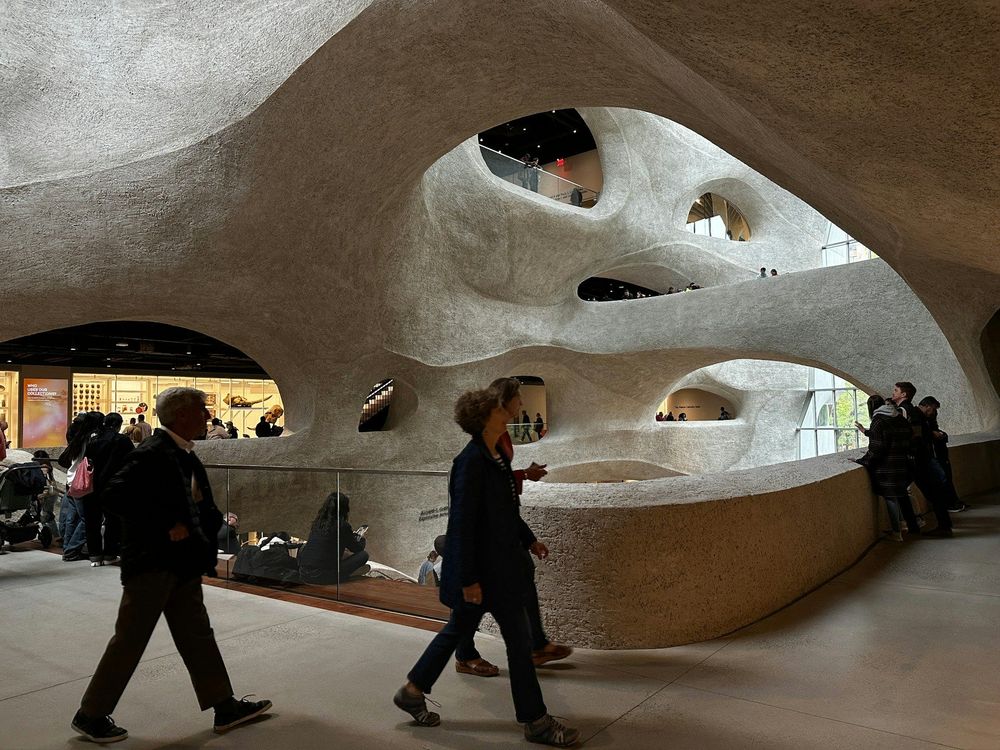
Cover photograph: Visitors inside the sculpted atrium of AMNH’s Gilder Center — Raman Shaunia, Unsplash License.
Frequently Asked Questions
Can all visitors pay what they wish?
No. That arrangement is for New York State residents with accepted ID and covers general admission only. Ticketed exhibitions are not included; confirm current purchase rules and resident-pricing options with the museum. Other visitors normally use standard pricing.
Are the butterflies and planetarium included in general admission?
The Butterfly Vivarium and Hayden Planetarium Space Show are ticketed extras. Check the product inclusions and available entry times before buying.
How long should a first visit take?
Allow roughly three to four hours for selected halls and a break, or longer for several themes. This is an editorial estimate; a final-hour introduction cannot deliver the same visit.
Is the nearest subway station step-free?
The museum describes 81st Street–Museum of Natural History on B/C as stairs-only. Its accessibility page identifies 72nd Street on 1/2/3 as the closest accessible station; verify current service and elevators, then plan the remaining walk and entrance.

Keep Exploring
Anahuacalli Museum: Plan Your Mexico City Visit
Visit Anahuacalli for Rivera’s collection, volcanic architecture and ecological space, with current tickets and Casa Azul courtesy rules.

Edo-Tokyo Museum: Plan Your Visit
Visit the reopened Edo-Tokyo Museum in Ryogoku: current tickets, hours, a focused exhibition route and practical access advice.
9/11 Memorial and Museum: Plan Your New York Visit
Choose the free memorial or ticketed museum, check Tuesday openings and plan a considerate visit with time for reflection.