
Santo Tomás Jalieza: Plan a Weaving Village Visit
Plan Santo Tomás Jalieza from Oaxaca: backstrap weaving, named artisan contacts, workshop questions, thoughtful textile buying and return transport.
Choose Santo Tomás Jalieza for a focused encounter with backstrap weaving: watching how cloth is made, asking about a particular piece and, if you wish, buying from someone who can explain its production. The strongest visit begins with a confirmed maker or workshop, not with a long list of craft villages to cover before lunch.
This is a living community in Oaxaca's Ocotlán valley, rather than a museum with one ticket and a universal opening schedule. A sales visit, a weaving demonstration and a hands-on lesson are different arrangements. Decide which you want before organising transport. Our broader Oaxaca cultural guide helps compare this textile outing with archaeology, city museums and other valley trips.
Make the key choices first
Research checked on 5 November 2026. Time allowances below are editorial estimates; workshop duration, price and availability require direct confirmation.
| Choice | Best suited to | What to confirm |
|---|---|---|
| Village browsing | Comparing finished textiles and asking questions | Which sellers will be present and where |
| Maker visit | Understanding a specific person's work | Appointment, location, language and any fee |
| Demonstration | Watching the backstrap loom in use | Whether weaving will actually be shown |
| Practical lesson | Trying a process with instruction | Duration, materials, physical requirements and cost |
| Focused half-day | One substantial visit and a village walk | Outward and return transport |
| Longer craft outing | Jalieza plus one contrasting craft stop | Enough time with each host, rather than many brief sales stops |
For a first visit, protect around two hours in the village and a half-day overall as a planning starting point. Increase that allowance for a booked lesson. These estimates should be adjusted to your accommodation, traffic and the host's proposed session.
What makes Jalieza's textiles distinctive
The Oaxaca tourism board's village description identifies cotton textiles made on a backstrap loom as the local speciality. It describes a loom secured at one end to a fixed support and at the other to the weaver's waist. That relationship between body, tension and cloth is the central process to look for during a demonstration.
A useful first question is which part of the object was woven on that loom. A finished bag or garment can combine woven panels with sewing, linings or other components. Ask the maker to show how the textile becomes the final object, rather than assuming that every part of a product was made in exactly the same way.
Look for the difference between the cloth's structure and the design. Ask whether a motif is woven into the fabric, brocaded during weaving or added afterward. You do not need to master textile terminology before visiting: asking the maker to show the reverse of a piece, with permission, can make an explanation easier to follow.
Avoid deciding quality or authenticity by colour alone. Bright colours do not prove the use of synthetic dyes, and muted colours do not prove natural dyes. Ask about the fibre and colouring of the specific item in front of you. A general tourism description of a community cannot certify every product sold there.
Find a maker before choosing a tour
Mexico's Secretaría de Cultura provides useful starting points through its Original artisan directory. For example, Humberta Gómez Mendoza's profile identifies backstrap-woven table runners, narrow bands and vests from Santo Tomás Jalieza. Elsa Abigaíl Mendoza Antonio's profile identifies cotton huipiles woven and brocaded on a backstrap loom.
These are documented examples of makers and techniques, not promises of open workshops or endorsements based on personal visits. The profiles publish contact details; use them to ask whether a visitor appointment is possible. An artisan directory entry does not establish that the maker is at home, teaching or accepting walk-ins on your date.
Keep the initial enquiry specific: your date, number of visitors, language and whether you want to observe, learn or buy. Ask how much time the host recommends and whether there is a fee for a demonstration or lesson. If your Spanish is limited, arrange interpretation beforehand rather than assuming that a driver will provide it.
A useful message is: “We are two visitors interested in backstrap weaving. Could we arrange a visit on this date? We would like to understand the process and look at your work. Please tell us the duration, price, address and available language.” This gives the host a practical request without implying an obligation to perform or provide free teaching.
A simple route through the visit
Go first to the confirmed meeting place. If you have arranged a maker visit, do not ask the driver to substitute another shop because it is easier to reach. Check the exact name and map point with the host, especially if the meeting place is away from the village centre.
Begin with an introduction and ask what the host would like to show. During weaving, watch how the threads are organised and how tension is maintained, then ask to compare the work in progress with a finished piece. Keep hands away from the loom unless invited: moving a tool or thread for a photograph can interrupt the work.
After the explanation, allow time to look at finished textiles and ask about use, price and care. This sequence makes shopping more informed. It also gives you the option of appreciating the visit without making a purchase, provided you have respected any agreed teaching or demonstration fee.
Then take a short central walk if time and conditions allow. The state tourism page names the central El Higo market and a Parador Turístico at Pirú associated with textile sales and workshops. Treat these as places to ask about, not as evidence of a daily published programme. Confirm which location is operating and appropriate for your visit before travelling specifically for it.
Finish by returning to the agreed pickup point with time to spare. A compact visit with one good conversation is often more useful than leaving five shops with little idea of who made what.
How to buy a textile thoughtfully
Start with what you will use: a table runner, bag, belt, garment or smaller piece. Measure a table or note garment dimensions before leaving your accommodation. A beautiful textile that does not fit its intended use can become an expensive object you rarely take out.
Ask who made the piece and which processes were done locally. If different people wove and assembled it, record that distinction instead of seeking a simple yes-or-no “handmade” label. Ask the maker how long the work involved takes, while recognising that preparation, dyeing and finishing may not be visible in a short demonstration.
For care, ask about washing, colour transfer, drying and any leather, metal or lining components. Do not assume a general cotton-care rule suits every assembled item. If you order a custom piece, agree measurements, materials, total price, deposit, completion date and collection or delivery in writing before paying.
Confirm payment methods in advance and carry appropriate cash if requested; do not assume a working card terminal or nearby cash machine. Ask the price politely and respect a clear answer. Comparing pieces should mean comparing materials and work, rather than treating the lowest possible price as the purpose of the visit.
Photography deserves its own question. Ask before photographing a person, their home or a detailed design, and explain any intended publication. Permission to enter or buy is not automatically permission to record a demonstration. A short respectful conversation is more valuable than leaving with images the host did not want taken.
Transport: arrange the return as carefully as the outward trip
For a first visit centred on an appointment, a prearranged driver or a carefully chosen small tour can simplify the journey from Oaxaca. Request Santo Tomás Jalieza by its full name and give the workshop's location. Agree the waiting time, return meeting point and complete price, including any extra stops.
If choosing a tour, ask for the actual time in Jalieza, the named host or workshop and whether the stop is a demonstration, lesson or shopping visit. Clarify whether the guide interprets and whether workshop fees are included. A tour description listing several craft villages does not tell you how much learning time you receive in each.
Independent local transport may suit confident Spanish-speaking travellers with a flexible schedule. Confirm the departure point, the precise drop-off, any onward connection and the return service locally before setting out. This guide does not publish a fixed colectivo fare, timetable or guaranteed direct service because a current operator schedule was not verified.
If driving yourself, confirm the workshop pin and parking with the host. Do not assume that a road-side stop and the village centre are the same destination. Keep the day flexible around local conditions and avoid making a distant, timed reservation immediately after the expected return.
Add one contrasting craft, or prepare in Oaxaca
The state's Ruta Mágica de las Artesanías includes Santo Tomás Jalieza, San Bartolo Coyotepec and San Martín Tilcajete among its craft communities. This is a framework for choosing, not a requirement to visit every stop in one day.
For a contrast in materials, pair weaving with black pottery. Our San Bartolo Coyotepec guide explains that separate visit and its workshop choices. Confirm the order with your hosts and driver, prioritising appointments over an arbitrary map sequence. If both visits become hurried, keep Jalieza and leave pottery for another day.
Alternatively, prepare in the city at the Museo Textil de Oaxaca, whose visitor page lists free admission at Hidalgo 917. Use the labels to notice differences between regions, fibres and techniques. The museum does not replace the maker encounter, but it can help you arrive with better questions.
For children or anyone uncomfortable sitting low for long periods, ask how a proposed lesson is organised before booking. Watching and trying are different physical experiences. A shorter demonstration with time to handle an approved sample may suit your group better than a long practical session.
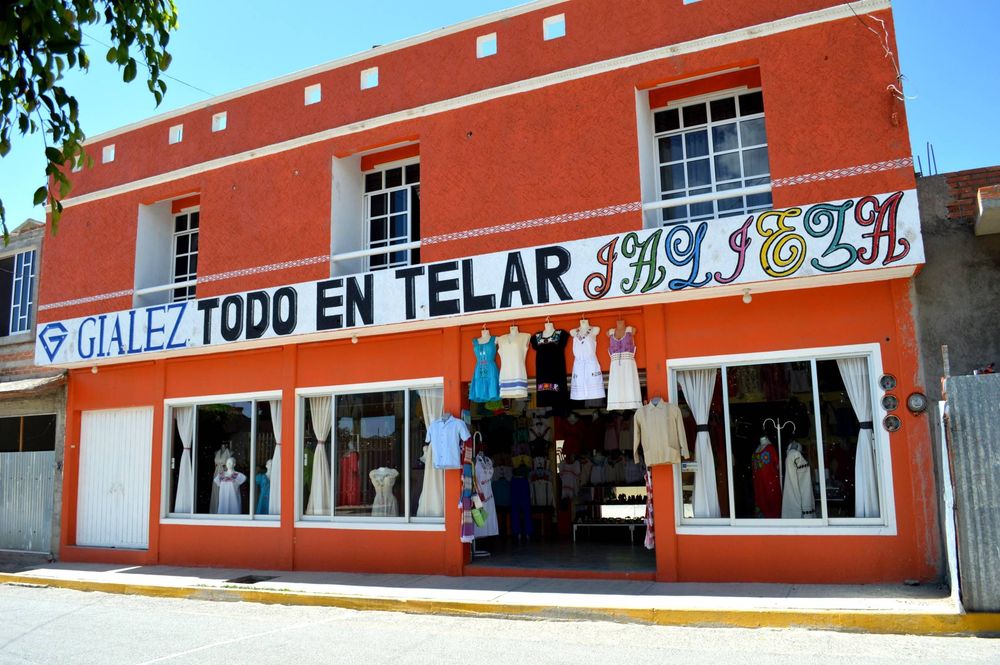
Cover photograph: Textile shop with displayed garments in Santo Tomás Jalieza, Oaxaca — Archive photograph; no edits to the downloaded file — AlejandroLinaresGarcia, CC BY-SA 4.0.
Frequently Asked Questions
What is Santo Tomás Jalieza known for?
It is associated with cotton textiles made on backstrap looms, including garments and everyday items. The most useful visit explores the maker's technique and the particular piece, rather than assuming all textiles share identical materials or dyes.
Do I need to book a weaving demonstration?
Arrange it in advance if watching the loom is the reason for travelling. An open shop or an artisan-directory profile does not guarantee that a demonstration or lesson is available when you arrive.
How much time should I allow?
Around two hours in the village and a half-day including travel are editorial starting estimates for a focused visit. Add time for a booked lesson or another substantial craft stop, following the host's advice.
Can I combine Jalieza with San Bartolo Coyotepec?
Yes, they are options within the state's craft-route framework. Arrange transport and appointments so both visits receive meaningful time; avoid adding further stops if they reduce each encounter to hurried shopping.


Keep Exploring
San Bartolo Coyotepec: Plan a Pottery Village Visit
Plan a San Bartolo Coyotepec pottery visit with named workshops, MEAPO checks, questions about barro negro and a focused half-day from Oaxaca.

Edo-Tokyo Museum: Plan Your Visit
Visit the reopened Edo-Tokyo Museum in Ryogoku: current tickets, hours, a focused exhibition route and practical access advice.

9/11 Memorial and Museum: Plan Your New York Visit
Choose the free memorial or ticketed museum, check Tuesday openings and plan a considerate visit with time for reflection.