
San Bartolo Coyotepec: Plan a Pottery Village Visit
Plan a San Bartolo Coyotepec pottery visit with named workshops, MEAPO checks, questions about barro negro and a focused half-day from Oaxaca.
Visit San Bartolo Coyotepec for one well-chosen pottery workshop, then use the village centre and its folk-art museum to put what you see in context. A good visit follows the material from shaping to surface treatment and asks who made the object in front of you. It does not need to become a tour of interchangeable souvenir shops.
The village lies on the southern craft route from Oaxaca. The state tourism description identifies its Zapotec heritage, family pottery workshops, two craft markets and the Museo Estatal de Arte Popular de Oaxaca beside the municipal palace. These give you several different ways to approach barro negro: meeting a maker, comparing work and seeing a wider cultural collection.
Use our Oaxaca highlights guide to choose how this fits your stay. Pick San Bartolo when clay, technique and contemporary makers interest you. If your priority is archaeological architecture, make that a separate decision rather than accepting a craft stop merely because it appears in a long excursion programme.
Plan the half-day
| Part of the visit | Suggested allowance | What to establish |
|---|---|---|
| Prearranged workshop | 60–90 minutes | Maker, demonstration, language and any fee |
| MEAPO museum | 45–75 minutes | Current opening, admission and exhibitions |
| Centre and craft browsing | 30–60 minutes | Which market or shop you actually want to visit |
| Travel from Oaxaca | Separate from these allowances | Exact drop-off, waiting and return arrangements |
The durations are editorial estimates. Allow a half-day overall if transport and your workshop appointment fit; leave more room for a practical class or a serious purchase. Information was checked on 4 November 2026, but neither a workshop's welcome nor a museum's opening should be inferred from an old tour itinerary.
Understand what makes the pottery black
The Mexican cultural information system's barro negro record distinguishes surface techniques from firing: burnishing creates sheen, while reduced oxygen during firing produces the dark colour. It associates Doña Rosa with the polished finish but acknowledges earlier precedents. Avoid the simplified claim that one person invented the entire pottery tradition.
That distinction gives you useful questions at a demonstration. Which surface is being polished? At what stage is decoration added? How does the maker decide between a smooth area and an opening cut through the wall? Ask to see examples at different stages if they are available, rather than expecting an entire production cycle to happen during a short visit.
Look closely at the edges of openwork and the transition between glossy and matte areas. A large shine does not by itself tell you how much work an object required. A restrained vessel can depend on careful proportion and finishing, while a complex figure may demand many separate decisions about shape and support.
Do not touch unfinished pieces without permission. What looks firm may still be vulnerable, and a demonstration table is a working space. If the maker lets you try a technique, ask what the exercise includes and what happens to the piece afterward. A hands-on session does not automatically mean you leave that day with a fired object.
Choose a workshop by the work
The Friends of Oaxacan Art directory provides concrete starting points: the De Nieto Real family at Benito Juárez 24, Adelina Pedro Martínez at Zaragoza 3, and Carlomagno Pedro Martínez at Guerrero 1. Treat these as directory addresses to reconfirm when arranging a visit, not as guaranteed walk-in hours or an assurance that a particular artist will be present.
For the Doña Rosa tradition, ask the De Nieto Real workshop who will demonstrate and how the current family members describe their own work. Doña Rosa is a historical figure, not someone visitors can meet today. The value of the stop includes the people continuing and changing the practice, so learn their names rather than describing every object only through a famous ancestor.
For sculptural work, Carlomagno is a useful name to investigate. The Secretaría de Educación Pública profile records his roots in San Bartolo and recognition for sculpture in clay. Ask whether a visit can focus on composition and subject as well as making technique. Do not promise yourself a meeting with him unless it has been confirmed.
Adelina provides another named option to compare through the directory. Before choosing, look at the actual work being shown and explain your interests: vessels, figures, surface patterns or learning to shape clay. A workshop should earn its place through that fit. There is no need to visit three families simply because three names are available.
When contacting a host, give your date, group size, language and the time you can spend. Ask whether the visit is a demonstration, a class or a sales-room appointment, and whether payment or a purchase is expected. Those distinctions matter more than the vague promise of an “authentic workshop.”
MEAPO: connect one workshop with a wider tradition
The Museo Estatal de Arte Popular de Oaxaca, usually shortened to MEAPO, is the museum option in the village centre. The national cultural registry lists it on Independencia s/n and describes displays covering craft traditions across Oaxaca. Its public record was last modified in 2021 and does not supply a usable current timetable.
A separate federal Culture Ministry directory publishes Tuesday–Sunday, 10:00–18:00, but it is not a dated operating bulletin. Use that as a starting point to confirm, not a guarantee of access. Ask the museum for the current opening, last admission, standard tariff and any concessions; this guide does not quote a current ticket price because one was not verified from an up-to-date primary visitor source.
Place MEAPO before the workshop if you want to develop questions from the displays. Put it afterward if you prefer to connect the process you have just seen with other objects and traditions. Either sequence works; the workshop appointment should decide the order when it is the less flexible element.
Inside, read maker and place names carefully. Oaxaca's craft traditions are not one uniform style, and objects from different communities should not be treated as alternatives produced by the same anonymous group. Notice how labels connect material, location and authorship. That makes later browsing more informed without turning the museum into a price-comparison exercise.
Do not rely on an old exhibition announcement to establish what is currently displayed. Ask which galleries are open and whether a temporary presentation matches your interest. If the museum is unavailable, retain your workshop and centre visit rather than replacing it with several hurried shop stops.
A compact route through the centre
Use the municipal centre as the meeting point for the flexible part of your visit. Locate MEAPO on Independencia, take time around the public square and approach the church only if visitor access allows. The federal heritage catalogue identifies the church as San Bartolomé; it is a religious place, not an annex of the pottery sales route.
A sensible sequence is museum, centre and one workshop, followed by a modest browse if you still want to compare objects. Reverse it when your maker appointment comes first. Establish the workshop's precise location before starting: a central meeting point does not mean every family studio is next door.
For markets, ask locally which of the village's craft-selling areas fits your route that day. Browsing can show how different makers interpret similar forms. Keep it distinct from the workshop visit: a display of finished pieces does not necessarily include a demonstration, and a market seller should not automatically be described as the maker.
If you are accompanying someone who is deeply interested in ceramics, agree on the length of the workshop before arriving. A shorter centre walk and a seated break may suit the rest of the group better than several consecutive demonstrations. One substantial visit gives the host a clearer brief and makes the day easier to pace.
Buying a piece you can use and take home
Begin with intended use. Ask whether the specific piece is decorative or intended for contact with food or liquids, and request the maker's care instructions. A vessel shape does not establish suitability as a drinking cup, cooking pot or vase filled with water. Do not infer use from colour or appearance alone.
Then ask about authorship and process. Record the maker's name, not just the workshop or the driver who brought you. If different relatives shaped and decorated the object, let the workshop explain that contribution. It is a more useful record than attaching a generic label such as “traditional Mexican pottery.”
Inspect a piece with the seller before packing, paying attention to delicate projections and openwork. Ask for protective wrapping that supports the object without pressing on fragile details. Consider the packed size as well as the display size: an elaborate figure needs more room than its height alone suggests.
For a large purchase, clarify shipping, insurance, contact details and what happens if damage occurs before paying. No universal village price or shipping policy exists. Comparing a simple bowl with a detailed sculpture by weight or size alone misses the work involved; ask about the particular piece rather than demanding a supposedly standard pottery price.
Transport and which excursion to combine
For a focused half-day, a driver or small-group excursion can be practical if it protects the time at your chosen workshop. Ask for the maker's name, the actual time there and whether the guide interprets or simply provides transport. Clarify museum admission and demonstration charges separately from the journey.
Independent travel requires a precise drop-off and a reliable return arrangement. This guide does not publish an unverified bus departure point, colectivo fare or fixed drive time. Confirm the current service from your accommodation's location and establish whether it reaches the village centre or only a roadside stop.
Keep the geography in mind when adding another destination. San Bartolo is a southern craft outing; Mitla is a separate eastern-valley archaeology choice. Our Mitla visit guide explains that excursion. Combining them can consume time better spent with a maker, especially when a tour adds several more stops.
For your first pottery visit, one workshop, MEAPO if open and a short centre walk form a coherent day. Add another craft community only when its different material or technique is something you actively want to compare, and ask how much uninterrupted time remains in San Bartolo after the extra driving.
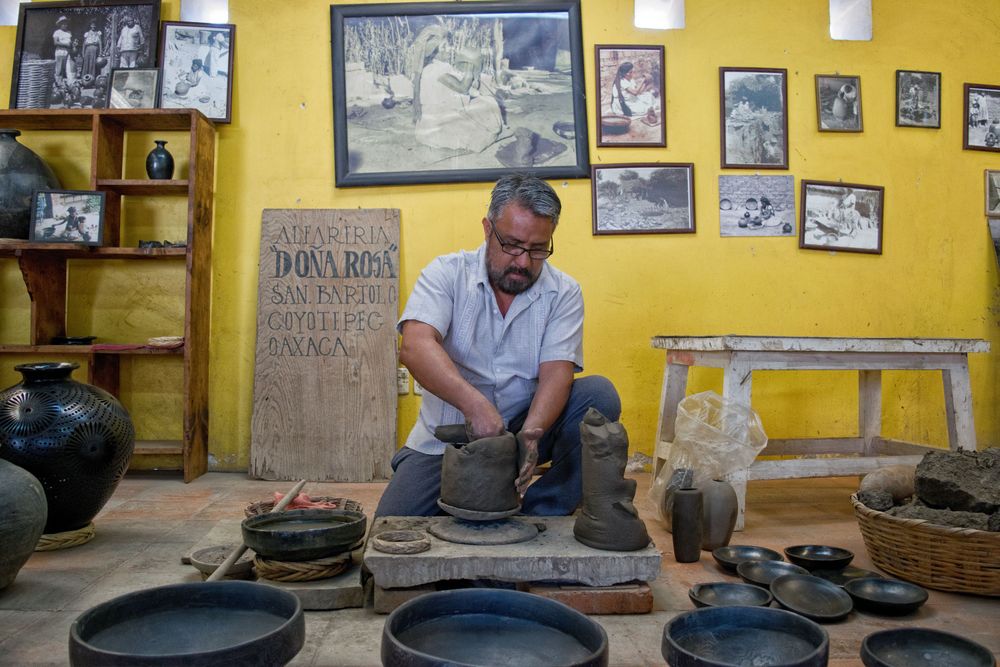
Cover photograph: Potter shaping clay at Alfarería Doña Rosa in San Bartolo Coyotepec — Archive photograph; no edits to the downloaded file — Jnmmtz, CC BY-SA 4.0.
Frequently Asked Questions
Can I visit San Bartolo Coyotepec in half a day?
Yes, with transport arranged and a focused plan: one workshop, the centre and MEAPO if its opening fits. A class or substantial purchase may need longer.
Do I need to book a pottery demonstration?
Arrange it ahead if a particular maker, language or technique matters. A workshop address does not guarantee a demonstration or the artist's presence whenever you arrive.
Is barro negro suitable for food and water?
Ask about the specific piece and obtain its intended-use and care guidance. Do not assume every vessel is functional simply because it resembles a cup, bowl or vase.
Are MEAPO's hours confirmed for my date?
No. A federal directory gives a regular schedule, but the museum's current opening and admission need direct confirmation. No live availability or current ticket quote was verified.


Keep Exploring
State Library Victoria: Plan Your Melbourne Visit
Plan a State Library Victoria visit around Queen’s Hall, the La Trobe Reading Room and books, with current Dome closures and tour booking advice.

National Museum of Singapore: Plan Your Visit
Plan the National Museum of Singapore: the renewed history experience, admission checks, visit length, entrances and access needs.
Museum of Oaxacan Cultures: Plan Your Visit
Plan Oaxaca’s museum at Santo Domingo: Tomb 7 objects, the former convent, conflicting official hours and separate garden access.