
State Library Victoria: Plan Your Melbourne Visit
Plan a State Library Victoria visit around Queen’s Hall, the La Trobe Reading Room and books, with current Dome closures and tour booking advice.
State Library Victoria rewards a visit that goes beyond photographing the dome. Its reading rooms show different ideas of what a public library can be: a grand nineteenth-century hall, a radial room beneath a vast roof, and contemporary spaces where people meet, work and read. Add a book exhibition and the building becomes more than an architectural backdrop.
The practical catch is that the famous elevated view is not currently a reliable plan. On 4 November 2026, the official opening-hours page lists Dome Levels 5 and 6 as closed. The La Trobe Reading Room and Level 4 book exhibition provide a worthwhile visit without promising access to the sixth-floor balcony. Check those notices again before travelling.
Our Melbourne cultural guide helps you choose the library's place in the wider trip. If you are deciding between a building-and-books visit and a substantial art collection, compare our NGV guide. They offer different experiences, even though both can fit a central Melbourne day.
The essentials and current exceptions
Use the library's opening-hours page for date-specific planning. General descriptions of magnificent spaces can still mention viewpoints that a temporary closure has made unavailable.
| Decision | Information checked 4 November 2026 |
|---|---|
| Main address | 328 Swanston Street, Melbourne |
| Main public hours | Daily, 10:00–18:00 |
| Ian Potter Queen's Hall | Daily, 10:00–16:00, subject to specific closures |
| Ordinary visit | Public reading rooms and free exhibitions; booked experiences may differ |
| Current Dome restriction | Levels 5 and 6 closed |
| Current entrance restriction | Entry 2 and La Trobe Street Cafe closed |
| Annual closure days | New Year's Day, Good Friday, Christmas Day and Boxing Day |
| Suggested visit | 60–90 minutes for selected spaces; around 2 hours with an exhibition |
These durations are editorial estimates. If Queen's Hall matters, arrive comfortably before 16:00 rather than assuming all interiors follow the main 18:00 closing. Cowen Gallery and its rotundas can also close for functions. Check the current notices and ask staff for an open route on arrival.
Choose architecture, books or a guided history visit
An architecture-focused visit needs two contrasting rooms: the Ian Potter Queen's Hall and the La Trobe Reading Room. That is enough to see how light, furniture and room shape organise reading differently. You do not need to visit every service area or climb to a closed balcony to make the trip meaningful.
For a book-focused visit, add World of the Book on Level 4. Give it a separate block of attention rather than treating the display cases as decoration on the way to a photograph. A visitor interested in bindings, illustration or the movement of ideas may spend longer here than in either reading room.
For historical context, consider the free History of the Library Tour. It introduces heritage spaces and stories with a volunteer guide. That is a different decision from simply entering the library: it needs an actual reservation and ties part of your day to a fixed meeting time. Choose your preferred format first, then organise the other stops around it.
A compact route starting on Swanston Street
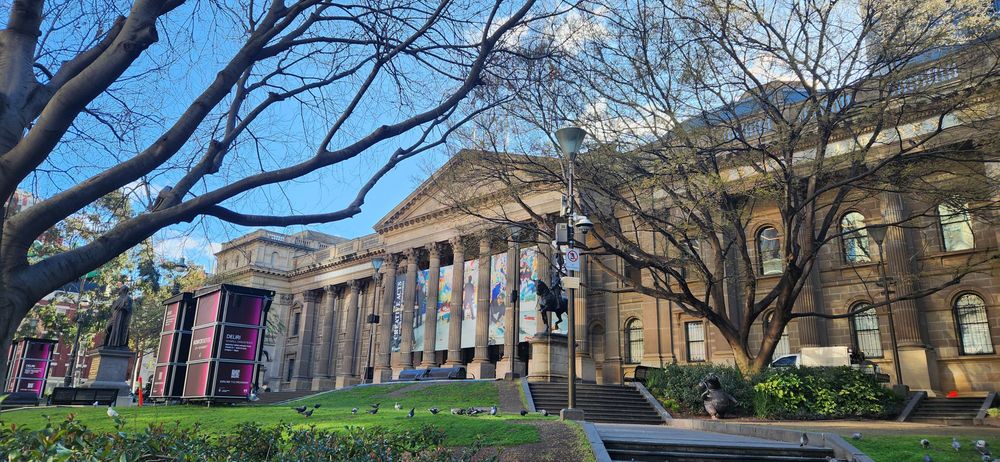
Begin at the Swanston Street frontage. Look at the columns, steps and public forecourt before going inside. The exterior presents a formal civic building; the people using the lawn and entrances give it a more everyday character. A short pause here helps connect the institution with the street rather than treating it as an isolated interior.
Enter through the open public entrance and orient yourself in the Swanston Street Welcome Zone. Hansen Hall is the meeting place for the history tour and a useful named reference if your group separates. Ask for the current map, confirm the closure notices and locate the lifts or stairs appropriate for your route.
Put Queen's Hall first when its shorter opening window matters, then continue to the La Trobe Reading Room and the Level 4 book exhibition if open. Cowen Gallery can be an additional stop on an available route, rather than a compulsory detour when it is reserved for a function. This sequence is an editorial suggestion; follow the signs and staff instructions rather than an old downloadable floor plan.
A late-afternoon arrival needs a different expectation. After 16:00, do not build the visit around Queen's Hall. Choose the open reading room and exhibition spaces, or return earlier another day if comparing both historic halls is your main reason for coming. A flexible itinerary is more useful than racing between doors before closing.
Queen's Hall: read the room before the books
The Ian Potter Queen's Hall began with the library's original reading room in 1856 and reopened after restoration in 2019. Its long form, columns and patterned skylights make a strong contrast with the dome. Spend a moment looking along the room, then notice how daylight reaches the tables.
The library explains that the original skylights helped extend reading hours before gas lighting was installed. That is a useful way to look at the architecture: decoration and practical reading conditions are connected. You can appreciate the restoration without memorising a list of dates or treating the room as a static period set.
By day it remains a reading room, with Australian literature, poetry, drama and young-adult fiction browsing collections. If time allows, choose a book to look through rather than immediately moving on. A few minutes reading makes the building's purpose tangible. Keep conversations quiet and avoid turning occupied desks into props for a photograph.
The hall is reached by stairs or lift. Its evening use for events does not mean visitors can stay after the published daytime closing, and a paid event elsewhere should not be assumed to include access to this room. Check the terms of the activity you actually book.
La Trobe Reading Room: the dome from the floor
The La Trobe Reading Room opened in 1913. Its octagonal plan and radiating desks draw your attention towards the centre and upwards. The green-shaded lamps and the geometry of the desks are part of what makes the room distinctive, not merely accessories beneath a famous ceiling.
Start by looking from an unobtrusive position on the reading-room level. Compare the radial arrangement with the length of Queen's Hall: one space spreads attention around a centre, while the other draws it along an axis. This simple comparison gives architecture enthusiasts and casual visitors something concrete to notice together.
Remember that it is a quiet study space. People at the desks are working, not participating in a visitor display. Keep phones silent, avoid photographing individuals closely and leave circulation routes free. If you need to discuss what you see, move to a suitable public conversation area afterwards.
The room's own descriptive page mentions a sixth-floor viewpoint, but the current closures page is the operational reference. Do not follow an old photograph or lift label into a restricted area. The ground-level view remains a different, valid experience of the room; there is no need to claim it reproduces the familiar overhead image.
World of the Book: make one subject your focus
The current World of the Book listing places the free exhibition in the Dome Galleries, Level 4, with the listed edition running from 4 July 2026 to 16 May 2027. Recheck those dates and access before a later visit. The closure of Levels 5 and 6 should not be misread as a statement that every Dome space is closed.
Choose one thread to follow through the cases: how books are made, how images explain ideas, or how different readers use a text. You will see more by comparing a few objects than by reading every label at the same speed. Look at size, page arrangement, materials and illustration before relying on a title alone.
An especially useful comparison is between a book intended for intimate reading and one designed to make an impression as an object. Ask what changes in scale, decoration and handling. The aim is not to rank old and new books, but to understand that a text's physical form affects how people encounter it.
Displays can rotate, so avoid making a particular rare item the sole reason for coming unless the library confirms its presence. The exhibition is a viewing experience, not permission to handle material in cases. If you want to consult collections for research, that belongs to a separate enquiry with library staff.
Book a tour only when its format suits you
The official History of the Library Tour page advertises a one-hour, free, volunteer-led tour, at 10:45 or 13:45 on selected days, with advance booking essential. It meets in Hansen Hall. The date range shown on the checked listing reaches 30 November 2026; use its booking link for actual availability and later schedules.
Its advertised highlights include historic reading rooms, galleries, Queen's Hall and Ned Kelly's armour. The route still depends on current access. Do not assume a reservation overrides a temporary closure. Arrive with enough time to find the meeting point rather than treating the start time as your arrival at the street entrance.
The library also sells other guided experiences, including access before ordinary opening. A free history tour and a paid specialist tour are separate products. Compare the actual route, duration and booking conditions; there is no need to pay for an ordinary self-guided visit simply because a search result promotes a premium option.
Access, families and a practical finish
The library's access and inclusion page describes lifts to the principal reading rooms and galleries, accessible toilets and a courtesy wheelchair that can be booked. For the Swanston Street Welcome Zone, it identifies a ramp near La Trobe Street. Current entrance closures still apply, so ask which approach is open rather than following a café entrance mentioned in older guidance.
If you need a wheelchair, book ahead and confirm your own assistance arrangements: the library states it cannot provide staff to push it. For a visit involving a specific room, check its route as well as the building entrance. Step-free entry alone does not establish access to every mezzanine or temporarily restricted space.
With children, keep the quiet-room portion short and choose a few visible details to compare. The Pauline Gandel Children's Quarter offers a different kind of library space; check its current activities and arrangements before promising a particular session. A family visit can include the dome without expecting children to spend an adult-length exhibition visit reading labels.
Finish with one nearby direction. The northern city centre suits a meal or a separately planned Queen Victoria Market visit; heading south along Swanston Street connects with the central lanes and, farther on, Federation Square. If choosing NGV afterwards, confirm whether you mean NGV Australia at the square or NGV International across the river. The library visit works best as a focused cultural stop, leaving enough attention for whatever follows.
Cover photograph: State Library Victoria’s columned facade, front lawn and trees in Melbourne — Archive photograph; no edits to the downloaded file — BindiS, CC BY 4.0.
Frequently Asked Questions
Can I visit State Library Victoria without booking a tour?
Yes. A self-guided visit to open public reading rooms and free exhibitions is separate from a guided booking. Tours, events and research services can have their own requirements.
Is the sixth-floor Dome viewpoint open?
The official opening-hours page lists Dome Levels 5 and 6 as closed on 4 November 2026. Recheck before visiting and do not rely on older photographs or the general room description.
How long should I allow?
Allow roughly 60–90 minutes for selected heritage spaces, or around two hours with an exhibition. These are editorial estimates. Queen's Hall normally closes at 16:00, earlier than the main library.
Is the History of the Library Tour free?
Yes, the checked listing offers a free one-hour tour at 10:45 or 13:45 on selected days. Advance booking is essential, with the meeting point in Hansen Hall; check the calendar for your date.


Keep Exploring
San Bartolo Coyotepec: Plan a Pottery Village Visit
Plan a San Bartolo Coyotepec pottery visit with named workshops, MEAPO checks, questions about barro negro and a focused half-day from Oaxaca.
National Museum of Singapore: Plan Your Visit
Plan the National Museum of Singapore: the renewed history experience, admission checks, visit length, entrances and access needs.
Museum of Oaxacan Cultures: Plan Your Visit
Plan Oaxaca’s museum at Santo Domingo: Tomb 7 objects, the former convent, conflicting official hours and separate garden access.