
Museum of Oaxacan Cultures: Plan Your Visit
Plan Oaxaca’s museum at Santo Domingo: Tomb 7 objects, the former convent, conflicting official hours and separate garden access.
Choose the Museo de las Culturas de Oaxaca for the objects and historical context that an outdoor visit to Monte Albán cannot provide on its own. The museum occupies the former Santo Domingo convent in central Oaxaca. Its Tomb 7 collection is a strong reason to come, but a useful visit also looks beyond those objects to the building and the region's changing cultural history.
The first planning task is to confirm opening directly: official sources currently disagree. The second is to keep the museum, the church and the garden as separate visits. Our Oaxaca highlights guide compares the city's wider experiences; this guide helps you give the museum a realistic place within them.
Fast facts
| Detail | Planning information |
|---|---|
| Museum | Museo de las Culturas de Oaxaca, former Santo Domingo convent |
| Address | Macedonio Alcalá s/n, historic centre |
| Official hours conflict | INAH visitor portal: Tuesday–Saturday 10:00–16:00; SIC: Tuesday–Sunday 09:00–17:00 |
| Published general admission | MXN 210; qualifying Mexican nationals and foreign residents: MXN 105 with required identification |
| Suggested visit | Around two hours for a selective route; longer for detailed reading |
| Main distinction | Museum entry does not establish church, garden or library access |
Information was checked on 3 November 2026. The duration is our editorial planning allowance, excluding entry procedures and other institutions. Neither the hours table nor an old ticket price should replace confirmation for the date you intend to visit.
Resolve the opening-hours conflict first
The INAH visitor portal lists Tuesday–Saturday, 10:00–16:00. The Secretaría de Cultura's SIC museum record lists Tuesday–Sunday, 09:00–17:00. The discrepancy affects both Sunday access and the beginning and end of the day; it cannot be solved by choosing the more convenient timetable.
Contact the museum through the details in those official records and ask for the day's opening, last admission and any gallery closures. A Tuesday–Saturday visit comfortably within the narrower published window reduces dependence on the disputed hours, but it is not a guarantee of opening. Avoid making Sunday your only chance without direct confirmation.
This matters if you are combining the museum with a timed garden tour or an excursion return. Build the day around the least flexible confirmed arrangement. If the museum cannot confirm access, keep another city activity available rather than paying for a tight sequence that relies on an assumption.
Do not interpret a Sunday discount notice as proof that the museum will be open that Sunday. Tariff rules and operating schedules answer different questions. The same applies to a page offering online tickets: a payment option does not settle which rooms will be accessible during your visit.
Understand the ticket categories
The current SIC record lists MXN 210 general admission and a 50% reduction, to MXN 105, for Mexican nationals and foreign residents in Mexico who present the specified valid original identification. The INAH portal also displays MXN 105 for national visitors and MXN 210 for foreigners. Use the fuller SIC conditions when checking whether the reduced price applies to you.
A foreign visitor staying in a hotel is not automatically a resident for this purpose. Check documentation before assuming eligibility. The official record also lists exemptions with conditions; if you expect free entry because of age, study, teaching or another category, ask what proof is required and whether it applies to your status.
Keep the museum budget separate from transport to Monte Albán, a garden visit, a guide and any purchases. Do not assume a cultural-complex ticket covers every institution sharing the site. When offered a tour, ask explicitly which entrance fees are included and how much time is allocated inside this museum.
Tomb 7: connect the objects with their archaeological setting
The Tomb 7 material is the museum's strongest link with a Monte Albán excursion. The SIC account explains that the tomb was built by Zapotec people and later reused by Mixtec elites; Alfonso Caso excavated it in 1932. This distinction matters: the location of an object and the cultural attribution of the burial are not necessarily the same thing.
Before focusing on individual pieces, read the gallery introduction for the archaeological context. Then choose a few objects and compare materials, scale and workmanship. The point is not to rank them by preciousness, but to consider what skilled making, adornment and burial could communicate.
Ask staff whether the Tomb 7 gallery is open that day if it is your main reason for visiting. A museum collection listing describes holdings and interpretation, not a live guarantee that every object is displayed. Do not arrive expecting to enter the tomb itself: this is the city museum, not the archaeological site.
INAH's Monte Albán page describes a separate hilltop archaeological destination. The two visits complement one another: the museum allows close study of objects, while the site provides spatial scale and landscape. You do not need to complete both on the same day for the connection to be meaningful.
Choose a route beyond one famous collection
A good two-hour visit should include more than a hurried look at Tomb 7. Start with the available orientation, locate your priority gallery and identify one later historical theme to explore. Follow the current visitor route and ask about closed sections before committing to an ambitious circuit.
INAH's gallery descriptions range from early cultures and the growth of regional societies to conquest, colonial change and later history. That breadth makes the museum useful for understanding transitions, rather than treating Oaxaca as a single moment in the pre-Hispanic past. You can select a thread through the displays without trying to read the entire regional history in one sitting.
For example, compare how objects communicate power or status across different periods. Or follow materials and techniques, noticing where a label identifies continuity, exchange or change. These are editorial ways of looking, not claims that every gallery follows one simple linear story.
Read place and community names carefully. Oaxaca is a state with distinct histories and living cultures; the city is your base for the visit, not a synonym for every community represented. If a term is unfamiliar, note it for later rather than reducing it to a generic “local tradition.”
Treat the former convent as part of the visit
The museum's setting adds a second layer to its collections. A former Dominican convent presenting Indigenous history invites you to consider both the objects and the later institution that frames them. Look at the relationships between galleries, corridors and open spaces as you move through the authorised route.
Pause to distinguish the history of the building from the history of an archaeological object. They belong to different contexts even when encountered together. This simple distinction helps prevent the architecture from becoming only a photographic backdrop, or the collections from being treated as original furnishings.
Historic buildings can make the route more physically demanding than a quick map glance suggests. Ask about steps, lifts, places to rest and the galleries reachable on a step-free route if these affect your visit. Do not infer full accessibility from the presence of an entrance ramp or from an online photograph of one courtyard.
Follow current photography instructions. INAH's visitor information prohibits flash and flags a charge for professional cameras; confirm how the museum classifies your equipment before arranging photography as the main purpose. A general visit does not imply permission for a professional shoot or unrestricted tripod use.
Church, museum and garden are separate decisions
“Santo Domingo” can mean the church, the former convent museum or the surrounding cultural complex. Be precise when asking directions or booking a tour. A church visit does not mean that the museum galleries are open, and museum admission does not automatically include the garden.
The Jardín Etnobiológico de Oaxaca's official website has its own visits information. Its name and focus concern the relationship between plants and cultures, which makes it an interesting companion to the museum, but entry arrangements must be checked independently. Seeing the garden from a museum window is not the same as entering it.
Our Oaxaca garden guide explains the separate planning questions. If a particular language or tour time matters, confirm that first, then fit the museum around it with room to exit and reach the correct meeting point. Do not combine advertised durations as though both experiences begin at the same doorway.
Apply the same care to the library and any other institution in the complex. Shared architecture does not imply shared hours, admission or public access to every room. Ask for the specific institution you intend to visit rather than requesting an undefined “complete Santo Domingo ticket.”
Before or after Monte Albán?
Visit the museum first if you want objects and chronology to guide what you notice at the archaeological site. You can leave with a short list of questions about the ancient city rather than trying to learn everything during an exposed outdoor circuit.
Visit afterward if you prefer beginning with landscape and scale. The museum can then help you revisit details that were difficult to understand on site. Either order works; the practical priority is confirmed opening and enough attention for each experience.
For a museum-focused city day, allow around two hours inside, then leave space for a meal or a shorter central visit. For a day combining it with an excursion, account honestly for transport, outdoor walking and tiredness. A rushed final hour before a disputed closing time is a poor substitute for a separate, well-paced visit.
If your group has different interests, agree on a small shared core: the available Tomb 7 displays, a later historical theme and the convent architecture. Beyond that, let curiosity determine where to spend the remaining time. The museum is most useful when you leave able to connect a few objects, places and histories, rather than only remembering how many rooms you passed.
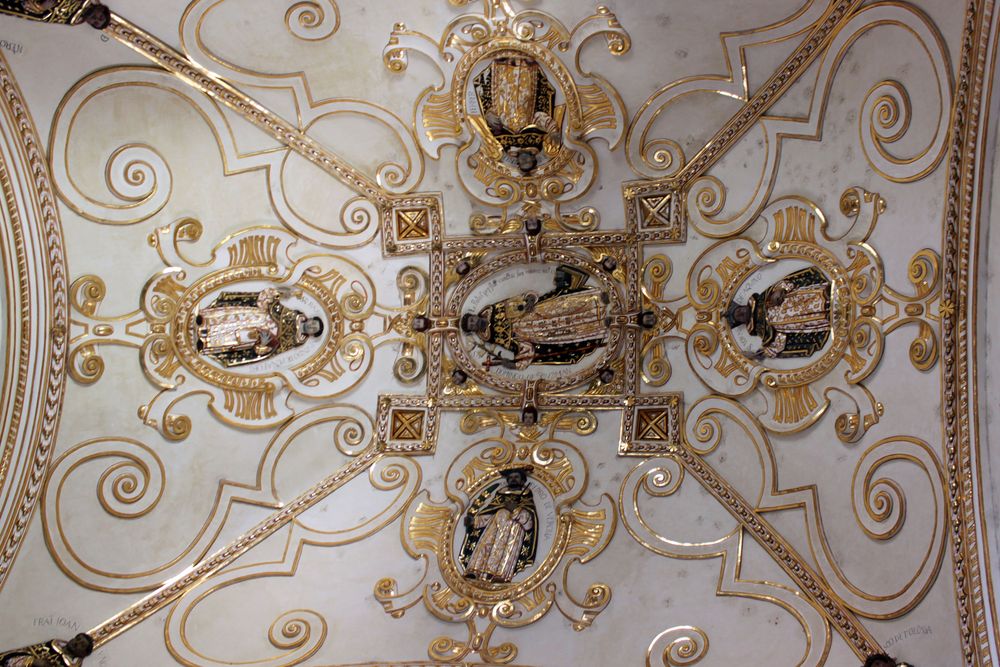
Cover photograph: Painted figures and gilded patterns on a ceiling in the Museum of Oaxacan Cultures — Archive photograph; no edits to the downloaded file — Anagoria, CC BY 3.0.
Frequently Asked Questions
Is the Museo de las Culturas de Oaxaca open on Sunday?
Official sources checked on 3 November 2026 disagree: SIC includes Sunday, while the INAH visitor portal lists Tuesday–Saturday only. Confirm directly before making Sunday your only museum day.
Are the Tomb 7 objects at Monte Albán itself?
This guide concerns their collection at the city museum in the former Santo Domingo convent. Monte Albán is a separate archaeological outing. Check current gallery access if Tomb 7 is your priority.
Does the museum ticket include the garden?
Do not assume so. The garden has its own visit arrangements, and the church and other cultural institutions also need separate checks.
What should a foreign tourist budget for admission?
The published general tariff is MXN 210. The MXN 105 reduction has nationality or Mexican-residency and identification conditions; do not assume a temporary visitor qualifies.


Keep Exploring
National Museum of Singapore: Plan Your Visit
Plan the National Museum of Singapore: the renewed history experience, admission checks, visit length, entrances and access needs.
Dar El Bacha: Plan Your Marrakech Museum Visit
Visit Dar El Bacha for its palace interiors and museum. Compare published admission, allow time for the medina and treat Bacha Coffee separately.
Whitney Museum: Plan Your New York Art Visit
Choose Whitney tickets, free sessions and exhibitions, then plan a focused art visit with a nearby High Line walk.