
Oaxaca Ethnobotanical Garden: Plan Your Visit
Plan Oaxaca’s garden with clear access uncertainties, tour-language checks, official contacts and ways to connect plants with local culture.
Oaxaca's Ethnobotanical Garden is worth considering if you want to connect the region's plants with food, craft and community knowledge. The first planning step, however, is to confirm a guided visit for your date and language. The official pages checked on 28 October 2026 do not provide one consistent current timetable, so an old English-tour schedule or a photograph of the garden is not enough to establish access.
The site now presents itself as Jardín Etnobiológico de Oaxaca. It occupies part of the Santo Domingo complex in the historic centre and offers a different experience from the church or museum. Use our Oaxaca highlights guide for the broader choice of city visits and valley excursions; this guide focuses on how to approach the garden without planning around unverified entry details.
Fast facts
| Detail | What can safely guide your plan |
|---|---|
| Location | Reforma at Constitución, beside the Santo Domingo complex |
| Current name on garden website | Jardín Etnobiológico de Oaxaca |
| Visit format to arrange | Guided visit; do not assume unrestricted individual entry |
| Current hours and languages | Require direct confirmation; official information conflicts |
| Admission | Free tours advertised in an August 2025 government notice; current terms need confirmation |
| Planning allowance | Keep a flexible 1–2-hour window nearby; this is not a verified tour duration |
| Contacts | Garden: +52 951 516 5325; OCCE: +52 951 132 5296 |
The garden's current tours page directs tourist and school-tour enquiries to the Oficina de Convenciones, Congresos y Eventos de Oaxaca, or OCCE. This is the important operational instruction; the office and library hours elsewhere on the website are not a visitor-departure timetable.
What the official information does and does not establish
A state administration announcement dated 18 August 2025 advertised free guided tours from Monday to Saturday. A later state tourism article dated 25 November 2025 instead describes Tuesday–Sunday opening from 10:00–18:00. These are incompatible enough that neither should be presented as a confirmed October 2026 departure schedule.
Meanwhile, the garden's own tours page refers to administrative changes in 2025 and sends enquiries to OCCE rather than supplying a replacement timetable. That notice concerns responsibility for visits; it does not by itself establish that the physical garden has permanently closed, or that it reopened on a particular date.
The practical conclusion is to confirm access directly. We have not verified a current reopening date, same-day capacity, a new tariff or a regular English or French departure. Historical paid tours and older language-specific schedules should not be treated as current simply because they appear in a recently updated travel article.
This uncertainty is manageable if you are already spending time around Santo Domingo. It matters much more if you plan a special journey, have only one free morning or require a particular language. In those cases, secure the answer before making the garden the centre of your day.
Ask the questions that determine your visit
The official OCCE directory lists the office's contact number and a department responsible for the garden. The garden's own published number remains another starting point. If staying locally, your accommodation may help you make the enquiry in Spanish, but ask for the actual answer rather than a general assurance that “the garden is open”.
A useful enquiry gives your date, number of people and preferred language, then asks five things: is a public tour operating; at what time; in which language; what does it cost; and how is a place obtained? Also confirm the meeting entrance and expected duration. These details distinguish a usable visit from an opening-hours listing.
A simple Spanish question is: “¿Hay recorrido para visitantes el día que queremos ir? ¿A qué hora, en qué idioma y cómo se obtiene lugar?” Add your date and party size. If you need step-free access, mention that in the same conversation rather than discovering the route after joining the group.
For a school or large group, arrange matters in advance. The 2025 government notice requested at least two weeks for such groups; ask OCCE whether that lead time still applies. Do not assume the procedure for one or two independent travellers also works for a coach party.
Find the garden, not just Santo Domingo
Save the entrance area at Reforma and Constitución. The garden homepage publishes this location, which is more useful than navigating only to the church's main façade. Several institutions share the historic complex, and an open door elsewhere does not establish garden admission.
From a central accommodation, compare the actual walking route rather than automatically booking transport. Allow time to find the correct entrance and read any notice posted there. For a taxi, specify the garden and street corner, not simply Santo Domingo, and confirm where the vehicle can stop.
Once a departure is confirmed, arrive with the margin staff recommend. If the next group is full or cancelled, ask whether there is a later option before reorganising the day. A flexible visit to nearby streets or a meal is easier to move than a distant excursion with a fixed return.
Do not buy admission to the church's neighbouring museum in the belief that it includes the garden. Any view across planting from elsewhere in the complex is a different experience from a guided walk within it, with different access arrangements.
Understand what “ethnobiological” adds
This is not simply a collection of attractive drought-tolerant plants. The garden's collections page explains that plants were contributed by Oaxacan communities for their cultural value or uses, alongside scientific collections. The central question is how people and living organisms relate, rather than how many species a visitor can count.
On a guided visit, ask where a plant comes from, who uses it and which part is used. Then ask whether the same plant has different names or roles in different communities. These questions avoid reducing Oaxaca's varied traditions to a single story about “local people”.
An explanation of medicinal use is cultural information, not a recommendation to try a plant yourself. Do not taste leaves, break stems or collect seeds. The point is to understand knowledge in its context, with the guide identifying both the plant and the limits of what can be inferred.
The garden can also change how you look at a market or craft workshop later. A label on a souvenir is less informative than a conversation about the material, where it was obtained and who transformed it. Keep that connection in mind without assuming every product sold in Oaxaca was produced locally or sustainably.
Three useful things to look for
First, compare growth forms. A columnar cactus, a rosette-shaped agave and a tree organise their leaves, stems and shade differently. Ask the guide what those differences mean for the plant's environment rather than relying on a visual guess about species or age.
Second, connect a plant to a familiar food or material. The state administration's account names examples including nopales, magueyes and chile chilhuacle. Use such names as prompts for questions if they feature on your route, not a checklist of guaranteed specimens. A short visit becomes more memorable when one explanation connects to something you later eat or see being made.
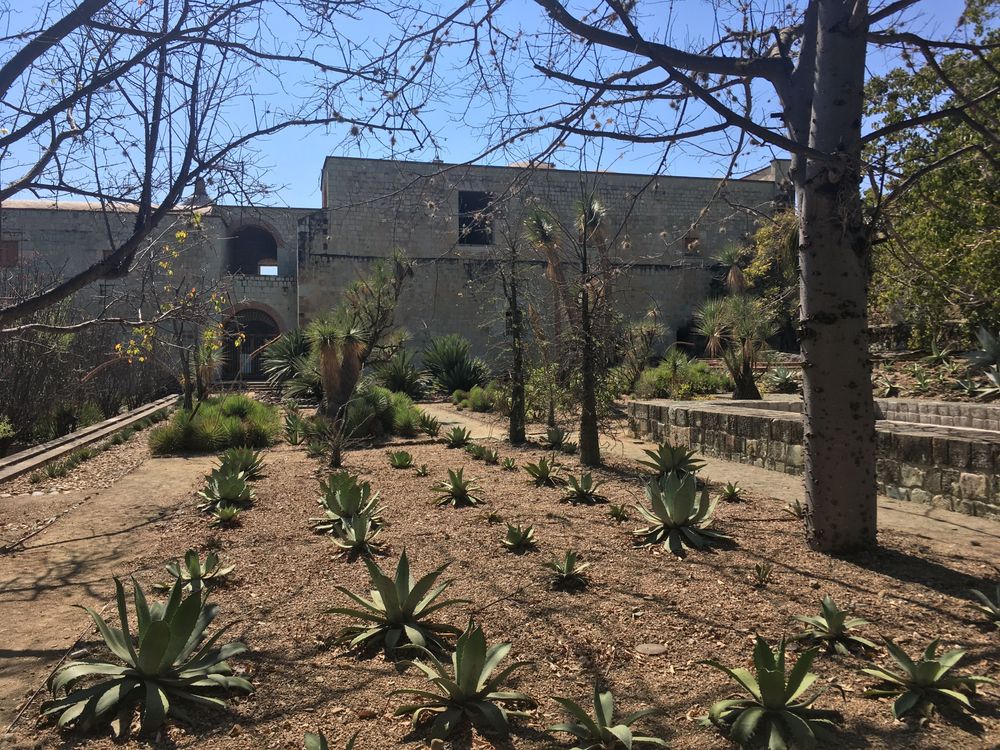
Third, look at the designed setting. Paths, channels, planting and the old convent walls form a composed landscape. Ask which features belong to the historic site and which were added for the garden. Photographing the relationship can tell more than taking isolated close-ups of every plant.
The route available on the day may show only part of the collection. Research areas, seed collections and herbarium access should not be assumed to form part of ordinary tourist admission. Choose your questions around what the guide can actually show.
The garden is also a civic and historic project
The garden's own history describes the citizen initiative associated with Francisco Toledo and the transformation of former convent and military spaces. This gives the place a story beyond botany: a decision about how a historic urban site should serve the public.
Keep the distinction between that origin and current administration. The people involved in establishing a garden, the specialists studying its collections and the office arranging today's tours do not necessarily have the same responsibilities. That is why the current tours notice matters for access even when older material remains valuable for understanding the project.
Look for the relationship between the living collection and the surrounding architecture without treating the whole area as untouched nature. This is a cultivated and maintained setting. Its value includes the work of moving, caring for and interpreting plants, not only the visual impression of greenery against stone.
Weather, photographs and access needs
Bring water, sun protection and shoes suitable for an outdoor walking route. Check the forecast and ask what happens to the tour in rain. A centrally located garden can still involve exposed standing, uneven ground or a route without a seat exactly when you need one.
For mobility requirements, ask about the specific entrance, surfaces, steps, total walking and places to pause. Do not infer complete wheelchair access from a general reference to paved paths. If a companion needs to leave early, confirm how that works on a guided circuit.
Keep photographic equipment simple and ask about current restrictions on flash, tripods and organised shoots. Follow the group's pace, leave paths clear and stay out of planting beds. The cover photograph documents the garden in an earlier year, not today's vegetation, weather or permitted visitor route.
With children, choose one observation task: compare plant shapes, find a repeated pattern or listen for a connection to food. Keep hands away from spines and unfamiliar plants. Confirm the tour's duration and language first; a visit designed for adults is not automatically suitable for every child's attention span.
Fit it into a flexible city day
If your place and language are confirmed, let the garden anchor a modest Santo Domingo outing with a meal or another separately checked visit nearby. Do not schedule every gap before knowing the actual tour length.
If access cannot be confirmed, keep the rest of the city day intact. Our Oaxaca three-day itinerary helps distribute city time and excursions without making one uncertain activity carry the whole plan. Select an alternative for its own interest rather than buying something simply to fill the wait.
The garden is most rewarding as an interpreted encounter with plants and the people connected to them. Confirm the practical conditions, arrive with a few thoughtful questions and leave space afterward to follow those connections into the city's food, craft and history.
Cover photograph: Agaves and trees beside stone paths in Oaxaca’s Ethnobotanical Garden — Photograph from 2022; resized for display. Vegetation and visitor access may change. — Nosferattus, CC0 1.0.
Frequently Asked Questions
Is Oaxaca's Ethnobotanical Garden currently open?
Official pages checked on 28 October 2026 give conflicting schedules, and the garden's tours page directs enquiries to OCCE. Confirm a public departure for your date; this guide does not establish a current reopening date or guaranteed daily access.
Is admission free or paid?
An August 2025 state notice advertised free guided tours. Current charges and booking arrangements were not consistently confirmed, so ask before planning around free entry or paying an intermediary.
Are there English or French tours?
No current language-specific timetable was verified. Ask for the language of the actual departure you want; older English or French schedules do not establish present availability.
Can I walk around without a guide?
The official visitor material describes guided visits. Do not assume unrestricted independent entry, or that a church or museum ticket includes the garden. Confirm the present format with OCCE or garden staff.


Keep Exploring
ANIMA Garden from Marrakech: Plan Your Visit
Plan ANIMA as a garden outing from Marrakech, with the official shuttle, ticket categories, café time and clear limits on access and onward travel.
Rio Botanical Garden: Plan Your Visit
A focused Jardim Botânico visit: paid arboretum versus free museum, themed plant routes, Wednesday opening and practical food and access choices.
Hierve el Agua from Oaxaca: Plan a Day Trip
Plan a Hierve el Agua day trip around current community access, transport, mineral formations and optional pools, with a realistic alternative if plans change.