
Santa María del Tule: Plan Your Oaxaca Visit
Plan a thoughtful Tule tree visit, with botanical context, honest access checks, the BinniBus route to investigate and a Teotitlán pairing.
Choose Santa María del Tule for a short, attentive encounter with a remarkable living tree and the town around it. The best visit gives the trunk, canopy and local interpretation time to register, instead of treating the Árbol del Tule as a photograph taken during a rushed transfer. Allow about 60–90 minutes for the tree and a modest town pause as an editorial estimate, excluding travel.
This is a different outing from a hike, an archaeological site or a full craft workshop. Use our Oaxaca highlights guide to decide which experience matters most. Tule can anchor a gentle half-day from the city or become one carefully chosen stop on an eastern-valley day.
Fast facts
| Detail | Planning information |
|---|---|
| Main attraction | Árbol del Tule, an ahuehuete beside the church in the town centre |
| Position | East of Oaxaca city, toward the Mitla corridor |
| Suggested time | 60–90 minutes for tree and town; travel extra |
| Entry and hours | No current tree-specific tariff or opening schedule verified in the official pages consulted |
| Public transport lead | BinniBus RA15 extension to Tule announced in February 2026; confirm current stops and service |
Research was checked on 11 November 2026. Time allowances are recommendations, not official tour durations. The access details of the tree enclosure, church and any guided explanation should be checked separately.
Why the tree deserves more than a quick photograph
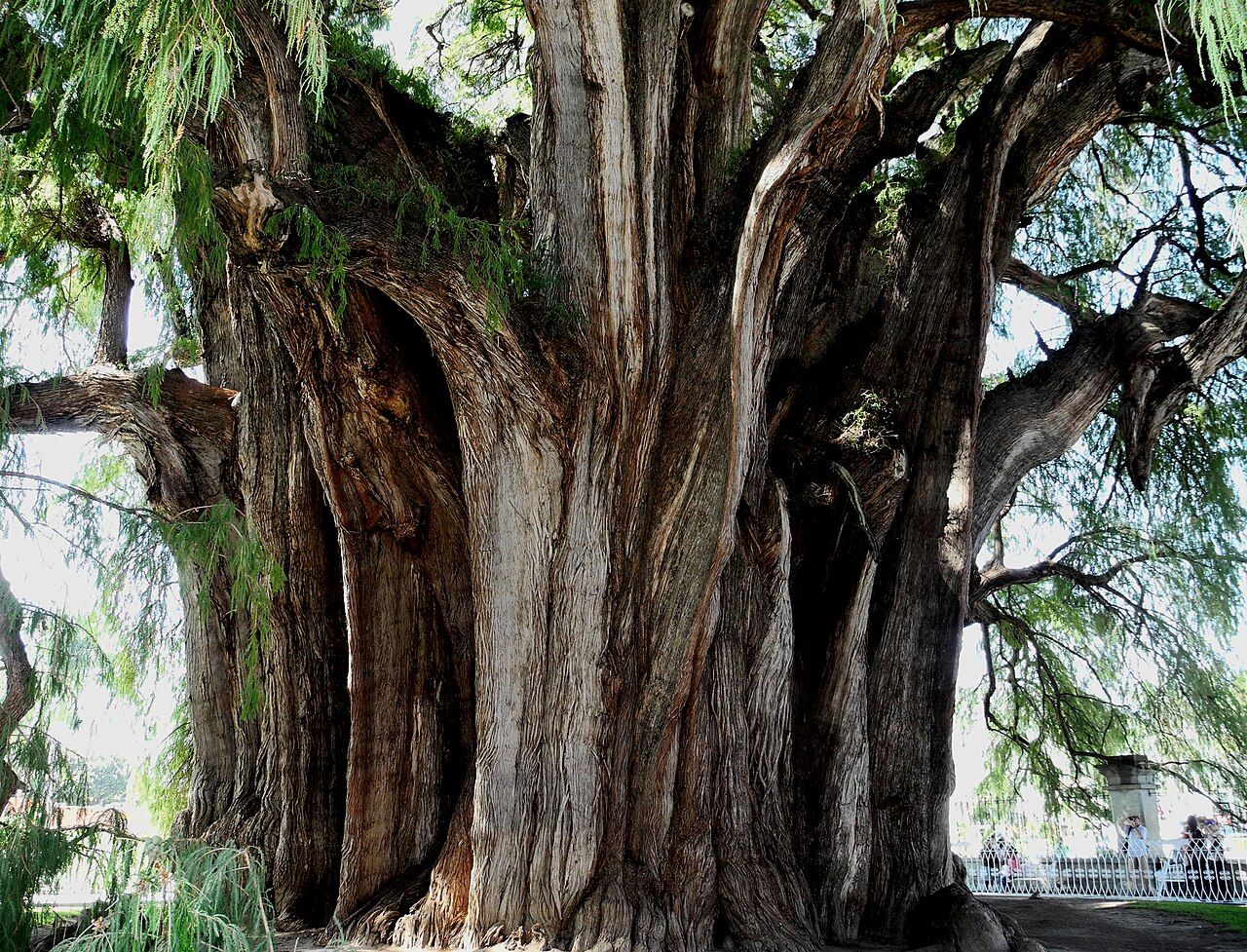
The scale of the trunk is the immediate attraction, but the experience improves when you change viewpoint. Look first from a distance that lets you relate the tree to its surroundings. Then, from the permitted visitor area, concentrate on the folds, branching structure and texture of the bark.
A photograph can flatten those differences. Moving slowly around the accessible perimeter helps distinguish the broad base from individual ridges and branches. It also makes the tree's relationship with the church and town more apparent than a tightly cropped image of bark alone.
The Oaxaca tourism page describes local guides interpreting animal-like forms in the trunk and recounting stories around the tree. If that interests you, ask about an available explanation and agree its language, duration and charge before starting. A published description of guiding does not guarantee that a particular guide is present whenever you arrive.
Treat those forms as an invitation to look and imagine. One person may recognise an animal where another sees a pattern of wood. The pleasure is in the change of perspective and the local storytelling, not in proving that every shape has a single correct name.
Understand what kind of tree you are seeing
Mexico's biodiversity agency CONABIO identifies the Tule tree as an ahuehuete, using the scientific name Taxodium mucronatum. You will also encounter the common name sabino. These names are more useful botanical anchors than treating “Tule” as the name of an entire species.
Look at the whole organism as well as its exceptional trunk. The canopy, finer foliage and way branches emerge from the wood help make it a living tree rather than merely a large sculptural object. You do not need to collect leaves or touch the bark to observe those differences.
Its age should be described as an estimate. INIFAP's discussion of ahuehuete longevity treats an age around 2,000 years for Tule as a possibility rather than a verified birthday. Tourism descriptions often use firmer wording. For travel planning, “an ancient tree with an estimated age” is more accurate than assigning an exact planting year.
Published measurements also vary. Height, trunk diameter, trunk circumference and canopy spread are different quantities; they should not be combined as though they describe the same dimension. The impressive thing you can judge directly is its scale in relation to nearby buildings and people at the permitted viewing distance. You do not need a world-record claim to justify the visit.
A simple sequence for looking closely
Begin with the broad view before seeking a close detail. Spend a few minutes identifying the trunk, the canopy and the church setting. This gives scale to the photographs you take later and helps distinguish the principal tree from other trees in the town.
Next, follow the open visitor route and choose two or three viewpoints. Compare a deep fold in the trunk with a smoother section and look at how the branches divide above them. If someone offers interpretation, use that moment to ask both about local stories and the tree's care.
Leave a final pause for the wider setting. The church grounds and town centre are part of why this tree has a public life, rather than existing as an isolated specimen in a remote forest. Observe the relationship without assuming access to every part of the church or enclosure.
For children, the search for shapes can provide a manageable focus. Ask what they notice before suggesting a named animal. A short visit with genuine observation is more successful than stretching the stop until everyone becomes tired of the same subject.
Admission and opening: what still needs checking
The official tourism and municipal pages reviewed did not establish a current tree-specific entrance fee or access schedule. We therefore do not repeat the small fees and long daily hours circulated elsewhere as confirmed facts. Ask the municipality or the staff at the visitor entrance for the applicable charge and opening arrangements.
The municipal website publishes office attention hours. Those are not evidence of when the tree enclosure or church opens. This distinction matters if you are arranging an early pickup, a late stop or a visit around a religious service.
Confirm what a payment covers: access to the tree's viewing area, a guide's explanation and church entry are different things. Do not assume that a tour's transport price includes every local charge. Carry a practical payment option advised by your operator or the site, without relying on an unverified promise of card acceptance.
A broad view from public space and close access within a managed enclosure are also different experiences. Ask which route is available on your date if close observation is the reason for travelling. The existence of photographs taken near the trunk does not grant permission to repeat their exact position.
Getting there: a specific public-transport lead
A BinniBus announcement dated 23 February 2026 described the extension of RA15 “XRA” to Santa María del Tule. It placed the return route along Calle Guerrero, one block from the tree, before rejoining Federal Highway 190.
That announcement gives a useful route to investigate, rather than a live departure guarantee. It announced an 8 MXN general fare at the time. Reconfirm today's fare, payment method, boarding point, direction and return stop with BinniBus before using it. This guide does not convert a February service announcement into a verified November timetable.
Pay attention to the route's starting-area name: colonia Monte Albán in the announcement is a neighbourhood, not a promise of a bus from the Monte Albán archaeological entrance. Confusing those two would turn a useful transport lead into an impractical combined itinerary.
For a taxi or private driver, request a dated return quote that includes the intended waiting time. Specify Santa María del Tule's town-centre tree visit, not merely a drop-off somewhere along the highway. If continuing to a workshop, agree the onward destination and return to Oaxaca before departure.
A short outing or an eastern-valley combination?
Choose a standalone outing if the tree is a strong interest, your available time is limited or you want a gentler contrast to a museum-heavy stay. Give yourself room for observation and a town pause, then return to Oaxaca. There is no requirement to add a second destination to make the journey worthwhile.
Choose Tule plus Teotitlán del Valle when the second part of the day is a genuine weaving visit. Our Teotitlán workshop guide explains how to arrange that encounter. Fix the workshop appointment first, then fit Tule into the transport plan without reducing the maker's time to a brief sales stop.
These places are not one continuous walking visit. Confirm each transfer and avoid assuming a vehicle serving Tule automatically continues to a particular workshop. A private route can simplify the connection, but it should still preserve time for both experiences.
If Mitla or a longer landscape excursion is your main purpose, inspect the full proposed schedule before adding Tule. A list of tree, weaving, archaeology, food and several commercial stops can conceal very little time at each. Keep the stop only if its pace matches the way you want to see the tree.
Church, market and the town around the tree
The state tourism page identifies the Templo de Santa María la Asunción and a craft market opposite the municipal palace as other points of interest. Treat the church as a functioning religious place. Check access, keep your visit considerate during worship and ask before photographing an interior when the rules are unclear.
The market can extend the outing if you enjoy browsing, but it is not equivalent to visiting the workshop where an item was made. Ask the seller about the maker, material and place of production. The tourism page describes crafts from the Central Valleys, so do not assume every object was produced within Santa María del Tule itself.
If you want an explanation of weaving or another process, arrange the relevant workshop rather than expecting a retail stall to provide a demonstration. If you only want a small purchase and a pause, the town visit may be enough. These are different uses of the afternoon, both valid when chosen deliberately.
Care, comfort and what to leave out
Stay within the permitted visitor areas and respect barriers around the tree. Do not climb, remove material or step into protected ground for a closer image. Its size is not a reason to treat a living organism as durable visitor furniture.
Ask about the actual route from drop-off to viewing area if uneven paving, steps or standing affect your visit. A short attraction does not automatically mean a fully accessible one. Choose a comfortable daylight period and plan water and a pause according to the day's conditions.
Leave out an exact-age claim, a guaranteed record and a rushed chain of extra stops. Santa María del Tule works best when the tree remains the reason for coming and the town has enough space around it to feel like a place rather than a transfer point.
Cover photograph: Deeply folded trunk and spreading branches of the Árbol del Tule in Oaxaca — Archive photograph from 2013; Wikimedia thumbnail, no further edits — LBM1948, CC BY-SA 4.0.
Frequently Asked Questions
How long should I spend in Santa María del Tule?
Allow about 60–90 minutes for the tree and a modest town pause, excluding travel. A workshop in another town or an extended meal needs additional time.
What does admission cost and when does the tree open?
No current tree-specific fee or schedule was verified in the official pages consulted on 11 November 2026. Confirm locally; the municipal website's office hours are not attraction hours.
Can I reach Tule by public transport?
BinniBus announced the RA15 extension to Tule in February 2026. Confirm current stops, direction, payment and return service before relying on it; the announcement is not a live timetable.
Is the tree exactly 2,000 years old?
Its age is estimated, not a verified planting date. INIFAP discusses an age around 2,000 years as a possibility. Visit for the living tree and its setting rather than an exact numerical claim.


Keep Exploring
Oaxaca Ethnobotanical Garden: Plan Your Visit
Plan Oaxaca’s garden with clear access uncertainties, tour-language checks, official contacts and ways to connect plants with local culture.
Night Safari Singapore: Plan Your Evening Visit
Plan a Night Safari evening around the tram, walking trails and presentation bookings, with current exhibit restrictions and a realistic return journey.
New York Botanical Garden: Plan Your Visit
Choose NYBG tickets, a forest or exhibition route, and the right Bronx arrival, with current tram limits and the 2026 Holiday Train Show dates.