
Tlacolula Sunday Market: Plan Your Oaxaca Visit
Plan a Sunday visit to Tlacolula: the weekly tianguis, market meals, textiles and pottery, transport from Oaxaca and whether to add Mitla.
Tlacolula works best as a Sunday trip built around the market itself: arrive with room to wander, choose a proper meal and leave time for the streets beyond the first food stalls. The weekly gathering spreads beyond the permanent market into the centre of town. It is a different outing from dropping into an Oaxaca city market between museums.
For a first visit, allow roughly two to three hours in the market area and treat the round trip from Oaxaca as a half-day commitment. That is a planning recommendation, not an opening schedule. A longer visit makes sense if you want to compare textiles or pottery, sit down for a substantial meal, or spend time in the church when services permit. Our Oaxaca guide places the trip within a broader city stay.
Why Sunday matters
The municipality of Tlacolula de Matamoros describes the Sunday market as occupying the main street, adjoining streets and the established municipal market. The permanent market and the weekly tianguis are therefore related but distinct. Visiting on another day is not a substitute for the expanded Sunday gathering, even though the town continues its ordinary trading life.
The Oaxaca tourism authority identifies participating communities including San Marcos Tlapazola, San Juan Guelavía, San Lucas Quiaviní and Magdalena Teitipac. Produce, prepared food and household goods sit alongside objects visitors might buy as souvenirs. Chiles, cacao, quelites, clay comales and woven baskets help explain why this is a regional shopping trip for many of the people around you.
Do not expect every lane to have the same character or every stall to appear at a fixed point. Begin with a short circuit before settling down. The useful distinction is between buying ingredients, eating a meal and comparing craftwork: each calls for a different pace, and trying to do all three while continuously moving tends to produce a rushed visit.
Choose your main purpose before leaving Oaxaca
| Main interest | Build the visit around | Leave room for |
|---|---|---|
| A substantial market meal | Compare barbacoa and grilled-meat options before ordering | A short walk afterwards and a separate drink or bread stop |
| Ingredients and everyday trading | Explore produce, chiles, cacao and household goods | Questions about quantities and intended uses |
| Textiles, baskets or pottery | Compare materials, workmanship and portability | Time to return to a stall after a first circuit |
| Market plus Mitla | Protect a proper market visit before the onward journey | A full-day plan and confirmed transport between stops |
If food is the priority, avoid a large breakfast immediately before departure. If shopping is the priority, bring a bag that leaves your hands free and think about the journey home before buying a fragile comal or a bulky basket. Neither approach requires collecting every food or craft named in a guide.
Sunday morning is a practical starting point for this itinerary because it leaves flexibility for lunch and the return journey. It is not a promise that every vendor will be set up at a particular hour. Check the current arrangement with your accommodation or transport operator, especially if a specific meal or stall is the reason for travelling.
Getting there: identify the town-centre stop
The municipality places Tlacolula about 38 kilometres from Oaxaca on Federal Highway 190 towards the Isthmus of Tehuantepec. Use that as a route description, not a guaranteed journey time. Leaving Oaxaca, reaching the town and getting from your drop-off point into the market are separate parts of the trip.
With a driver or organised excursion, confirm that the itinerary actually includes time in the Sunday market. A route passing through the Tlacolula valley or stopping briefly on the highway does not establish that. Ask where you will be dropped off, where you will meet again and how much time you have on foot. For a food-led visit, a short photo stop is unlikely to be useful.
For independent public transport, verify the current Oaxaca departure point, the service’s destination and the Tlacolula drop-off before boarding. No single bus timetable or fare is assumed here. Establish the return boarding point while you still have clear directions, rather than postponing that question until after lunch. If your service leaves you outside the centre, include the final connection in the plan.
Driving yourself gives flexibility over departure but does not mean you can park beside the stall you want. The Sunday expansion occupies central streets. Choose a lawful parking place outside the trading area and continue on foot; arrange an equally clear meeting point if different members of your group separate.
Start with one orientation circuit
Use the permanent market and the Templo de Santa María la Asunción as orientation anchors, checking their positions on your map before entering the busier lanes. Walk a short loop, notice the route back to your arrival point and identify a place where the group can regroup without blocking a stall. This is more useful than trying to follow a rigid list of every market aisle.
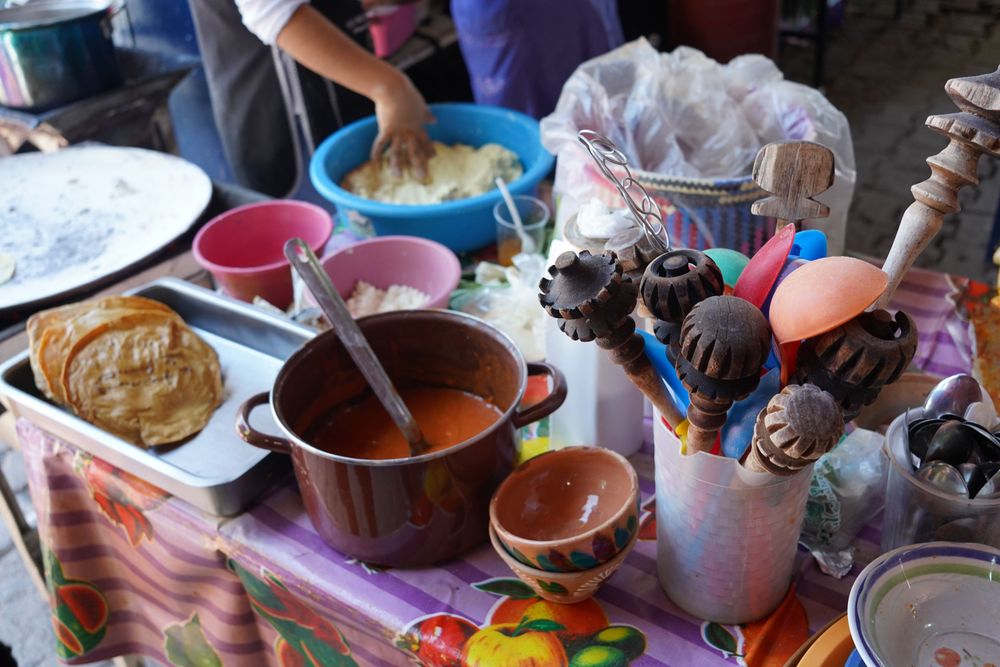
On that first circuit, look at what is being prepared and how meals are ordered. Some counters suit a quick drink and bread; others make more sense for a seated meal. Ask whether the quoted price is per portion, per piece or by weight, and which accompaniments are included. Decide on the main meal before buying several snacks simply because they are the first things you see.
After eating, move into a different part of the market rather than retracing only the food passage. The ingredient and household-goods stalls show a different side of the Sunday gathering. If you want to buy something you noticed earlier, use the stall’s surroundings as a reference: a photograph of a sign or your own map pin can be more reliable than remembering a turn in a dense crowd.
What to eat: choose a meal, then a second stop
An Oaxaca government account of regional markets associates Tlacolula with barbacoa, the grilled meats of the pasillo de humo, chocolate de agua and pan de cazuela. The article dates from 2021; these food associations are useful context, while its dated event announcements and pandemic measures are not current visiting instructions.
Barbacoa is a good starting point if you want the meal to anchor the visit. Ask what the portion contains and how it is served at that stall. A dish name alone does not tell you how much to order for your group or whether extras are included. Share only when the quantity and service make that sensible, rather than assuming every order is designed for several people.
The pasillo de humo offers another direction: the government source specifically names tasajo and chorizo among the meats. Before selecting food, clarify how choosing the meat, having it cooked and sitting down fit together at the counter you are using. Ask about the total order, tortillas and accompaniments before committing. There is no need to prescribe one supposedly definitive stall to enjoy this part of the market.
Chocolate de agua and pan de cazuela offer a separate, less elaborate stop. Confirm the drink you are ordering and ask what is in the bread if ingredients matter to you. This pairing also works for visitors who would rather make the market a morning outing than organise their whole day around a large lunch.
Pulque and mezcal also appear in the government’s account, but tasting is optional. A market visit does not need an alcohol stop to be complete. Keep your meal and shopping plans consistent with whoever is driving and with the return journey you have arranged.
Buying textiles and pottery with better questions
The regional mix is a reason to ask where an object comes from, not a reason to infer the answer from a seller’s clothing or the appearance of the stall. Start with the item: what material is it, how was it made, and who made it? For a textile, distinguish weaving, embroidery and other decoration rather than treating them as interchangeable descriptions.
For pottery or a comal intended for cooking, ask about its intended use, any preparation the maker recommends and how to carry it. Do not assume that every ceramic object sold in a food market has the same finish or cooking properties. If you only want a decorative piece, say so; it changes which questions matter.
Compare before negotiating. Size, fibre, finish and the amount of work can explain differences that are invisible in a hurried glance. Agree on the total before paying, particularly when buying several pieces. Carry cash in manageable denominations and keep purchases together so that browsing does not become an awkward procession of loose bags.
Photographs and the church
A crowded market is not automatic permission to make a close portrait. Ask before photographing a vendor or a person working at a counter, accept a refusal and avoid holding up a transaction. If you want a food photograph, your own order is usually the simplest subject to discuss with the stallholder. Buying something does not create a right to photograph the person selling it.
The tourism authority highlights the Templo de Santa María la Asunción and the Capilla del Señor de Tlacolula. Treat a possible visit as a pause in a place of worship, conditional on access and services that day. Keep food outside, follow posted photography rules and avoid turning the church into a guaranteed timed attraction in your market route. No fixed visiting hours or admission price are assumed here.
Should you add Mitla?
A market-only half day leaves space to return to Oaxaca without racing through lunch. Adding Mitla can make sense for a full day if you want both the market and an archaeological visit, with transport that connects them sensibly. Use our Mitla planning guide to assess the second stop on its own terms.
Protect the market time first, then check the onward journey and current admission arrangements for Mitla. Avoid treating the whole valley as a list to complete in one afternoon. Adding Hierve el Agua, a weaving visit, a mezcal stop and ruins to the same Sunday can leave very little time for the activity that brought you to Tlacolula.
Before leaving the centre, confirm where your return transport departs and keep fragile purchases accessible for the journey. The most successful plan is usually a simple one: understand the Sunday layout, choose a satisfying meal, make a few considered purchases and leave without feeling that the market was merely a stop between other attractions.
Cover photograph: Food preparation counter and wooden whisks at Tlacolula market — Bluerasberry, CC BY-SA 4.0.
Frequently Asked Questions
Is Tlacolula market only open on Sundays?
The town has a permanent market, while the larger Sunday tianguis extends into the main and adjoining streets. Choose Sunday for that expanded regional gathering; do not assume the same stalls and layout on other days.
How long should I allow for the Sunday market?
Roughly two to three hours in the market area is a useful first-visit allowance, with the round trip from Oaxaca taking a half-day slot. Add time for detailed craft shopping or a longer meal. This is planning advice, not an official schedule.
How do I get to Tlacolula from Oaxaca?
Tlacolula is about 38 kilometres away via Federal Highway 190. Confirm current departure and return points for public transport, or arrange a driver or excursion that includes a genuine town-centre market stop.
Can I combine Tlacolula market with Mitla?
Yes, as a considered full-day plan with enough market time and confirmed onward transport. Check Mitla’s current visiting arrangements separately and avoid adding several more valley stops automatically.


Keep Exploring
Queen Victoria Market: Plan a Melbourne Food Visit
Choose a market morning, food stops or a guided tasting, with ordinary opening hours, access advice and separate evening-event dates.
Tsukiji Outer Market: Plan a Food Visit
Plan a Tsukiji morning with shop-day checks, meal choices, Uogashi rules and practical shopping advice.
Nishiki Market Kyoto: Plan a Food Visit
Plan a focused Nishiki Market visit with named food specialists, shop hours, eating etiquette and a manageable route through central Kyoto.