
Prague to Vienna by Train: 2026 Times, Fares & Tips
Everything about the Prague–Vienna train in 2026: journey time, ČD/ÖBB Railjet vs RegioJet fares from €15, rail pass rules, station guides and a Brno stopover.
The train from Prague to Vienna is one of Central Europe's easiest wins: roughly 400 km through the Bohemian-Moravian highlands and the Weinviertel vineyards, city centre to city centre in about 4 hours, with advance fares from around €15. Better still, this is one of the few corridors in Europe where a private operator genuinely competes with the state railways — which keeps prices honest and gives you a real choice of comfort levels. Here is exactly how the route works in 2026, which operator to pick, and how not to overpay.
Fast Facts
| Detail | Info |
|---|---|
| Best time to go | April–June and September–October for mild weather and lighter crowds; December for the Christmas markets in both capitals (book trains 2–3 months ahead for Advent weekends) |
| Getting there | Direct train Praha hlavní nádraží → Wien Hauptbahnhof, ~4h, every 2 hours (ČD/ÖBB Railjet) plus 4 daily RegioJet departures; advance fares from ~€15 (checked July 2026) |
| Where to stay | Prague: Nové Město near the station (€80–€150/night) or leafy Vinohrady (€70–€130); Vienna: Wieden/Karlsplatz (€100–€180) or the Innere Stadt (€150–€300) |
| Average daily budget | Prague €80–€140/day mid-range; Vienna €110–€180/day — Vienna runs roughly 30% pricier for food and hotels |
| Don't miss | The Weinviertel vineyard scenery in the last 45 minutes before Vienna; a Brno stopover (Villa Tugendhat needs booking weeks ahead); Railjet business class from €44.90 if you catch the lowest tier |
The route: what actually happens between Prague and Vienna
All direct trains run the same way: south-east from Praha hlavní nádraží through Pardubice or Havlíčkův Brod territory to Brno, Czechia's second city, then across the border at Břeclav and down through Lower Austria's wine country into Wien Hauptbahnhof. The full run is roughly 400 km and takes just over 4 hours on the fastest services — typically 3h55 to 4h10 depending on the departure.
Two practical consequences follow from that routing. First, Brno makes an effortless stopover — more on that below. Second, because both Czechia and Austria are in the Schengen area, there are no passport controls on board or at the border. The train rolls through Břeclav and the only way you notice you have changed country is that the conductor's announcements switch language and the phone signal changes network.
Seat comfort aside, the scenery is quietly enjoyable rather than spectacular: rolling Bohemian farmland, the Moravian hills around Brno, then — the best stretch — the vineyards and cellar lanes of the Weinviertel in the final 45 minutes before Vienna. Sit on the left side heading south for the better light in the afternoon.
Timing your trip is straightforward because the service pattern barely changes across the year. Frequencies hold steady in winter, and the trains are well heated and air-conditioned, so the real seasonal variable is demand: Advent weekends (late November to 23 December) and the Easter period are when the cheapest fare tiers vanish first, while a random Tuesday in March will still have €15 seats a few days out. If your dates fall in the Christmas-market season, treat this route like a budget flight and book the moment schedules open.
Operators compared: ČD/ÖBB Railjet vs RegioJet
This corridor has two genuinely different products, and picking the right one matters more than on most European routes.
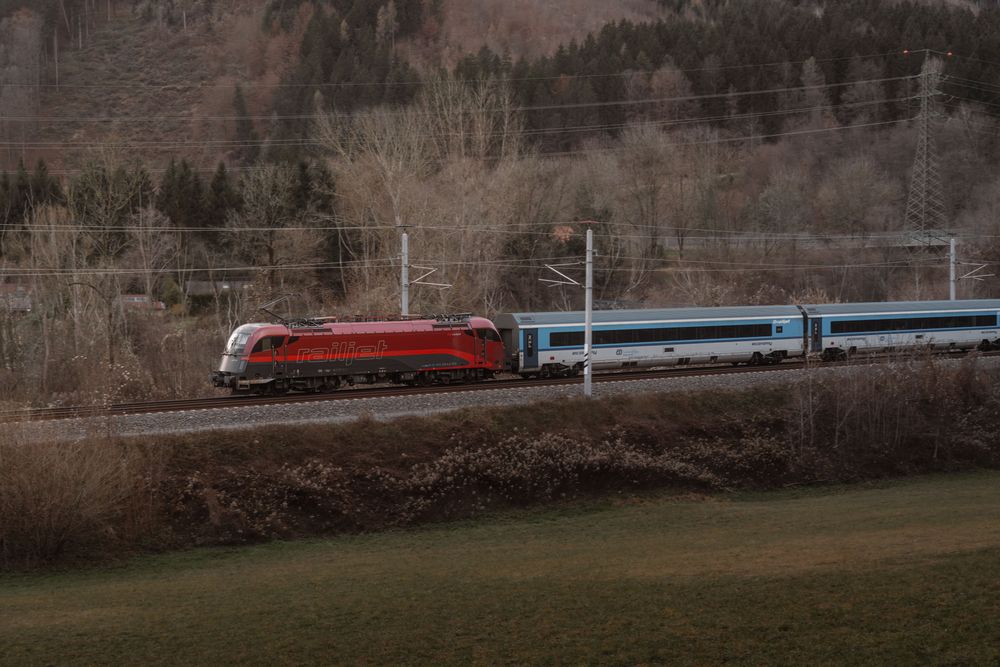
The Railjet is run jointly by České dráhy (ČD) and Austrian Federal Railways (ÖBB). Trains leave every two hours through the day — from Prague at 37 minutes past even-numbered hours (06:37, 08:37 and so on, with the last useful departure at 18:37), and from Vienna at 10 minutes past odd-numbered hours from 05:10 to 19:10. Many continue beyond Vienna towards Graz, so the same seat can carry you deep into Austria. Railjets carry three classes: economy, first, and a small business section with wide leather armchairs; there is a proper restaurant car serving Czech and Austrian dishes with beer on tap.
RegioJet is the Czech private operator that shook up this market. It runs four daily departures each way — from Prague at 06:01, 09:01, 13:01 and 16:01; from Vienna at 06:39, 10:39, 14:39 and 17:36 (checked July 2026) — with a four-tier class system that undercuts the incumbents: Low Cost, Standard, Relax and Business. Even the cheap seats are air-conditioned with a free bottle of water; from Standard upwards you get complimentary Illy coffee served at your seat, and Business buys you a quiet leather-seat compartment for only a few euros more. Crucially, RegioJet's pricing stays relatively flat as departure day approaches, which makes it the default choice for last-minute bookings.
| ČD/ÖBB Railjet | RegioJet | |
|---|---|---|
| Frequency | Every 2 hours (7–8 daily each way) | 4 daily each way |
| Journey time | ~4h | ~4h |
| Advance fares (checked July 2026) | From €14.90 2nd class / €29.90 1st / €44.90 business | From €14.90 Low Cost / €19.90 Standard / €22.90 Relax / €23.90 Business |
| Last-minute prices | Rise steeply once cheap quotas sell out (walk-up ~€59–€88) | Rise only modestly; often the cheaper same-day option |
| Food | Restaurant car, pay as you go | At-seat service; free Illy coffee from Standard class up |
| Rail passes | Interrail/Eurail valid, reservation optional | Interrail/Eurail valid, reservation compulsory (€1.30–€2.80) |
The honest summary: book three or more weeks ahead and the Railjet's frequency and restaurant car make it the more flexible pick; book late, or want maximum comfort per euro, and RegioJet usually wins.
Tickets and 2026 prices: what you should actually pay
Fares on this route are dynamic on the Railjet side and semi-dynamic on RegioJet, so the spread between a smart booking and a careless one is wide. All figures below were checked in July 2026.
ČD First Minute Europe. Czech Railways sells its advance-purchase ticket, the First Minute Europe fare, from 457 CZK (about €18.50) in 2nd class and 741 CZK (about €30) in 1st class Prague–Vienna. Sales open 180 days before departure, and unusually for a European advance fare it is semi-flexible: you can return it until midnight the day before travel for a €3 service charge. Buy in the ČD e-shop — counter purchases add a 50 CZK fee.
ÖBB Sparschiene. Austria's equivalent advance fare starts at €14.90 in 2nd class (rising through €19.90, €24.90 and upwards as each quota sells), with 1st class from €29.90 and business from €44.90. ÖBB recommends booking up to six months ahead, because each train carries a fixed allocation of cheap tickets that sells from the bottom up. Sparschiene tickets are train-specific and non-refundable, so they suit fixed plans only.
Walk-up fares. Turn up on the day without a booking and a fully flexible ticket runs from roughly €59 (bought through the Czech system) to €88 (through the Austrian one) — the single most expensive way to make this journey. If you find yourself bookingless on the day, check RegioJet first: its Low Cost and Standard tiers often still sell near their base price even hours before departure.
RegioJet fares. From €14.90 in Low Cost, €19.90 in Standard, €22.90 in Relax and €23.90 in Business (checked July 2026). Book at regiojet.com or in the RegioJet app; tickets are issued instantly with a QR code and can be rebooked or cancelled for a small fee up to shortly before departure, which is more generous than any Sparschiene condition.
Children and family savings. All three sellers discount for children — small children travel free and older ones at reduced fares on both ČD/ÖBB and RegioJet, with exact age bands and percentages shown at booking. The practical takeaway: a family of four booking a few weeks out usually crosses the border for less than the fuel-plus-vignette cost of driving, before you even count Vienna's parking prices.
Where to buy. Book Railjet tickets from either operator's own site — the cheapest quotas appear in both systems, though availability at each price point can differ slightly, so it is worth checking cd.cz and oebb.at against each other before paying. Third-party resellers add booking fees for the identical ticket. For a wider primer on how European advance fares, quotas and booking horizons work, see our Europe by train guide.
Using rail passes: Interrail and Eurail on this route
This is one of the more pass-friendly corridors in Europe, with one detail that catches people out.
On the Railjet, Interrail and Eurail passes are valid with no compulsory reservation — you can board any departure, find an unreserved seat and simply show your pass. A seat reservation is optional and worth the few euros on Friday and Sunday afternoons or around public holidays, when unreserved seats get scarce between Brno and Vienna.
On RegioJet, passes are also accepted — it was the first Czech private operator to recognise them — but a seat reservation is compulsory on every train. It costs €1.30 in Low Cost, €2 in Standard and €2.80 in Relax (Business is available to 1st-class pass holders for €1.30), and you book it through RegioJet's Interrail page by selecting the pass-holder ticket type in the journey planner, or at the RegioJet sales points in Praha hlavní nádraží and Wien Hauptbahnhof. Boarding a RegioJet without one risks being treated as ticketless, so do not skip this step.
For pass holders the arithmetic is worth stating plainly: a travel day on a typical Interrail pass costs far more than a €15–€19 advance single on this route. If Prague–Vienna is one of only a few journeys on your trip, point-to-point tickets beat a pass. Passes earn their keep when this leg is one hop in a longer chain — say Berlin–Prague–Vienna–Budapest inside a week.
Station guide: Praha hlavní nádraží and Wien Hauptbahnhof
Praha hlavní nádraží (Prague main station, usually abbreviated "Praha hl.n.") sits on the eastern edge of the New Town, a 10-minute walk from the top of Wenceslas Square. The modern lower concourse holds the ticket machines, supermarkets and left-luggage lockers; one level up, do not miss the restored Art Nouveau dome of the original 1909 Fanta building, one of the most beautiful station interiors in Europe and invisible from the platforms unless you go looking. Metro line C stops directly beneath the station (Hlavní nádraží), one stop from Muzeum where lines A and C cross. Trams 5, 9, 15 and 26 stop outside. Arrive 15–20 minutes before departure: platform announcements typically appear about 10 minutes out, and the escalator scrum is real on peak trains.
Wien Hauptbahnhof is Vienna's showpiece through-station, fully opened in 2015, south of the centre in Favoriten. It is compact and legible — you can walk from the U-Bahn to any platform in five minutes. The U1 metro (station: Hauptbahnhof) reaches Stephansplatz in the historic core in about 5 minutes; S-Bahn lines head towards Wien Mitte for the airport train (CAT) or take the S7 from the Hauptbahnhof area directly; trams D and O cover the Ringstrasse side. The station's own shopping level is open long hours, seven days — useful in a country where Sunday shopping barely exists.
One warning for Vienna: some long-distance services in Austria also call at Wien Meidling. For the city centre, stay on until Hauptbahnhof — Meidling is a residential district further out.
The Brno stopover: turning one journey into a two-city break
Every direct train on this route stops at Brno hlavní nádraží, almost exactly at the journey's hinge point — about 2h30 from Prague and 1h30 from Vienna. Czechia's second city gets a fraction of Prague's visitors and rewards even a half-day stop.
The headline sight is Villa Tugendhat, Mies van der Rohe's 1930 functionalist masterpiece and a UNESCO World Heritage Site — but interior tours sell out weeks ahead, so book on the villa's official site the moment your dates firm up. With less planning you can still fill a day well: the Cathedral of St Peter and Paul on Petrov hill (whose bells famously ring noon at 11 a.m., a legend from the 1645 Swedish siege), Špilberk Castle and its casemate prison, the Zelný trh vegetable market, and a bar scene — Brno is a university city of about 380,000 — that locals will tell you beats Prague's for value.
Ticketing a stopover is simple: buy two separate advance tickets (Prague–Brno and Brno–Vienna), which usually costs only a few euros more than a through fare and lets you fix your stopover length. Luggage lockers are available at Brno station. If you are travelling in December, note that Brno's Christmas markets are far less crowded than the famous ones — pair the stop with our Prague Christmas markets guide if you are doing the route in Advent, when trains on festive weekends genuinely fill.
What to skip and the booking mistakes that cost money
Skip the bus unless the price gap is huge. Coaches on this route take 4h30–5h30 with traffic risk, arrive at less central stops, and the train's advance fares are frequently within a euro or two of the coach.
Skip flying entirely. There is no sensible air route for this city pair once you count airport transfers and check-in; the train is faster door to door and emits a fraction of the carbon.
Do not buy a flexible walk-up fare "to be safe." At €59–€88 it costs three to five times the advance price. If you need flexibility, ČD's First Minute fare is refundable until the day before for €3, and RegioJet allows cheap changes — both give you most of the flexibility at a quarter of the price.
Do not assume the last train is late. The final comfortable departure from Prague is 18:37 (Railjet) or 16:01 (RegioJet); from Vienna, 19:10. There is no useful night-train option on this short corridor — if sleeper trains appeal, they make sense on longer hauls like Vienna–Rome or Prague–Zurich, covered in our European night trains guide.
Do not board RegioJet on a rail pass without a reservation, as above — it is compulsory, and it costs less than a coffee to do it right.
Taking a bike? Railjets carry bicycles in dedicated spaces, but they are limited and must be reserved in advance — do it when you buy the ticket, not at the platform.
Frequently Asked Questions
How long does the train from Prague to Vienna take?
Just over 4 hours on direct services — typically 3h55 to 4h10 from Praha hlavní nádraží to Wien Hauptbahnhof, running via Brno. ČD/ÖBB Railjets leave every 2 hours and RegioJet adds 4 daily departures each way.
How much does the Prague to Vienna train cost in 2026?
Advance fares start around €15: ÖBB Sparschiene from €14.90, ČD First Minute Europe from 457 CZK (~€18.50), and RegioJet from €14.90 in Low Cost class (checked July 2026). Walk-up flexible tickets run roughly €59–€88, so booking even a week or two ahead saves serious money.
Do I need my passport for the Prague–Vienna train?
There are no border controls: both Czechia and Austria are in the Schengen area, so the train crosses at Břeclav without passport checks. Carry your passport or EU ID card anyway, as spot identity checks are legally possible and hotels will ask for ID.
Is RegioJet or the Railjet better?
Booked early, they cost about the same (~€15) — the Railjet wins on frequency (every 2 hours) and its restaurant car, while RegioJet wins on last-minute pricing and cheap comfort upgrades (Relax class €22.90, Business €23.90). For same-week bookings, check RegioJet first.
Can I use an Interrail or Eurail pass on this route?
Yes, on both operators. Railjets require no reservation for pass holders (optional, recommended on Friday/Sunday peaks); RegioJet requires a compulsory seat reservation of €1.30–€2.80 depending on class, bookable at regiojet.com.

Keep Exploring
Vienna to Budapest by Train: 2026 Route & Ticket Guide
Hourly Railjets link Vienna and Budapest in about 2h20. 2026 fares from €13, the MÁV booking trick, rail pass rules, station guides and day-trip timings.
London to Amsterdam by Train: Complete Eurostar Guide
The complete guide to the London–Amsterdam Eurostar: 4h19 direct from £39, check-in at St Pancras and Amsterdam Centraal, booking windows, Interrail and alternatives.
Europe by Train: Interrail, Eurail & Country Networks
How to actually travel Europe by train in 2026: Interrail vs Eurail, pass prices, reservation traps, country-by-country operators, night trains, and when point-to-point tickets beat the pass.