
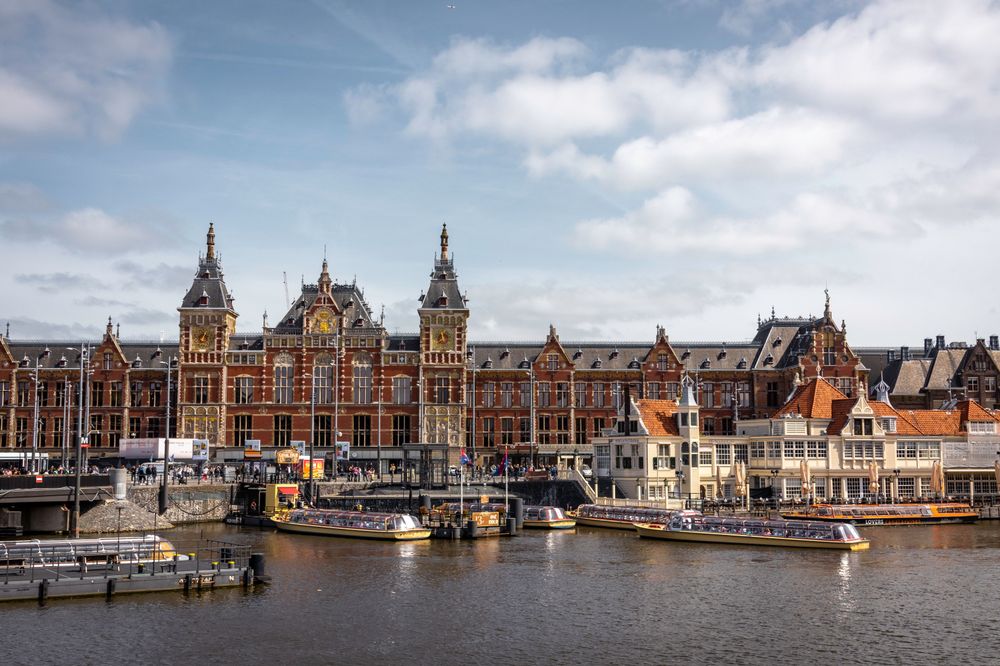
London to Amsterdam by Train: Complete Eurostar Guide
The complete guide to the London–Amsterdam Eurostar: 4h19 direct from £39, check-in at St Pancras and Amsterdam Centraal, booking windows, Interrail and alternatives.
The train from London to Amsterdam has quietly become one of Europe's great short-haul success stories: a direct Eurostar now links St Pancras International and Amsterdam Centraal in 4 hours 19 minutes, city centre to city centre, with fares from £39 one way. There is no airport transfer at either end, no liquid limits at security, and the journey ends a few steps from Amsterdam's canal ring rather than 20 km away at Schiphol. This guide covers the timetable, every ticket class, check-in at both stations, the return leg, and the alternatives worth knowing — from a Brussels stopover to the night train.
Fast Facts
| Detail | Info |
|---|---|
| Journey time | 4 hours 19 minutes direct (Eurostar) |
| Frequency | Up to 4 direct trains daily, with a 5th planned as Eurostar expands the route |
| From-fare | £39 one way in Eurostar Standard (both directions) |
| Stations | London St Pancras International ↔ Amsterdam Centraal (calling at Brussels-Midi/Zuid and Rotterdam Centraal) |
| Best booking window | Sales open 10–11 months ahead; book 2–3+ months out for the £39 fares |
The direct Eurostar route
The direct service runs from London St Pancras International through the Channel Tunnel and across Belgium, calling at Brussels-Midi/Zuid and Rotterdam Centraal before terminating at Amsterdam Centraal. Eurostar's official journey time is 4 hours 19 minutes — comparable, door to door, with flying once you add airport transfers, and without the baggage carousel at the end.
Frequency has grown steadily since the route's relaunch. When Eurostar added a fourth daily departure, the London timetable settled around an early-morning weekday service (06:16), a breakfast-time train (08:16), a late-morning departure (11:04) and an evening one (18:04), according to Eurostar's press announcement. The operator has stated its ambition to run five daily services on the route, so always check the live timetable for your travel date — Saturday frequencies are typically thinner than weekday ones.
On board, all trains are Eurostar's e320/e300 sets with free wi-fi and power sockets at every seat. Three classes are available:
- Eurostar Standard — the £39-from fare. Two pieces of luggage plus a small daypack, and access to the Eurostar Café bar carriage for snacks and drinks.
- Eurostar Plus — a wider seat in a 1+2 layout, the same two-bags allowance, and a light meal served at your seat.
- Eurostar Premier — the top cabin, with access to exclusive station lounges, priority ticket gates and an onboard fine-dining service.
For a four-hour hop, Standard is perfectly comfortable; Plus earns its premium mainly on the morning departures, when the at-seat breakfast replaces a queue at the café bar.
Luggage is one of the train's quiet advantages over flying: Standard and Plus passengers take two pieces of luggage plus a small daypack at no extra charge, with no weight limit beyond being able to lift and carry them yourself — no baggage fees, no 23 kg scales, no waiting at a carousel in Amsterdam. Racks sit at the carriage ends and above the seats, so keep valuables in the daypack beside you. If you can't travel light, that alone can swing the maths against a budget airline fare.
Tickets and prices: classes, booking windows and discounts
Eurostar prices work like airline fares: each departure has a limited allocation of cheap seats, and prices climb as they sell. The headline from £39 one way in Standard is real, but it belongs to off-peak departures booked well in advance — a Friday evening train three weeks out will cost considerably more.
The single most useful fact for bargain hunters is the booking horizon. According to Eurostar's help centre, tickets on trains to or from London can be booked 10 to 11 months in advance — far earlier than the 90–180 days typical of many European operators. Practical rules of thumb:
- Book 2–3 months ahead minimum for a realistic shot at £39–£55 fares on normal dates.
- Book at or near sales opening for school holidays, Christmas (Amsterdam is a hugely popular December city break), King's Day in late April, and Friday/Sunday departures.
- Travel mid-week and off-peak: Tuesday and Wednesday middays are consistently the cheapest departures.
Eurostar also sells discounted child fares and youth fares for younger travellers, plus reduced fares for wheelchair users and their companions — check current age bands and conditions on eurostar.com when booking.
Interrail and Eurail passes are valid on Eurostar, but a compulsory seat reservation applies. For London–Amsterdam the passholder fee is €35 in Standard or €43 in Eurostar Plus, per Interrail's official reservation fee table. Passholder places are subject to availability and are non-refundable, so reserve as soon as your dates firm up — the passholder quota on popular departures disappears long before the train itself sells out. For the wider strategy of pass versus point-to-point tickets, see our Europe by train: Interrail and Eurail guide.
Station guide: St Pancras and Amsterdam Centraal
Check-in at London St Pancras
Eurostar is not a turn-up-and-go railway: you pass ticket gates, airport-style security (though with no airline liquid limits) and two sets of border controls before boarding — UK exit checks and French border police handling Schengen entry, so you step off in the Netherlands with no formalities at all. Eurostar's official check-in guidance asks Standard and Plus passengers to arrive 75 minutes before departure, with ticket gates closing 30 minutes before; Premier passengers can arrive 45 minutes ahead (gates close 15 minutes before). Build in more time on the first trains of the morning and in peak holiday weeks.
A quick word on the EU's new border systems, since this route crosses into Schengen. The Entry/Exit System (EES) — biometric registration replacing passport stamps — began a gradual rollout at Eurostar terminals from 12 October 2025, as noted on Eurostar's station pages; first-time registration adds a few minutes, so respect the recommended arrival times. ETIAS, the separate €20 travel authorisation for visa-free visitors including UK and Irish-resident non-EU citizens, is not yet in force — the EU has removed its late-2026 target date and a launch is now expected later, per the European External Action Service. Nothing extra to buy for this trip as of publication; we'll cover both systems in depth in a dedicated guide.
Your passport matters more than it used to: UK travellers need a full passport that meets Schengen validity rules (broadly, issued within the last 10 years and valid for at least 3 months beyond your return). ID cards are not accepted for UK citizens.
Arriving at (and leaving from) Amsterdam Centraal
Arriving is the easy part: you simply walk off the train into the heart of the city — trams, the metro, the IJ ferries and the canal ring are all immediately outside.
Departing to London is a different story, and it changed for the better in 2025. Eurostar's dedicated UK Terminal at Amsterdam Centraal — opened in February 2025 after station works had forced a pause in direct London-bound trains — sits a 3-minute walk from the main city-side (Centrum-zijde) entrance, and handles the full pre-departure sequence: ticket scan, security screening, then passport control twice — Dutch authorities first, then UK Border Force (Eurostar's Amsterdam Centraal guide). Because everything is done before boarding, you arrive at St Pancras and walk straight out.
Eurostar recommends Standard and Plus passengers arrive 75–90 minutes before departure in Amsterdam (checks close 30 minutes before); Premier passengers 30 minutes (closing 15 minutes before). One genuinely important tip from Eurostar itself: download your ticket to your phone the day before — Amsterdam and Rotterdam use QR-code gates, and a ticket stuck in a crashing app with no signal is a real way to miss a train.
The return leg: Amsterdam to London
The return direction mirrors the outbound: direct trains, the same 4 hours 19 minutes, and the same from £39 lead-in fare, per Eurostar's Amsterdam to London page. Direct Amsterdam–London services resumed in February 2025 with the new terminal — before that, passengers briefly had to change in Brussels for UK border checks — and capacity has since been raised in stages to full trainloads, so the awkward workaround era is over.
Two practical notes. First, complete your Advance Passenger Information (API) online before travel if prompted — Eurostar asks for it on UK-bound journeys. Second, the earlier arrival window (up to 90 minutes) matters more in Amsterdam than in London: the terminal is compact and queues concentrate before each departure. Grab your stroopwafels in the main station hall before going through, as the choice airside is limited.
Alternatives: via Brussels, the night train, and how the plane compares
Via Brussels. Booking your journey as London–Brussels plus a separate Brussels–Amsterdam leg opens up more departures and a free stopover. The connecting hop is quick: Eurostar's (formerly Thalys) Brussels–Amsterdam high-speed service takes 1 hour 52 minutes with fares from £25, per Eurostar's route page. SNCB and NS also run slower, cheaper InterCity trains on the same corridor with no compulsory reservation — useful as a same-day fallback if a connection goes wrong. If you book the legs separately, leave a generous gap in Brussels (90+ minutes) since separate tickets carry no missed-connection protection.
The night train. European Sleeper's Good Night Train links Brussels, Antwerp, Rotterdam and Amsterdam with Berlin (and on towards Dresden and Prague) three nights a week, with fares from €49.99 in a shared compartment. It doesn't serve London directly — you'd connect via Eurostar to Brussels — so it's less an alternative for Amsterdam itself than a smart way to extend the trip deeper into Europe overnight. Our night trains in Europe guide covers routes, cabin classes and booking strategy.
The plane. Flying London–Amsterdam takes about an hour in the air, but the honest comparison is door to door: add the transfer to a London airport, the two-hours-early arrival, and the 15–20 minute train from Schiphol into the city, and the total journey time lands within touching distance of the train's 4h19 — often beyond it. The environmental gap, meanwhile, is not close: Eurostar states that its journeys emit up to 93% less CO2 than an equivalent flight, with one flight's carbon footprint equal to up to 13 Eurostar journeys (Eurostar media centre). Unless a rock-bottom air fare is the deciding factor, the train wins this route on comfort, city-centre convenience and emissions.
Making it a trip: stopovers in Brussels and Rotterdam
Because the direct train calls at Brussels-Midi/Zuid and Rotterdam Centraal, this route doubles as a ready-made two- or three-city itinerary — just book the legs you need as separate tickets.
Brussels deserves more than a platform change: the Grand-Place, the comic-strip murals, and Belgium's beer and frites culture fill an easy 24–48 hours, and Eurostar's Brussels–Amsterdam fares from £25 keep the onward hop cheap. Rotterdam is the Netherlands' architecture capital — the Markthal, the Cube Houses and Europe's largest port — and sits under two hours from London's perspective once you're on the continental leg; from Rotterdam Centraal, Amsterdam is a short intercity ride away.
A workable rhythm for a long weekend: take the morning Eurostar and break the outbound journey in Brussels for one night, continue to Rotterdam the next morning for an afternoon among the towers and the Markthal's food stalls, then finish with two nights in Amsterdam and ride the direct train home. Every leg is on the same corridor, so there is no backtracking, and the two intermediate hops are short enough that no day feels lost to travel.
Timing your trip seasonally? Amsterdam in December pairs the route with festive lights and skating rinks — see our Amsterdam Christmas markets guide — but book December trains as close to the 10–11-month opening as you can, as it's the route's peak leisure season.
Common mistakes to avoid
- Treating it like a domestic train. Arriving 20 minutes before departure works at King's Cross next door; at St Pancras International the gates for your Eurostar close 30 minutes out and Eurostar asks for 75. Missing check-in usually means buying a new ticket.
- Waiting for prices to drop. Eurostar fares almost never get cheaper close to departure. With sales open 10–11 months out, the cheap seats go to the organised.
- Booking a via-Brussels connection as separate tickets with a tight gap. Separate tickets mean no protection if the first train runs late. Either book a through connection or leave 90+ minutes.
- Ignoring passport validity. Post-Brexit Schengen rules (10-year issue limit, 3 months' validity beyond departure) catch out UK travellers with older passports every day.
- Not downloading your ticket before the return. Amsterdam Centraal's gates scan QR codes; do not rely on station wi-fi at 07:00 with a queue behind you.
- Leaving Interrail reservations late. The €35 passholder allocation on London trains is limited and non-refundable once booked — but it sells out well before the train does.
Frequently Asked Questions
How long is the train from London to Amsterdam?
The direct Eurostar takes 4 hours 19 minutes from London St Pancras International to Amsterdam Centraal, calling at Brussels-Midi/Zuid and Rotterdam Centraal. Door to door between city centres, it is usually as fast as — or faster than — flying once airport transfers and security are included.
How much does the London to Amsterdam train cost?
Eurostar Standard fares start at £39 one way in each direction. Prices are demand-based and rise as cheap allocations sell out, so peak Friday, Sunday and holiday departures cost considerably more. Interrail and Eurail passholders pay a €35 seat reservation fee in Standard (€43 in Eurostar Plus).
How far in advance should I book?
Eurostar opens sales 10 to 11 months before travel. For ordinary dates, booking 2–3 months ahead usually secures a low fare; for December, school holidays and weekend departures, book as close to the sales opening as possible.
Is the return from Amsterdam to London also direct?
Yes. Direct Amsterdam–London Eurostar services run from the dedicated UK Terminal at Amsterdam Centraal, opened in February 2025, where Dutch and UK border checks are completed before boarding. Arrive 75–90 minutes before departure in Standard or Plus, and download your ticket the day before, as the gates scan QR codes.
Do I need a visa or ETIAS to take this train?
UK and Irish citizens need no visa for a short visit to the Netherlands. UK travellers need a full passport meeting Schengen validity rules; the EU's biometric Entry/Exit System (EES) has been rolling out at Eurostar terminals since 12 October 2025, while ETIAS is not yet in force and its launch date has been pushed back.

Keep Exploring

Vienna to Budapest by Train: 2026 Route & Ticket Guide
Hourly Railjets link Vienna and Budapest in about 2h20. 2026 fares from €13, the MÁV booking trick, rail pass rules, station guides and day-trip timings.
Prague to Vienna by Train: 2026 Times, Fares & Tips
Everything about the Prague–Vienna train in 2026: journey time, ČD/ÖBB Railjet vs RegioJet fares from €15, rail pass rules, station guides and a Brno stopover.

Europe by Train: Interrail, Eurail & Country Networks
How to actually travel Europe by train in 2026: Interrail vs Eurail, pass prices, reservation traps, country-by-country operators, night trains, and when point-to-point tickets beat the pass.