
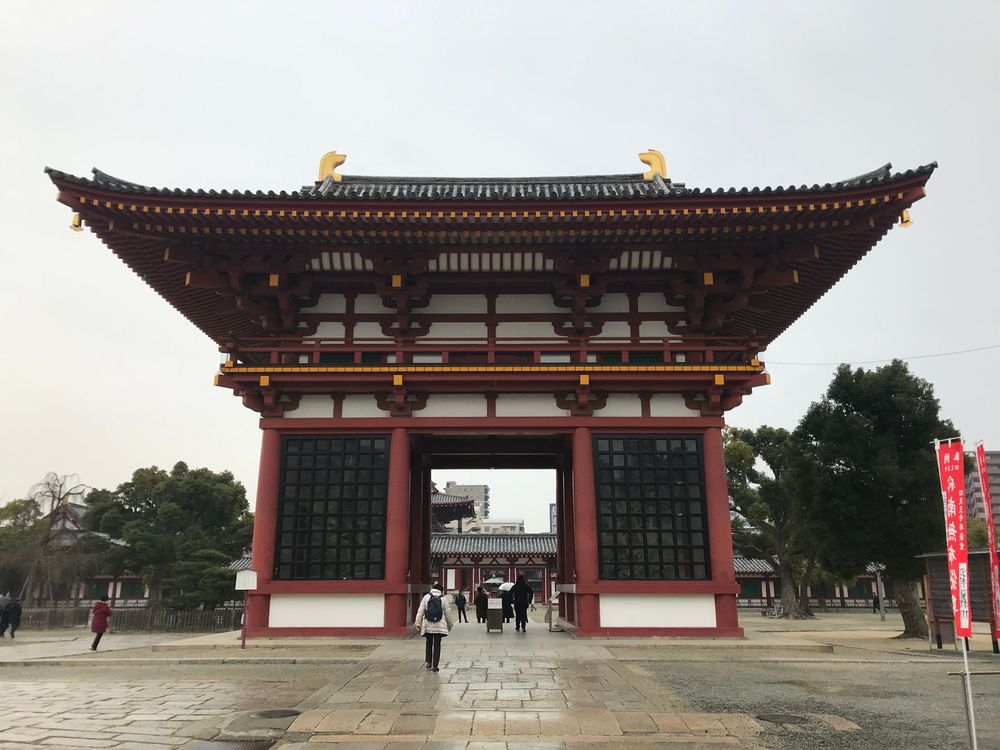
Shitennoji Osaka: Temple, Garden and Admission
Plan Shitennoji in Osaka: free grounds, central precinct tickets, separate garden and museum access, hours and transport.
Choose Shitennoji for a focused Buddhist temple visit in Osaka, and decide separately whether to enter the central precinct, the garden and the Treasure Hall. The wider grounds are free to visit, but that does not make every interior free or continuously open. A good first visit gives the temple's architecture and continuing religious life time before adding another attraction.
Shitennoji fits into the Osaka portion of our 14-day Japan itinerary as an alternative cultural outing, not an extra that must be squeezed into a full schedule. This guide explains the admission choices, seasonal hours and the difference between the temple's ancient foundation and the buildings seen today.
Fast facts: choose the visit before the ticket
| Detail | Planning information |
|---|---|
| Address | 1-11-18 Shitennoji, Tennoji-ku, Osaka |
| Closest documented metro approach | Shitennoji-mae Yuhigaoka, Tanimachi Line; about five minutes on foot |
| Alternative approach | Tennoji Station; about 12 minutes on foot according to the temple |
| Ordinary central-precinct hours | April–September 08:30–16:30; October–March 08:30–16:00 |
| Standard adult central precinct | ¥500 |
| Standard adult garden | ¥300, with its own opening calendar |
| Standard adult Treasure Hall | ¥500, during announced exhibitions |
| Suggested allowance | 60–90 minutes for grounds and central precinct; add time for optional sections |
Prices and the ordinary central-precinct timetable come from the official admission page, checked on 26 November 2026. The garden and Treasure Hall require separate date checks. Our time allowance is an editorial planning suggestion, excluding the journey, queues and a meal.
Understand the three admission decisions
Begin by asking what you want to experience. A free walk around the accessible outer grounds introduces the setting and the relationship between halls, gates and daily worship. Paying for the central precinct brings you into the architectural core around the pagoda and main halls. The garden is a different choice, suited to someone who wants additional landscape time rather than another interior.
The Treasure Hall adds objects and exhibition interpretation when it is open. Do not buy or budget for it solely because a map marks a museum building. The temple FAQ identifies these three paid areas separately; it does not describe one universal ticket covering everything in the precinct.
At the listed standard adult rates, central precinct plus garden would total ¥800, or ¥1,300 if all three paid visits are available and chosen. These are simple sums of separate advertised admissions, not a combined-ticket offer. Check student, child and disability-related conditions for your actual party instead of multiplying the adult total automatically.
Arrive from Yuhigaoka or Tennoji
The official access information gives approximately five minutes southwards on foot from Shitennoji-mae Yuhigaoka Station on the Tanimachi Line. It lists around 12 minutes northwards from Tennoji Station, served by JR and Osaka Metro, and about 14 minutes from Kintetsu's Osaka-Abenobashi area.
Choose the approach that fits the rest of your day. Tennoji can be convenient if you are already using its transport hub or planning a meal nearby; Yuhigaoka reduces the documented final walk. The quoted minutes are not door-to-door travel times. Allow for finding the exit, road crossings and locating the entrance you intend to use.
For someone who needs a step-free route, check the station exit and the temple approach together. A station with a lift does not establish that every path, threshold or interior is accessible. Save the address and the Japanese name 四天王寺 before leaving, especially if you may return by a different station after exploring the grounds.
Read the temple's age correctly
The temple's history places its foundation in 593, associated with Prince Shotoku. That gives the institution an exceptionally long history, but does not mean the present pagoda and central buildings have stood unchanged since the sixth century. Fires, storms and war repeatedly affected the site.
The temple describes severe damage in the 1934 typhoon and the 1945 air raids, followed by rebuilding of the central ensemble completed by 1963. Visit with that distinction in mind: an ancient religious foundation and a reconstructed architectural arrangement can both be significant. Reconstruction is part of the site's story rather than a detail that should be hidden.
This is particularly useful if your Japan trip already includes several temples. Instead of comparing only the age of visible timber, consider how layout, ritual and memory continue through rebuilding. The question becomes what the arrangement allows you to understand about Buddhist architecture and worship, rather than whether every surface is original to the first foundation.
Give the central precinct a clear focus
The historical account explains the south-to-north alignment of the middle gate, five-storey pagoda, main hall and lecture hall, enclosed by corridors. Look at the relationship between these structures before moving into details. The plan is one of the most useful things to understand here; it gives the buildings a coherent setting rather than leaving them as isolated photo subjects.
Walk slowly enough to notice how your view changes along the axis and from the surrounding corridors. Choose one building to examine more carefully instead of rushing around the entire enclosure twice. Where an interior is open, follow the instructions for shoes, photography and movement. A ticket grants access under those conditions, not unrestricted use of every space.
The official pagoda description identifies the north side as its usual entrance and explains its religious images. Check current access on arrival, particularly if climbing or reaching an upper level is important to you. A special opening announced for a festival date should not be treated as a daily guarantee.
Make the garden optional until its calendar is clear
The garden is called Gokuraku-jodo no Niwa, often rendered as the Garden of the Pure Land. Choose it if a quieter landscape section would add something to your visit. It is not necessary to pay for every area to understand the temple, and a garden visit deserves attention rather than being a hurried extra after the halls.
Opening details need care. The general admission table groups halls, central precinct and garden together, but the separately linked garden schedule shows its own hours and closure periods. The garden image available during this check was undated and could not establish an unambiguous calendar for every future visit date. Confirm directly if the garden is your main reason for travelling.
Keep enough flexibility to enjoy the temple even if the garden is unavailable. A route that depends on seeing both before an early closing can be fragile. If you add the garden, decide beforehand which later activity can shorten; otherwise a peaceful space becomes another place to hurry through while watching the time.
Check the Treasure Hall exhibition, not just the building
At the time of checking, the admission page advertised a New Year exhibition from 1 January to 7 February 2027. That is a specific forthcoming exhibition period, not evidence that the museum is open every day in late November or December. Use the current exhibition notice for your date and confirm any admission cutoff or special opening hours attached to it.
An exhibition is the stronger addition if you want to examine religious objects and the stories behind them. It is less useful if everyone is already tired of reading and would prefer a meal. Give the displays their own time instead of buying admission simply because you are already nearby or because a guide suggests that a visit must be complete.
Do not assume that every treasure illustrated on the temple website is currently on view. Exhibition rotations can limit individual objects to part of a run. If a particular piece matters to you, check its display dates before arranging the journey around it. Otherwise, approach the current selection with an open question rather than a fixed photographic checklist.
Decide whether a monthly festival day suits you
The temple's monthly events page explains religious observances on the 21st and 22nd. The admission information says the central precinct is free on those monthly observance days and during the spring and autumn equinoctial observances. That exception applies to the central precinct; it should not become a claim that all paid areas are free.
Choose such a date because the religious activity and market atmosphere interest you, not just to save the ordinary central admission. More visitors and stalls change how the grounds feel and how easily you can move through them. A quieter ordinary day may be better for studying the architectural arrangement and taking an unhurried walk.
Check the relevant month's programme before travelling. A recurring date does not guarantee a particular stall, ceremony location or special interior on every occasion. Keep passages clear, do not interrupt worship and ask before photographing people. The temple is a working religious place even when visitors are browsing stalls around it.
Keep access and etiquette practical
Plan for walking outdoors between buildings. In wet weather, take extra care at changes of surface and avoid making the entire outing depend on an exposed circuit. In summer, a shorter visit with breaks may be more enjoyable; in winter, the earlier ordinary closing time makes a daytime arrival especially useful.
Contact the temple for exact mobility needs, including thresholds, interior access and any route involving the pagoda. A free outer walk can still be worthwhile if some paid interiors are unsuitable. With children, explain before entering that ceremonies and memorial observances involve real people, and that quiet behaviour matters even when the architecture invites curiosity.
Follow on-site photography signs rather than inferring permission from online images. Keep cameras away from private ceremonies unless expressly allowed, and avoid blocking the entrance to a hall while checking photographs. A respectful visit usually requires simple adjustments: wait, move aside, lower your voice and let worshippers use the space for its primary purpose.
Fit Shitennoji into one manageable Osaka day
Grounds and central precinct followed by a meal around Tennoji can be a complete cultural outing. Add the garden or museum only if it is open and genuinely interesting to your group. You do not need to combine all three paid areas with another major attraction to justify the journey.
If your interest is more in fortifications and a historical museum, compare our Osaka Castle guide before choosing the day's anchor. The two sites answer different questions, and travelling between them consumes time that a map of Osaka can make easy to overlook.
Before leaving, verify the ordinary or special-date hours, the exact paid areas you want and the return journey. Then give Shitennoji a clear focus: architecture, a current exhibition or the experience of an active temple. That is more rewarding than treating its foundation date and pagoda as two facts to collect before rushing elsewhere.
Cover photograph: West gate of Shitennoji Temple in Osaka in 2019 — Archive photograph 2019 — そらみみ, CC BY-SA 4.0.
Frequently Asked Questions
Is Shitennoji free to visit?
The outer grounds and other accessible halls are generally free, while the central precinct, garden and Treasure Hall have separate admissions. Standard adult prices checked on 26 November 2026 were ¥500, ¥300 and ¥500 respectively.
Are the temple buildings open 24 hours?
No. The temple distinguishes round-the-clock worship from outside the halls from daytime interior and paid-area access. Ordinary central hours are 08:30–16:30 April–September and 08:30–16:00 October–March, with special-date exceptions.
Which station is closest?
The temple lists about five minutes on foot from Shitennoji-mae Yuhigaoka on the Tanimachi Line. Tennoji is another useful approach, listed at about 12 minutes on foot.
Does the founding date of 593 describe today's buildings?
No. It refers to the temple's foundation. The central ensemble was rebuilt after major storm and wartime damage; the temple dates completion of that post-war rebuilding to 1963.
Can I assume the garden and Treasure Hall are open?
No. Confirm the garden's specific calendar and the Treasure Hall's exhibition period. The notice checked advertised 1 January–7 February 2027 for a forthcoming exhibition, not continuous access outside those dates.


Keep Exploring
Hasedera Kamakura: Temple, Garden and Coastal Views
Plan Hasedera in Kamakura: admission, stairs, gardens, coastal views and the confirmed 2026 autumn evening opening.
Ryoan-ji Kyoto: Rock Garden and Temple Visit
Plan Ryoan-ji’s rock garden and pond walk, with current admission, winter hours and the separate autumn 2026 evening programme.
Todaiji Nara: Great Buddha Hall and Temple Grounds
Choose Todaiji’s Great Buddha Hall, museum or Nigatsudo hillside, with separate tickets, seasonal hours and the December 2026 museum closure.