
Hasedera Kamakura: Temple, Garden and Coastal Views
Plan Hasedera in Kamakura: admission, stairs, gardens, coastal views and the confirmed 2026 autumn evening opening.
Hasedera combines three experiences in a compact but steep site: a Buddhist temple centred on a monumental Kannon image, gardens that change with the seasons, and an elevated view towards Kamakura's coast. Choose it when you want time inside one temple complex rather than another hurried stop on a day-trip checklist. The stairs matter as much to your planning as the admission price.
This is Hasedera in Kamakura, at 3-11-2 Hase, not the temple of the same name in Nara Prefecture. If you are coming from Tokyo, use our Kamakura day-trip guide for the wider journey. Here the focus is the temple itself: the lower garden, upper halls, coastal viewpoint and the choices that affect your visit.
Admission and the opening window
The temple's official visitor information lists admission at ¥400 for adults and ¥200 for children aged 6–11. From July through March, the grounds open at 08:00 and close at 17:00, with last admission at 16:30. From April through June, closing moves to 17:30 and last admission to 17:00. Check for special notices before travelling; an evening event is an exception to the normal timetable.
These are temple admission prices. Do not assume that a museum visit or a special seasonal area is included simply because it is within the same complex. The temple's current information lists the Kannon Museum separately at ¥300 for adults and ¥150 for children. Check its own opening arrangements if the collection is central to your plans.
| Choice | What you gain | What to allow for |
|---|---|---|
| Main temple and gardens | Kannon hall, lower garden and coastal outlook | Admission and a substantial stair climb |
| Add the Kannon Museum | More time with the temple's religious art | Separate admission and its own availability |
| Visit for hydrangeas | A seasonal garden focus | Flower timing, crowd management and current notices |
| Visit during autumn evening opening | Illuminated grounds after daylight fades | Event dates, weather and a later return journey |
As a planning estimate, allow 60–90 minutes for the main grounds, longer if you want the museum, a meal or a slow garden visit. This is not an official tour duration. A late arrival shortly before last admission leaves little room to pause on the climb or wait respectfully near worshippers.
Getting to the right Hase station
From Kamakura, the Enoden railway serves Hase station. The operator's Hase station page places Hasedera about five minutes away on foot. Use the temple name and address in your map rather than assuming that every visitor leaving the station is heading there: Kotoku-in and its Great Buddha are another destination in the same district.
The short station-to-temple walk does not make the whole visit step-free. Enoden lists wheelchair ramps and a multipurpose toilet at Hase, but gives a specific instruction for wheelchair and stroller users arriving on a Fujisawa-bound train: tell staff at your boarding station because a temporary slope is needed at the exit. Arrange assistance for your actual direction of travel instead of relying on a general station accessibility symbol.
At street level, take your time on the approach and keep clear of shops and other pedestrians when checking directions. Hase is a neighbourhood as well as a sightseeing district. If you are carrying large luggage, solve that before the temple visit; narrow paths and stairs are not a good setting for moving a suitcase.
Start with the lower garden
The entrance's red lantern is an easy visual marker, but the lower garden deserves more than a quick pass on the way upstairs. Pause here to understand the site's layout and decide how much climbing suits your group. There is no need to tackle every corner in one continuous circuit.
The temple's guide to its halls and grounds identifies Benten-do, associated with Benzaiten, and the Benten-kutsu cave, with figures carved into the rock. Treat the cave as an optional, confined part of the visit: assess the entrance and current signs before going inside, particularly if bending, dim spaces or restricted movement are difficult for you. Skipping it does not mean missing the main Kannon hall.
Take extra care with children around water, steps and other visitors. A garden pause is useful before the upper climb, but this is still a working religious site. Keep voices low near prayer areas and do not turn small statues or temple furnishings into things to touch or climb.
The climb and the Kannon hall
The upper grounds are reached by stairs. Build your pace around the slowest person in the group, and step aside where there is space if you need to stop. A visit that looks compact on a map can feel quite different when the route rises through several levels.
The Jizo-do area is on the ascent. Let its devotional setting determine your behaviour: give worshippers room and read local photography notices rather than assuming every statue is an unrestricted photo subject. The purpose of the climb is not merely to reach the viewpoint; the halls and their approaches are the centre of the visit.
Hasedera's principal image is an eleven-headed Kannon, which the temple describes as 9.18 metres tall. Its foundation story connects two images carved from one tree and a figure reaching Kamakura by sea. Present that story to children or travel companions as temple tradition, rather than as a documented account of every event. The distinction preserves the meaning of the story without confusing legend with independently established history.
At Kannon-do, follow the signs and staff guidance about worship and photography. You can observe quietly without taking part in a ritual. Do not photograph an interior merely because photography was allowed in the garden; each space may have different rules.
Coast, museum or a longer pause?
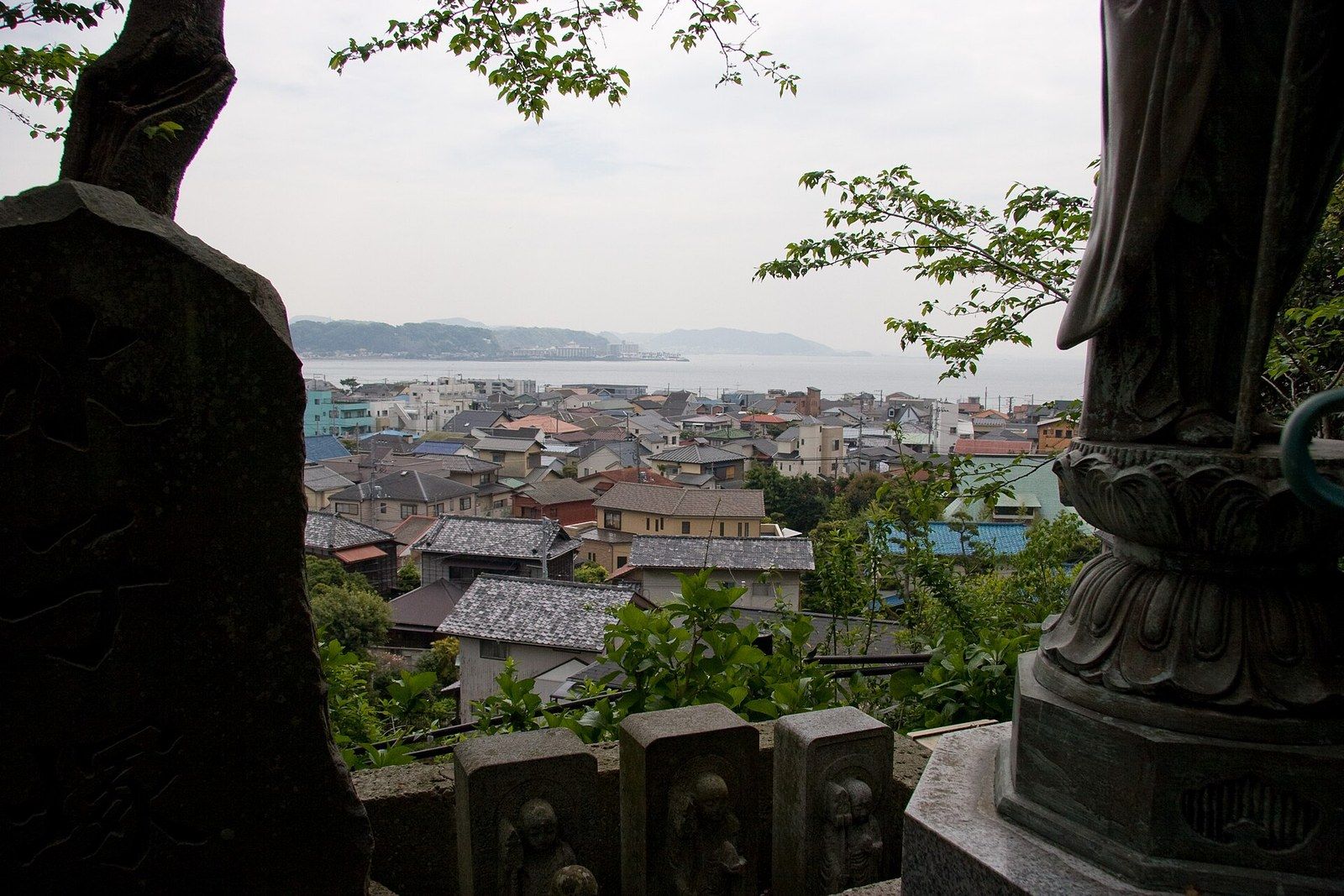
The upper observation area is one of Hasedera's strongest reasons to linger. It gives a view over the roofs towards the sea, making the relationship between the hillside temple and coastal town easy to understand. Visibility depends on the weather. A grey day can still suit the temple and gardens, but do not make a distant view the only reason for paying admission.
Decide here whether to add another part of the complex or simply sit for a while. The Kannon Museum is a separate choice for visitors interested in religious art; check opening arrangements and the additional fee before planning around it. The temple also lists Kaikoan as a place to eat, but treat dining as dependent on its own operating hours and availability, not as a guaranteed seat at the end of your walk.
If the afternoon already includes the Great Buddha, protect some energy for that second stop. Hasedera and Kotoku-in offer different experiences: one has gardens, multiple devotional spaces and a coastal outlook; the other is a separate temple with its own admission arrangements. You do not need to rush through Hasedera to prove that you have “done” Hase.
Gardens: choose a season, not a guaranteed bloom
The temple's garden information describes its seasonal planting. Hydrangeas are a particular draw around June, but flowering is not a fixed appointment. Check the temple's current flower reports and entry arrangements close to the date; neither a photograph from a previous year nor a generic June itinerary proves what will be open or in bloom on your day.
The hydrangea route is an additional hillside experience, not a way to avoid climbing. Busy seasonal periods can also change the pace of a visit. Leave space in the day rather than attaching a tightly timed lunch or another reservation immediately afterwards. This guide does not quote a future hydrangea surcharge because the relevant season's arrangements should be checked when announced.
At other times, let the actual garden determine your route. Winter visits can emphasise the halls and coastal view; autumn visits may add colour, but foliage timing varies. The temple remains worth considering when your travel dates do not match a famous flowering peak.
The confirmed autumn evening dates for 2026
For late-autumn travel, Hasedera has announced special evening admission from 21 November to 6 December 2026. The notice gives evening viewing from sunset, entry until 19:00 and closure of the grounds at 19:30. Admission is ¥400 for adults and ¥200 for elementary-school children.
The event operates in rain but may be cancelled because of severe weather or other conditions. Tripods and monopods are prohibited. Do not treat a possible extension mentioned in the notice as a confirmed later date: beyond 6 December, check for a new announcement.
Choose daylight if the coastline and easier visual orientation on the stairs matter most. Choose the evening for the illuminated setting, with a clear return route and enough time to descend carefully. A lighting event does not turn a hillside temple into a flat route. Check the official notice again on your intended day.
Fit Hasedera into a realistic trip
Hasedera works best as an anchor for the Hase side of Kamakura. If your priorities lie instead around other parts of town, use the wider day-trip guide to make the trade-off rather than crossing back and forth solely to collect sights. For a longer journey, our two-week Japan itinerary helps decide whether Kamakura belongs in the Tokyo part of the trip.
Before leaving, check three things: the temple's current notice, the weather and the return journey. Wear shoes that feel secure on stairs and keep a hand free where possible. If mobility is the deciding issue, contact the temple about the exact areas you hope to reach. Do not assume that an accessible railway station guarantees access to the upper halls.
Cover photograph: View from Hasedera over Kamakura rooftops towards the coast — Archive photograph Resized for publication. — KimonBerlin, CC BY-SA 2.0.
Frequently Asked Questions
How much does Hasedera in Kamakura cost?
Standard temple admission is ¥400 for adults and ¥200 for children aged 6–11. The Kannon Museum is separate, listed at ¥300 for adults and ¥150 for children. Check current seasonal notices for additional arrangements.
Is Hasedera accessible without stairs?
The main upper grounds involve stairs. Check your exact route with the temple if mobility is a concern; Hase station's access facilities do not guarantee access to every temple area.
When is the 2026 autumn evening opening?
The announced dates are 21 November–6 December 2026, from sunset, with entry until 19:00 and grounds closing at 19:30. Severe weather may cause cancellation; tripods and monopods are prohibited.
Can I combine Hasedera with the Great Buddha?
Yes, both are in the Hase district, but they are separate temple visits. Allow around 60–90 minutes for Hasedera as a planning estimate, then add the journey, admission and time for Kotoku-in.


Keep Exploring
Ryoan-ji Kyoto: Rock Garden and Temple Visit
Plan Ryoan-ji’s rock garden and pond walk, with current admission, winter hours and the separate autumn 2026 evening programme.
Rippon Lea Estate: Melbourne House and Garden Visit
Plan Rippon Lea Estate: garden admission versus mansion tours, seasonal hours, access limits, picnics and the journey from Melbourne.
Heian Shrine Kyoto: Courtyard, Garden and Current Works
Visit Heian Shrine and Shin’en in Kyoto: garden hours, admission, subway access and the November 2026 building-work notice.