
Heian Shrine Kyoto: Courtyard, Garden and Current Works
Visit Heian Shrine and Shin’en in Kyoto: garden hours, admission, subway access and the November 2026 building-work notice.
Heian Shrine makes most sense as two related visits: the broad, colourful shrine precinct and the quieter Shin'en garden behind it. Choose the courtyard for a short architectural stop; add the garden when you want ponds, changing viewpoints and enough time to slow down. The giant torii on the approach is a landmark, but reaching it is not the same as visiting either part.
There is an important current qualification. A shrine notice dated 6 November 2026 reports seismic reinforcement and repainting work on the shrine buildings. It does not give a completion date or a detailed visitor diversion in the text checked on 19 November. Expect the appearance or route to differ from older photographs; check the notice before making an unobstructed architectural view the main purpose of your journey.
Fast facts for the two-part visit
| Decision | Practical answer |
|---|---|
| Where | Okazaki, eastern Kyoto; 97 Okazaki Nishitenno-cho |
| Main precinct | Ordinary access is free; ceremonies and works can affect movement |
| Shin'en garden | Published admission ¥600 adult, ¥300 child |
| Garden in November–February | 08:30–17:00; last entry 16:30 |
| Arrival | Higashiyama station on the Tozai subway line, then approximately 10 minutes on foot |
| Time to allow | About 30–45 minutes for the precinct or 90–120 minutes including the garden; editorial estimates |
| Current caution | Building reinforcement and repainting announced in November 2026 |
Prices are published yen amounts, not converted euro quotations. Transport, food and any special event are separate. For the wider choice between Kyoto's districts and cultural sights, use our guide to things to do in Kyoto; this page concentrates on whether Heian's garden belongs in your visit.
What kind of shrine are you looking at?
Heian Jingu is a Shinto shrine, not a Buddhist temple and not the surviving imperial palace of the Heian period. The Kyoto tourism board dates its foundation to 1895, commemorating 1,100 years since the establishment of Heian-kyo. Its buildings recall the earlier palace, while the gardens belong to the Meiji tradition. That distinction makes the visit more interesting: this is also a statement about how modern Kyoto chose to remember its imperial past.
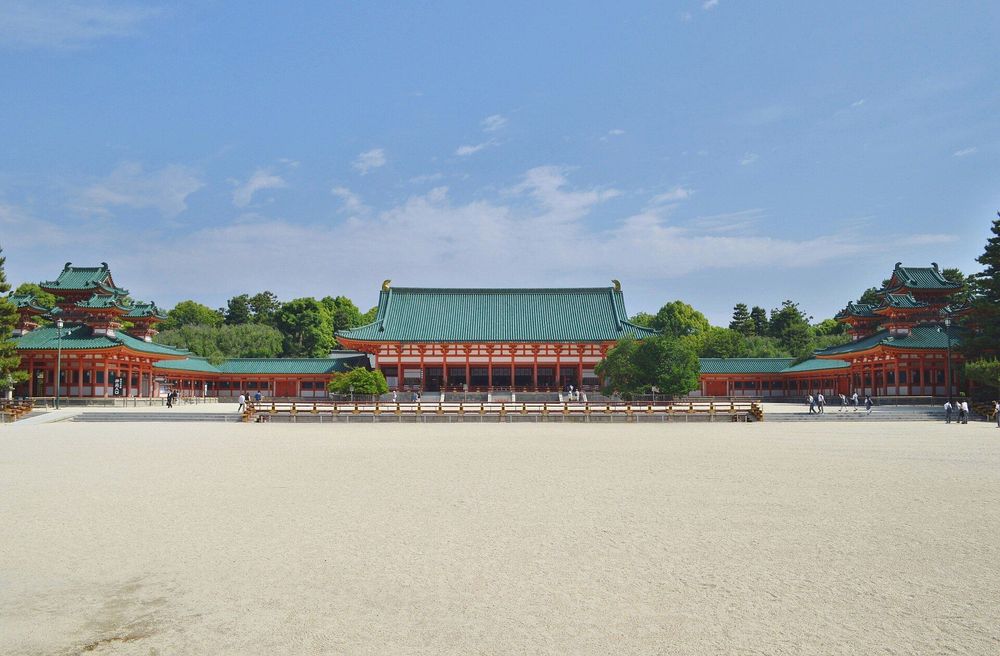
Start by taking in the relationship between the gate, the open courtyard and the central hall. The spaces are part of the composition. Walking directly to the centre for one photograph can make the precinct seem simpler than it is; looking back from a permitted side position helps explain how the buildings frame the approach. Avoid assuming that every door or veranda belongs to the public route.
The current works make this approach especially useful. If a facade is screened, the visit may still offer the overall layout, worship and the garden, subject to conditions on the day. But if a clean architectural photograph is your only reason for coming, consult the latest notice and decide whether another date would serve you better. The archive cover shows the shrine in 2016 and does not document November 2026 conditions.
Decide whether to pay for Shin'en
The garden is the stronger choice when you enjoy landscape design rather than collecting another famous gate. Its sequence of water, planting, paths and views rewards a different pace from the courtyard. You do not need to identify every plant to enjoy it: compare where the route opens, where it narrows and how reflections change the shape of a building or tree.
The shrine's garden guide describes four garden areas around the buildings. It identifies pond scenery, the Taihei-kaku covered bridge and the stepping stones known as Garyukyo among the features. Treat these as points of attention, not a checklist that requires crossing every possible surface. Wet stones and narrow viewpoints are good reasons to pause or choose another view.
A useful decision is to ask what you would otherwise do with the next hour. If the alternative is another rushed transfer, staying for the garden can give the day a clearer centre. If you are already tired of gardens, the free precinct may be sufficient. Paying does not oblige you to complete a particular photographic route, and skipping the garden does not make the shrine visit incomplete.
Allow about 60–75 minutes for attentive garden viewing within the broader 90–120 minute visit estimate. These are planning suggestions, not official tour lengths. Families, photographers and visitors who rest frequently may need longer; a late entry leaves less room to adjust.
Read the seasonal timetable correctly
The published garden schedule changes by season. The official page lists 08:30–18:00 from March through September, with entry until 17:30; 08:30–17:30 in October, with entry until 17:00; and 08:30–17:00 from November through February, with entry until 16:30. These are garden hours. They should not be copied onto every shrine service, shop or ceremony.
Last admission is a deadline, not a recommended arrival time. In November, entering at 16:25 gives you very little of the slower visit described here. Work backwards from closing and leave space for finding the garden entrance inside the precinct. If you have another fixed booking, decide which visit deserves the unhurried part of the day.
Special openings, festivals and evening events need their own date-specific check. The regular garden ticket should not be assumed to include night illumination or permit a return after closing. Likewise, an annual free-opening tradition is not proof that a future date will follow the same arrangements. Read the current announcement rather than planning around an old social-media caption.
Choose a season for more than one photograph
Spring brings an emphasis on flowering trees; early summer offers other planting interest, while autumn shifts attention to leaves and water. Winter can reveal more of the garden's underlying structure. These are seasonal possibilities, not guaranteed conditions for a particular travel date. Weather, maintenance and the precise timing of growth change what you find.
If blossoms are the main reason for travelling, look for a recent condition update close to your date. A photograph taken at peak bloom gives little guidance about what will remain a week later. In autumn, make the garden visit worthwhile even if colour is patchy: take time with the pond edges, framing and reflections rather than judging the entire outing by a single tree.
Rain changes the practical choice. A light shower may make the garden appealing, but it also makes photography, umbrellas and uneven surfaces slower to manage. The courtyard and garden are not an all-indoor bad-weather alternative. Wear shoes suited to walking outdoors and keep your next appointment flexible enough that you do not rush on wet paths.
Arrive through Okazaki without a complicated transfer
The official Kansai visitor listing gives an approximate 10-minute walk from Higashiyama subway station. Use that as an orientation estimate, with additional time for station exits, crossings and mobility needs. The station is on the Tozai line; choose your connection from your actual starting point rather than assuming every journey begins at Kyoto Station.
The walk through Okazaki is part of the approach, but keep the shrine entrance as your map destination. A pin for the large torii can leave you short of the precinct. If you use a bus, verify the current stop and service with Kyoto's transport operator: historical tourism pages can preserve route names long after a change. There is no need to build a visit around a quoted bus number you have not checked.
Travelling light helps. A large suitcase changes a simple neighbourhood walk into a storage problem, and this guide has not established a luggage service at the shrine. Leave bulky bags at your accommodation or an independently confirmed facility before coming. If the visit follows a train arrival, include that extra stop when estimating your available garden time.
Pair it with one neighbouring experience
For a half-day, Heian plus a meal and time around Okazaki is enough. Visitors who want another substantial religious site can compare the garden-and-precinct experience with our Nanzen-ji visit guide. Nanzen-ji offers a different set of building and garden choices; it should not become an automatic second full visit simply because both sit in eastern Kyoto.
Choose the order around the more restrictive opening or reservation. If Heian's garden matters most, secure enough daylight for it first. If a nearby museum exhibition is the day's anchor, check that museum's own opening arrangements and keep Heian's free precinct as the flexible element. Each institution controls its own admission; proximity does not imply a combined ticket.
Avoid adding a distant western or southern Kyoto attraction merely to fill the afternoon. Cross-city transfers can consume the time you hoped to spend looking. A compact day leaves room for a second view of the garden or a quiet meal, which may be more memorable than arriving late at a third venue.
Respect worship and plan for your own needs
Keep entrances and worship approaches clear, lower voices near ceremonies and follow staff directions around the works. Ask before photographing people closely. A wedding or family observance is not a public performance arranged for visitors. If an area is closed or a sign limits photography, use another viewpoint instead of treating the barrier as an obstacle to a better image.
The garden page has specific restrictions concerning tripods and monopods, with tighter rules during busy periods. Check those before bringing equipment; do not assume that buying a garden ticket grants unrestricted photographic access. A small camera or phone is usually easier to manage in shared narrow spaces, but current signs remain decisive.
For step-free access, contact the shrine about the route you actually need, including garden sections and current diversions. We have not verified a complete step-free circuit. An open courtyard does not establish that every pond-side path, bridge or entrance is suitable for every mobility aid. With children, keep pond edges and stepping stones optional and agree on a shorter route if attention or energy fades.
Cover photograph: Heian Shrine buildings and broad courtyard in Kyoto, photographed in 2016 — Photograph from May 2016, before the works announced in November 2026. — Saigen Jiro, CC0.
Frequently Asked Questions
Is Heian Shrine free to visit?
Ordinary access to the main precinct is free. Shin'en is a separate paid garden, with published adult admission of ¥600 and child admission of ¥300. Special events can have separate arrangements.
How long should I allow for Heian Shrine and the garden?
Allow approximately 90–120 minutes for both as an editorial planning estimate, excluding travel and queues. A precinct-only visit can fit into around 30–45 minutes, depending on works, worship and your pace.
What time does the garden close in November?
The regular November–February schedule is 08:30–17:00, with last entry at 16:30. Arrive earlier for a comfortable visit and check current notices for exceptions or special events.
Will the shrine look exactly like older photographs?
Not necessarily. A 6 November 2026 notice announces seismic reinforcement and repainting of shrine buildings without a completion date in the checked text. Check the latest notice and expect possible screens or changes to the visitor route.


Keep Exploring
Tenryu-ji Kyoto: Garden, Tickets and Cloud Dragon
Choose Tenryu-ji garden, buildings and Cloud Dragon tickets, with current hours, autumn 2026 openings and practical Arashiyama planning.
Ryoan-ji Kyoto: Rock Garden and Temple Visit
Plan Ryoan-ji’s rock garden and pond walk, with current admission, winter hours and the separate autumn 2026 evening programme.
Ginkaku-ji: Plan Your Kyoto Garden Visit
Plan Ginkaku-ji with current admission, seasonal hours, garden highlights, stepped paths and a realistic Philosopher’s Path extension.