
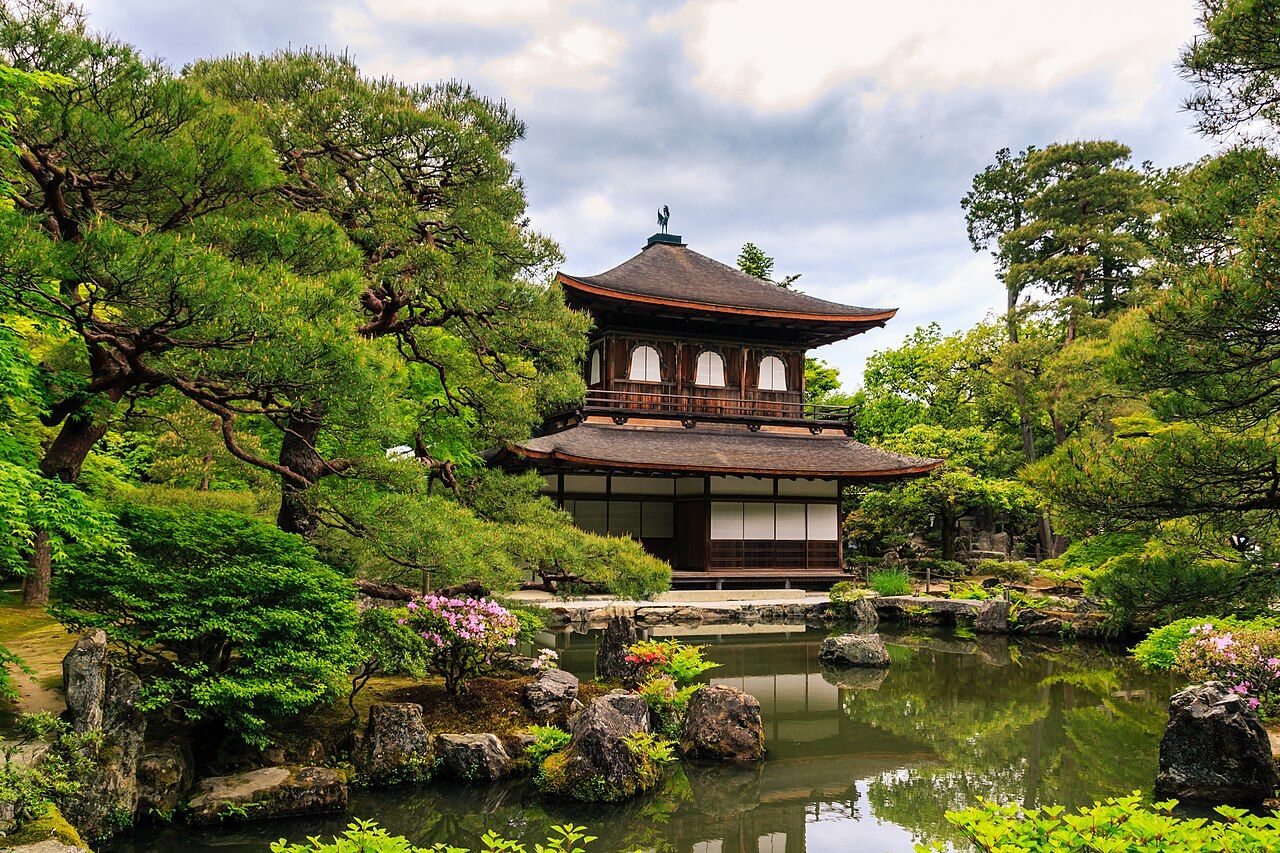
Plan Ginkaku-ji with current admission, seasonal hours, garden highlights, stepped paths and a realistic Philosopher’s Path extension.
Choose Ginkaku-ji for a garden visit with changing views of one compact temple landscape. The Silver Pavilion is part of that landscape, rather than an interior you can tour. Give the garden room in your day, then decide how much of the neighbouring Philosopher's Path you want to walk.
This guide helps you choose a practical arrival time, understand ordinary admission and decide whether the upper path suits your group. For the wider choice between Kyoto's districts and temples, start with our things to do in Kyoto. Ginkaku-ji makes most sense as an eastern Kyoto outing with a clear purpose, rather than another compulsory name on a city checklist.
Fast facts
| Question | Planning answer |
|---|---|
| Official name | Higashiyama Jisho-ji, commonly Ginkaku-ji |
| Location | 2 Ginkakuji-cho, Sakyo-ku, Kyoto |
| March–November | 08:30–17:00 admission |
| December–February | 09:00–16:30 admission |
| Ordinary admission | ¥1,000 adults/high-school students; ¥500 elementary/junior-high students |
| Allow on site | About 45–75 minutes for an unhurried garden visit; editorial estimate |
| Main access distinction | Lower garden route versus stepped upper path |
Information checked 29 October 2026. The temple's current Japanese visitor page is the reference for admission prices and seasonal hours. Recheck before travelling, especially for temporary restrictions and special openings. Suggested visit lengths exclude transport, queues and café stops.
Decide what you are coming to see
Ginkaku-ji rewards attention to relationships: the pavilion beside its pond, pale sand against dark timber, and the lower garden seen again from above. If you enjoy landscapes that change as you move, this is a strong choice. If your priority is entering richly decorated halls, ordinary admission will not provide that experience.
The official temple history connects the site to Ashikaga Yoshimasa's Higashiyama residence and its later conversion into a Zen temple. The name Silver Pavilion came later. This is useful context for understanding why a building associated with a ruler can feel markedly different from a grand palace visit.
There is no silver coating to find. Kyoto's official destination introduction confirms that the pavilion was never plated in silver. Look at its proportions, timber and setting instead of expecting a silver counterpart to Kinkaku-ji. Avoid making the visit depend on a story about an unfinished silver project: accounts differ, and the visible building is the reason to come.
Before setting out, choose one personal priority. It might be the sand garden, photographing the pavilion in its setting, or walking slowly through planted areas. A clear priority helps when the route is busy or someone in the group needs a shorter visit. You do not need specialist knowledge to notice changes in texture, scale and perspective.
Check the current ticket and the actual opening window
The Japanese admission and access page lists ¥1,000 for adults and high-school students and ¥500 for elementary and junior-high students. These are advertised ordinary-admission prices, not a dated booking quote. Older references to lower fees should not be used to budget this visit.
Admission runs 08:30–17:00 from March through November and 09:00–16:30 from December through February. A late entry leaves little time to linger. Plan to arrive well before the final admission if you want a considered garden visit; the end of ticket sales is not the beginning of an unrestricted extra hour.
Keep the budget simple: temple admission, transport and anything you choose to eat afterwards. A city transport product should not be assumed to include temple entry. If comparing two temple visits, compare their actual admissions and the journeys between them, rather than treating all gardens as interchangeable purchases.
Have a workable payment method and check the entrance information before joining a line. The operator currently lists cash and supported cashless payments for ordinary admission, while excluding special admission and temple seals from that statement. Do not assume a particular foreign wallet or every card will work merely because cashless payment is advertised.
Separate the garden from special interior access
The temple's FAQ explains that the normal visit is to the garden. Selected buildings have spring and autumn special openings, while the Silver Pavilion itself is not open inside. A seasonal programme is therefore a separate planning question, not an inclusion to infer from the ordinary ticket.
If a special interior is your main reason for coming, verify the named building, date, hours, additional fee and booking conditions with the operator. Do this before organising the rest of the day around it. This guide does not promise a specific special opening on your travel date or transfer a previous year's dates into the current season.
For most first visits, the ordinary garden provides a coherent experience on its own. You can enjoy the pavilion as part of the composition without entering it. Consider any additional opening only if the interior genuinely interests you and the schedule leaves time for the garden as well.
Follow the garden as a sequence of views
Start by slowing down after the approach. Near the sand composition, notice how the raked surface and raised forms sit beside the buildings. The official grounds guide identifies Ginshadan and the truncated cone of Kogetsudai. It also cautions that familiar moonlight explanations are not firmly established as original Muromachi-period meanings.
You do not need to turn that uncertainty into a puzzle to solve. Compare the straight edges and repeated lines with the irregular plants and stones elsewhere in the garden. Look first with your eyes, then choose a photograph. A close detail and a wider view communicate different things; neither requires stepping beyond the permitted path.
Around the pond, give yourself time to see the pavilion from more than one allowed position. The relationship between roof, water and planting changes as you move. A photograph taken from someone else's preferred angle is only one possible record. Keep the passage open and move on when other visitors are waiting for the same narrow space.
If you continue uphill, use the upper perspective to reconnect the parts you have just seen. The value is the change in scale: features that dominated at ground level become components of the larger garden. The upper path is optional when steps, weather or energy make it unsuitable. Skipping it does not erase the visit below.
Plan for steps, children and wet weather
The operator identifies stepped sections around the upper viewpoint and several numbered features. Wheelchairs and pushchairs cannot use that upper route. Ask at reception about the lower alternative and the turn before Sengetsusen, rather than following the crowd until the first staircase. An accessible toilet is listed beside the shop.
For a visitor who cannot manage steps, establish the usable route before buying tickets. A lower route does not guarantee that every surface, slope or turning space suits every mobility aid. Explain the specific requirement to staff. The most useful question is whether the actual route works for your group, not whether the entire attraction carries a broad accessibility label.
With children, give the walk a small observation task: compare reflections with the building itself, or notice where sand gives way to moss and stone. Do not make the viewpoint a compulsory achievement. A short attentive visit can work better than repeatedly asking tired children to continue for one more photograph.
In rain, take footwear that grips and keep your hands as free as practical. Umbrellas need extra space at narrow points. If footing feels uncertain, remain on the suitable lower route or shorten the visit. Rain can change the atmosphere of the garden, but a pleasing photograph is not a reason to persist on steps that your group finds uncomfortable.
Arrive with the last walking section in mind
Use Ginkakuji-michi or the relevant Ginkakuji-mae service as shown on the temple's current access information. They are different stops, and bus services should be checked from your actual starting point. Do not board on the strength of an old route number copied into a saved itinerary.
Leave time for the approach between the stop and entrance. Shops can turn a short connection into a longer browse, which is pleasant when planned and frustrating near closing. If the temple is the day's priority, go there first and return to the approach for a drink or shopping afterwards.
Road traffic makes a precise bus arrival less dependable than a map estimate may suggest. Avoid attaching a tightly timed booking immediately after the garden unless you have allowed for the return journey. Carry the temple name in Japanese, 銀閣寺, and save your return stop before arriving; these small preparations reduce phone use at crowded junctions.
Add the Philosopher's Path without overfilling the day
The neighbouring canal walk is a natural continuation if you still want to be outdoors. Choose the length after the garden, based on daylight, weather and energy. Walking some of the path is a complete choice; there is no requirement to reach every temple mentioned along it.
For a larger plan, use our Kyoto three-day itinerary. Keep this outing within a manageable eastern cluster. Adding a distant western garden simply because it also appears in photographs can consume the time you hoped to spend looking slowly.
For a compact half-day, make Ginkaku-ji the anchor, take a meal or drink after leaving, and choose a canal stroll if conditions suit. This is an editorial sequence, not a timed tour. It leaves the garden enough attention and gives the rest of the outing a natural stopping point.
Cover photograph: Silver Pavilion of Ginkaku-ji reflected in its pond among trees and stones — Photographed in 2015; resized for display. Image licensed CC BY 2.0. — Reginald Pentinio, CC BY 2.0.
Frequently Asked Questions
Is the Silver Pavilion actually silver?
No. The building was never plated in silver. Visit for the timber architecture and its relationship with the pond, sand garden and surrounding planting, rather than expecting a metallic exterior.
Can I go inside Ginkaku-ji's pavilion?
The Silver Pavilion interior is closed to visitors. Ordinary admission is for the garden; selected other buildings may have separately announced spring or autumn openings with their own conditions.
How long should I allow?
Allow about 45–75 minutes on site for an unhurried garden visit, as an editorial estimate. Add transport, queues, the approach and any Philosopher's Path walk separately. Shorten the route if steps or weather require it.
Is the whole route suitable for a wheelchair or pushchair?
No. The upper route has steps. The operator describes a lower alternative; ask reception about current conditions and whether it suits your particular mobility aid before starting the circuit.


Keep Exploring
Kiyomizu-dera: Plan Your Kyoto Temple Visit
Plan Kiyomizu-dera with temple hours, the uphill approach, Main Hall viewpoints, autumn night viewing, accessibility and Jishu Shrine closure.
Meiji Jingu: Plan Your Tokyo Shrine Visit
Plan Meiji Jingu with seasonal gate hours, the forest approach, shrine etiquette, photography rules and optional garden or museum visits.
Palacio de Bellas Artes: Plan Your Mexico City Visit
Choose murals, architecture or a performance at Bellas Artes. Plan museum admission, Sunday access, time, tickets and the historic-centre visit.