
Osaka Castle: Museum, Park and the Right Ticket
Choose Osaka Castle’s museum or park: ¥1,200 tower ticket with buried Toyotomi walls, separate Nishinomaru Garden, hours and practical access.
Visit Osaka Castle's museum if you want the history behind the landmark; choose the park alone if the exterior, moats and a walk are your priorities. The main tower is a 1931 reconstruction housing a museum, not an untouched sixteenth-century interior. The Toyotomi Stone Wall Museum adds a different experience: seeing earlier masonry preserved underground, included with the main museum ticket.
That combination makes the paid visit more than an ascent to a viewpoint. It also explains why “Osaka Castle” is an imprecise item on an itinerary: park, tower museum, archaeological display and Nishinomaru Garden have different access arrangements. Our Japan itinerary for 14 days leaves room in Osaka to make this a considered half-day rather than a stop squeezed before the airport.
Official information checked on 19 November 2026. Visit durations are editorial allowances. Prices are in Japanese yen; exhibition and operational notices should be checked for your date.
Compare the parts before buying
| Part of the visit | Admission and practical distinction |
|---|---|
| General castle park | Free; individual facilities have their own charges and hours |
| Main tower museum | Adult ¥1,200; university/high-school student ¥600 with required proof |
| Children | Age 15 and under free with age proof under the visitor information |
| Toyotomi Stone Wall Museum | Included in the main museum admission |
| Nishinomaru Garden | Separate ordinary adult admission ¥300; seasonal-event terms can differ |
| Main museum hours | 09:00–18:00; last admission 17:30 |
| Main museum year-end closure | 28 December–1 January |
| Suggested allowance | About 3–4 hours for selected park sights and both museum elements |
The official museum visitor guide is the authority for ticket categories. Overseas university and high-school students are asked to show an ISIC; visitors aged 15 and under need proof such as a passport. Do not assume a student discount will be granted without the specified document. The operator also warns that the ticket queue may close before 17:30 when necessary to meet final admission.
Understand what was rebuilt
The museum's historical introduction distinguishes the present main tower from the earlier Toyotomi and Tokugawa castles. The current tower was reconstructed in 1931 through public donations and has served as a museum since that reconstruction. Its history is meaningful in its own right, but it is a different kind of visit from walking through an intact feudal residence.
Look at the castle as layers rather than a single building of one date. The fortifications visible above ground belong to the Tokugawa rebuilding and later history, while earlier Toyotomi masonry survives below. The tower, massive walls, gates and modern exhibition spaces therefore require different explanations. A photograph that fits them into one frame does not make them contemporaneous.
Inside, expect displays and interpretation relating to Toyotomi Hideyoshi, the castle and the period's conflicts. Objects rotate, so a famous collection piece seen in a previous exhibition is not guaranteed to be on view. Choose the museum for the subject as a whole rather than a single object unless you have checked the dated programme.
Give the buried stone walls their own time
The Toyotomi Stone Wall Museum opened in 2025 and presents masonry exposed by archaeological investigation. It makes the idea of one castle buried beneath another physically understandable. This is a separate building within the castle area, even though admission is included in the tower museum ticket.
Keep the ticket available and follow the on-site directions between the two facilities. Do not spend the whole afternoon upstairs and assume the stone-wall display remains available after the tower's closing time. Its regular hours also run 09:00–18:00, with final entry at 17:30 and the same stated year-end closure.
The operator notes that viewing may be suspended without notice according to the condition of the remains. That is a reason to check current notices, not a reason to promise a replacement experience. If archaeology is your main motivation, prioritise this element early enough to adapt the rest of your visit. If you enjoy interpretation more than a skyline view, it may be the most memorable part.
Nishinomaru Garden has its own ticket and calendar
The official 2026 park guide lists ordinary adult admission at ¥300. Older ¥200 references do not reflect the current standard price. This garden is a separate choice, not automatically included because you paid to enter the main tower.
Normal hours are 09:00–17:00 from March to October and 09:00–16:30 from November to February, with last admission 30 minutes earlier. It normally closes on Mondays, or the following day when Monday is a national holiday, and from 28 December to 4 January. Cherry-blossom arrangements can change both hours and fees.
Choose it for a lawn-and-garden setting with a view of the tower, especially when the seasonal landscape interests you. You can still see the castle from other parts of the park without entering Nishinomaru. On a short visit, decide whether another garden is genuinely a priority before adding a ticket. Do not confuse Nishinomaru with every planted or landscaped area inside the wider grounds.
Choose a station for the route you want
The official access page lists several approaches, including Osakajokoen, Morinomiya, Tanimachi 4-chome and other stations around the park. None should be interpreted as a platform directly under the museum entrance. The walk through the grounds is part of the visit, not an invisible connection.
For a route through gates and walls, the park's official highlights map outlines an approximately 3 km walk from Tanimachi 4-chome through Otemon Gate and the central castle area toward Aoyamon Gate and Osakajokoen Station. The route connects several gates and viewpoints, so choose the sections that match your interests rather than treating the full walk as compulsory.
You do not need to return to the station where you started. Choose an exit that suits your next destination and energy level. Before leaving your hotel, save the museum entrance and your chosen station separately. Searching only for the park can lead you to a side that adds more walking than you expected.
Build a half-day around one clear priority
For a history-focused visit, arrive with enough morning time for the tower museum and buried walls, then use the afternoon for a selective walk through the gates and moats. For a landscape-focused visit, walk first and buy museum admission only if the history remains appealing. Neither plan requires adding every paid facility.
An editorial allowance of 3–4 hours covers selected park sights, the two museum elements and short pauses; it does not include a long restaurant meal, your journey from elsewhere in Osaka or exceptional queues. Add Nishinomaru separately if you want to linger. If you only want the exterior, a shorter walk is reasonable, but include the approach from the station.
Avoid treating 17:30 as a target arrival. Even when admission remains possible, it leaves little time to read and move between facilities. If a train journey or hotel change delays you substantially, choose the park on that day and return for the museum when you can give it attention. A purchased ticket does not create more time.
Views, seasons and photography
The tower's observation level adds a view across Osaka, while the park gives you views of the tower itself. These are different photographs and different reasons to visit. Decide which matters to you before joining a queue purely because everyone else is entering.
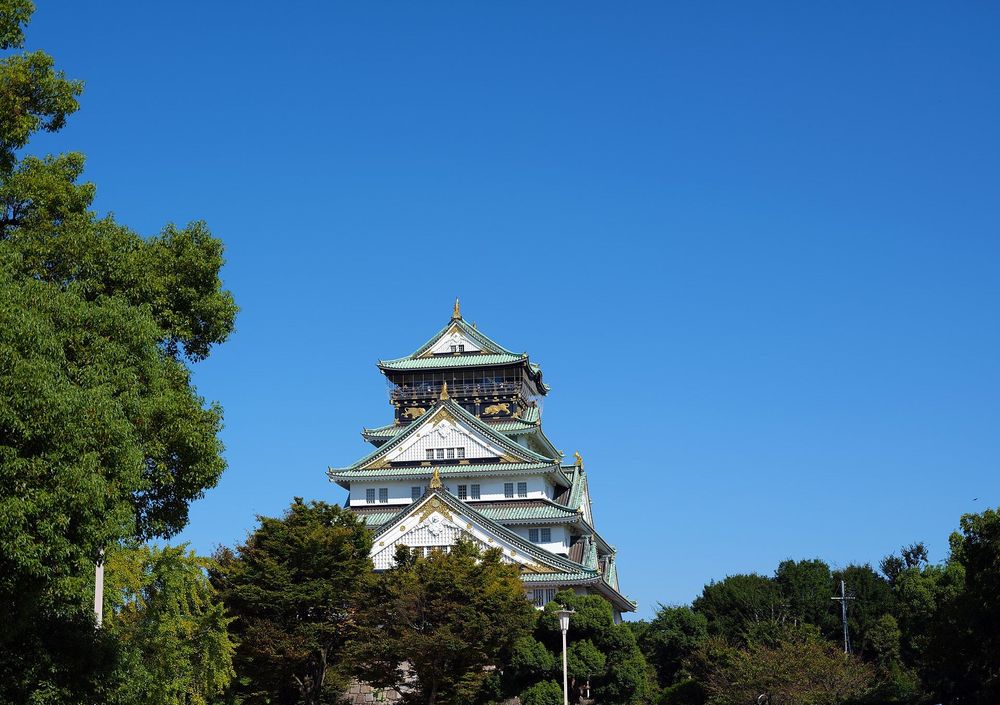
Seasonal flowers can change the atmosphere, but their timing depends on the year and conditions. Do not infer a future bloom date from an old photograph or an event poster. Check the park's dated notices when planning a blossom visit, and expect seasonal events to have their own access arrangements. The cover image for this guide is an October 2024 exterior, not a forecast of present foliage.
Inside, obey the photography signs for each exhibition area. A camera permitted on the observation level does not mean every museum object can be photographed. Pause where you can let other people pass, particularly in narrower upper sections. A clear view is more enjoyable when the route remains usable for everyone.
Mobility, stairs and pushchairs
The official visitor guide explains that the ordinary lift route goes up to the fifth floor, with stairs for the remaining ascent and descent. Visitors using wheelchairs or having difficulty walking can receive staff assistance with lift access to the relevant floors. Ask for the suitable arrangement rather than assuming that the standard visitor route meets your needs.
The official barrier-free map shows the approach lifts and notes slopes near the tower entrance. It also describes lift access to the underground stone-wall display. Accessible equipment does not erase the distances through the park or congestion around viewpoints, so plan the complete journey.
Pushchairs are normally discouraged inside the tower because upper spaces become narrow and crowded; the museum offers storage at the entrance. Confirm what works for your family and prepare for carrying younger children if necessary. Keep bags light and allow breaks outside. This is a more useful preparation than assuming the historic-looking exterior indicates either complete inaccessibility or effortless access.
Fit Osaka Castle into a wider Japan trip
Osaka Castle is strongest when you want to understand a fortified landscape and its changing political history. If you have already visited several museums, a park-only walk may provide the better balance. Do not buy admission simply to make the landmark count as completed.
For comparison with another castle-related experience on the same route, our Nijo Castle guide explains Kyoto's separate ticket and visit decisions. Choose each stop for what it actually offers. Osaka's reconstructed tower, museum interpretation and buried Toyotomi walls are a specific combination, not a generic replacement for every other Japanese castle.
Cover photograph: Osaka Castle’s main tower above park trees under a blue sky, photographed in October 2024 — Historical photograph from October 2024; current foliage and visitor arrangements may differ. — Don Ramey Logan, CC BY 4.0.
Frequently Asked Questions
Can you see Osaka Castle without buying a ticket?
Yes. The general park is free and provides exterior views. The tower museum, Nishinomaru Garden and other paid facilities have their own admission arrangements; entering the park does not include them.
Does the tower ticket include the stone-wall museum?
Yes. Main museum admission includes the Toyotomi Stone Wall Museum. It is a separate facility with its own entrance, and access can be suspended according to the remains' condition. Keep the ticket and check notices.
Is Osaka Castle's interior original?
The present tower was reconstructed in 1931 and houses a museum. It is not an untouched sixteenth-century interior. The buried Toyotomi masonry and later fortifications help explain the site's different historical layers.
Is Nishinomaru Garden included and open every day?
No. Its ordinary adult ticket is separate at ¥300. It normally closes on Mondays with holiday exceptions and 28 December–4 January. Winter hours are shorter, and blossom-season terms can differ.


Keep Exploring
Chapultepec Castle: Plan Your Museum Visit
Plan Chapultepec Castle around its history galleries, furnished Alcázar and hilltop setting, with current admission guidance and a realistic visit route.

Academy Museum Los Angeles: Plan Your Visit
Plan an Academy Museum visit with gallery tickets, separate screenings and Oscars Experience, current closures and a realistic afternoon route.
Tenement Museum New York: Choose Your Tour
Compare actual Tenement Museum tours by family story, age, stairs, wheelchair access and language support before reserving a time.