
Tenement Museum New York: Choose Your Tour
Compare actual Tenement Museum tours by family story, age, stairs, wheelchair access and language support before reserving a time.
Choose a Tenement Museum tour by the story you want to follow, then check whether its physical route and age rules work for your group. There is no single general-admission visit that lets you roam through every apartment. The museum interprets real families through guided experiences, and the choice of programme determines what you will see.
For a first visit, book one apartment tour and leave time afterward to look at the Lower East Side with its stories in mind. A second tour can add another period or the surrounding streets, but it is optional. Our New York shortlist helps you compare this intimate social-history experience with the city's larger art museums and landmark outings.
Compare the tours by interest
| Tour | Choose it for | Important distinction |
|---|---|---|
| 1A: Wongs & Gumpertzes | Women's work and the garment industry across different periods | 75 minutes; substantial stairs; translation limited in interactive portions |
| 2A: Moores | An Irish Catholic family's life after migration | Different people from the Black Moore family in 4A |
| 3A: Schneiders | Small businesses and neighbourhood life | Listed among wheelchair-accessible programmes; confirm your route |
| 4A: Moores | Black New Yorkers and life after the Civil War | A distinct story, not an alternative name for 2A |
| 5A: Levines | Women, household pressures and the 1902 kosher meat boycott | Read the programme rather than assuming every apartment tour covers the same themes |
| 6A: Confinos | Conversation with a costumed interpreter portraying Victoria Confino | All ages permitted; no photography; Forum translation app unavailable |
| 7A: Rogarshevskys & Baldizzis | Families, housing, work and political change | A comparison of Jewish and Italian family experiences |
| 8A: Epsteins & Saez Velezes | Holocaust survivors and Puerto Rican migration in the 1950s–1960s | 60 minutes; wheelchair-accessible option; ages 5 and over |
Names and policies were checked on 13 November 2026 against the museum's apartment-tour catalogue and individual programme pages. Not every programme runs at every time. The codes help distinguish choices; they are not an order in which tours must be taken.
Choose a theme rather than your surname
A family connection can make a particular programme meaningful, but you do not need matching ancestry to benefit from it. Look for a question you want to explore: how people supported a household, established a business, maintained relationships or negotiated belonging. The museum's approach makes individual lives the entry point into those larger issues.
The 1A programme compares Natalie Gumpertz and Mrs. Wong through work and economic hardship. Its combination of an earlier apartment and a later garment-shop setting is a useful choice for visitors interested in how paid work and domestic life intersect. The official duration is 75 minutes, and the page lists 63 steps up and 62 down; it is not recommended for visitors with mobility difficulties.
Choose 7A if the relationship between family life, living conditions and political change interests you more than a cross-century workplace comparison. Choose 5A for a more focused question about women responding collectively to household pressures. These are editorial ways of choosing among the published themes, not rankings of guide quality or claims that one tour is universally best.
If you choose a Moore programme, check the code. The Irish family in 2A and the Black family in 4A are different households. Similar surnames should not lead you to book the wrong story. Read the short description again at checkout, especially if another member of your group made the shortlist.
Consider 8A for the later twentieth century
The 8A tour introduces the Epstein and Saez Velez families at 103 Orchard Street, focusing on the 1950s and 1960s. It contrasts the experiences of Jewish Holocaust survivors and Puerto Rican migrants in a changing neighbourhood. This is a useful choice if you want migration history to extend beyond the familiar image of nineteenth-century arrivals.
Be precise about the distinction between immigration and migration. Puerto Rican movement to New York should not simply be described as foreign immigration. Listening to the families' different circumstances is part of the value of this tour: the building provides a shared setting without making every history identical.
The programme is advertised as 60 minutes, for ages 5 and over, and wheelchair accessible. Its page also displays stair counts for the ordinary route, so do not interpret those counts as cancelling the access option. Contact the museum about the wheelchair route and your specific device before booking. Accessible participation is a practical arrangement to confirm, not a reason to guess from a photograph of the façade.
Visiting with children: 6A is a real exception
Children under 5 are not allowed on most apartment tours. The 6A: Confinos page explicitly allows all ages and describes an actor portraying Victoria Confino in 1916. Questions and conversation form part of the format, making it different from an ordinary educator-led apartment visit.
The museum gives a duration of 1 hour and lists 7 steps up and down, with a warning that the tour is not recommended for mobility difficulties. All-ages admission does not mean step-free access. It also does not guarantee that a particular child will enjoy an hour indoors; consider their attention, comfort with an unfamiliar performer and ability to remain with the group.
Prepare one simple question with children before arriving, such as what school, work or a new neighbourhood might feel like. Explain that the interpreter portrays a historical person rather than being that person. Afterwards, invite the child to recall one detail rather than testing them on a long list of dates. Photography and video recording are not permitted on 6A, so plan to participate without trying to document the performance.
Access and language support should shape the booking
The museum's accessibility page lists accessible programmes including 8A, 3A and several walking tours. Historic interiors can be narrow, and larger motorised scooters may not fit. If you need a loan wheelchair, the museum asks for contact at least 24 hours ahead; supply is limited. Confirm the actual programme, device and route with Visitor Services.
Language support is also programme-specific. The official FAQs describe the Forum app for simultaneous translation on apartment tours, with limitations on interactive parts of 1A, 3A and 4A. It is unavailable for 6A. Ask which languages and arrangements work for your chosen visit instead of assuming that reading this guide in your language means the tour will be delivered in it.
The museum also advertises a Spanish-language Victoria programme, Visitando a Victoria, with enquiries required. Treat that as an option to request, not a daily departure. For hearing, visual or sensory needs, explain what assistance would make the experience workable before paying. An accessible visitor centre alone does not establish suitability of every historic room or every presentation format.
Book a programme, date and time
Use the official tour calendar to select the precise experience. A time showing availability in a search result can already be out of date; only the current booking flow can confirm places. Advance purchase is strongly recommended by the museum, particularly when a specific tour or limited holiday window matters.
The published FAQ lists ordinary tickets at US$30 per person per tour, with a US$3 service fee for online or phone orders, checked on 13 November 2026. Confirm the total for your chosen product and category before payment; specialty programmes and concessions should be checked on their own pages. Buying in person avoids the stated service fee but risks losing the tour or time you wanted.
Check the change and cancellation conditions before committing. Do not plan around the late-arrival allowance: it can shorten the experience and differs for 6A. Aim to reach the visitor centre early enough to use the facilities, store permitted belongings and locate the group without rushing. The meeting point is the Museum Shop and Visitor Center at 103 Orchard Street, on the corner of Delancey Street.
One apartment tour or a day of history?
One well-chosen tour is a complete visit. Add a second only if its subject contributes something different and everyone still wants more guided listening. The museum asks visitors booking multiple tours to leave at least 15 minutes between them. That is a minimum gap, not an adequate lunch break or a guarantee that two demanding routes will feel comfortable back to back.
A neighbourhood walking tour changes the scale from household to street. W1, Outside the Home, considers public and community spaces; W2, Building On The LES, focuses on buildings and the people shaping them; W3, Reclaiming Black Spaces, broadens the area's Black history. Check each programme's date and physical requirements. An outdoor tour does not include wandering freely through the apartments afterward.
For a more flexible afternoon, keep only the apartment booking and explore nearby streets independently. Leave room for food before or after: the museum does not have a café. Avoid carrying a large bag through the historic spaces; the published rules prohibit large bags and luggage on apartment tours and provide visitor-centre lockers. Ask about unusual luggage rather than assuming it will fit.
Connect the experience without repeating it
Ellis Island offers a different perspective on arrival and immigration. Our Statue of Liberty and Ellis Island guide explains the ferry commitment and separate access choices. These visits can complement one another across a trip, but a timed apartment tour immediately after an uncertain ferry return is an unnecessarily fragile combination.
After the Tenement Museum, look at the street without turning current residents into exhibits. Notice entrances, shops and how limited space is used, while respecting privacy and ordinary business activity. The historical tour provides questions, not permission to enter private buildings or photograph people intrusively.
The most useful takeaway is often one changed assumption: a clearer distinction between migrant experiences, a different view of work at home, or an understanding of how a family relied on its neighbours. Choose the programme most likely to open that conversation, and let the rest of the day remain simple.
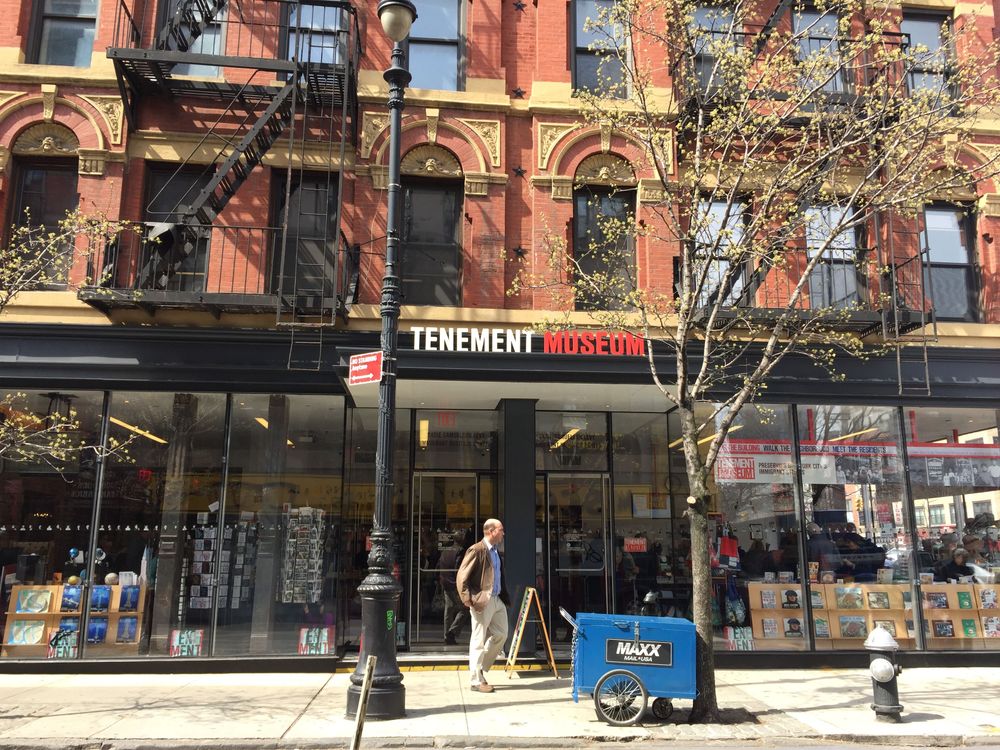
Cover photograph: Tenement Museum storefront and brick façade on Orchard Street — Jay manday, CC BY-SA 4.0.
Frequently Asked Questions
Can I visit the Tenement Museum without a tour?
The historic apartments are accessible through guided experiences, not a general self-guided admission. Choose a specific programme, date and time through the museum's calendar.
Which tour works for children under 5?
6A: Confinos explicitly permits all ages; most apartment tours do not permit children under 5. Walking tours are another option. Check the chosen programme's current rules and physical route.
Are all apartment tours wheelchair accessible?
No. The museum lists accessible choices including 8A and 3A, while other routes have substantial stairs. Contact Visitor Services about the exact programme, route and mobility device before booking.
Can I take two tours in one day?
Yes, subject to availability. The museum asks for at least 15 minutes between bookings. Allow a longer break for food or rest, and choose different themes or an apartment-and-walking combination.


Keep Exploring
Brooklyn Museum: Choose Your New York Art Visit
Plan the Brooklyn Museum with admission options, exhibition tickets, current hours, accessible routes and realistic Brooklyn combinations.

Intrepid Museum New York: Choose Your Visit
Choose the carrier, Enterprise, Growler or a Concorde tour, with access checks, digital tickets and dated closures.
Guggenheim New York: Choose Your Museum Visit
Plan a Guggenheim visit around the spiral, current exhibitions and Thannhauser Collection, with ticket choices and November closure checks.