
Nezu Shrine Tokyo: Gates, Azaleas and Visiting
Plan Nezu Shrine in Tokyo: seasonal gate hours, Otome Inari, azalea garden access, transport and current photography rules.
Visit Nezu Shrine for its Edo-period architecture, the approach to Otome Inari and a quieter-paced cultural stop in Tokyo's Bunkyo ward. The azalea garden is a separate spring experience, not a feature you can enter all year. The shrine itself deserves attention beyond the photograph of its red torii gates, and its current visitor notices make clear that worship takes priority over photography.
This is Nezu Shrine, or Nezu-jinja, at 1-28-9 Nezu. It is not the Nezu Museum in Minami-Aoyama. Our Tokyo highlights guide helps choose between different cultural visits; the purpose here is to plan this particular shrine without confusing its gates, office hours and seasonal garden.
Fast facts for an ordinary shrine visit
| Detail | Planning information |
|---|---|
| Address | 1-28-9 Nezu, Bunkyo-ku, Tokyo |
| Closest documented approaches | About five minutes on foot from Nezu, Sendagi or Todaimae stations |
| Ordinary admission | General shrine visit free; seasonal and special visits separate |
| November–December Karamon gate | 06:00–17:00 |
| November–December amulet office | 09:30–16:30; opens 09:00 Sundays and national holidays |
| Suggested allowance | 45–75 minutes, longer for queues or seasonal garden entry |
| Spring distinction | Azalea garden opens during the announced festival period |
The official hours chart, checked on 26 November 2026, explicitly concerns the Karamon gate and amulet office, not a universal timetable for every activity. GO TOKYO confirms free general admission and daily opening. Our visit duration is an editorial suggestion, not an official route time.
Pick the shrine for the right reason
Nezu works particularly well if you enjoy looking closely at buildings and seeing how an active religious precinct fits into a residential district. The sequence of gates, the enclosed main sanctuary and the smaller Inari shrines give a short visit structure. You can take your time without needing to turn the precinct into a full-day attraction.
It is a less suitable choice if your only goal is a guaranteed empty torii tunnel. No guide can promise that: other visitors and worshippers share the space, and narrow paths are not private photography sets. Arrive with an interest in the place itself and let the photographs follow the conditions, rather than arranging the visit around an image that may be impossible.
For travellers choosing one shrine in Tokyo, consider the difference in setting. Meiji Jingu offers a much broader woodland approach; Nezu offers a compact architectural focus that combines naturally with the surrounding older neighbourhoods. Including both is reasonable if shrines interest you, but neither needs to become a compulsory tick on a generic city checklist.
Use the correct station and address
The shrine's access page lists Nezu and Sendagi on the Chiyoda Line, and Todaimae on the Namboku Line, each around five minutes away on foot. Hakusan on the Toei Mita Line is listed at around ten minutes. Choose the station that fits your existing route rather than assuming a different line requires a long detour.
Walking estimates begin at the station area, not at your hotel door. Allow for finding the appropriate exit, crossing roads and identifying the shrine approach. If you need a lift, verify the station's accessible exit and then the actual street route; the shortest line on a map may not be the most comfortable way to arrive.
Save the Japanese name 根津神社 alongside the address. That helps avoid confusing the shrine with the art museum or with a general pin for Nezu neighbourhood. A short check before boarding is more useful than discovering the wrong destination after crossing Tokyo. Keep your onward route flexible until you know how much time you want at the shrine.
Separate the gates, office and special visits
The official chart varies by month. Karamon closes at 17:00 in November, December and January, 17:30 in February and October, and 18:00 from March through September. Opening times also vary. For a daytime cultural visit, aim comfortably within the relevant window rather than designing a journey around the final minutes.
The amulet office has shorter hours. That matters if you want to enquire about a goshuin or obtain an amulet: an open gate does not guarantee that every counter service is operating. Formal prayer reception has its own information and exceptions. Do not use a prayer timetable as if it were the opening schedule for ordinary visitors.
A practical late-autumn plan is to arrive with enough daylight to look at the architecture and enough time before the office closes if you need it. Check New Year arrangements separately. A special date may have different hours and a very different atmosphere from an ordinary weekday, so the normal table should not override an event announcement.
Look at the Romon, Karamon and sanctuary together
The shrine's own history dates the move to the present site and the surviving architectural ensemble to 1706, under Tokugawa Tsunayoshi. Earlier origins belong partly to shrine tradition; they are not the construction date of the buildings in front of you. The same account records wartime damage and subsequent repairs, so avoid imagining a place untouched by maintenance or restoration.
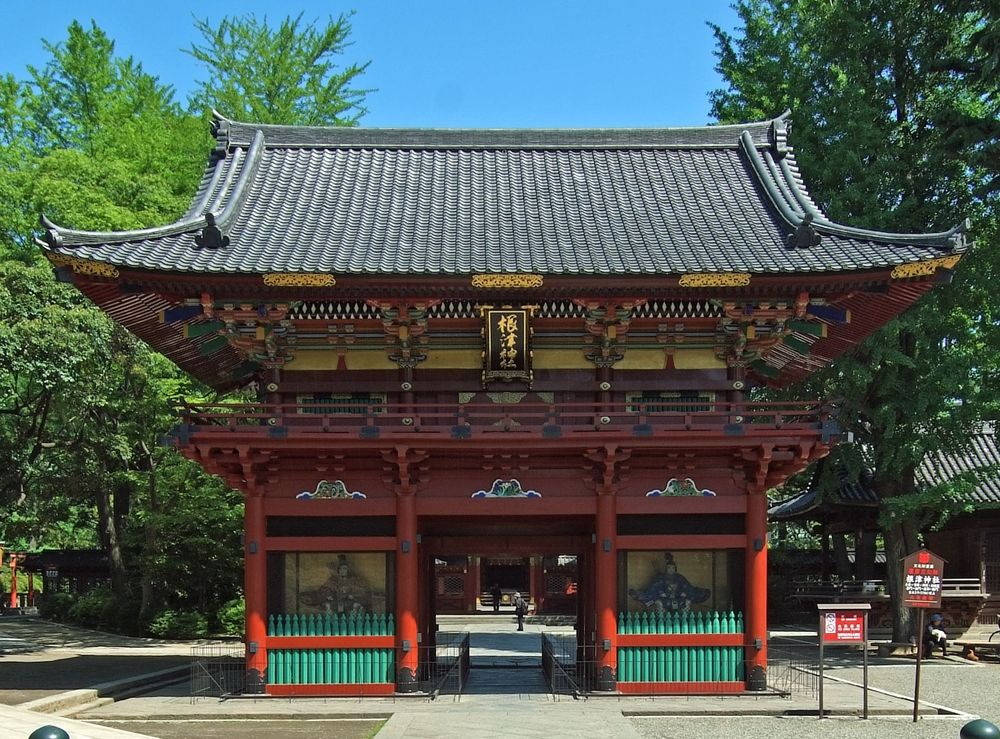
Start with the two-storey Romon gate, then notice how the approach leads towards the Karamon and the main buildings. The grounds guide distinguishes the worship hall, connecting hall and main sanctuary in the gongen-zukuri arrangement. You do not need specialist vocabulary to see that the buildings form a sequence with different functions.
Look for the contrast between the lacquered structures and the surrounding greenery, then examine the lattice fence from a permitted position. Resist leaning against it to improve a view. The precinct is not an open museum in which every doorway invites entry: barriers and local signs define where visitors can go, and worshippers need room to approach quietly.
Walk towards Otome Inari without taking over the path
The red torii line the approach to Otome Inari, one of the smaller shrines within the precinct. The official grounds description places its platform above the pond. Give this area attention as a religious setting, not just a tunnel-shaped composition. If people are approaching or leaving, let them pass before stopping.
The route is compact. There is no advantage in holding up a queue to create the impression that you have an entire long-distance pilgrimage path to yourself. Move slowly enough to notice the structures, but do not occupy a narrow section for repeated posing. A view from a wider permitted area may be more considerate and just as memorable.
If steps, narrow passages or uneven surfaces present a problem, choose the accessible parts of the visit after discussing the route with staff. Do not assume that every path towards a small shrine is suitable for a wheelchair or stroller simply because general facilities are available elsewhere. Viewing a structure from another position can still be a worthwhile part of the visit.
Treat azaleas as a separate seasonal decision
The official festival page currently documents the 2026 azalea festival, 1–30 April. Those dates are historical by the time of this November check; they are not a confirmed 2027 calendar. The garden's published seasonal access should not be turned into a year-round opening promise.
For a spring trip, wait for the relevant year's dates, garden hours and donation or admission conditions. Flowering also varies with weather. A fixed festival period does not mean that every azalea variety will be at its peak on each day, nor that a photograph from an earlier year shows the view you will get.
Outside the festival period, plan for the shrine architecture and grounds instead. This makes a November or winter visit coherent rather than disappointing. During the festival, allow extra time for entry arrangements and shared paths; if flowers are the priority, keep another part of the day adjustable instead of trying to squeeze the garden into a rigid short stop.
Follow the current photography guidance
The shrine's visitor rules prohibit photography on the stone-paved approach directly in front of the shrine buildings. They also ask visitors to keep quiet, avoid smoking and not sit or lean on historic structures. Read the signs on arrival because a photograph taken by somebody else does not establish permission for your own position or activity.
A further notice dated 21 November 2026 specifically addresses blocked approaches, dancing, large groups and prolonged photography. The practical response is simple: keep paths available, do not play music and never treat worshippers as obstacles to an image. Ask before photographing people and put the camera away where required.
The photography policy distinguishes personal commemorative images from commercial or publication shoots that require an application. If you are organising a production, follow that procedure in advance. An ordinary tourist visit is not a substitute for permission to stage a shoot with equipment, performers or a group occupying a location.
Continue into the neighbourhood at your own pace
Our Yanaka neighbourhood walk offers a useful next decision if you want more street-level exploration. Think of it as an optional continuation, with its own distance and stopping points, rather than assuming every place labelled Yanesen belongs to one tiny attraction.
Choose a meal or a short walk after the shrine, and leave room for small changes. Shops keep individual schedules; a neighbourhood visit is more resilient when it does not depend on a single café being open. With children, the shrine alone plus a break may be enough. In rain, shorten the outdoor extension rather than rushing the religious visit to compensate.
Before leaving your accommodation, confirm the shrine address, the monthly gate and office hours, and any seasonal event you genuinely want. Then approach the precinct as a shared place of worship. That combination of practical planning and patience makes Nezu more rewarding than a quick dash through its most photographed corner.
Cover photograph: Romon gate of Nezu Shrine in Tokyo in 2010 — Archive photograph 2010 — Wiiii, CC BY-SA 3.0.
Frequently Asked Questions
Is Nezu Shrine the same place as Nezu Museum?
No. Nezu Shrine is at 1-28-9 Nezu in Bunkyo. Nezu Museum is a separate art museum in Minami-Aoyama. Check the full name and address when planning transport.
Is ordinary admission free?
GO TOKYO lists the general shrine visit as free. Seasonal garden entry, special openings and religious services have separate arrangements; check the relevant official notice.
What are the late-autumn opening hours?
The official chart lists the Karamon gate at 06:00–17:00 in November and December. The amulet office normally operates 09:30–16:30, opening at 09:00 on Sundays and national holidays.
Can I visit the azalea garden in any month?
No. It has seasonal festival access. The page checked in November described April 2026; do not reuse those dates or charges as confirmed arrangements for 2027.
Can I take photographs everywhere?
No. Photography is prohibited on the stone approach directly before the shrine buildings and inside the halls. Elsewhere follow signs, avoid blocking paths and distinguish personal photos from shoots requiring permission.


Keep Exploring
Sumiyoshi Taisha Osaka: Shrine Grounds and Visiting
Plan Sumiyoshi Taisha in Osaka: free grounds, precise gate times, Sorihashi bridge, step-free approaches and train or tram arrivals.
Nezu Museum Tokyo: Art, Garden and Visit Planning
Plan Nezu Museum in Aoyama: exhibition dates, ticket scope, garden access, Omotesando exits and a realistic visit alongside the galleries.
Meiji Jingu: Plan Your Tokyo Shrine Visit
Plan Meiji Jingu with seasonal gate hours, the forest approach, shrine etiquette, photography rules and optional garden or museum visits.