
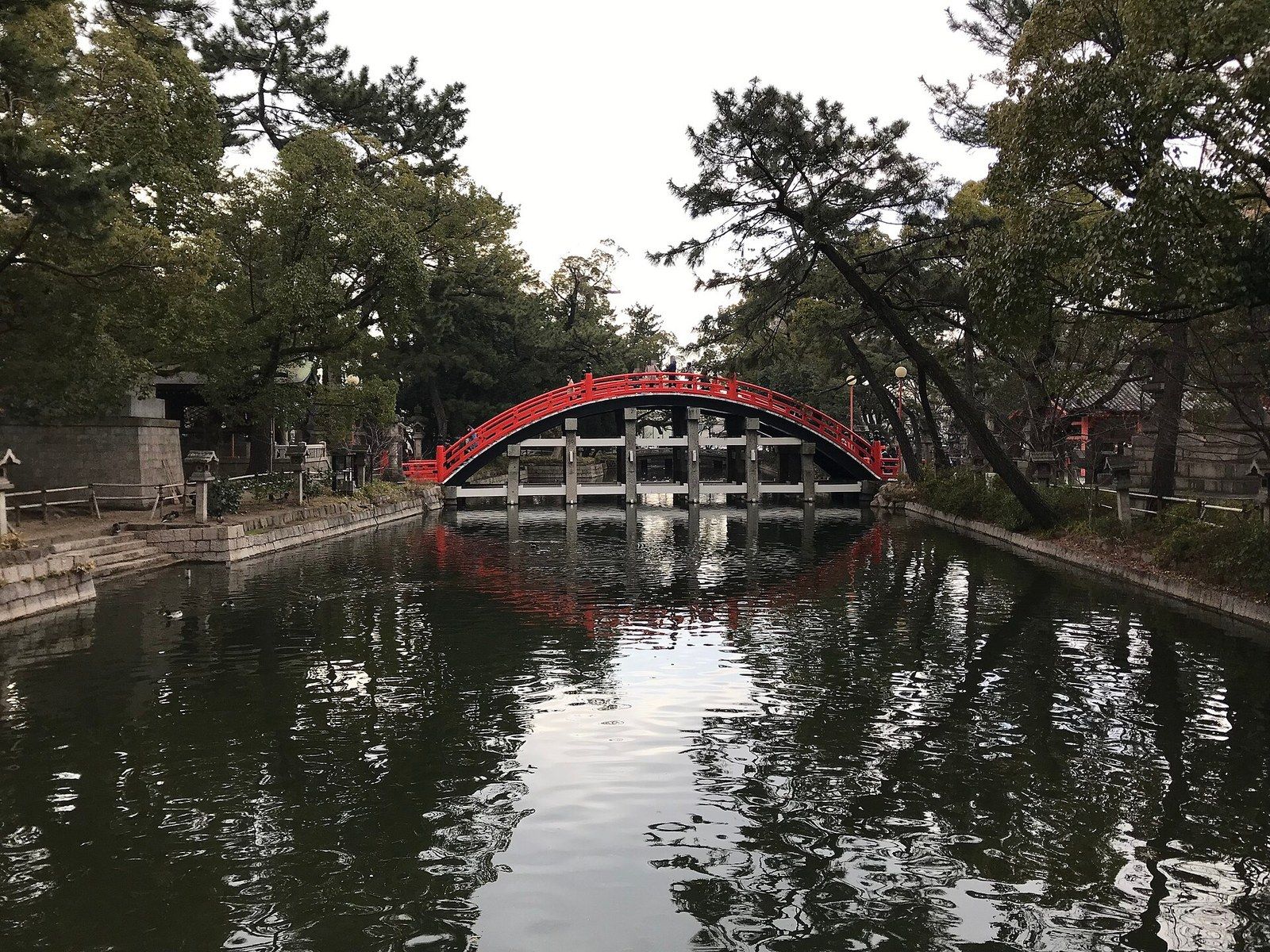
Sumiyoshi Taisha Osaka: Shrine Grounds and Visiting
Plan Sumiyoshi Taisha in Osaka: free grounds, precise gate times, Sorihashi bridge, step-free approaches and train or tram arrivals.
Sumiyoshi Taisha is a strong choice for an Osaka morning when you want to spend time in a working Shinto shrine rather than another shopping district. The arched Sorihashi bridge is the familiar image, but the four main sanctuaries, subsidiary shrines and broad grounds give the visit its substance. You can enter the shrine grounds without buying an admission ticket; optional devotional items and services are separate decisions.
The most useful planning distinction is between access to the grounds and the hours of individual gates and facilities. Do not arrive late assuming that everything remains available until the broad closing time shown in an English summary. For a wider route, our two-week Japan itinerary places Osaka within a longer trip; this guide helps you reserve a manageable part of that Osaka stay for Sumiyoshi.
What is free, and what needs separate planning?
The shrine's official English FAQ confirms that entrance is free. A normal walk through the public precincts does not require a paid tour, prayer booking or souvenir purchase. Leave room in your budget only for the things you actually choose, such as an amulet or another devotional item.
The same FAQ says that credit cards are not accepted at the shrine shop or Nankun-sha. Carry cash if you intend to make purchases there. Do not treat a devotional object as a compulsory admission charge or assume that a card accepted elsewhere in Osaka will work at every shrine counter.
| Your priority | A sensible focus | What changes the plan |
|---|---|---|
| Architecture and a first visit | Sorihashi, main sanctuaries and central precinct | Stairs, photography stops and worshippers |
| A slower religious visit | Main shrines plus selected subsidiary shrines | Your own devotional interests and counter hours |
| Step-free access | A suitable side approach and paved route | Exact entrance, slopes and assistance needs |
| A short stop between other sights | Main precinct in daylight | Travel time and the earlier gate closures |
As an editorial planning estimate, allow around 60–90 minutes for an unhurried first visit. More time makes sense if you want to study the buildings, visit subsidiary shrines or request a service. This is a suggested allowance, not an official guided-tour duration.
Read the gate times carefully
The Japanese access page gives the more detailed timetable: opening is normally 06:00 from April to September and 06:30 from October to March. It distinguishes outer-gate closure at 16:00 from closure inside the inner fence at 17:00. The English FAQ gives a simpler 17:00 closing time, so use the detailed gate information when arranging your arrival.
The same Japanese page lists the amulet counter from 09:00 to 17:00 and prayer reception from 09:00 to 15:50. Several named areas, including Goshogozen, Nankun-sha, Tanekashi-sha and Omokaru-ishi, are listed until 16:00. A late-afternoon arrival therefore reduces your options even if part of the precinct is still open.
For the simplest visit, choose morning or early afternoon and finish the parts that matter before 16:00. Opening arrangements can differ on festival dates and around New Year. The first day of the month and Hattatsu days also have an earlier opening provision in the Japanese timetable; you do not need to build your first visit around those exceptions unless you are attending for that reason.
Do not interpret the presence of an outdoor bridge or shrine approach as permission to enter every gated area after hours. Follow the signs and any staff directions on the day.
Choose between the train and tram approaches
Three useful arrival points have similar names. The shrine lists Sumiyoshitaisha station on the Nankai Main Line, about three minutes on foot; Sumiyoshihigashi on the Nankai Koya Line, about five minutes; and Sumiyoshitoriimae on the Hankai tramway, immediately by the approach. Check the actual line and destination when planning from your accommodation.
For many visitors staying around Namba, the Nankai approach is worth comparing first. If you want to include a tram ride, investigate the Hankai option from your starting point. Choose according to the full journey, transfers and accessibility rather than assuming that a particular vehicle makes the visit more authentic.
This guide does not fix a fare or promise that every train stops at your station. Check the operator's current journey planner and stopping pattern when you travel. Save the station name for the return as well: Sumiyoshitaisha, Sumiyoshihigashi and Sumiyoshitoriimae are not interchangeable platforms in one building.
The bridge is a choice, not an access test
Sorihashi is the steep arched bridge over the pond. Look at it from the side before deciding whether to cross. Its curve and reflection are easier to understand from that angle, and you can appreciate the structure without treating the climb as compulsory.
When crossing, use a steady pace and avoid stopping where others need to pass. Wet steps, bags and distraction from a camera can make a short crossing more awkward than it looks in photographs. Keep children close and let the person who needs more time set the pace.
For visitors avoiding steps, Osaka's official accessibility information describes a paved route from the south car park via a slope, without steps. It also identifies a northern approach with some gravel and notes that certain ramps are steep. This is a reason to choose an entrance carefully, not a blanket promise that every part of the grounds is equally accessible.
The same access guide recommends Nankai Sumiyoshitaisha station for rail arrivals and describes using its lift towards the main torii approach. If you need a continuous step-free route to a particular prayer area, ask the shrine to confirm the route and any assistance before travelling. Skipping the arched bridge does not mean skipping Sumiyoshi Taisha.
Understand the four main sanctuaries
Once inside, look at the arrangement of the main sanctuaries rather than rushing from one facade to the next. The official Osaka tourism description explains that the first three stand in a line, with the fourth beside the third. Their relationship is one of the things that distinguishes this shrine from a single-fronted monument.
The buildings are examples of sumiyoshi-zukuri, with straight roof lines, white walls and vermilion woodwork. The four main sanctuaries are designated National Treasures. Concentrate on the shapes and the view from public areas; admission to the grounds is not a promise of access inside every sacred building.
The shrine's official history connects Sumiyoshi with maritime protection and the port of Osaka. Its foundation in 211 is presented in traditional histories associated with Empress Jingū. Distinguish that foundation tradition from the age of the buildings you see: the current main sanctuaries date from 1810 according to the shrine.
That connection with the sea is useful context even though the modern shore is no longer beside the precinct. The shrine explains that silting and land reclamation moved the coastline westward over time. The surrounding city does not erase the maritime identity of the place.
Add only the subsidiary stops that interest you
Use the official precinct map to pick a small number of additional places. Nankun-sha, Tanekashi-sha, Goshogozen and the Omokaru-ishi stones appear on the shrine's map, alongside the sacred rice paddy and stone stage. Their names are useful orientation points, but a first visit does not require completing every one.
Follow the instructions at each place, especially where an activity involves offerings, stones or devotional objects. Observing a practice is different from treating it as an interactive tourist display. If you are unsure what to do, watch from a respectful distance or ask staff rather than copying a partial gesture from another visitor.
The stone stage and other ceremonial spaces are worth noticing as architecture. Do not promise yourself a performance merely because there is a stage. Rituals and festivals take place on particular dates, and a normal visit can be rewarding without seeing an event. Consult the shrine's current calendar if a ceremony is your main reason for travelling.
Shrine etiquette without overcomplicating it
The essential starting point is to recognise that people come here to pray. Keep routes to worship areas clear, lower your voice and give people space to finish before moving closer for a photograph. Follow posted instructions at purification basins and prayer points. You can observe quietly if you prefer not to participate.
The official FAQ prohibits eating, drinking, smoking and drone use within the precinct. Plan your snack or drink stop outside the grounds and put food away before entering. A large outdoor site can still have rules that differ from a public park.
Read photography notices at individual buildings. Do not assume that photographing the bridge means every interior, ceremony or worshipper can be photographed in the same way. If an area is reserved or a procession needs to pass, step back and follow staff instructions.
Put the visit into an Osaka day
Sumiyoshi works well as a substantial morning stop followed by a meal elsewhere. Protect the time to return to your next district rather than assuming that every major Osaka sight is close by. If you want a different kind of history later, our Osaka Castle guide separates the castle museum from the park and helps you judge the extra walking involved.
Avoid attaching too many timed commitments to the same day. A shrine visit may take longer because you are enjoying the architecture, because a ceremony changes the route, or simply because your group moves slowly. Those are ordinary reasons to keep the next stop flexible.
Before leaving your accommodation, check the shrine's current notices, the weather and the transport route. Carry cash only for optional purchases you intend to make, and remember the 16:00 closures when setting your latest useful arrival. With those decisions made, the visit can remain simple: enter respectfully, explore at your own pace and leave space for the people who use the shrine every day.
Cover photograph: Red Sorihashi arched bridge reflected in the pond at Sumiyoshi Taisha — Archive photograph Resized for publication. — そらみみ, CC BY-SA 4.0.
Frequently Asked Questions
Is Sumiyoshi Taisha free to visit?
Yes, entrance to the shrine grounds is free. Devotional items, purchases and requested services are separate; you do not need to buy something to make a normal visit.
What time does Sumiyoshi Taisha close?
The detailed Japanese timetable lists outer gates closing at 16:00 and the inner fenced area at 17:00. Several subsidiary areas close at 16:00, so plan a morning or early-afternoon visit and check special-date notices.
Do I have to cross the arched bridge?
No. The bridge involves steps, while the official accessibility guide describes alternative approaches, including a paved route from the south car park. Confirm the route for your particular needs.
Which station should I use?
Compare Nankai Main Line Sumiyoshitaisha, Nankai Koya Line Sumiyoshihigashi and Hankai Sumiyoshitoriimae from your starting point. They are different stops; check the line and return journey carefully.


Keep Exploring
To-ji Kyoto: Temple Grounds and Visiting Options
Choose between To-ji’s free precinct, sculpture halls, seasonal pagoda opening and evening illumination, with current autumn 2026 admission details.
Osaka Aquarium Kaiyukan: Tickets and a Bay Visit
Plan Kaiyukan tickets, the Pacific-themed route and a Tempozan meal, with transport choices and current exhibit checks.
Osaka Castle: Museum, Park and the Right Ticket
Choose Osaka Castle’s museum or park: ¥1,200 tower ticket with buried Toyotomi walls, separate Nishinomaru Garden, hours and practical access.