
Plan MUPO in central Oaxaca: changing exhibitions, current admission categories, daily opening, the historic building and a focused art visit.
The Museo de los Pintores Oaxaqueños, usually shortened to MUPO, is a good choice when you want to see Oaxaca through painting, printmaking and changing exhibitions rather than add another archaeological visit. Its central address makes it easy to fit into a city day, but the programme matters: do not arrive expecting a fixed checklist of famous paintings.
Choose it for a focused art stop, then leave time to walk around the centre or have a meal. If your priority is one particular artist, confirm that artist’s work is actually on display before making the museum the anchor of your day.
Fast facts
| Detail | Planning information |
|---|---|
| Name | Museo de los Pintores Oaxaqueños, MUPO |
| Address | Avenida Independencia 607, Centro, Oaxaca de Juárez |
| Published hours | Monday–Sunday, 09:00–18:00 |
| Published admission | Foreign visitors 100 MXN; Mexican visitors 50 MXN; Oaxacans free with official proof of origin |
| Listed reductions | 50% for teachers, students, children under 13 and INAPAM; verify accepted proof |
| Suggested duration | 60–90 minutes, adjusted to the exhibitions open |
| Contact in official directory | +52 951 647 5847; mupo2004@gmail.com |
Checked on 26 November 2026 against the national cultural directory, updated on 23 September 2026. Durations are editorial estimates. Prices are Mexican pesos, not US dollars; their euro equivalent varies with exchange rates and payment charges.
What kind of museum is MUPO?
The national cultural directory’s current listing describes an institution focused mainly on artists born in or resident in Oaxaca, with a programme extending across painting, prints, photography, sculpture and mixed media. The name should not lead you to expect only paintings or a single definition of Oaxacan art.
That makes it a useful counterpoint to archaeological sites and craft excursions. A painting or print can raise different questions about contemporary life, identity and visual choices. Look at who made the work, when and in which medium before assuming it represents an entire region or community.
The museum also hosts cultural activities beyond gallery displays. A scheduled talk or presentation may be worth attending if the language and subject suit you, but an ordinary admission should not be treated as a booking for every event. Ask about the current programme when arriving.
For the wider context, our guide to things to do in Oaxaca compares city museums, food, craft villages and valley excursions. MUPO fills a particular role within that choice: visual art in the centre, with relatively little travel required.
Changing exhibitions: what not to assume
The current directory identifies the Sala Rodolfo Morales as a permanent gallery whose displayed works rotate according to availability and conservation needs. “Permanent gallery” therefore does not mean a permanent arrangement of the same pictures. Other rooms present temporary projects.
Room names honour artists; they do not guarantee that every room always contains work by its namesake. A Rufino Tamayo room within MUPO is also not the separate Museo de Arte Prehispánico de México Rufino Tamayo. Use the institution’s full name and Avenida Independencia address when arranging a visit.
Past announcements are helpful for understanding the programme but need their dates read carefully. The state government’s Leonora Carrington exhibition announcement concerned a show scheduled from 19 December 2025 to 10 February 2026. It demonstrates the museum’s interest in graphic art beyond a narrow local-only category; it is not a current exhibition recommendation for November 2026.
No complete current exhibition roster was established for this guide. Before a special journey, ask which shows and rooms are open, whether an installation change affects the visit and whether your chosen work is included. If you are already nearby, the entrance information can help you decide whether the day’s selection interests you.
Opening hours and admission
The current official listing gives 09:00–18:00 every day, including Monday. This is useful when many museum itineraries assume a Monday closure, but confirm exceptional changes around holidays or installation work. No separate final-admission time was established, so do not plan to arrive just before 18:00.
Published general admission is 100 MXN for foreign visitors and 50 MXN for Mexican visitors. Oaxacans are listed as entering free on presentation of an official document confirming their origin. The directory also gives a 50% reduction for teachers, students, children under 13 and INAPAM.
Ask which documents are accepted, especially for an overseas student or teacher. The directory does not explain every credential or combination of categories. Bring the relevant original identification and let the ticket desk confirm eligibility; do not calculate a whole group’s bill around an unverified concession.
Event-specific free admission is not necessarily the museum’s everyday tariff. For example, the government announcement for Imágenes en Libertad advertised free access for that exhibition when it opened in January 2026. That dated statement does not cancel the general prices in the later official directory.
A building worth noticing
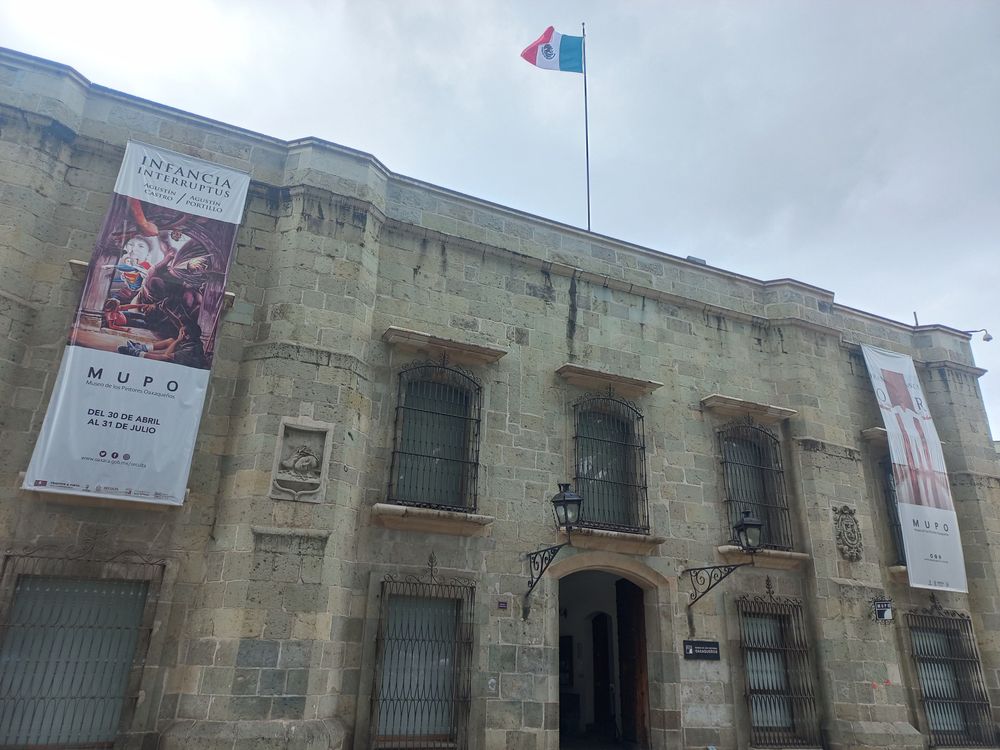
The building provides a second reason to slow down. The state government’s historical account of MUPO describes a colonial green-stone building, courtyards and an earlier role as a school for girls. Later institutional uses included archaeology and government offices.
Those layers help explain why the architecture does not resemble a purpose-built white-box gallery. Notice the transition from the street façade to the courtyard and from open space to exhibition rooms. Look at how the scale and light of each room affect the artworks, while following the permitted visitor route.
The building previously housed archaeological material, but that history does not make MUPO today the place to seek the Monte Albán Tomb 7 collection. Keep the present institution distinct from the earlier uses of its address. It is easy to confuse a historical account of a building with a description of what is currently exhibited there.
The cited government account is from 2020. Its pandemic-closure statement belongs to that date and is not current visiting advice. The newer cultural-directory entry provides the hours and admission information used in this guide.
A rewarding 60–90-minute visit
Begin at the entrance by finding out which exhibitions are open. If you have limited time, ask which part can be seen without rushing and whether any room is temporarily unavailable. A useful visit can focus on one substantial exhibition rather than move quickly through every space.
Read the introductory text, then make a first pass through the works before choosing two or three to examine closely. Look at material, size and technique as well as subject. A small print can deserve as much attention as a large painting; its detail may become clearer only after you stop and look.
For one work, separate what you can see from what the label tells you. You might notice a repeated shape, a particular colour relationship or a rough surface. Then read the title, date and artist’s context. This simple sequence leaves room for your response while avoiding assumptions based only on an image’s apparent subject.
Compare your chosen works before leaving. Do they use similar motifs for different purposes? Does a change of medium alter the effect? You do not need to settle on a definitive interpretation. Recording the artist’s name and the exhibition title is more useful for later reading than collecting unidentified photographs.
With children, use a shorter version: choose one work each, describe a detail and compare what caught your attention. Keep voices low and follow the museum’s rules about distance from works. A family visit does not require every label or every room to be worthwhile.
Printmaking and the museum’s wider role
MUPO’s programme can connect visual art with social experiences outside the gallery. The January 2026 Imágenes en Libertad announcement concerned work produced in the Gráfica Siqueiros workshop at Villa de Etla’s penitentiary. This is a documented example of a past programme, not a claim that those works remain on view.
Such context offers a useful question for whatever exhibition you encounter: how does the museum explain the conditions in which the work was made? Read the artist’s own information and the curatorial text rather than treating the work only as decoration or reducing its maker to a single biographical fact.
The cultural directory also identifies MUPO as an official venue of the Shinzaburo Takeda National Graphic Arts Biennial from 2025. That association is a reason to check for print-related programming; it is not evidence that a biennial exhibition is continuously installed. Consult the current announcement for any event you plan to attend.
If printmaking particularly interests you, allow enough time to study technique and repetition. An editioned print is not automatically a reproduction of a painting. Read the medium on the label and ask for clarification when terms are unfamiliar, without assuming that staff can provide a guided lesson in every language.
Fit MUPO into a central Oaxaca day
Use Avenida Independencia 607 as the destination. If staying in the historic centre, compare the walking route from your accommodation before arranging transport. The museum’s central position is its practical advantage: it does not need the road time or organised departure associated with a valley excursion.
A useful sequence is the museum, a break, then a walk through the central streets. Put the art visit before an activity that tends to leave you tired if you want to read and look carefully. On a day already filled with exhibitions, another museum may add less than time outside or a proper meal.
Our Oaxaca three-day itinerary helps separate city exploration from longer excursions. MUPO can replace another indoor stop when its programme appeals more. It should not become an extra obligation squeezed into the last half-hour before closing.
For access requirements, contact the museum about entrance thresholds, the location of the relevant galleries and any lift or alternative route. The historical description mentions stairs to the upper level, but current step-free arrangements were not confirmed. Ask about the actual exhibition you want rather than assuming that access to the courtyard means access everywhere.
Confirm photography, bag and food rules at the entrance. The directory lists a shop and café, but their independent hours and services were not established; do not make them essential to the day. The strongest reason to choose MUPO remains the exhibition itself.
Cover photograph: Green-stone facade of MUPO in Oaxaca with entrance and exhibition banners photographed in September 2022 — Archive photograph 2022 — B.jars, CC BY-SA 4.0.
Frequently Asked Questions
Is MUPO the same as the Rufino Tamayo museum?
No. MUPO is the Museo de los Pintores Oaxaqueños at Avenida Independencia 607. Rooms named after Rufino Tamayo do not make it the separate pre-Hispanic art museum bearing his name.
Is MUPO open on Mondays?
The current national cultural directory lists Monday–Sunday, 09:00–18:00. Confirm exceptional closures and the day’s available rooms; a separate last-admission time was not established.
How much is admission?
The directory lists 100 MXN for foreign visitors, 50 MXN for Mexican visitors and free admission for Oaxacans with official proof. Listed reductions require checking eligibility and accepted documents at the museum.
Will I see a fixed collection of famous paintings?
Do not assume so. Temporary exhibitions change, and the Sala Rodolfo Morales also rotates its displayed works. Confirm any artist or work that is essential to your visit.
How long should I spend at MUPO?
Allow 60–90 minutes as an editorial starting point, depending on the open exhibitions and your interest. A focused visit to one show can be better than rushing through every room.


Keep Exploring
Oaxaca Textile Museum: Plan Your Visit
Plan a thoughtful textile museum visit, with current hours, guided tours, workshop checks and a useful link to Oaxaca’s weaving communities.
National Museum Maldives: Plan Your Malé Visit
Visit the National Museum in Malé: official hours, admission, collection themes, bag rules and a practical pairing with Sultan Park.
Natural History Museum Los Angeles: Plan Your Visit
Plan the Natural History Museum in Los Angeles: free Commons, Dinosaur Hall, admission, extras, transport and access for a focused visit.