
National Museum Maldives: Plan Your Malé Visit
Visit the National Museum in Malé: official hours, admission, collection themes, bag rules and a practical pairing with Sultan Park.
The National Museum in Malé is worth choosing when you want some historical context for a Maldives holiday: writing, craftsmanship, royal life and everyday objects, rather than another photograph of a beach. Give it a proper place in a daytime city visit. It is less useful as a last-minute stop when the ticket counter is about to close or your airport return is already tight.
For the complete arrival and return calculation, use our Malé stopover guide. This guide concentrates on the museum itself: what to look for, the current official visitor information and how to combine it with a small part of the historic centre.
The practical details that shape the visit
The National Centre for Cultural Heritage's museum page, checked on 23 November 2026, lists opening Saturday–Thursday, 10:15–16:00, with the ticket counter closing at 15:30. Government holidays are excluded. Friday is outside that regular opening pattern. Check your particular date rather than relying on an older listing that may show different weekend arrangements.
The official standard foreign adult admission is MVR 155. Separate child and student categories exist; ask about the applicable category and any proof required for your party. Confirm accepted payment methods instead of assuming that a foreign card or a large banknote will be suitable.
| Decision | Useful approach |
|---|---|
| Choosing a time | Arrive with at least an hour of usable visiting time, not at the ticket cutoff |
| Travelling with bags | Arrange storage before arriving; museum rules prohibit bags and handbags inside |
| Visiting on a holiday | Confirm opening directly before travelling across the city |
| Joining an airport stopover | Fix the return transport first and fit the museum inside the remaining window |
| Interested mainly in photography | Check the rules for the specific object or gallery; flash is prohibited |
As an editorial allowance, plan 60–90 minutes inside, longer if you enjoy reading labels carefully. That is not a museum-issued duration. It excludes transport, the ticket counter, any bag arrangements and a walk through the surrounding neighbourhood.
What the museum adds to a Maldives trip
A resort stay can reveal little about how the country developed or how people represented authority, faith and daily life. A museum visit gives you objects to connect with those questions. You do not need to know the chronology before arriving; it helps to choose two or three themes rather than attempting to remember every date.
Visit Maldives' experience guide highlights stone carving, Thaana panels and historical artefacts. These are useful starting points for looking, not a guaranteed checklist of individual pieces currently displayed. Gallery arrangements and conservation needs can change what is on view.
Start with materials and workmanship. Compare the way a carved surface communicates detail with the way writing or painted decoration does. Look for the label's account of what an object was used for and where it came from. A beautiful object becomes more informative when you can connect its appearance with a function, owner or place.
Three themes for a focused visit
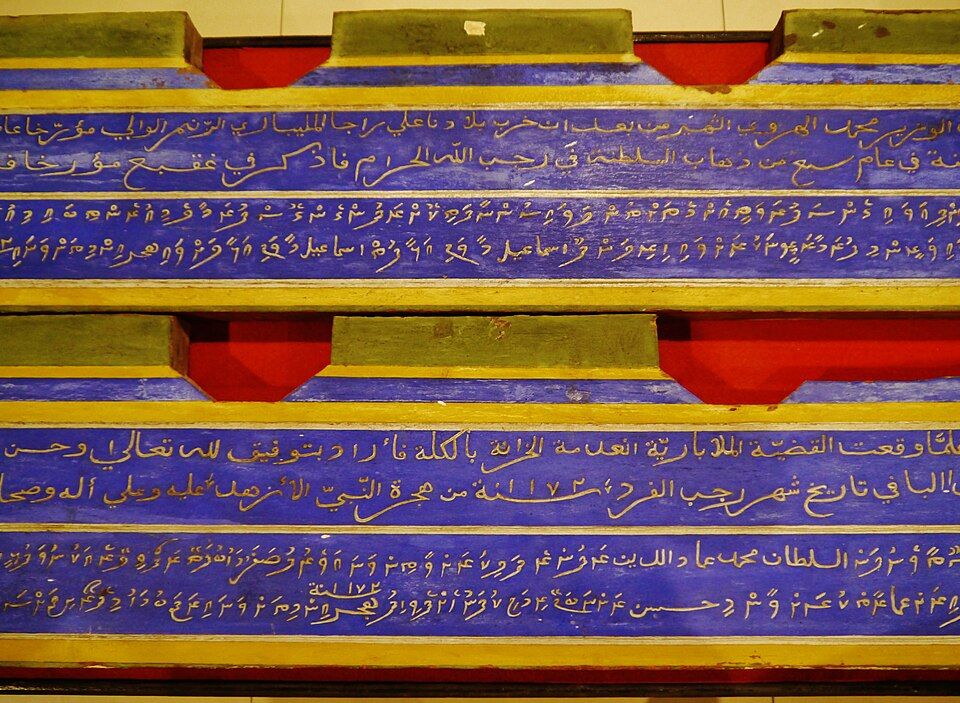
Writing and decoration: when you encounter an inscribed panel, distinguish what you can actually observe from what you need the label or staff to explain. Ask about the script, language, date and original setting. Do not assume every inscription uses Thaana, or that an unfamiliar script is merely ornamental. The archival cover photograph shows a painted inscribed panel photographed inside the museum; it does not identify every inscription in the collection.
Public history and royal life: look for the relationship between an object's practical use and its role in expressing status. Ask what made it appropriate to a royal household or a formal occasion, if that is how the label identifies it. This is more useful than treating every elaborate object as a treasure with no context.
Everyday life: the heritage authority's museum overview also highlights bodu beru, historical lighting equipment and household objects in its collection features. These themes connect the visit with music, light and domestic routines. Ask which related objects are currently accessible rather than expecting every item featured online to be in a particular room.
For children, give the visit a small task: find two materials, compare two ways of decorating a surface, or choose one object whose purpose they want to understand. Keep questions observational and let the labels provide the answers. This works better than turning an unfamiliar national history into a memory test.
A museum with its own history
The museum authority dates the original institution to 19 November 1952 and the opening of the newer building to 26 July 2010. The distinction matters when you see photographs or descriptions of the former palace setting: the institution's history and the building you visit are not identical.
You can use that change as another question during the visit. How are objects from different periods presented together, and what does the museum choose to explain about national heritage? Follow the current gallery route and signs rather than trying to reproduce an old floor-by-floor itinerary from a travel blog.
A visit need not cover every room to be worthwhile. If time is limited, ask at the entrance which accessible areas best match your interests. Choose a coherent small selection and leave time to understand it. Rushing through the whole building may produce more photographs but less of a sense of the country.
Bags and photography need planning
The museum's published rules prohibit bags and handbags in the interior, as well as food and drink. This is a practical constraint for a traveller carrying island luggage or a daypack. Ask about the current deposit arrangements before arriving; the rule itself is not evidence of a staffed cloakroom, large lockers or secure suitcase storage.
For a stopover, leave the main luggage with your hotel or another confirmed storage service and establish how it will be collected. Keep documents and valuables under arrangements you are comfortable with. If you need medication or an essential personal item, ask staff how to bring it through the visit appropriately.
Flash photography is prohibited. Follow any additional signs concerning individual displays and ask before using other equipment. Keep movement calm, do not touch or sit on objects, and make room for other visitors reading labels. The museum is a place for looking closely; treating fragile surfaces as photo props defeats the reason for visiting.
Combine the museum with Sultan Park
The tourism board's Greater Malé itinerary pairs the National Museum with a break in Sultan Park. That is a useful small-scale combination: an indoor historical visit followed by outdoor space, rather than several unrelated city stops connected by a hurried walk.
Treat the park as a separate access decision. A museum ticket does not establish its current opening, price or entry conditions. Check the park entrance information on the day and keep the break optional if your schedule is tight or the weather is poor.
For a comfortable morning, arrive for the museum's opening period, spend your chosen hour or more inside, then decide whether to add the park and lunch. If the museum is the priority, visit it before an extended meal rather than discovering that the ticket counter has closed when you finish eating.
Add one heritage stop, not the whole capital
If you have extra time, continue towards the Old Friday Mosque area or another part of the historic centre described in our stopover guide. The purpose is to connect objects seen indoors with the city outside. A carved detail or an inscription can feel more meaningful after you have paid attention to materials in the museum.
Mosque access is a separate matter governed by current permission and worship arrangements. Do not assume a museum visit includes entry to religious buildings or private grounds. A respectful exterior view can be enough, especially when your available time is modest.
For a broader holiday, our Maldives activities guide helps balance cultural time with sea-based experiences. The museum is a focused capital visit; it does not replace an inhabited-island stay, and you do not need to turn it into an all-day cultural programme for it to add value.
Choose a day that works for your journey
An overnight stay in Malé makes the visit easier to organise because you can leave bags, check the day's opening and start without airport uncertainty. During a flight connection, calculate the usable museum window only after immigration, city transport, bag collection and the airline's departure requirements are accounted for.
If the resulting visit would be shorter than the travel and entry arrangements, choose a simple outdoor walk or meal instead. If you arrive on Friday or after the ticket cutoff, move the museum to another day if possible. A closed museum does not make the entire city unavailable, but it does change the purpose of the outing.
Visitors who need step-free access should ask about the entrance, lifts and access to the galleries they want to see. A newer building alone does not establish that every part of the current visitor route is accessible. Clarifying the actual route makes the visit more useful than relying on a general description.
Cover photograph: Painted inscribed panel photographed inside the National Museum in Malé — Archive photograph Image adapted for publication. — Zairon, CC BY-SA 4.0.
Frequently Asked Questions
What are the National Museum's opening hours?
The official page checked on 23 November 2026 lists Saturday–Thursday, 10:15–16:00, with the ticket counter closing at 15:30 and government holidays excluded. Reconfirm your date before travelling.
How much is admission for a foreign adult?
The standard foreign adult rate listed by the museum is MVR 155. Check the current rate, payment method and any child or student category before your visit.
How much time should you allow?
Our editorial allowance is 60–90 minutes inside, plus ticketing, bag arrangements and travel. Visitors interested in detailed labels may want longer.
Can you take luggage and photographs inside?
Published rules prohibit bags and handbags inside and prohibit flash photography. Confirm deposit arrangements and any additional gallery restrictions; do not assume suitcase storage is available.
Is the museum worth adding to a short Malé stay?
Yes, if you want historical context and have a suitable daytime window. Choose a few collection themes, then add Sultan Park or one nearby heritage stop if time allows.


Keep Exploring
National Museum of Singapore: Plan Your Visit
Plan the National Museum of Singapore: the renewed history experience, admission checks, visit length, entrances and access needs.
Utheemu Ganduvaru: Plan a Maldives Heritage Visit
Plan Utheemu Ganduvaru from the northern Maldives: palace history, confirmed access, boat arrangements and a respectful island visit.
Natural History Museum Los Angeles: Plan Your Visit
Plan the Natural History Museum in Los Angeles: free Commons, Dinosaur Hall, admission, extras, transport and access for a focused visit.