
Kawagoe from Tokyo: Plan a Heritage Day Trip
Choose Kawagoe’s warehouse streets, bell tower and sweet shops, then add Kitain or Honmaru Goten according to transport and opening dates.
Kawagoe makes sense as a Tokyo day trip when you want a historic streetscape, a proper lunch and one substantial cultural stop. The warehouse quarter, Toki no Kane bell tower and Kashiya Yokocho sweet shops provide the compact core. Add either Kitain Temple or Honmaru Goten according to your interests and the opening calendar, rather than automatically trying to cover every landmark.
The main planning mistake is treating the train journey as the whole transfer. Kawagoe, Kawagoeshi and Hon-Kawagoe are different stations, and the historic quarter still requires a walk or local bus. Choose the arrival that fits your accommodation and first stop. Our Tokyo guide helps decide whether this excursion deserves a day that could otherwise go to another city neighbourhood.
Choose your version of the day
| Your priority | Build around | Main trade-off |
|---|---|---|
| Streets and food | Warehouse quarter, Toki no Kane, Kashiya Yokocho | Shops have individual hours; streets can be busy |
| Temple and historic interiors | Kitain, then a shorter warehouse walk | Admission hours and ceremony-related closures matter |
| Castle history | Honmaru Goten, then the warehouse quarter | Check the exact municipal closure calendar |
| Less walking | Selective local buses and a compact route | Confirm the operator and pass coverage |
| Flexible half-day | Streets, one meal and no distant add-on | Less time for interiors or a second historic site |
Allow roughly four to six hours in Kawagoe for the core plus one cultural visit, excluding the journey from Tokyo. This is an editorial planning estimate, not a fixed tour duration. A shorter trip works if you remove the extra admission; a longer stay suits people who enjoy reading, shopping or sitting over lunch.
Choose the railway before the pass
Tobu's route from Ikebukuro serves Kawagoe and Kawagoeshi. Seibu's route from Seibu-Shinjuku leads to Hon-Kawagoe. JR also serves Kawagoe. These options are not interchangeable simply because the station names resemble each other. Compare the complete journey from your hotel, including the transfer within Tokyo and the walk after arrival.
For Tobu travel, the current Kawagoe Discount Pass Premium page explains the return rail journey and covered local bus sections. Read the actual coverage before purchase. Older brochures and general tourism pages can describe different products or prices; the live operator product page is the stronger reference for what is currently being sold.
For a Seibu arrival, use the operator's Hon-Kawagoe station information and current journey results. A limited-express service, where chosen, can have separate conditions from an ordinary train. Do not assume a general pass includes every supplement or that a pass from one railway covers another company's service.
Buy a pass only after deciding how you intend to move around. A day spent walking between nearby streets may not need the same ticket as a route using several buses. The useful comparison is the cost and convenience of your actual plan, not the largest number of advertised inclusions.
Start with the stop whose doors matter
If Kitain or Honmaru Goten is your priority, visit it before leaving the rest of the day to shops and food. A street remains visible after a building's admission desk closes, but an interior cannot be recovered by arriving five minutes too late. Check the exact date first, then arrange the route around that constraint.
With no particular interior in mind, begin with the warehouse quarter and keep the cultural addition optional. This suits travellers who mainly want to look at buildings and try something to eat. It also avoids paying for a site merely because a generic itinerary says every day trip needs a temple and a castle.
Do not schedule lunch as an afterthought between two closing times. A queue or a slower meal can be part of a pleasant day if the plan allows it. One confirmed cultural stop, one meal and the street circuit form a more resilient outing than a chain of tightly timed admissions.
Look closely at the warehouse quarter
The Japan National Tourism Organization's warehouse guide describes the kurazukuri streetscape of merchant buildings and storehouses, many now used as shops and restaurants. The attraction is the relationship between substantial façades, tiled rooflines and continuing commercial life. It is not a sealed historical theme park.
Walk one side slowly before crossing to compare details from the other. Look at the thickness suggested by walls and openings, the way roofs frame the street and how contemporary shops occupy older forms. You can enjoy the architecture without assuming every building dates from the same period or survives unchanged from the Edo era.
Keep to pavements and use appropriate crossings. A photogenic street should not be presumed pedestrianised. When the pavement feels crowded, stop somewhere that leaves room for others rather than stepping backwards into the road for a wider photograph. The best pace is the one that allows you to notice details safely.
Toki no Kane is a landmark, not the entire excursion
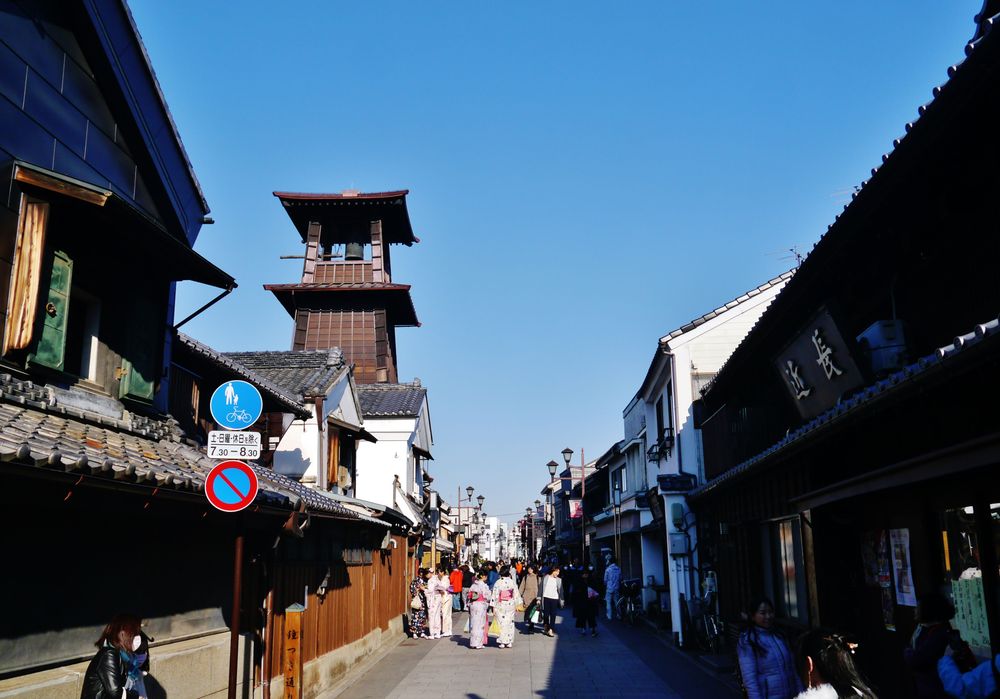
The bell tower provides a recognisable focal point within the historic quarter. Approach it as part of the street composition: notice how the timber structure rises above the lower buildings and how the surrounding lane changes your view. A brief stop can be satisfying without turning the day into a wait for one perfect empty photograph.
The national tourism board describes the bell as sounding four times daily. This guide does not promise an uninterrupted ringing schedule on every date or recommend building the whole visit around a particular chime. If hearing it is essential, verify the current local information and leave time to arrive comfortably.
After looking at the tower, keep exploring the nearby buildings or take your meal break. There is no need to treat reaching the best-known landmark as proof that the trip is complete. Equally, if that street experience is what you came for, you need not add a distant attraction to make the day feel more substantial.
Browse Kashiya Yokocho with an appetite plan
Kashiya Yokocho, often translated as Candy Alley, adds small sweet shops to the architecture-focused route. The appeal is browsing individual products and choosing something you actually want, not collecting a prescribed number of snacks. A few careful purchases leave more room for conversation and a proper meal.
Ask about ingredients where needed. Traditional sweets can contain allergens or ingredients that are not obvious from colour or shape. For food bought to take home, check storage and shelf-life information before purchasing. A product that looks like an easy souvenir may not suit the rest of your journey.
Businesses have their own trading arrangements. Do not assume every shop operates whenever the lane is accessible, or that all close on the same weekday. If one particular maker is the reason for the trip, confirm directly. Otherwise, keep the browsing flexible and accept that the selection depends on the day.
Kitain: choose the temple for more than a quick gate photo
Kitain's own visitor information describes its historic buildings and admission arrangements. The temple offers a different kind of attention from the shopping streets: interiors, cultural objects and the Rakan statues reward a deliberate visit. Choose it when that content matters, not simply because it is the nearest temple name on a map.
Its published hours change after 23 November, and last admission is thirty minutes before closing. The site also lists annual closure periods and warns that temple events can cause additional closures. Check the date-specific information before travelling; winter timing is particularly important if you have spent the morning browsing.
Follow the temple's rules inside. It prohibits photography and touching exhibits in the hall, as well as entering the courtyard from the permitted visitor route. Respect quiet and worship. A temple visit is not an extension of the street photography session, and a paid admission does not remove those boundaries.
Honmaru Goten: let the actual calendar decide
Honmaru Goten is the surviving palace-building visit associated with Kawagoe Castle, rather than a promise of a towering castle keep. Choose it if you want to spend time with historic rooms and the setting of administrative life. Decide whether that experience appeals before adding the extra movement across town.
The city's official closure calendar lists specific dates. For November 2026 these include 2, 9, 16, 24, 27 and 30 November. That is why a vague instruction to avoid Mondays is not enough: holiday adjustments and additional closure days can change the pattern.
If it is closed, keep a street-focused day or choose another verified opening. Do not present an exterior photograph as the equivalent of an interior visit. If the palace is your main reason for coming, moving the day trip to a suitable date is more useful than travelling and hoping for an exception.
Use buses selectively and finish without rushing
Tobu's Kawagoe bus information helps identify its routes and covered sections. Check the bus company as well as the route name; a tourist-oriented bus is not automatically covered by every Kawagoe pass. Services and roads may change for events, so use the current timetable on the day.
A bus can save energy for the part you most want to walk. It can also introduce waiting and uncertainty when the remaining distance is modest. Make the choice according to your group, weather and the actual next departure. For mobility needs, verify the vehicle and the entrances of intended sites rather than relying on a broad claim that the town is easy to visit.
Keep the return station deliberate. If your ticket requires a particular railway or destination, follow those conditions rather than simply boarding the first train labelled Tokyo-bound. Leave some margin before a fixed evening reservation in the capital. Our Tokyo itinerary helps keep the other days geographically coherent so Kawagoe can remain a relaxed excursion in its own right.
Cover photograph: Toki no Kane bell tower rising above the historic streets of Kawagoe — Zairon, CC BY-SA 4.0.
Frequently Asked Questions
Is Kawagoe suitable for a half-day from Tokyo?
Yes, for a compact street walk and meal. Allow more time if adding Kitain or Honmaru Goten, and calculate the complete hotel-to-quarter journey rather than only the train ride.
Are Kawagoe and Hon-Kawagoe the same station?
No. Kawagoe serves JR and Tobu; Hon-Kawagoe serves Seibu. Kawagoeshi is another Tobu station. Choose the route and arrival that fit your plan.
Can I visit Honmaru Goten on any weekday?
No. Use the city's exact closure calendar. The November 2026 list includes 2, 9, 16, 24, 27 and 30 November, so avoiding Mondays alone is insufficient.
Do I need a local transport pass?
Not automatically. Compare your actual rail and bus journeys with the current product's coverage, eligibility and conditions. A mostly walking visit may need fewer inclusions.


Keep Exploring
Dainzú from Oaxaca: Plan Your Archaeology Visit
Plan Dainzú from Oaxaca: ballplayer reliefs, current admission, opening hours, the final road approach and a realistic half-day archaeology visit.
Edo-Tokyo Open Air Museum: Plan Your Visit
Choose historic shops, Kodakara-yu and modern houses at Koganei, with current hours, access and the Jisho-in repair closure.
teamLab Planets Tokyo: Plan Your Visit
Plan teamLab Planets in Toyosu with clear ticket choices, water and clothing advice, family logistics and artwork-specific accessibility checks.