
Eikando Kyoto: Day Visit or Autumn Illumination?
Choose Eikando by day or night, with verified 2026 autumn dates, separate tickets, temple context, closures and transport advice.
Eikando is one of Kyoto's most rewarding temple choices when you want autumn gardens and a meaningful indoor visit in the same place. Its other name, Zenrin-ji, appears on maps and temple information, so recognise both before setting out. The important planning decision is not simply whether to visit: it is whether you want the daytime temple-and-exhibition experience or the separately ticketed evening illumination.
They are different visits. You cannot buy a daytime ticket and remain inside until the lights come on. Choose the experience that matters more, then use our Kyoto highlights guide to build the rest of the day around it rather than trying to fit every eastern Kyoto temple into one afternoon.
Day or night: the 2026 choice
| Visit | Published 2026 dates | Reception and closing | What it covers |
|---|---|---|---|
| Autumn daytime exhibition | 11 November–6 December | Reception 09:00–16:00; closes 17:00 | Temples, garden and special exhibition, subject to closures |
| Night illumination | 20 November–6 December | Reception 17:30–20:30; closes 21:00 | Amida-do and garden |
| Ordinary daytime visit | Outside the autumn exhibition period | Reception 09:00–16:00; closes 17:00 | Temple interiors and garden, subject to religious-service closures |
These details were checked on 20 November 2026 against the temple's detailed admission information. For the autumn daytime exhibition, individual adult admission is ¥1,500; the night visit is ¥1,000 for junior-high-school age and above. Ordinary adult daytime admission outside the exhibition is ¥1,000. These are separate products, not a day-and-night pass.
The autumn daytime table lists ¥1,000 for university students and ¥800 for junior-high and high-school students. For younger children or another category, confirm the applicable arrangement directly rather than applying an ordinary-season price to the special exhibition. Admission arrangements can change, so check again shortly before travel.
Choose daytime for the fuller temple visit
Daytime is the stronger choice if this is your first Eikando visit and you want the architecture, religious context and exhibition as well as the garden. The special autumn exhibition includes Buddhist art, while the garden provides a different pace between the interior sections. You can appreciate the place even if the leaves are not at the exact colour shown in a photograph.
As an editorial allowance, set aside 90–120 minutes on site, plus any queue and travel. This is not an official duration. A visitor interested in the exhibition may spend longer, while a tightly scheduled tour may move faster. Do not arrive at the last reception time expecting an unrestricted afternoon inside.
Bring a small bag for your shoes, as the temple requests. Choose footwear you can remove and put back on easily. Keep your belongings compact enough to carry through shared spaces without knocking against people or the building. These small preparations are more useful than a detailed sequence of photographs you hope to reproduce.
Daytime visitors must leave the precincts by 17:00. If you also want the illumination, plan a genuine break outside and a separate evening admission. Allow for the second queue rather than treating the interval as a guaranteed quick turnaround.
Choose night for the garden's illuminated atmosphere
The night visit focuses on Amida-do and the garden, not the complete daytime exhibition route. It suits someone whose main interest is the relationship between the illuminated trees, water and temple buildings. It is a separate evening outing, with a different mood and a more limited set of spaces.
Allow an editorial 60–90 minutes inside, with additional time for the queue. This should remain flexible: crowds and the authorised route may change how quickly you move. Darkness also makes a complicated onward walk less appealing, so decide how you will return to your accommodation before arriving.
The temple expects substantial crowds, especially in the latter half of November, and warns that reception may close earlier for crowd management. The published final reception time is therefore not a reliable target for a last-minute arrival. If the night visit is essential, leave margin rather than planning to reach the gate just before the cut-off.
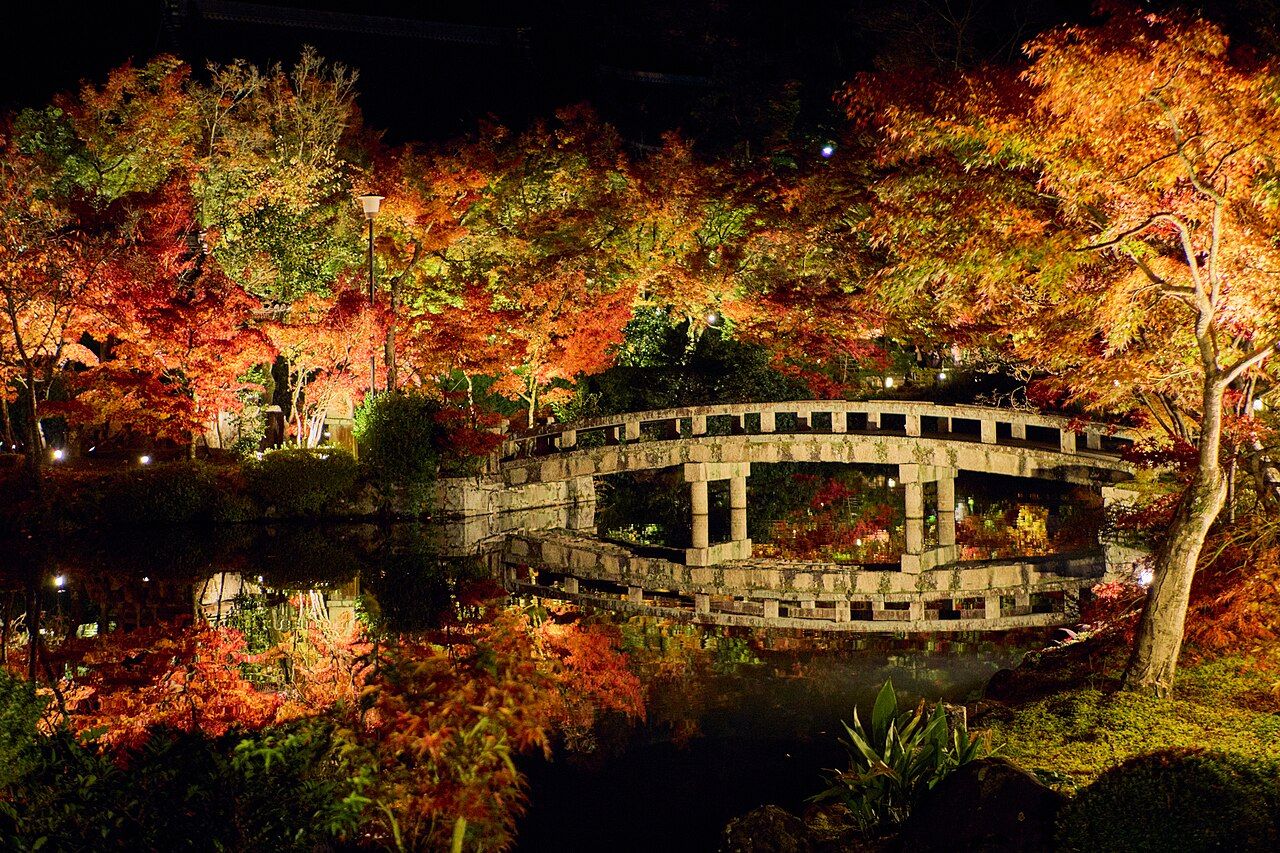
The cover image is an archive photograph, not a live report of this year's foliage. Illumination dates do not guarantee peak colour, dry weather or a quiet pond reflection. Come for the place and the evening setting, keeping expectations about leaves and photographs flexible.
Understand the temple beyond its maples
Eikando's official introduction identifies it as the head temple of the Jodoshu Seizan Zenrinji branch. Despite the name Zenrin-ji, it should not simply be described as another Zen temple. Its devotion to Amida gives the indoor visit a different focus from a garden-only stop.
The principal image is Mikaeri Amida, the Amida looking back over his shoulder. The temple's explanation of the image relates a legend in which Amida moves ahead of the monk Eikan, then looks back towards him. Read this as a religious story, not a historical event proven by a modern visitor guide.
The temple interprets the backward glance through compassion for those who have fallen behind. Knowing that meaning changes the encounter: the image is more than an unusual pose to recognise. Pause without turning the worship space into a photography stop, and let visitors who wish to pray use it respectfully.
You do not need specialist knowledge to make the visit worthwhile. A short introduction before arriving can be more useful than reading a long explanation on your phone while standing in a doorway. Save the historical questions for a quiet moment outside the circulation route.
Closures that matter for an autumn itinerary
For 11 November–6 December 2026, the temple states that Garyu-ro corridor and Senbutsu-do are closed. The Taho-to pagoda may also close because of crowds or poor weather. A route described in an older guide may therefore be impossible during your visit.
Do not make a particular corridor photograph or pagoda viewpoint the sole reason for buying a ticket without checking the current notice. The garden and the parts of the temple that are open can still form a worthwhile visit, but expectations should match the actual access. A temporary closure is not a reason to follow another visitor past a barrier.
Consult the official precinct guide for orientation, then follow the route marked on the day. A map shows the complex; it does not promise that every building is open under every admission type. Daytime and night routes are especially important to keep separate.
Getting there: train plus walk or a bus closer to the gate
The temple's directions give Keage station a 15-minute walk and Nanzen-ji Eikando-michi bus stop a 3-minute walk. These are published approximations, not guarantees for a crowded pavement or a slower walking pace.
From Kyoto Station, the subway option uses the Karasuma Line to Karasuma Oike, then the Tozai Line towards Rokujizo to Keage. City bus 5 is another listed option to Nanzen-ji Eikando-michi. Compare the live journey from your starting point: the bus reduces the final walk, while the subway may fit better with the rest of your route.
During the autumn programme, the temple provides no parking for private cars, motorcycles or e-scooters and asks visitors to use public transport. A taxi drop-off also does not remove the crowd or walking conditions near the entrance. Give the driver the correct destination and follow local access instructions.
If steps, footwear changes or standing in queues are difficult, contact the temple about the specific route before buying into a wider itinerary. Strollers are not permitted in the temple aisles during the autumn programme. A nearby station or a garden photograph does not establish a fully step-free visit.
Combine with Nanzen-ji without overloading the day
Nanzen-ji's temple precincts are a useful neighbouring comparison: they offer a different temple setting and can form part of the same area outing. Choose which place deserves your attention first. A daytime Eikando visit plus a selective Nanzen-ji stop is more realistic than assuming every paid sub-area and viewpoint will fit.
For an evening Eikando plan, use the afternoon for one nearby visit, then leave time outside the temple for food and a break. Check that the place where you intend to eat is actually serving at that hour. The interval between daytime closure and night opening is not permission to picnic in the precincts.
If you are already tired after a long Kyoto sightseeing day, choose one temple and enjoy it properly. The attraction of this district is proximity, but proximity does not remove queues, shoe changes or the attention required to appreciate separate sites.
Photograph the garden respectfully
The temple prohibits photography and video inside the temple buildings, with the garden as the permitted exception. Tripods and similar equipment are not allowed in the precincts. Keep the camera away in indoor religious spaces even if another visitor is taking pictures.
At night, work within those restrictions rather than bringing equipment you cannot use. Share viewing positions, avoid blocking narrow passages and move on when staff direct the flow. A handheld image may be imperfect; the experience does not require an unobstructed professional photograph.
Food, drinks, smoking and pets are prohibited in the precincts. Finish your snack before entering and keep a warm layer available for waiting outdoors. Eikando works best when the logistics are settled early enough that the garden and temple can receive your attention.
Cover photograph: Illuminated maple trees and stone bridge reflected in Eikando’s pond in Kyoto — Archive photograph taken before 11 March 2026; not a live report of autumn foliage. — lumoplank, CC0 1.0.
Frequently Asked Questions
Can I stay inside from the daytime visit until illumination?
No. Day visitors must leave by 17:00. Night admission is separate, with reception beginning at 17:30 during the published 2026 night programme.
Can I buy advance tickets for the autumn visits?
The temple says advance daytime and night tickets are not available. Buy on the day; the ticket is valid that day only. Allow for queues and possible early closure of reception.
What are the 2026 illumination dates?
The published night programme runs from 20 November to 6 December 2026. Reception is 17:30–20:30 and the precincts close at 21:00, subject to crowd-management changes.
Are the corridor and pagoda always accessible?
No. Garyu-ro and Senbutsu-do close from 11 November to 6 December 2026. Taho-to may close for crowds or weather. Check current access before making a specific viewpoint the reason for visiting.


Keep Exploring
Sanjusangen-do Kyoto: Plan Your Temple Visit
Plan Sanjusangen-do in Kyoto: sculpture highlights, seasonal hours, admission, access and a sensible pairing with Kyoto National Museum.
Daigo-ji Kyoto: Choose Your Temple Visit
Choose Sanboin, Garan and Reihokan with current ticket distinctions, access advice and the Kami-Daigo mountain closure clearly separated.
Uji from Kyoto: Tea, Temples and a Riverside Visit
Plan Byodoin, a tea experience and Uji’s river, with separate interior tickets, station choices and current visitor notices.