
Choose Sanboin, Garan and Reihokan with current ticket distinctions, access advice and the Kami-Daigo mountain closure clearly separated.
Daigo-ji makes most sense as a choice between a garden, a group of major temple buildings and a collection of religious art. It is not one entrance followed by an obligatory mountain climb. Choose the lower precincts for a substantial Kyoto temple visit, then buy admission for the areas you actually want to see.
There is an important current restriction: when checked on 9 November 2026, the temple's Japanese homepage prohibited entry to Kami-Daigo until further notice because of landslide danger on the mountain path. Plan a lower-precinct visit unless the temple explicitly announces reopening. General mountain hours elsewhere on its website do not override that notice.
Our wider Kyoto guide helps decide whether this southeastern outing fits your stay. Daigo-ji is particularly useful when you want to compare different kinds of temple space without travelling between distant districts.
Choose your lower-precinct visit
| Area | Main reason to choose it | Important distinction |
|---|---|---|
| Sanboin | Garden composition and architecture viewed together | Special palace viewing has an additional charge |
| Garan | Five-storey pagoda, Kondo and the temple landscape | Grounds admission does not promise entry inside every building |
| Reihokan | Buddhist sculpture, painting and other temple treasures | Check the current exhibition and which galleries are open |
| Kami-Daigo | Historic mountain precinct | Entry prohibited in the notice checked on 9 November 2026 |
For a first visit, Sanboin and Garan make a useful pair: one concentrates attention on a composed garden, the other gives you the buildings and broader setting. Add Reihokan because religious art interests you, rather than because the largest ticket automatically makes the best visit. If your main interest is sculpture, reverse that priority and check the museum before choosing the other areas.
Allow around 2–3 hours for two or three lower areas with pauses, as an editorial estimate excluding transport. The temple's own FAQ gives a shorter outline of approximately 30 minutes per area. That is a starting point, not a requirement to hurry through a garden or exhibition.
Understand the ticket before choosing it
The current Japanese admission page gives ordinary adult prices of ¥600 for one area, ¥1,000 for two and ¥1,500 for all three: Sanboin, Garan and Reihokan. The corresponding junior-high and high-school prices are ¥400, ¥700 and ¥1,000; elementary-school children and younger enter free. Sanboin's special palace viewing is an additional ¥500 for adults and secondary-school students.
These are the ordinary rates checked on 9 November 2026. The same page publishes different spring arrangements, including ¥1,800 for the adult three-area ticket and ¥800 for one area, with a spring period beginning 20 March and ending on the third Sunday in April. Recheck the date-specific table before a spring visit; do not extend an ordinary ticket comparison into that period.
Some English pages still describe different combinations and museum arrangements. Use the current Japanese tariff page and confirm the areas at the desk. A screenshot of an older English table is not evidence that a cheaper combination remains available. Tickets are sold at the Sanboin reception; ordinary visits do not require advance reservations according to the temple FAQ.
Two ordinary adult single-area tickets cost more than the ordinary two-area combination. However, buying three areas only saves a decision if you genuinely want all three. Ask what is open, choose the experience, then purchase the appropriate ticket. If you are considering an additional special viewing, clarify its separate entrance and conditions before assuming it is included.
Sanboin: let the garden set the pace
Sanboin is the place to begin if you enjoy looking from a building into a deliberately arranged landscape. The temple's Sanboin guide connects the garden with Toyotomi Hideyoshi's cherry-blossom gathering in 1598 and identifies the Omote Shoin as an important viewing building. That relationship between interior and garden is more useful to a visitor than a long list of architectural terms.
Start with the whole view, then pick out the balance between water, stones, planting and buildings. Look again from the permitted positions instead of treating the garden as scenery to cross as quickly as possible. You do not need to identify every named stone to see how one element draws attention towards another.
Sanboin also has spaces classed as special viewing, while other rooms are normally closed. Follow the route offered that day. The fact that a room appears on the temple's plan does not establish ordinary access. If a particular interior matters to you, ask before paying the supplement rather than buying it merely because the word “special” sounds essential.
You remove shoes in the buildings, and the temple asks visitors to wear socks to protect the cultural properties. Bring socks even if you arrive in sandals. Keep the transition area clear and allow a little time for putting shoes back on; this is part of the visit, not an inconvenience to rush through while others are entering.
Garan: architecture before the photograph
Choose Garan for the relationship between the pagoda, halls and wooded grounds. The official grounds guide identifies the Niomon, Kondo, five-storey pagoda and Bentendo among its buildings. Use these names to orient yourself and choose a few points of attention, rather than assuming each label represents a separate interior visit.
The five-storey pagoda is a strong visual anchor. Look at how its successive roofs change the building's proportions as you move along the permitted route. Then give the Kondo time as a religious building in its own right. A successful visit can be a sequence of three attentive stops instead of a continuous search for the next picture.
Bentendo and its waterside setting are another reason to continue through the lower grounds if conditions and energy allow. Autumn photographs often make this part of Daigo-ji look like a single seasonal event, but foliage depends on the year and the precise moment of your visit. The architecture and setting need to justify the journey even when the leaves do not match an image you saved.
Stay on the authorised paths and respect closed doors. Ordinary admission to Garan is not a guarantee of access inside the pagoda, a ritual or an evening illumination. Those require their own current notices. The homepage still contains older dated event announcements, so read the year as carefully as the month.
Reihokan: check the display, not just the collection
Reihokan is the museum choice for visitors who want to understand the objects associated with Daigo-ji. Its official page describes sculpture, paintings, documents and other treasures. The scale of a collection does not tell you how many objects will be on view during your visit.
The FAQ distinguishes the main building, Heiseikan and statue hall, with display arrangements varying and exceptional closures possible. Check the current exhibition information or ask reception which rooms are available. Do not use an old spring or autumn poster as a programme for another year.
Inside, choose a manageable number of objects and read their labels carefully. Compare materials, posture and the way a figure is presented, while avoiding invented explanations for details you cannot identify. A gallery visit can make the temple outside more meaningful, especially if you give yourself a pause between the two.
Photography is prohibited inside Reihokan. If you want a record of a particular work, ask about authorised publications or reproductions. This also changes the rhythm of the visit: the useful thing to take away may be a question or an observation rather than another image on your phone.
Keep Kami-Daigo out of the current route
The upper precinct is historically important, but it is not an available extension while the homepage's entry prohibition remains in force. Do not infer reopening from an old hiking account, a map showing a trail or the general mountain registration hours. Check the temple's current notice again before travelling.
Even after an explicit reopening, it would be a separate walking decision. The normal Kami-Daigo guidance concerns a mountain precinct, while the FAQ describes access on foot and a substantial return outing. Someone comfortable with the lower garden is not automatically prepared for that terrain.
For now, use the time you might have allocated to climbing for a considered lower-precinct visit and an unhurried return. There is no need to replace a closed mountain route with several hurried extra attractions elsewhere in Kyoto.
Reach Daigo-ji and plan the return
The temple's access page shows Daigo Station on the Tozai subway line. From Kyoto Station, one rail option is JR to Yamashina, followed by the subway to Daigo. The temple FAQ allows approximately 10–15 minutes on foot from Daigo Station; add time for navigation and your own pace.
Keep that approach separate from your time inside. For a morning visit, travel early enough to choose your ticket without making lunch or the return journey a deadline. For an afternoon visit, work backwards from admission cutoffs rather than the moment the gates close.
Ordinary lower-precinct hours are 09:00–17:00 from 1 March through the first Sunday in December, then 09:00–16:30 from the following day through the end of February. Admission normally ends 30 minutes before closing. Special programmes can differ. Arriving at the cutoff leaves very little useful time for a multi-area ticket.
The temple recommends public transport because surrounding roads are narrow and parking is limited. If you choose a bus, check its current operator timetable and actual boarding point; this guide does not republish an old departure schedule. Save the return station and your accommodation route before entering.
Access, photography and a comfortable visit
The lower precincts include gravel and gentle slopes. The FAQ says some wheelchair routes may require assistance, and Sanboin's buildings cannot be visited while remaining in a wheelchair because of their steps. Wheelchairs are not available to borrow. Ask about your intended route and facilities before buying; a lower-level visit is not automatically a step-free one.
Personal photography has limits: halls, Buddhist statues and Reihokan interiors are excluded, and tripods, monopods and selfie sticks are prohibited throughout the precincts. Follow additional signs and requests. Commercial photography requires advance arrangements; a visitor ticket is not permission for a shoot.
Plan food outside the sightseeing sequence or use the temple's designated restaurants. Its rules prohibit bringing meals into the precincts, while allowing sealed water containers for drinking outdoors. Bring what you need for hydration and avoid turning a garden viewing place into a picnic stop.
For seasonal planning, our guide to when to visit Kyoto compares broader tradeoffs. At Daigo-ji, the dependable decision is which spaces interest you; blossom, foliage and special access should remain date-specific checks.
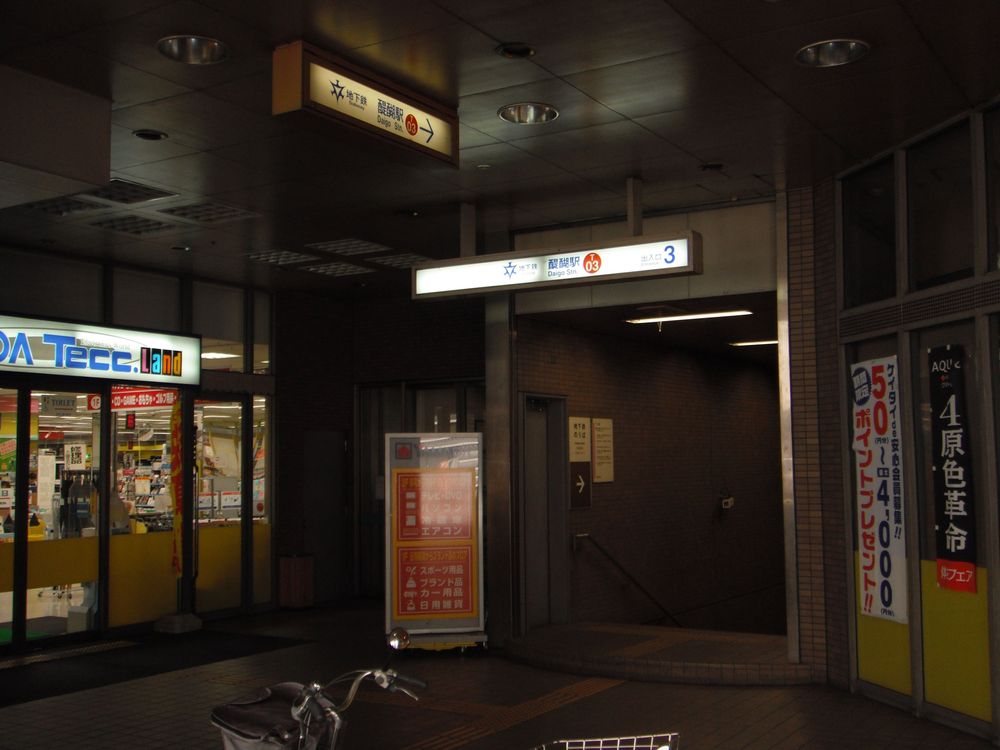
Cover photograph: Entrance 3 of Daigo subway station, an arrival point for Daigo-ji in Kyoto — L26, CC BY 3.0. Photographed in 2011.
Frequently Asked Questions
Can you climb to Kami-Daigo now?
The temple homepage checked on 9 November 2026 prohibited entry until further notice because of landslide danger. Plan the lower precincts and require an explicit reopening announcement before considering the mountain route.
Which ticket suits a first Daigo-ji visit?
Sanboin and Garan are a useful pair for garden and temple architecture. Add Reihokan if the current art display interests you. Confirm the day's open areas and seasonal tariff before buying.
How long should you allow?
Around 2–3 hours for two or three lower areas with pauses is our planning estimate, excluding transport. A focused single-area visit can be shorter; last admission is not a sensible arrival target for the complete lower precinct.
Does the ordinary ticket include every interior?
No. Sanboin special palace viewing has a separate charge, museum galleries have their own opening arrangements, and grounds access does not guarantee entry into every hall or the pagoda.


Keep Exploring
Nanzen-ji: Choose Your Kyoto Temple Visit
Choose Sanmon, the Hojo garden and the aqueduct at Nanzen-ji, with separate fees and the limited November 2026 opening of Nanzen-in.
Kinkaku-ji: Plan Your Kyoto Temple Visit
Plan the Golden Pavilion, pond walk and northwest Kyoto journey, with current admission, access and photography rules.
Ryoan-ji Kyoto: Rock Garden and Temple Visit
Plan Ryoan-ji’s rock garden and pond walk, with current admission, winter hours and the separate autumn 2026 evening programme.