
European Spa & Wellness Getaways: HU, CZ, SI
Budapest's Turkish baths, Karlovy Vary's UNESCO colonnades and Slovenia's black thermal water — a planner's guide to Central Europe's spa towns with EUR entry prices and named hotels.
Europe invented the spa break. Long before "wellness" was a marketing word, Romans were soaking in Bath and Baden-Baden, Ottomans were steaming Budapest, and Belle Epoque aristocrats were taking the waters at Vichy and Karlovy Vary. That heritage is still bathable today, often for the price of a museum ticket. This guide covers the best spa and wellness getaways in Europe, from the dense thermal culture of Central Europe to grand UNESCO spa towns, single iconic bathhouses and modern geothermal lagoons, with named spas, verified or indicative 2026 prices, and practical planning notes so you can build a trip around hot water rather than just hoping for it.
We have focused on real, bookable places. Where a price changes constantly (Iceland's lagoons use demand-based pricing, for example) we say so rather than pretend a single number holds all year.
Fast Facts
| Detail | Summary |
|---|---|
| Top thermal destinations | Budapest (Hungary), Czech spa triangle, Slovenia, Baden-Baden (Germany), Bath (England), Spa (Belgium), Reykjavik area (Iceland), Tuscany/Saturnia (Italy), Styria (Austria) |
| Typical day at a thermal bath | Roughly €15–€50 for European thermal baths; Iceland's lagoons run higher (from about US$96 / ISK 11,990 at the Blue Lagoon) |
| Best season | Year-round; autumn and winter are most atmospheric for steaming outdoor pools, summer best for lakeside thermal resorts |
| UNESCO "Great Spa Towns of Europe" | 11 towns, 7 countries, inscribed 2021 (World Heritage ref. 1613): Baden bei Wien (AT); Spa (BE); Karlovy Vary, Mariánské Lázně, Františkovy Lázně (CZ); Vichy (FR); Baden-Baden, Bad Ems, Bad Kissingen (DE); Montecatini Terme (IT); City of Bath (UK) |
| Best for first-timers | Budapest (cheap, central, dramatic) |
| Best for luxury | Baden-Baden, Terme di Saturnia, Iceland's Blue Lagoon Retreat |
| Best on a budget | Saturnia's free Cascate del Mulino, Budapest weekday tickets, Slovenia's Pannonian resorts |
Prices below are 2026 figures from official or specialist sources where available. Treat euro conversions of forint and krona prices as indicative; currency moves and many baths quote (and prefer) the local currency.
Central Europe: the heart of European bathing
If you want the densest, most affordable and most atmospheric concentration of thermal culture in Europe, head to the centre of the continent. Hungary, Czechia and Slovenia are where bathing is least a luxury and most a way of life, and where the Belle Epoque colonnades, Ottoman domes and modern wellness worlds sit within a short train ride of one another.
Budapest, Hungary: the world's bath capital
No city makes thermal bathing as central to daily life as Budapest, which sits on over 100 natural thermal springs feeding around 15 working bathhouses. The water ranges from roughly 21°C to 78°C at source, with a pH-neutral mineral composition. It is the cheapest entry point to a serious spa break in Europe and the easiest to combine with a city weekend.
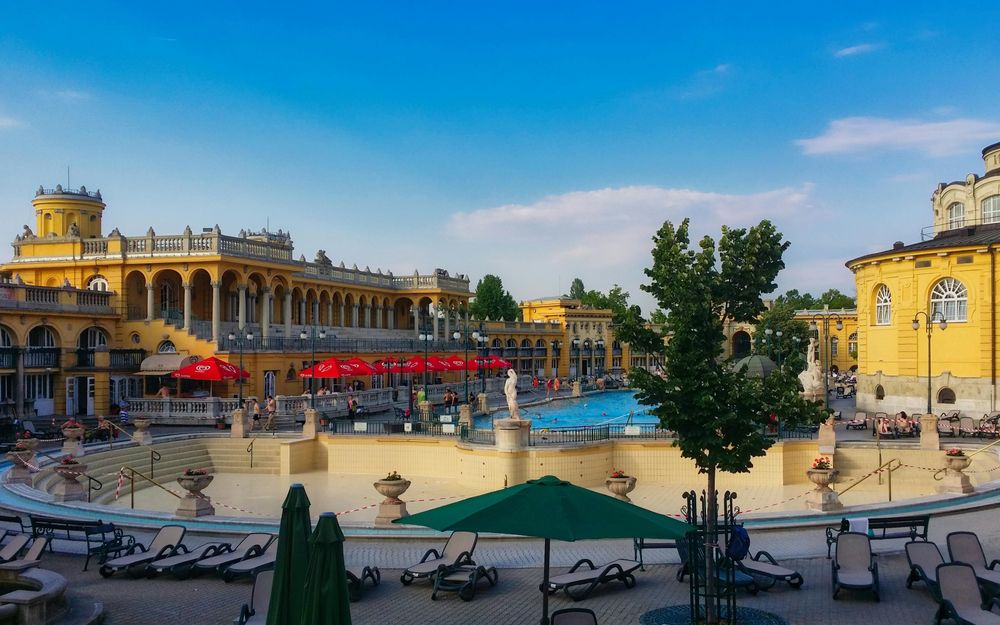
Széchenyi Thermal Bath is the giant, the largest medicinal complex in Europe: 18 pools, three of them outdoors, in a yellow neo-Baroque palace opened in 1913. The warmest outdoor pools are fed at bathing temperature year-round, and this is the home of the famous winter image of locals playing chess on floating boards amid the steam. From 7 January 2026, Budapest's baths raised prices by roughly 5%. A standard daytime ticket runs around HUF 13,000–16,000 (broadly €33–€41) depending on weekday/weekend and locker-vs-cabin; weekend entry with cabin access sits at the top of that range, around €30–€35. Fast-track/QR tickets sold by third parties cost more (often €44–€47), so buy the standard ticket on the official site to avoid markup.
Gellért Thermal Bath, attached to the Gellért Hotel, is the Art Nouveau showpiece, with stained glass, mosaic-tiled indoor halls and details that are among the most photographed in the city. Following 2024 renovations, day entry runs roughly €30–€38, and it draws quieter weekend crowds than Széchenyi.
Rudas Bath, built in 1550, preserves a genuine 16th-century Ottoman bathing experience most authentically: the octagonal Turkish dome, the central hot pool ringed by four corner basins. It also has a modern rooftop hot tub with Danube and Parliament views (thermal access roughly €15–€30 at weekends; the sunset rooftop experience €30–€45). Note that some sessions are single-sex, so check the schedule. Király is the small, atmospheric Ottoman original for a quieter soak.
For a more local, less polished experience there are smaller neighbourhood baths such as Lukács, long favoured by serious bathers and physiotherapy patients, where the walls are lined with marble plaques of thanks from people the waters are said to have cured. The point of Budapest is range: in a single weekend you can move from a grand neo-Baroque palace to a 450-year-old Ottoman dome to a steamy rooftop pool, all within a few tram stops.
Practical notes: bring or rent flip-flops, take a swim cap if you want lane swimming, and go early or late to dodge the heaviest crowds at Széchenyi (mid-morning on a weekday is the sweet spot, while weekend afternoons are busiest). Most baths offer lockers or private cabins; the cabin is worth the small extra for somewhere to leave your things and change in privacy. Towels and robes can be rented but cost more than bringing your own, and many bathers pack a reusable water bottle, since the heat dehydrates faster than you expect. A spa-focused weekend in Budapest is comfortably one of the best-value wellness breaks on the continent, and it slots neatly around the city's ruin bars, riverside walks and coffee houses.
The Czech spa triangle: colonnades and the drinking cure
Western Bohemia holds three of the UNESCO-inscribed "Great Spa Towns of Europe," a designation made in 2021 (World Heritage ref. 1613) that recognises their Belle Epoque architecture and bathing-cure culture. Here the ritual is as much about drinking the mineral water as soaking in it.
Karlovy Vary (Carlsbad) is the grandest, built around 12 hot springs ranging from about 30°C to 73°C. The local tradition is the drinking cure: visitors walk between five colonnades, sipping water at each from a spouted porcelain cup (cups cost roughly €4–€10 and make a fine souvenir). The showpiece is the Vřídlo geyser, which shoots around 12 metres into the air at about 72°C. Beyond the water, the town is a confection of pastel facades, grand hotels and forested hills.
Mariánské Lázně (Marienbad) offers around 40 cold mineral springs and a famous singing fountain that performs to music below its colonnade on the hour. It is the greenest of the three, a town of parks and forested slopes that drew Goethe, Chopin and Edward VII in its heyday; day spa access at historic bathhouses runs roughly €25–€40, and many hotels here still operate as full medical-spa establishments with doctors on site. Františkovy Lázně (Franzensbad) provides the gentlest cure of the three, a tidy yellow-and-white town specialising in peat baths and mineral mud said to help with circulatory and gynaecological complaints, all at lower prices (half-board from around €90/night).
What unites the triangle is that bathing here is woven into a whole choreography of slow days: the morning walk to fill your cup, the unhurried promenade between colonnades, the afternoon treatment, the evening concert. Visiting is as much about colonnades, pump rooms, wafer-thin spa wafers (oplatky) and manicured parks as about the water itself, and the towns sit close enough together to see two or three over a long weekend, with Prague an easy two-hour drive or train away.
Slovenia: thermal Pannonia for value and families
Slovenia is a quietly excellent and very affordable thermal destination. Its eastern Pannonian plain concentrates 87 registered thermal springs, and the resorts there are among the best value in Europe.
Terme 3000 Moravske Toplice is built around a rare "black" thermal water, a hyperthermal mineral water with high mineral and bitumen content that surfaces dark at about 38°C and is unusual enough to have its own loyal following. The resort wraps multiple indoor and outdoor pools, slides and saunas around that signature water; day entry costs roughly €19–€26 at weekends, while hotel half-board starts around €90/night, which makes a two- or three-night stay genuinely cheap by Western European standards.
Terme Olimia, near Podčetrtek, is known for its sleek, architecturally significant Orhidelia wellness world, a wave-roofed pavilion by the Slovenian studio Enota that has won design awards and feels closer to a contemporary art space than a municipal pool. Terme Čatež, the country's largest resort, serves families with water-park energy: a "Thermal Riviera" of summer pools, slides and a riverside setting. Day tickets across these resorts generally sit in the roughly €19–€55 range depending on resort and season, making Slovenia one of the best-value wellness regions in Europe. The Pannonian resorts are an easy add-on after the more famous sights of Ljubljana and Lake Bled, turning a short city-and-lakes trip into a fuller week.
The grand cure: Western Europe's heritage baths
Baden-Baden, Germany: the grand cure, two ways
Baden-Baden is the most aristocratic of the UNESCO Great Spa Towns and offers a rare choice between two world-class baths a few steps apart.
Friedrichsbad is the 19th-century Roman-Irish bath: a textile-free, 17-station ritual of warm air, steam, brush-soap massage, thermal pools and a domed central hall topped by a frescoed cupola. You move through the stations in a set sequence, building heat, scrubbing, soaking and then cooling, before being wrapped to rest. Mark Twain famously wrote that here "you lose track of time within ten minutes and track of the world within twenty." In 2026 the classic circuit costs roughly €36, or about €49 including the soap-and-brush massage, and takes around three to three-and-a-half hours. It is famously serene and largely silent; this is bathing as ceremony, not a splash zone, and there is no swimwear, so first-timers should arrive ready for a communal, mixed, fully nude experience.
Caracalla Therme next door is the modern, swimsuit-on alternative with indoor and outdoor thermal pools, current channels, neck showers, a grotto and a large upstairs sauna world. 2026 indicative prices: about €21 for two hours, €29 for four hours, and around €35 for a full day. Families and anyone uneasy about nude bathing should choose Caracalla; purists choose Friedrichsbad. Either way, the wider town rewards a slow day: a casino made famous by Dostoevsky, the Lichtentaler Allee park promenade along the Oos river, and grand 19th-century hotels keep Baden-Baden squarely in the world of the leisurely "cure" rather than the quick dip.
Bath, England: the only natural thermal spa in the UK
Bath is the namesake of the entire concept and the UK's sole entry on the UNESCO list. You cannot bathe in the ancient Roman Baths (they are a museum), but Thermae Bath Spa lets you soak in the same naturally hot, mineral-rich water, most famously in the open-air rooftop pool with views over the Georgian city.
A standard two-hour session in 2026 costs £42.50 Monday–Friday and £47.50 at weekends, including the rooftop pool, the Minerva Bath and the Wellness Suite (aroma steam rooms, infrared sauna). It is compact and very popular, so book a timed slot in advance, especially for sunset, when the rooftop water glows against the honey-coloured stone of the city below. Pair the spa with the adjoining Roman Baths museum, where you can see the original sacred spring and 2,000-year-old plunge pool, and you have a half-day that joins ancient and living thermal Britain in a few hundred metres. Bath itself is small, walkable and packed with Georgian architecture, so it is an unusually easy place to build a soak into a wider sightseeing weekend.
Spa, Belgium: the town that gave bathing its name
The word "spa" comes from this small town in the Ardennes, whose iron-rich springs were drawing European nobility to "take the waters" centuries before the term went generic. Les Thermes de Spa, reached by a short funicular ride above the town, combines indoor and outdoor pools (including a heated rooftop pool with valley views) with saunas and hammams across roughly 800 m². 2026 prices: €35 for three hours on weekdays (€37 weekends/holidays) and €48 for a full midweek day. The town below still has its pump rooms and Belle Epoque galleries, and the surrounding forested Ardennes hills invite walking and cycling, so it pairs well with a quiet, green, low-key weekend rather than a city trip.
Baden bei Wien and Montecatini Terme
Austria's UNESCO entry is the elegant Baden bei Wien, an easy spa-town add-on to Vienna, while Italy fields Montecatini Terme for grand-spa-town architecture. Both are more about colonnades, pump rooms and Belle Epoque promenading than dramatic soaking.
Modern lagoons and luxury resorts
Iceland: geothermal lagoons near Reykjavik
Iceland's lagoons are the most photogenic wellness destinations in Europe, though they price quite differently from mainland baths and use demand-based pricing, so book ahead.
The Blue Lagoon on the Reykjanes peninsula is the icon: milky, silica-rich geothermal water in a black-lava setting near the airport. 2026 published starting prices are about ISK 11,990 (≈US$96) for Comfort, ISK 14,990 (≈US$121) for Premium and ISK 18,490 (≈US$149) for Signature; a bathrobe is included on Premium and Signature. Individual prices vary with demand, and pre-booking a time slot is mandatory.
Sky Lagoon, on the edge of Reykjavik, is the easier-to-reach, ocean-facing alternative with an infinity edge that appears to spill straight into the Atlantic. Its Saman Pass (public changing rooms) is around ISK 13,990 (roughly US$110), including the seven-step Skjól bathing ritual that moves you through a hot lagoon, cold plunge, sauna, cold mist, a salt and body scrub, steam and a final rinse; the Sér Pass adds private changing facilities. Both are excellent; Sky Lagoon is the simpler add-on to a city stay, only a short drive from central Reykjavik, while the Blue Lagoon is the bigger-day-out destination, best timed for arrival or departure since it sits close to Keflavík airport.
Note: Iceland's lagoons sit in a volcanically active region and have occasionally closed or evacuated during eruptions on the Reykjanes peninsula. Check the operator's status page before travelling.
Tuscany, Italy: Saturnia's free waterfalls and a luxury resort
Saturnia in Maremma offers the most charming contrast in this guide. The Cascate del Mulino are open-air, sulphurous thermal waterfalls tumbling into natural travertine pools, free to access 24/7 (you only pay for parking, around €2.50/hour in 2026, free overnight). Go at dawn for steam and quiet.
A short drive away, the luxury Terme di Saturnia resort offers day access to its landscaped thermal pools and spa from about €29 midweek and €39 on weekends/holidays for adults (with afternoon and reduced rates available). The sulphur-rich water surfaces at around 37.5°C, close to body temperature, and the resort sets it in terraced pools surrounded by Maremma countryside. It is the upgrade option if you want loungers, treatments, order and a poolside lunch rather than a muddy riverbank, and many visitors do both: the free Cascate at dawn, the resort by day. The surrounding Maremma is one of Tuscany's quieter corners, with hilltop villages, Etruscan tombs and uncrowded beaches making the area worth a few nights in its own right.
Styria, Austria: bathing inside a Hundertwasser fantasy
Rogner Bad Blumau in Styria is a thermal resort designed by artist Friedensreich Hundertwasser, all undulating roofs, golden cupolas, irregular windows, tiled columns and grass-topped buildings that seem to grow out of the rolling Styrian landscape. There are no straight lines, by design; Hundertwasser believed them unnatural. Beneath the whimsy is a serious thermal resort, with indoor and outdoor pools fed by local springs, including one of Austria's deepest thermal wells, plus saunas and treatment areas. Day tickets are available (typically from a 9am start). Exact 2026 day-rates are published only on the operator's German-language price page and we could not confirm a single figure here, so check blumau.com directly before booking; resort guests get discounted entry. It is the most distinctive-looking bath in this guide and a natural pairing with the food-and-wine roads of southern Styria.
How to plan your European spa break
Choose your style first. City-and-bath (Budapest, Bath, Karlovy Vary, Baden bei Wien near Vienna) suits a culture weekend; resort-and-treatment (Slovenia, Bad Blumau, Terme di Saturnia) suits a slower escape; bucket-list soak (Iceland's lagoons) is a destination in itself.
Budget. Most mainland European thermal baths cost €15–€50 for a half- to full-day visit, with Slovenia and Budapest at the cheaper end. Iceland is the outlier at roughly US$96 and up. Pair baths with mid-range hotels and you can run a weekend spa break from around €280 per person in Budapest or Slovenia. A thermal-bath weekend is also one of the easier trips to book on short notice — the city baths of Budapest and Bath especially — so it fits neatly among our last-minute weekend getaways in Europe.
Combine destinations by rail. Central Europe's spa culture is unusually well connected: Budapest, the Czech triangle (via Prague) and Slovenia's resorts (via Ljubljana) all sit on or near fast train lines, and Baden-Baden, Baden bei Wien and Spa are likewise easy rail add-ons to Frankfurt, Vienna and the Ardennes. Iceland and the Italian and English baths are the exceptions that need their own dedicated trip rather than a stopover.
Etiquette. Many German and Austrian baths (and Friedrichsbad in particular) are textile-free and often mixed; saunas across the region are usually nude even where pools are not, and entering a German sauna in a swimsuit is considered poor form. In the Czech towns the headline ritual is drinking the water, not just soaking, so buy a cup and pace yourself between colonnades. Bring flip-flops, a towel (or rent one), arrive hydrated, and check single-sex session times at Ottoman baths like Rudas before you go.
For more weekend trip ideas you can reach by rail, see our guide to the best European weekend city breaks by train. To build Slovenia's thermal resorts into a longer trip, pair them with our 4-day Ljubljana and Lake Bled escape, and for the Central European angle see our hidden gems of Eastern Europe.
Sources and further reading
- UNESCO World Heritage Centre, "The Great Spa Towns of Europe" (ref. 1613): https://whc.unesco.org/en/list/1613/
- Széchenyi Baths official prices: https://szechenyibath.com/prices/
- Thermae Bath Spa (Bath), official site: https://www.thermaebathspa.com/
- Friedrichsbad Baden-Baden, opening hours and prices: https://www.friedrichsbad.eu/
- Caracalla Spa Baden-Baden, opening hours and prices: https://caracalla.eu/opening-hours-and-prices/
- Blue Lagoon Iceland, day visit: https://www.bluelagoon.com/day-visit/the-blue-lagoon
- Sky Lagoon Iceland, tickets: https://www.skylagoon.com/packages/
- Les Thermes de Spa (Belgium), prices and opening hours: https://thermesdespa.com/prices-and-opening-hours/
- Rogner Bad Blumau, price list: https://www.blumau.com/en/bathing/price-list.html
Frequently Asked Questions
Which European city has the best thermal baths?
Budapest is widely considered the best, sitting on over 100 natural thermal springs and home to grand historic baths like Széchenyi, Gellért and the 16th-century Ottoman Rudas. It is also one of the cheapest and most central options for a spa-focused city break.
How much do the Budapest baths cost?
From 7 January 2026, Budapest's bath prices rose about 5%. A standard daytime ticket at Széchenyi is roughly HUF 13,000–16,000 (around €33–€41) depending on weekday/weekend and whether you choose a locker or cabin. Third-party fast-track tickets cost more, often €44–€47.
What are the Great Spa Towns of Europe?
They are 11 historic spa towns across 7 countries, inscribed as a single UNESCO World Heritage Site in 2021 (ref. 1613): Baden bei Wien (Austria), Spa (Belgium), Karlovy Vary, Mariánské Lázně and Františkovy Lázně (Czechia), Vichy (France), Baden-Baden, Bad Ems and Bad Kissingen (Germany), Montecatini Terme (Italy) and the City of Bath (UK).
What is the drinking cure in the Czech spa towns?
In towns like Karlovy Vary, the tradition is to walk between the colonnades sipping warm mineral water from a spouted porcelain cup, rather than only bathing. Karlovy Vary has 12 hot springs (about 30–73°C) and five colonnades; the Vřídlo geyser there erupts around 12 metres at roughly 72°C.
What are the best wellness destinations in Europe?
For value and atmosphere, Budapest and Slovenia's thermal resorts; for grand heritage, the Czech spa triangle, Baden-Baden and Bath; for luxury, Terme di Saturnia and Iceland's Blue Lagoon; and for design, Rogner Bad Blumau in Austria. Choose between a city-and-bath weekend or a slower resort escape.
How much does a day at a European thermal bath cost?
Most mainland European thermal baths charge roughly €15–€50 for a half- to full-day visit. Examples in 2026: Slovenia's Moravske Toplice from about €19, Caracalla Therme in Baden-Baden from about €21 (2 hours), Thermae Bath Spa in Bath £42.50 (2 hours, weekday), Les Thermes de Spa €35 (3 hours). Iceland's lagoons are pricier, from about US$96.
When is the best time for a spa break in Europe?
Year-round. Autumn and winter are the most atmospheric for steaming outdoor pools and indoor historic baths, while summer suits lakeside and resort thermal destinations such as Slovenia. Iceland's lagoons are spectacular in winter under low light or the northern lights.
What are the best thermal baths in Europe?
Standout individual baths in this guide include Budapest's Széchenyi (the largest medicinal complex in Europe), the Art Nouveau Gellért and the 16th-century Ottoman Rudas; Baden-Baden's Roman-Irish Friedrichsbad and modern Caracalla Therme; Thermae Bath Spa, the only place to bathe in Britain's natural hot springs; and Iceland's Blue Lagoon and Sky Lagoon. For dense variety in one trip, Budapest is hard to beat.
What are the best spa towns in Europe?
The most rewarding spa towns covered here are the UNESCO Great Spa Towns: Baden-Baden in Germany, the Czech triangle of Karlovy Vary, Mariánské Lázně and Františkovy Lázně, the City of Bath in England, Spa in Belgium, Baden bei Wien near Vienna and Montecatini Terme in Italy. They reward slow days of colonnades, pump rooms and Belle Epoque promenading as much as the bathing itself.

Keep Exploring
Last-Minute Weekend Getaways: Europe Guide
Need a quick escape? This practical Europe guide gives destination picks, 48-hour itineraries, booking hacks, packing lists and seasonal tips for last-minute weekend trips.
London City Break: Complete Weekend Guide
What to see, where to stay, how to get around and a sample weekend in London — free museums, the daily fare cap, Christmas markets and real costs.
Best European City Breaks for a Weekend
Where to go for a 48–72 hour European city break: the best cities by mood, with flight times, transit-pass costs and the best season to visit.