
Buenos Aires Japanese Garden: Plan Your Visit
Choose a Japanese Garden walk or guided visit in Palermo, with current resident and visitor prices, rain rules, access and meal arrangements.
Buenos Aires' Japanese Garden is worth choosing when you want a designed landscape with a cultural purpose: water, bridges, planting and interpretation of the relationship between Argentina and Japan. It is a paid attraction within Palermo's wider park landscape. Choose it for that particular experience, rather than assuming that every green space in Palermo offers the same kind of afternoon.
A self-guided visit can fit into roughly 60–90 minutes, while a guided visit, meal or cultural activity needs more room. Those are editorial planning allowances, excluding travel and queues. Our Buenos Aires culture and neighbourhood guide helps place it among the city's other experiences; this guide concentrates on whether to pay for the garden and how to use the visit well.
Fast facts
| Decision | Current guidance |
|---|---|
| Visitor entrance | Avenida Casares 3500, between Avenida Berro and Avenida del Libertador |
| Standard hours | Daily 10:00–18:45; ticket office closes at 18:30 |
| Published admission | Argentine residents ARS8,000 with ID; non-residents ARS24,000 |
| Suggested visit | 60–90 minutes for a selective independent walk |
| Guided visit | Saturday, Sunday and holidays at 11:00; limited capacity, first come |
| Rain | Garden normally stays open; guided visits are cancelled in rain |
| Picnic | Not permitted inside |
Information was checked on 11 November 2026. The operator's general information page distinguishes ticket-office closing from the time visitors may remain. Other official pages still carry a dated closure notice for 9–10 November; that is a specific exception, not a change to the normal daily pattern. Check fresh notices before leaving, rather than treating standard hours as a live confirmation of access.
Decide between a garden visit and a park afternoon
Choose the Japanese Garden if you enjoy looking at how water, rocks, paths, bridges and plants form a composition. The visit has boundaries, an entrance charge and rules intended for a maintained cultural landscape. It works especially well when you want a defined outdoor stop after museums or neighbourhood streets.
Choose the surrounding park landscape instead when the main aim is a longer, flexible walk without this attraction's admission charge. A picnic is not a reason to buy a Japanese Garden ticket: the operator prohibits picnics inside. Likewise, a group interested primarily in shopping and cafes may prefer our Palermo neighbourhood walk, which addresses a different part of the Palermo experience.
The non-resident price makes this distinction material. Decide whether the designed setting and cultural programme appeal before arriving at the gate. You do not need to justify the ticket by adding every available extra. An attentive walk can be the whole visit; lunch, shopping and a demonstration are separate choices.
Understand the Argentine-Japanese story
The garden was created in 1967 around the visit of then Crown Prince Akihito and Princess Michiko. The national heritage entry describes its creation by the Japanese-Argentine association, the 1977 redesign under landscape engineer Yasuo Inomata, and its national historic-artistic designation in 2008. These dates explain an evolving local institution, rather than a timeless scene imported without change.
The managing foundation's own introduction places cultural exchange and the relationship between the two countries at the centre of its purpose. Read the garden through that lens. Its location in Buenos Aires is part of its meaning, not simply an incidental backdrop for photographs that resemble Japan.
Begin by reading any interpretation available near your route. A monument, a planted area or an architectural element becomes more interesting when you know why it is here. Avoid assigning a symbolic meaning to every stone or bridge from memory: if a label or guide does not establish a specific interpretation, simply describe the form you can see.
Walk slowly around water and changing viewpoints
Use the official garden map to orient yourself, then let the paths and current access signs determine your circuit. For a first independent visit, choose three priorities: an overview across the water, a close look at planting and one cultural or architectural feature. This gives the walk structure without turning it into a race between numbered stops.
At the water, compare a wide view with a closer one. A bridge can organise the composition from the shore as effectively as it can provide a crossing. You do not have to stand at the centre of every bridge to understand the landscape. Move aside for other visitors, and return later to a viewpoint if the path is busy.
The koi give families a useful reason to slow down. Look at their movement and colours from the designated paths, keeping children beside you at the water. The city tourism page mentions fish food sold on site. Ask staff what is currently permitted and use only approved food if feeding is allowed; do not empty snacks or bread into the pond.
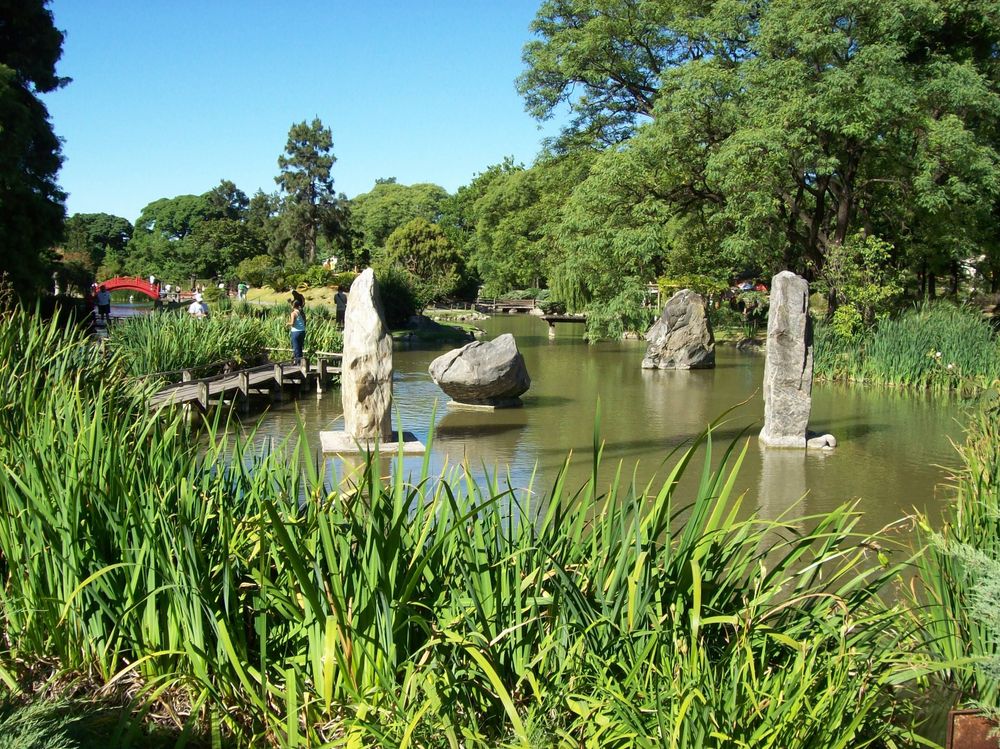
For photography, look beyond the most recognisable red bridge. Reflections, the relationship between foliage and water, or the framing of a lantern can tell more about the garden than a sequence of nearly identical portraits. Drones are prohibited. Keep the experience compatible with other visitors' movement instead of treating a narrow path as a private studio.
Choose a season without promising a bloom
Buenos Aires follows Southern Hemisphere seasons, so a Japanese cherry-blossom calendar from the Northern Hemisphere is not a useful booking guide here. The city's green circuit guide describes changing seasonal features, including winter cherry flowers and autumn ginkgo colour. That is general seasonal interpretation, not a forecast for your travel dates.
If a particular flowering plant is the reason for visiting, ask the garden about current conditions close to your date. Weather and individual plants determine what is actually visible. Otherwise, choose a comfortable day for walking and enjoy the structure of the landscape regardless of the flowering stage.
Rain does not normally close the garden, but it changes the experience. Wet surfaces, reflections and reduced comfort matter differently to different visitors. A shorter independent circuit may still suit you; a planned guided tour is a different case because the operator cancels tours in rain. Do not infer that an open gate means every programme continues.
Take the guided visit when interpretation is the priority
The official guided-visit page advertises tours at 11:00 on Saturdays, Sundays and public holidays. They are free after the applicable garden admission, have limited capacity and operate in order of arrival without prior registration. That combination means a garden ticket does not reserve a place on the tour.
Choose this format if you would rather understand the history and cultural context than interpret everything alone. Arrive early enough to find the meeting arrangements and ask staff about availability. Confirm the language if that affects your ability to enjoy it; the published schedule does not establish an English-language departure.
Have a self-guided alternative in mind in case the group is full or rain cancels the session. The alternative can be the three-priority circuit above, followed by time in the nursery or another available area. A missed tour does not oblige you to stay longer to compensate, especially if the weather no longer suits an outdoor visit.
Treat tea, food and events as separate arrangements
The city tourism description identifies a cultural centre, restaurant, nursery, shop and tea-ceremony space. Their presence does not mean that a tea ceremony, workshop or performance runs continuously. Check the operator's current cultural calendar for an actual activity, time and participation conditions before building your day around it.
The restaurant page currently lists 10:00–18:30 opening and reservations at 12:30 only, with later service in order of arrival. This is a meal-planning detail, not proof of table availability. If lunch is essential to the outing, contact the restaurant through its published booking channel and confirm the arrangement separately from garden admission.
A garden visit followed by an independent meal elsewhere is equally coherent. Do not let an uncertain restaurant queue consume the time you wanted for the paths and water. At the nursery, browsing plants can extend the botanical interest, but purchasing a living souvenir is a separate decision requiring attention to your onward journey and destination rules.
Match the admission category to the visitor
The posted ARS8,000 resident and ARS24,000 non-resident prices are Argentine pesos, checked on the date above. They are not a fixed foreign-currency quote, and older travel articles may show substantially different figures. Confirm the operator's current amount before paying rather than converting a stale price from another guide.
Children under 12 enter free with the required identification and an accompanying adult. The free older-person category applies to Argentine citizens and permanent residents over 65 presenting Argentine ID; it is not a blanket exemption for every overseas senior. The operator also lists free entry with the applicable disability certificate. If you will use a foreign document, ask in advance what is accepted instead of assuming equivalence.
Bring the evidence needed for your category. Rules also prohibit alcohol, smoking and vaping, loudspeakers, pets apart from the stated officially accredited exception, and drones. These conditions matter when deciding whether the garden fits your group, especially if you hoped to combine it with a dog walk or picnic.
Find the right entrance and an appropriate route
Use Avenida Casares 3500, the entrance address currently specified by the operator. Some institutional heritage and tourism pages show other numbers for the site; they are useful for history, but the operator's visitor entrance is the practical destination. The operator directs subway users to Line D at Plaza Italia, followed by a walk of about eight blocks beside the Ecoparque. It is not a station directly outside the gate.
The accessibility page lists an elevator, tactile map, accessible toilets, ramps and assisted ramps. Those facilities are useful evidence, but do not establish that every bridge is suitable for every mobility aid. Ask about a route matching your needs and current equipment operation before arrival. A waterside view from an appropriate path can be more enjoyable than attempting every crossing.
End the visit when you have enjoyed the landscape you came for. The garden can be a complete, contained outing or one part of a Palermo day. Its value comes from the attention you give to the place, not from fitting every optional purchase and programme between opening and closing.
Cover photograph: Pond, standing stones and a red bridge in Buenos Aires Japanese Garden — Archive photograph from 2007; planting varies by season. — Alpertron, CC BY-SA 3.0.
Frequently Asked Questions
Is the Japanese Garden free?
Ordinary admission is paid: the checked rates are ARS8,000 for Argentine residents with ID and ARS24,000 for non-residents. Specific free categories require the stated documentation; check the current operator rules.
Does it close when it rains?
The garden normally remains open in rain, but guided visits are cancelled. Special notices can override ordinary opening, so check the operator before travelling.
Can I bring a picnic?
No. Picnics are prohibited inside. Choose the garden for its designed landscape and cultural features, and organise a meal separately.
Do I need to reserve the guided tour?
The advertised 11:00 tours on Saturdays, Sundays and holidays require no prior registration. Places are limited and allocated on arrival; garden admission does not guarantee participation.


Keep Exploring
Parque Lage Rio: Plan Your Garden Visit
Visit Parque Lage’s free gardens while the palace is closed for restoration, with a focused route, access advice and a separate Corcovado decision.
Shinjuku Gyoen: Plan Your Tokyo Garden Visit
Choose your Shinjuku Gyoen gate, garden route and greenhouse stop, with seasonal hours, entry rules and practical accessibility checks.
Oaxaca Ethnobotanical Garden: Plan Your Visit
Plan Oaxaca’s garden with clear access uncertainties, tour-language checks, official contacts and ways to connect plants with local culture.