
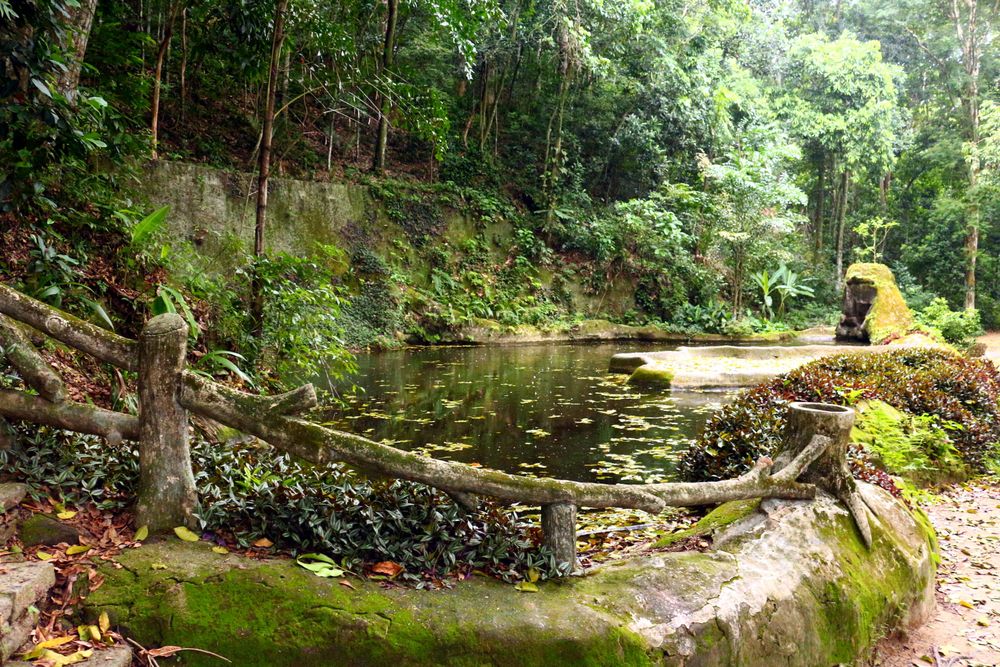
Visit Parque Lage’s free gardens while the palace is closed for restoration, with a focused route, access advice and a separate Corcovado decision.
Parque Lage currently makes sense as a garden visit beneath Corcovado, with historic landscape features and an art-school setting. It does not currently deliver the courtyard-and-pool visit seen in many photographs: on 4 November 2026, the Escola de Artes Visuais still states that the palacete is temporarily closed for restoration. Choose the park because its outdoor spaces interest you, rather than arriving with the interior photograph as your only objective.
That distinction changes both the route and the time to allow. A relaxed circuit of gardens and landscape features can work as a short outing; the mountain trail beginning here is a separate undertaking. Use our Rio cultural and sightseeing guide to place the visit in a broader trip, or compare our Rio Botanical Garden guide if labelled plant collections are your priority.
The practical facts
The EAV's official park page is the main source for present visitor arrangements. Its closure notice takes precedence over older courtyard photographs and older descriptions of the building's normal use.
| Question | Current answer |
|---|---|
| Entrance | Rua Jardim Botânico, 414; enter through the main gate |
| Ordinary park hours | 08:00–18:00 |
| Garden admission | Free |
| Palace interior | Temporarily closed for restoration |
| Garden visit allowance | About 60–90 minutes; 2 hours with slower pauses |
| Access limitations | Forest paths include slopes, steps and uneven ground |
| Corcovado trail | Separate strenuous outing; start cutoff at its guard post is 15:00 |
| Reopening date | No confirmed date used in this guide |
Visit durations are editorial planning estimates. The garden allowance excludes the Corcovado hike, transport and a meal elsewhere. A free entrance removes a ticket decision, but it does not remove the need to check weather, temporary barriers and the closing time before setting out.
Is it still worth visiting during the restoration?
Yes, if you want the landscape rather than access to the palace courtyard. The setting combines designed gardens, old trees, water and constructed features against a forested hillside. You can appreciate how a former private estate became a public place without entering the building. Allow the restoration to change what you choose to photograph and where you pause.
It is a weaker choice if your entire reason for going is breakfast beside the famous pool or recreating an interior photograph. Do not reserve transport on the assumption that a café booking bypasses the closure. This guide does not promise courtyard access, an operating café inside the palace or an opening date inferred from a construction estimate.
A useful test is to imagine removing the palace interior from your plan entirely. If a shaded walk, a lake and the history of the grounds still appeal, keep the visit. If not, spend that time at a different attraction and return when EAV explicitly confirms reopening. That is a more satisfying decision than arriving and discovering your only intended activity is unavailable.
Begin at the Cavalariças, then read the landscape
At the main gate, check which paths and features are open that day. The national park's Parque Lage description recommends beginning at the Cavalariças, the former stables, for historical context and information about other attractions. Treat this as the first orientation point, with any interior access or display subject to what staff confirm.
Then follow the open garden paths towards the palace exterior and the Jardim Francês area. The point here is the relationship between formal planting, the building and the forested backdrop. You do not need to approach a construction barrier to understand that relationship. Stop where access is permitted and let the view available on the day determine your photograph.
The contrast is worth noticing: near the building, the landscape has a composed, architectural character; farther into the grounds, enclosure and vegetation become more prominent. Look for that change as you walk. It gives a short visit a clear theme instead of turning it into a search for an unavailable interior.
For a shorter outing, these first stops and one waterside pause may be enough. There is no requirement to complete every branch of the path network. Keep the main entrance as your return reference and ask for directions before following a path that looks like a continuation into the hillside.
Add the lake, bandstand and grotto selectively
The state government's restoration announcement identifies the lake, gardens, artificial islands, bandstand and grotto as other features of the park. These give the outdoor visit substance while the palace is unavailable. Their presence is not a guarantee that every bridge, interior or approach remains open on your date; use on-site notices for the actual route.
Choose the lake and coreto, or bandstand, as a next focus. Pause to see how water, little islands and built elements create a landscape on a more intimate scale than Rio's mountain viewpoints. You are looking at a designed garden, not simply crossing an untouched forest. A few minutes of observation explains more than collecting a quick photograph at each named feature.
Add a grotto stop if the approach and permitted entrance suit your group and conditions. Its appeal is the change from open garden to a darker, more enclosed setting. Wet surfaces and uneven footing may make looking from outside the sensible choice. Avoid treating an old map's aquarium label as a promise of a fully operating animal attraction today.
If you have more interest in history, ask about the Lavanderia dos Escravizados, identified by the national park as a surviving trace of the estate's past. Its name directs attention towards enslaved labour, which should not disappear behind a romantic account of mansion and gardens. Read available interpretation and distinguish documented history from stories repeated in tourist captions.
A simple sequence is therefore: main gate, Cavalariças orientation, accessible garden and palace exterior, lake/coreto, an optional grotto or historical stop, then return. The sequence is an editorial suggestion, not an official marked circuit or a promise that each link between features is step-free.
Understand the art-school setting
The palace has housed the Escola de Artes Visuais do Parque Lage since 1975. That identity matters even when the building is closed: this is a place of teaching and artistic work, not solely a visitor backdrop. A course or event has its own arrangements; ordinary garden entry does not include entering a class, studio or restricted work area.
The EAV page also lists mediated visits. Its public programme specifies Tuesdays at 14:00, with at least ten participants needed, and cancellation in rain. Confirm current operation with the school before organising your day around it. A published weekly slot is not a personal tour guarantee, especially when a minimum group size applies.
For most independent visitors, a self-guided garden visit remains the simplest plan. If the guided option interests you, ask about the language and current scope as well as the time. Learning about the park and school is a different aim from gaining access to the closed palace; do not assume one implies the other.
Keep the Corcovado trail as a separate decision
The national park's trail page describes the route from Parque Lage towards Corcovado via Paineiras. It warns of very steep sections, says the ascent can take up to four hours depending on fitness, and does not recommend it for children under ten or people unaccustomed to hiking. This is not a scenic shortcut to add at the end of a garden stroll.
The trail guard-post entry cutoff is 15:00, earlier than the park's general closing time. That is a latest permitted start, not a recommendation to begin late. Plan current trail conditions, weather, daylight, water, footwear and the return before committing. Follow the marked route and on-site instructions rather than treating a visible mountain as enough navigation.
The trail itself is free; admission close to the Christ the Redeemer monument is separate. The park also distinguishes monument entry from paid downhill transport. Do not assume a free ascent gives you a train or van ride back. For this garden guide, the best default is to leave the mountain hike for a deliberately planned outing.
Comfort, access and photography
EAV explicitly warns that the entire park is not fully accessible to people with reduced mobility: much of it includes forest, steep paths, stairs and uneven terrain. It describes the garden and palace area as accessible, but the palace closure still applies. Ask for the currently usable garden route, available toilets and any works-related detours before choosing a longer circuit.
For children or anyone who prefers a gentler outing, retain the garden, exterior and one lake stop, then reassess. Carry water, use footwear suitable for damp paths and plan a real break outside the park if food is essential. Shade does not make heat and humidity irrelevant, and the closed palace should not be treated as a guaranteed shelter from heavy rain.
Simple picnics are permitted under EAV's rules, without tables, chairs or structures; rubbish must be removed for disposal outside the park. Do not feed wildlife. These rules support a small pause, not an improvised event. Check separately before bringing a large organised group.
Personal photographs with a phone or camera are allowed under the published rules, but staged shoots with tripods, flashes, lights, clothing racks or similar equipment are restricted. Commercial or organised image use requires prior authorisation. A normal travel photograph and a production with equipment are different activities; check EAV's requirements before planning the latter.
Finish with one nearby choice
Choose Jardim Botânico if you want the next part of the day to focus on plant collections. It is a separate institution with its own entrance, ticket categories and opening calendar, not an extension of Parque Lage. Two green spaces can work together when you enjoy gardens, but leave time for the transfer and a proper break.
Alternatively, finish with a neighbourhood meal and leave the afternoon open. The park is inland, not on the Ipanema beachfront, and Corcovado's tourist transport departure points are not interchangeable with its main gate. Use the exact address when arranging a ride; for public transport, EAV describes a connection from Botafogo metro to buses, which should be checked against current service.
The strongest short visit is a clear outdoor choice: understand the estate, look closely at a few landscape features and leave without turning it into an unplanned mountain ascent. While the palace is closed, that is the experience to judge on its own merits.
Cover photograph: Lago dos Patos with rustic balustrade and forest at Parque Lage in Rio — Archive photograph; no edits to the downloaded file — Filipo Tardim, CC BY-SA 4.0.
Frequently Asked Questions
Is Parque Lage open during the palace restoration?
The official page lists the park at 08:00–18:00 with free access, while stating that the palace is temporarily closed. Plan for gardens and permitted outdoor areas, and recheck notices before travelling.
Can I visit the famous pool courtyard?
Do not plan on it while the palace closure remains in force. An old photograph, café recommendation or projected completion date is not confirmation that the courtyard has reopened.
How long should I allow for the gardens?
About 60–90 minutes is a useful editorial allowance for a selective route; around two hours permits slower pauses. This excludes a meal, transport and the separate Corcovado hike.
Can I casually continue from the park to Christ the Redeemer?
The trail is a separate strenuous undertaking with steep sections and an ascent that may take up to four hours. Check conditions and plan your return; free trail access does not include monument admission or downhill transport.


Keep Exploring
Shinjuku Gyoen: Plan Your Tokyo Garden Visit
Choose your Shinjuku Gyoen gate, garden route and greenhouse stop, with seasonal hours, entry rules and practical accessibility checks.
Oaxaca Ethnobotanical Garden: Plan Your Visit
Plan Oaxaca’s garden with clear access uncertainties, tour-language checks, official contacts and ways to connect plants with local culture.
ANIMA Garden from Marrakech: Plan Your Visit
Plan ANIMA as a garden outing from Marrakech, with the official shuttle, ticket categories, café time and clear limits on access and onward travel.