
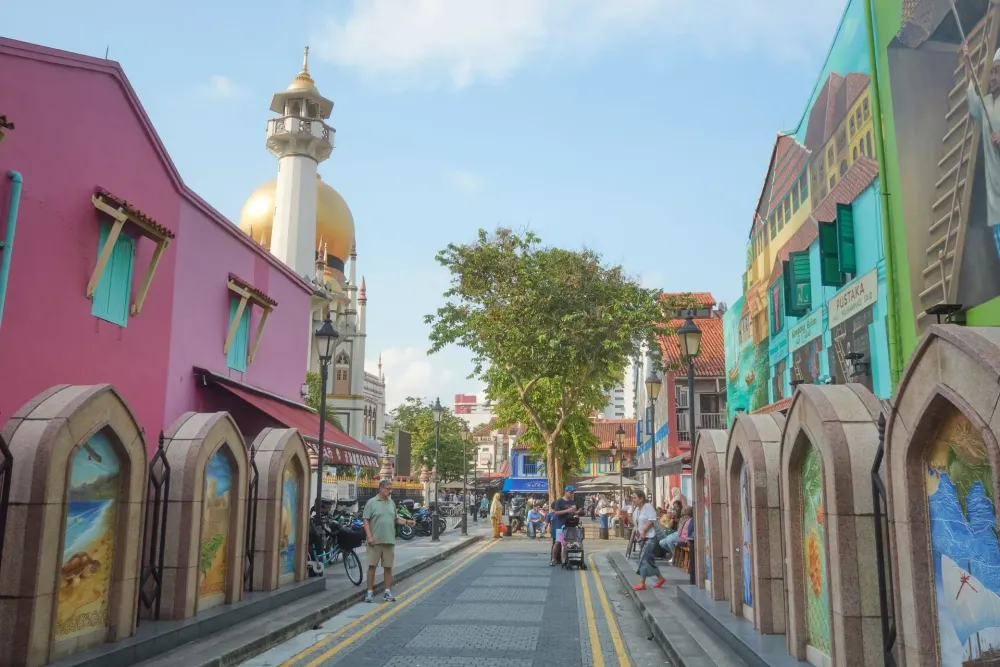
Choose a compact Kampong Glam walk, understand mosque visiting arrangements and leave time for Malay heritage, independent shops and a meal.
For a first Kampong Glam visit, connect Sultan Mosque and Bussorah Street with Arab Street, then choose either more heritage context or Haji Lane's shops and cafés. Two to three hours is a useful starting allowance for the streets and a meal. Add a museum visit only when you have time to give it attention.
Kampong Glam, also written Kampong Gelam, is more than a backdrop for the mosque's golden dome. Religious life, Malay heritage, trading histories and contemporary businesses sit close together here. Our Singapore highlights guide compares the district with other city experiences; this guide helps shape the neighbourhood outing itself.
Sources checked on 26 October 2026. Route order and time allowances are editorial suggestions, not a timed guided tour. Individual shops, places of worship and museums have separate opening arrangements.
Choose your version of the walk
| Your priority | Make this the anchor | Add if it suits you | Planning allowance |
|---|---|---|---|
| A first neighbourhood introduction | Mosque surroundings and Bussorah Street | Arab Street and a meal | 2–3 hours |
| Malay history and cultural context | Malay Heritage Centre | Nearby heritage streets | Half a day with breaks |
| Independent shopping and cafés | Haji Lane and Arab Street | Mosque exterior | 2–3 hours |
| An evening atmosphere | Streets and a booked meal | Businesses confirmed open | A flexible evening; no assumed mosque entry |
The walk has no single ticket or universal opening time. A street can remain accessible when a museum, shop or mosque visitor entrance is closed. Decide which interior matters before choosing when to come. If you only want the street setting, your plan can be much more flexible.
Start with the mosque, but separate worship from visiting
Sultan Mosque is the clearest landmark around which to orient yourself. Begin by looking at its exterior and the surrounding streets, without treating the main prayer hall as an ordinary sightseeing room. Visiting arrangements exist alongside a working place of worship.
The mosque's current visitor information lists walk-in visits Saturday–Thursday, 10:00–12:00 and 14:00–16:00, with Friday closed to these visits. Visitor access is through Gate 5 facing Bussorah Street and numbers per entry are limited. Recheck for your date; these are visiting hours, not the office schedule or prayer times.
Its rules require suitable covering clothing, removal of footwear and quiet behaviour. Robes are offered subject to availability, so dressing appropriately beforehand is more dependable. Visitors cannot enter the main or upstairs prayer halls without a mosque official. Photography without flash is allowed under the published rules; video needs approval.
Keep the visit successful even if entry is unavailable. You can still understand the mosque's place in the neighbourhood from outside, then continue to the heritage streets or museum. If interior access is essential, arrange the rest of the walk around the confirmed visitor window rather than arriving at the end and hoping.
Read Bussorah Street as more than a photograph
The view along Bussorah Street is an easy starting point, but the street's history gives it greater interest. The National Heritage Board's Kampong Glam Heritage Trail explains that different stretches were associated with pilgrims and copper trades. It also places the district within the histories of Malay royalty and communities from across the region.
Use that context to look beyond the dome. Notice the rhythm of the shophouse façades, the narrower adjoining streets and the different things businesses sell. The district was shaped by movement, trade and religious connections; describing it simply as an “Arab quarter” misses much of that story.
Pause somewhere that leaves the walking route clear. The most obvious photograph often puts you in the same place as everyone moving between streets. Take it briefly, then move aside. Ask before photographing staff, customers or a shop interior; a picturesque business is still a workplace.
For a short outing, you do not need to complete the entire heritage trail. Choose two or three stories that interest you and follow their nearby locations. A compact section understood properly gives the walk more substance than a much longer route spent reading every marker in a hurry.
Decide whether the Malay Heritage Centre is your main stop
The Malay Heritage Centre is the choice when you want interpretation beyond street façades. The Prime Minister's Office record of the April 2026 reopening describes refreshed galleries exploring Malay identities in Singapore and their connections with the wider region. The centre reopened on 25 April 2026, so older guides describing a renovation closure need updating.
Use the centre's official website to check current admission, hours, programmes and any booking conditions. Do not assume that the free-entry offer associated with the reopening is still running. A dated festival or launch promotion is not a permanent ticket policy.
Allow a substantial part of a half-day for the centre and the surrounding streets if the subject interests you. Visit the galleries first when you want their context to inform the walk; visit afterwards if seeing the neighbourhood raises questions you want to explore. Either order works better than squeezing the museum into the last few minutes before closing.
If you prefer an entirely outdoor visit, leave the galleries for another trip. You can still use the heritage trail to learn about the area. What matters is making a deliberate choice, rather than confusing a quick look at a building with a museum visit.
Arab Street and Haji Lane offer different kinds of browsing
Arab Street is useful for a walk focused on shops, materials and the district's trading character. Haji Lane adds smaller boutiques, cafés and street art. The tourism board's Kampong Gelam visitor map helps locate these streets and the surrounding landmarks; treat its business listings as starting points to check, not a guarantee that every outlet remains unchanged.
Browse with a purpose that suits you: textiles, a small gift, an interesting shopfront or somewhere to sit. There is no requirement to buy something to justify the walk. Equally, if shopping holds little appeal, shorten this section and give the museum or meal more time.
Murals and shop displays change. Rather than crossing the neighbourhood to reproduce one old social-media photograph, enjoy the streets you find and respect the current signs. Avoid blocking doors or turning a narrow lane into a prolonged photo set. The shops and cafés are part of the neighbourhood's daily economy, not scenery provided for visitors.
If a specific independent shop is the main reason you are coming, check it directly before fixing the day. An early start that works for outdoor sightseeing can be a poor fit for browsing businesses that open later. The district's general accessibility does not establish a shop's operating hours.
Make the meal part of the route
Choose lunch or dinner deliberately rather than leaving it until everyone is tired. The tourism board's Kampong Gelam neighbourhood page provides an official starting point for exploring the district. Use it for orientation, then confirm the venue and menu you actually intend to use.
A simple approach is to choose a meal near the mosque area and use browsing to fill the time before or after it. If the restaurant is your priority, book or check its service hours first. If the walk is the priority, keep two nearby possibilities so one closure or queue does not dominate the afternoon.
For halal or other dietary requirements, verify the particular business and current information rather than assuming every café in the district meets the same standard. Explain allergies directly to the venue. A neighbourhood's cultural identity is not a substitute for a restaurant-specific answer.
For a different food outing elsewhere in the trip, our Singapore hawker-centre guide explains that format. You do not need to leave Kampong Glam halfway through a satisfying visit simply to add a separate food centre.
A practical sequence from Bugis
Bugis is a useful starting station; the mosque's directions describe the approach as about ten minutes on foot. Check the route from your actual station exit to Sultan Mosque, rather than treating “Bugis” as a precise meeting point. Include road crossings and your group's pace.
For the street-focused version, head towards the mosque area, take in Bussorah Street, then work through Arab Street and Haji Lane before your meal or return. Use the current map to keep the loop compact. For the history-focused version, place the Malay Heritage Centre before or after those streets and shorten the shopping section.
In heat or rain, reduce the route before it becomes a test of endurance. A café break can be part of the visit, while an available museum programme offers a different kind of stop. Neither option should be assumed to provide an unbroken sheltered route. Check the actual entrance and facilities if steps, wheelchairs or a pushchair affect your plans.
Do not attach Chinatown simply because both appear under “heritage neighbourhoods”. Our Chinatown walking guide describes a separate outing with different temples, streets and food choices. Pick the district that interests you most, or give each its own space on a longer stay.
Before you set off
Confirm the one opening or reservation on which your outing depends, then keep the rest flexible. Wear clothing suitable for the mosque if you hope to enter, carry what you need for an outdoor walk and leave room in the plan to sit down. The strongest Kampong Glam visit combines attention to its heritage with ordinary pleasures such as browsing and a good meal.
Cover photograph: Shophouses and Sultan Mosque in Kampong Glam. Photo by CK Seng / Pexels. Source · License.
Frequently Asked Questions
How long should I allow for Kampong Glam?
Allow around 2–3 hours for the streets and a meal, or a half-day if the Malay Heritage Centre is a main stop. These are editorial allowances; transport, queues and your interests change the timing.
Can non-worshipping visitors enter Sultan Mosque?
The mosque offers walk-in visits in designated windows and permitted areas. Check its current visitor information, use Gate 5 facing Bussorah Street and follow staff directions; access is limited and prayer halls have restrictions.
Can I visit the mosque on Friday?
The published walk-in visitor programme is closed on Friday. An outdoor neighbourhood walk is a separate option, but do not assume it includes mosque entry.
Is the Malay Heritage Centre still closed for renovation?
It reopened on 25 April 2026 with refreshed galleries. Check current opening, tickets and programmes directly; old closure advice and temporary reopening offers should not be treated as current policy.
Is Kampong Glam the same as Haji Lane?
Haji Lane is one street within the wider district. Include Sultan Mosque's surroundings, Bussorah Street and the heritage context if you want more than a shopping-and-café visit.

Keep Exploring
Recoleta: Cemetery, Museums and a Neighbourhood Walk
Choose a cemetery visit, a substantial art stop and a manageable Recoleta walk, with admission distinctions and alternatives for rain or limited time.
Gion: A Respectful Neighbourhood Walk
A manageable Gion walk through the Shirakawa area, Yasaka Shrine and Hanamikoji, with public access, private boundaries and cultural visits kept clear.
Asakusa: Senso-ji and a Neighbourhood Walk
Follow the temple approach, understand the difference between Senso-ji and Asakusa Shrine, then choose shopping or a riverside finish.