
Frick Collection New York: Plan Your Art Visit
Plan the Frick Collection: age limits, timed tickets, Wednesday admission, gallery choices and practical access at the reopened New York mansion.
The Frick Collection is a good New York choice when you want to look closely at a manageable group of European paintings and decorative objects inside a former private house. It suits visitors who enjoy portraits, interiors and the relationship between art and a room, rather than a survey of every civilisation. There is one decisive restriction: children under 10 are not admitted.
Plan around the museum at 1 East 70th Street, beside Fifth Avenue. This is the reopened historic mansion, not the former temporary Frick Madison location. Our New York cultural guide helps place it within the wider trip; this guide concentrates on choosing an admission option and a satisfying visit of roughly 2–3 hours, an editorial estimate rather than a required route.
Fast facts
| Decision | Starting point |
|---|---|
| Location | 1 East 70th Street, Upper East Side |
| Regular hours | 10:30–17:30, Wednesday–Monday; Tuesday closed; check holidays |
| Standard adult admission | US$30, checked 25 November 2026 |
| Young visitors | Ages 10–18 free; under 10 not admitted |
| Lower-cost option | Wednesday 13:30–17:30 pay what you wish, with booking conditions |
| Best approach | Reserve a timed slot and choose a few works to study |
| Main practical limit | No luggage accepted; no photography in galleries |
Choose a ticket before building the day
The official ticket page lists adults at US$30, seniors aged 65+ and visitors with disabilities at US$22, and students with identification at US$17. Youth aged 10–18 enter free. Prices are in US dollars; check your card's conversion rather than treating a euro estimate as the museum's price.
Official wording is not completely consistent: the ticket page says advance timed tickets are required, while the general visitor page describes them as recommended. The reliable planning choice is to reserve. Do not build a short New York stay around an unconfirmed walk-in opportunity. Members have different arrangements, and concession eligibility should be checked before selecting a discounted ticket.
The Wednesday offer needs a little more explanation than “free museum afternoon”. According to the discounted-admission page, a reserved pay-what-you-wish ticket has a US$5 minimum online. Smaller contributions, including amounts below US$5, are possible onsite, but availability is not guaranteed. The period runs from 13:30 to 17:30; it is neither an all-day discount nor a promise that every arrival can enter.
Choose Wednesday if the saving is useful and the available slot fits. Choose another day if a fixed appointment matters more. Free First Friday events are a separate programme with their own registration and calendar; do not assume that every Friday has late opening. Check the date-specific page before rearranging dinner or transport around an evening visit.
Use the mansion as part of the collection
The Frick is more than paintings placed in an attractive shell. Furniture, sculpture, ceramics and the scale of the rooms affect how the art is experienced. A portrait viewed beside a fireplace or across a furnished room has a different setting from a work isolated in a large white gallery. Give that relationship some attention before moving to the next name on a checklist.
The museum's institutional timeline records the 2025 reopening and the opening of the historic second floor to visitors. That makes older itineraries incomplete: allow space for the upstairs galleries, while following the current museum map rather than an old photograph of a room arrangement. A collection object can be moved or temporarily unavailable without the whole museum changing its appeal.
Start with a room as a whole. Notice the largest visual anchor, the direction of daylight and how smaller objects interrupt or reinforce the composition. Then choose one painting and one decorative object. This is an editorial looking exercise, not a museum-prescribed route, and it works even when an expected masterpiece is not on display.
The setting also raises a worthwhile question: what did collecting communicate about wealth and taste? Enjoying the craftsmanship does not require treating the former owner's choices as a universal definition of good art. Looking at what a collector included, and what remains outside that selection, gives the house a clearer identity than describing every room as luxurious.
Pick a small number of works, then slow down
Use the museum's collection resource before arrival to identify interests, not to create an impossible completion list. Bellini, Holbein, Vermeer and Fragonard offer different starting points: landscape and devotional imagery, the construction of a public identity, an intimate domestic scene, or a decorative narrative across a room. Confirm current display information when a particular painting is the reason for your trip.
For a portrait, first look at the sitter's hands, posture and clothing. Then ask where the painter directs your eye. For a landscape, follow the route through foreground, middle distance and horizon. For a domestic scene, notice how light connects figures and objects. These simple prompts make it easier to spend several useful minutes with an unfamiliar painting without needing specialist vocabulary.
Choose approximately three anchors and let the spaces between them remain exploratory. If one work holds your attention, shorten the list. The Frick is especially rewarding when its smaller scale becomes permission to look longer rather than a reason to race through and add another museum immediately.
Prepare the mobile guide and respect the photo rules
The visitor guide points to free interpretation on Bloomberg Connects. Bring your own headphones and charge your phone before leaving the hotel. Read or listen to one commentary after looking at the work yourself: information becomes more memorable when it answers a question you have already noticed.
The collection's domestic atmosphere means that many permanent works have brief identifying plaques rather than extensive wall texts. If you usually rely on large explanatory panels, the guide can supply context. It is optional; a visit does not require listening to every recording. Keep the screen low and avoid stopping across a doorway while choosing the next track.
Photography is prohibited in the galleries. Personal photographs are allowed in designated public spaces such as the Garden Court, subject to the visitor guidelines. A rule permitting a photograph in one space does not extend to the neighbouring room. Ask staff when the boundary is unclear, and use the museum's online images to revisit artworks later.
Leave luggage elsewhere: the coat check does not accept suitcases of any size. This makes the Frick a poor stop immediately before an airport transfer unless storage is already arranged. Pack a small bag, allow time for inspection and use the cloakroom when directed. These choices matter more than trying to arrive at the very last admissible minute.
Make the visit work for your group
The minimum age is a firm admission policy, not a suggestion about whether a child enjoys painting. A family with an eight-year-old needs another plan even if the child is an experienced museum visitor. For older children, a short selection built around faces, materials or room design can be more engaging than an adult's full list of artists.
Review the accessibility information before booking if mobility, hearing or sensory arrangements are important. Public floors have lift access, but the historic upstairs rooms may not accommodate every type of wheelchair. Describe your actual equipment and requirements to the museum instead of relying only on a general “accessible” label.
The institution lists a discount for visitors with disabilities and complimentary entry for a care partner. Seating and interpretive resources can help shape a slower visit. Plan breaks before fatigue becomes the deciding factor, and remember that an available loan wheelchair is not the same as a reserved one.
Arrive with time to spare
The museum lists the 6 train at 68th Street/Lexington Avenue and the Q at 72nd Street/Second Avenue among the options. Allow for the walk from the station, pedestrian crossings and the entry process. An address on Fifth Avenue does not mean the museum entrance is wherever you first see the façade: head to East 70th Street.
If you need a step-free journey, check the transit operator's current lift status on the day as well as the museum's access advice. A suitable station on a map may have an unavailable lift. Keep the route flexible enough to use a bus or another connection if necessary, without turning a timed ticket into a race.
Pair the Frick with one contrasting activity
A Central Park walk gives the eyes a break after concentrated indoor looking. Keep it optional in poor weather and choose a modest section rather than treating the entire park as a necessary extension. A meal nearby can also provide a useful pause before another appointment.
If choosing between the Frick and the Met, our Met visit guide explains the broader museum's scale. The Frick suits a focused encounter with a collector's European art and domestic setting; the Met offers a much wider choice of periods and cultures. They can complement each other across separate days, but two substantial art visits back to back are not automatically a better use of one afternoon.
Before paying, settle three decisions: whether everyone meets the age rule, which ticket arrangement fits the budget, and how much attention the group wants to give to art. That leaves the actual visit open to discovery while preventing the avoidable problems that a beautiful interior cannot solve.
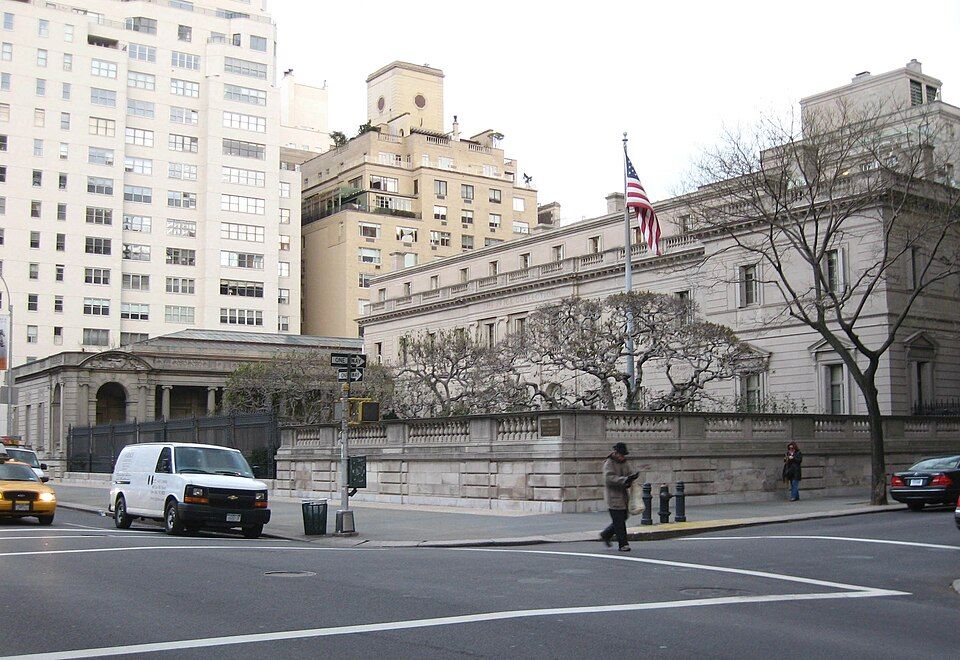
Cover photograph: Historic Frick Collection façade and garden wall beside Fifth Avenue in New York — Archive photograph 2008 Image adapted for publication. — Jim.henderson, Public domain (author dedication).
Frequently Asked Questions
Is the Frick still at Frick Madison?
No. Plan for the historic museum at 1 East 70th Street, which reopened in 2025. Old directions to the temporary Madison Avenue venue are unsuitable for this visit.
Can children visit the Frick Collection?
Children must be at least 10. Admission for ages 10–18 is free, but the minimum-age rule still applies and a suitable ticket should be reserved.
Is Wednesday admission completely free online?
The current online pay-what-you-wish reservation has a US$5 minimum. Lower contributions are available onsite on Wednesday afternoons, subject to capacity.
How long should I allow?
Around 2–3 hours is an editorial estimate for a selective visit, excluding travel and a substantial meal. A shorter visit works if you choose fewer rooms and works.
Can I take photographs and bring a suitcase?
Photographs are not allowed in galleries; designated public spaces have different rules. The museum does not accept luggage of any size, so arrange storage before arrival.



Keep Exploring
Cooper Hewitt: Plan Your New York Design Visit
Plan Cooper Hewitt in New York: design galleries, Carnegie Mansion, tickets, the November rotation, garden access and a realistic two-hour visit.
New York Public Library: Plan Your Schwarzman Visit
Choose exhibitions, architecture or an official tour at NYPL’s Schwarzman Building, with reading-room access and practical arrival advice.
The Met Cloisters: Plan Your New York Visit
Choose tapestries, gardens and medieval architecture at the Met Cloisters, with current hours, shared admission and step-free arrival advice.