
Semana Santa in Spain 2027: Dates & Where to Go
Confirmed Semana Santa 2027 dates, the best Spanish destinations and practical advice for transport, hotels and processions.
Semana Santa in Spain 2027 runs from Sunday, March 21, to Sunday, March 28. As it falls early in the calendar, it is wise to book accommodation and transport earlier than usual. In cities such as Seville, Málaga, Valladolid, and Zamora, well-located hotels and trains on the key dates can be in particularly high demand.
This guide is not intended to rank one celebration above another. It is designed to help you choose a destination that matches the atmosphere you want, understand which days matter most, and avoid common planning mistakes.
Key Dates for Semana Santa 2027
| Day | Date | What Happens |
|---|---|---|
| Palm Sunday | March 21 | The main week of processions begins |
| Holy Monday | March 22 | Processions and local events |
| Holy Tuesday | March 23 | Processions and local events |
| Holy Wednesday | March 24 | One of the busiest days in many cities |
| Holy Thursday | March 25 | Nighttime processions and religious celebrations |
| Holy Friday | March 26 | Central day in numerous destinations |
| Holy Saturday | March 27 | More subdued observances and vigils |
| Easter Sunday | March 28 | Closing day of Semana Santa |
Spain’s official tourism portal confirms the dates for celebrations in Seville, Calanda, and Segovia. Exact timetables for each brotherhood, routes, and any changes caused by rain will be published nearer the event.
Important: Public holidays vary between autonomous communities. Do not assume that Holy Thursday and Easter Monday are non-working days everywhere; check your community’s official labour calendar when it is published.
Choosing the Right Destination
Seville: The Most Intense and Crowded Experience
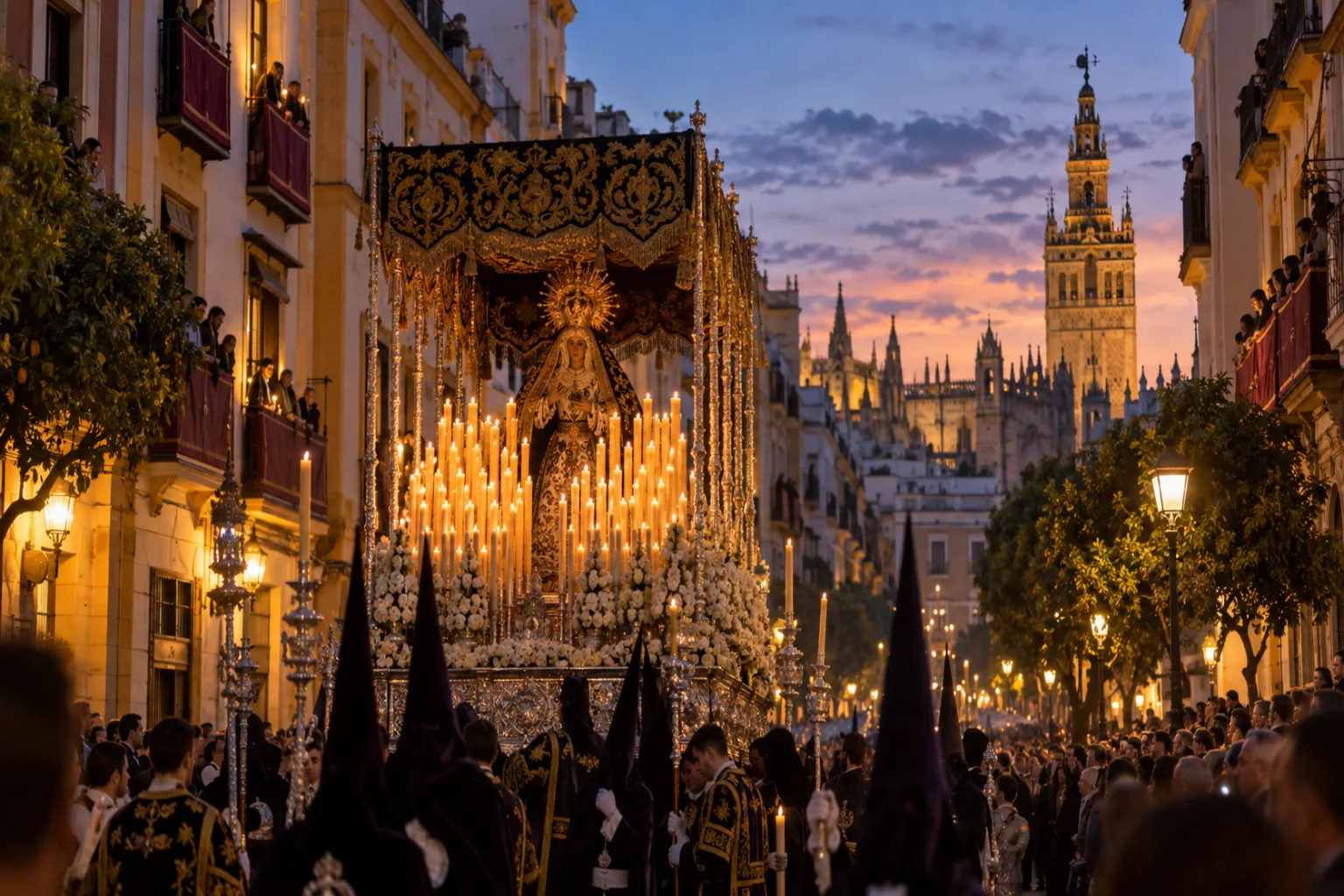
Seville is the right choice if you want to experience Semana Santa as the city’s defining event. The official agenda confirms celebrations from March 21 to March 28, 2027, and explains that daily routes pass through the historic centre. The night from Holy Thursday to Holy Friday, known as the Madrugá, brings together some of the most eagerly anticipated processions.
The trade-off is logistical: streets are closed, crowds are dense, and getting around is slow. The official route has chairs and grandstands, but you do not need a ticket to watch a procession outside that section. Consult the official Seville Semana Santa guide and allow plenty of time; a 15-minute walk on an ordinary day can take an hour during a procession.
Ideal for: A first large-scale Semana Santa, with heritage, music, and an urban atmosphere.
Not ideal for: Those seeking to improvise, move quickly through the center, or make a quiet escape.
Málaga: Grand Processions and a More Open Atmosphere
Málaga combines monumental processions with a compact city centre and the appeal of the coast. Its tronos (processional floats) differ in scale from Seville’s pasos, and some events have their own traditions, such as the ceremony linked to Jesús el Rico on Holy Wednesday. The official tourism portal also lists the celebration from March 21 to March 28, 2027 here.
It is a good choice if you want to alternate processions with museums, waterfront walks, and excursions. Even so, the historic centre will be very busy, and some monuments or shops may change their opening hours.
Ideal for: Combining culture, gastronomy, and coast without sacrificing a large-scale celebration.
Valladolid: Imagery and Solemnity
Valladolid offers a more austere Semana Santa, with a strong emphasis on religious sculpture. It is a clear alternative for visitors who prioritise artistic heritage and solemn ceremonies over a festive atmosphere. The official tourism portal confirms the programme from March 21 to March 28, 2027 here.
March can be cold and rainy in Castile and León. Bring discreet waterproof clothing and a warm layer: waiting outdoors is part of the experience, and changing weather can alter timetables.
Ideal for: Sacred art, contemplation, and a cultural trip lasting two or three nights.
Zamora: Silence, Romanesque Architecture, and a Manageable City
Zamora is one of the most distinctive destinations, thanks to the contrast between its solemn processions and Romanesque heritage. Its scale makes it easier to get around on foot than in a major city, although demand for accommodation can be high precisely because supply is limited. Spain’s tourism portal lists Zamora’s Semana Santa from March 21 to March 28 here.
Ideal for: A contained experience, architecture, and respectful urban photography.
Calanda: The Sound of the Ruta del Tambor y el Bombo
In Calanda, Teruel, the defining moment is the Rompida de la Hora on Holy Friday, when drums and bass drums begin to sound together. This is not a scaled-down version of Seville, but a different tradition with its own soundscape and rural logistics. The official listing confirms the dates and describes the Semana Santa of Calanda.
You will need to plan transport carefully. If you are travelling without a car, check connections and accommodation before booking your main tickets.
Ideal for: Popular traditions, road trips, and an experience very different from Andalusian capital celebrations.
How Many Days Will You Need?
For a first visit, three nights usually strike a good balance. Arriving on Holy Wednesday and leaving on Saturday lets you see several key days without taking on the full cost of staying from Palm Sunday to Easter Sunday. In Seville, if the Madrugá is a priority, book Thursday to Saturday at a minimum and do not plan an early departure on Friday.
A stay of five to seven nights makes sense if Semana Santa is the main purpose of your trip. If you want to see only part of it while exploring the city, two nights may be enough in Valladolid or Zamora, provided you check the programme before choosing your dates.
To extend your trip, our guide to the best European cities in spring can help you combine the celebration with a less crowded second destination.
Where to Stay Without Complicating Your Trip
The most central accommodation is not always the most practical. During a procession, a street may be closed for hours. Look for a hotel or apartment with two possible walking routes to a main station or avenue.
In Seville, neighbourhoods such as Arenal, Santa Cruz, and the area around the Alameda offer easy access, but require a larger budget and greater tolerance for noise. Areas connected by metro, such as Nervión, may offer a better balance. In Málaga, staying within walking distance of the historic centre but outside the procession routes reduces disruption. In Valladolid and Zamora, check the location of bridges, plazas, and main routes before choosing.
Before paying a non-refundable rate, ask the accommodation:
- whether taxi access will be possible on your arrival day;
- whether there are restrictions on entering at night;
- how long it really takes to walk from the station;
- whether the room faces a procession route or an internal courtyard.
How to Watch the Processions with Respect
Semana Santa is at once a religious, cultural, and community event. It is not a spectacle designed solely for visitors.
- Keep exits from churches and marked crossings clear.
- Avoid flash photography and do not hold your phone in front of participants.
- Do not cross a procession unless event staff direct you to do so.
- Remain quiet during contemplative moments, especially during a saeta or a nighttime procession.
- If you are travelling with children, choose viewing points with an easy exit rather than the most crowded areas.
- Always follow local instructions in case of rain or route changes.
Transportation: Book What Has the Least Flexibility First
For Seville and Málaga, compare train and flight options from your departure point, but avoid very tight connections. City traffic and street closures can delay the final leg. For Valladolid and Zamora, the train may be the most direct option from Madrid; check availability when the relevant ticket calendar opens. Calanda works best as part of a driving route through Aragón.
A practical booking order is:
- Accommodation with reasonable cancellation terms;
- Long-distance transport;
- The preliminary procession timetable;
- Timed monument visits;
- Restaurants only where reservations add value.
Do not build a minute-by-minute itinerary. Rain, crowd density, and the actual duration of processions can change any plan.
Budget: What Increases the Cost of the Trip
The largest cost increase is usually accommodation, not religious activities, which mostly take place in public spaces. Rates rise especially on Holy Thursday and Holy Friday nights, and for accommodation in the historic centre.
To keep costs under control:
- Travel at the start of the week and avoid concentrating your entire stay around the Madrugá;
- Stay near public transport, rather than necessarily next to the cathedral;
- Book a refundable rate and compare again once the programmes are published;
- Combine reserved meals with markets, taverns away from the central route, and lunchtime set menus;
- Add a day after the event only if it improves the total transport cost.
What We Know and What’s Still to Confirm
As of September 2026, the general dates of March 21 to March 28, 2027 are confirmed on the cited official portals. Detailed programmes, final routes, monument opening hours, mobility arrangements, and regional labour calendars may still be pending.
We will update this guide when local authorities and organisations publish that information. Until then, use the dates to book flexibly, rather than assuming every procession or service will follow the exact 2026 timetable.

Keep Exploring
Keukenhof 2027: Dates, Tulips & Amsterdam Day Trip
Plan Keukenhof 2027 with confirmed dates, the best tulip weeks, honest ticket guidance, transport planning and a respectful route through the flower fields.
Krakow Christmas Markets 2026: Dates and Weekend Guide
Plan a Krakow Christmas weekend with provisional 2026 market dates, airport fares, a 48-hour itinerary and a clearly labelled sample budget.
Carnivals in Europe: Best Celebrations to Visit in 2027
Explore top European carnivals in 2027, from Venice to Basel. Get key dates, free vs. ticketed access, and tips for Ash Wednesday (Feb 10) celebrations.