
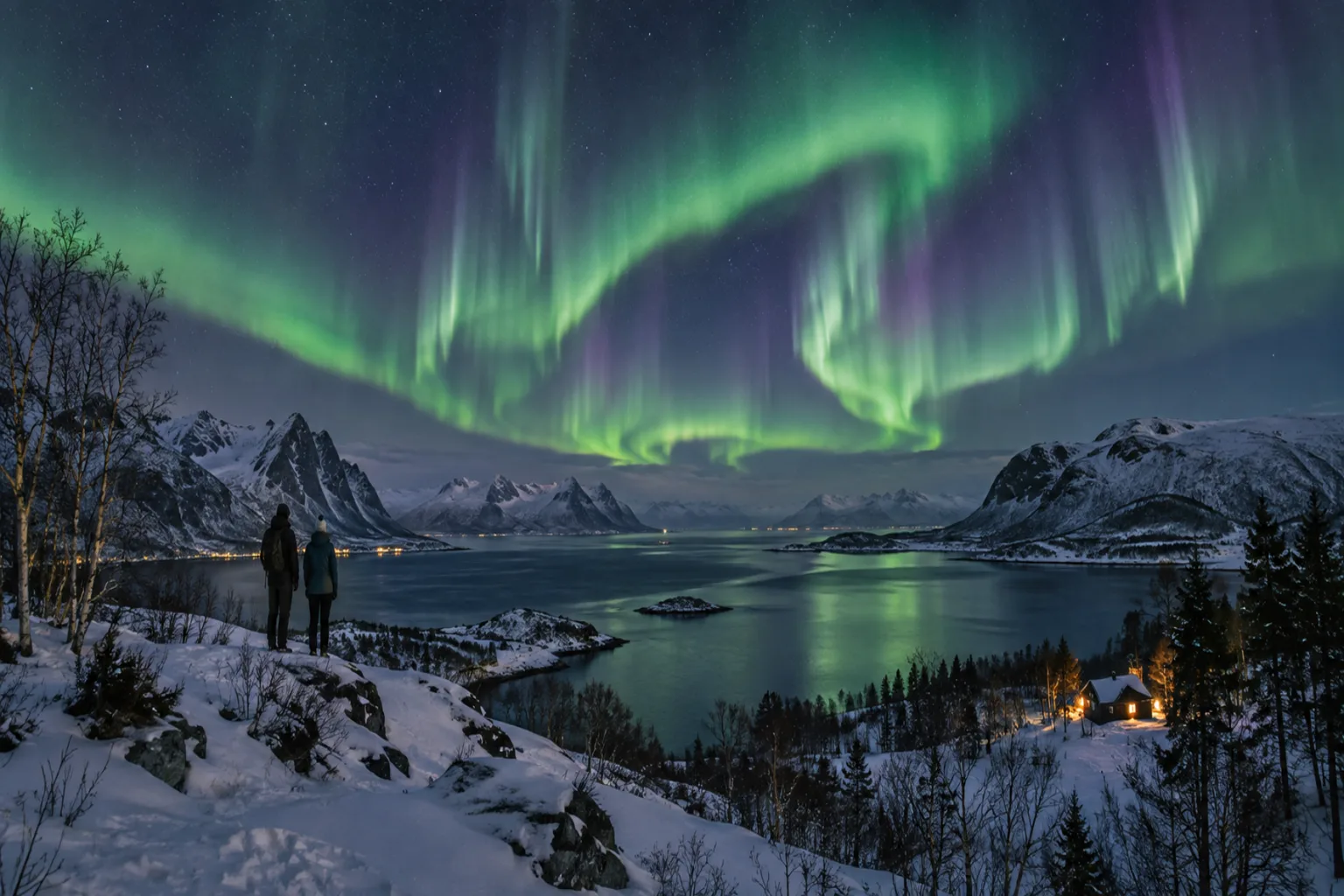
Northern Lights: Norway vs Iceland vs Finland
Compare Norway, Iceland and Finland for Northern Lights season, cloud risk, access, cost and the best trip style for you.
The best Northern Lights destination in Europe is not automatically the place furthest north. Norway, Iceland and Finland all sit beneath or close to the auroral oval, but they offer very different trade-offs in cloud, mobility, cost and what you can do when the sky stays quiet.
This guide compares the three countries for a real trip rather than promising a sighting. Aurora is a natural phenomenon: you need solar activity, darkness and a gap in the clouds at the same time. No hotel, tour or destination can guarantee that combination.
Norway vs Iceland vs Finland at a glance
| Country | Best for | Main base | Typical season | Biggest advantage | Main drawback |
|---|---|---|---|---|---|
| Norway | First-time visitors who want a city base | Tromsø | Late August to late March | Strong tour network and varied coastal weather | High daily costs |
| Iceland | Road trips and dramatic landscapes | Reykjavík or Akureyri | Late August to late April | Aurora can be combined with a flexible self-drive route | Cloud and wind can disrupt plans |
| Finland | Cabins, families and a slower winter stay | Rovaniemi, Saariselkä or Ivalo | Late August to early April | Easy access to dark inland locations | Peak Christmas dates are expensive |
If your only question is “where am I most likely to see the lights?”, choose a trip with at least four nights, flexible evening plans and the ability to move toward clearer skies. Duration and mobility matter more than a tiny difference in latitude.
When is the best time to see the Northern Lights in Europe?
The practical European season runs from late August or September until late March or April, depending on latitude. Northern Norway’s tourism board describes the main window as late August to late March and notes that autumn and the equinox periods can be particularly active. Visit Iceland gives a late-August to late-April season, while Visit Finland recommends late August to early April in Lapland and northern Lakeland.
That does not make midwinter automatically best. December and January deliver long darkness, but also holiday crowds, cold and potentially persistent cloud. September and March can combine a useful amount of darkness with milder conditions and more daylight for daytime activities.
A simple month-by-month choice
- September–October: good for autumn landscapes, longer daylight and aurora after dark. Snow is not guaranteed.
- November–January: maximum darkness and a strong winter atmosphere, but short days and peak festive prices.
- February–March: reliable winter scenery in many northern areas, improving daylight and a strong balance for a first trip.
- Early April: still possible in northern Finland and Iceland, but the usable dark window is shrinking quickly.
Norway: best for a first aurora trip with a city base
Tromsø is one of Europe’s easiest Arctic bases. It has regular air connections, restaurants, museums and a large choice of evening tours. That matters because an aurora holiday still needs to work when the lights do not appear. The city sits around 350 kilometres north of the Arctic Circle, and operators can drive inland or along the coast to look for clearer weather.
Visit Norway identifies Northern Norway as the country’s core aurora region and gives late August to late March as the viewing season. It also stresses the two conditions travellers often overlook: the sky must be both dark and clear.
Why choose Norway
- You can stay in a genuine city rather than an isolated resort.
- Guided chases can move between coastal and inland microclimates.
- Daytime alternatives include fjords, museums, wildlife trips and winter walks.
- Tromsø works without renting a car.
What to budget for
Norway is rarely the lowest-cost option once meals, accommodation and guided tours are included. Save by booking a room with a kitchen, travelling outside Christmas and school-holiday weeks, and taking one well-reviewed chase rather than purchasing a tour every night. On other evenings, use dark public locations only where access and winter conditions are safe.
Norway is best if…
You want the lowest-friction first trip, prefer organised transport and would still enjoy an Arctic city break after two cloudy nights.
Iceland: best for a flexible landscape road trip
Iceland adds volcanic landscapes, waterfalls, geothermal areas and a road-trip structure. Reykjavík is the easiest base for a short stay, but light pollution means you usually need to leave the central city. A self-drive trip offers flexibility, yet winter wind, ice and road closures must set the limits—not your itinerary.
The official Visit Iceland aurora guide places the season from late August to late April. Its most useful planning advice is to watch cloud cover and real-time space-weather conditions rather than treating a single Kp number as a promise.
Why choose Iceland
- Every day can include a major landscape even without aurora.
- A car allows you to react to local cloud gaps when conditions are safe.
- The viewing season extends into late April, though nights become shorter.
- Reykjavík offers the broadest flight access of the three main bases.
The cloud-and-driving trade-off
An open forecast does not make the whole island usable. A clear patch three hours away may be irrelevant if roads are icy or wind warnings are active. Check the Icelandic weather and road authorities before leaving, carry the correct winter equipment and never stop on the carriageway for a photograph.
For a four-night trip, either stay in Reykjavík and book a tour with a rebooking policy, or divide the stay between two bases without trying to circle the island. The Ring Road is not a sensible short winter itinerary.
Iceland is best if…
The aurora is one objective within a broader landscape trip, and you are comfortable changing plans around weather.
Finland: best for cabins, families and dark inland skies
Finnish Lapland offers a different rhythm: forests, frozen lakes, cabins and inland winter conditions. Rovaniemi has the best transport infrastructure, while Saariselkä and Ivalo move you further north and closer to readily accessible dark areas.
Visit Finland gives late August to early April as the main season and highlights September–October and February–March as strong periods. It also points travellers to the Finnish Meteorological Institute’s space-weather forecast, a better primary source than social-media predictions.
Why choose Finland
- Dark locations are often close to accommodation.
- Cabins make waiting more comfortable on a multi-night stay.
- February and March combine snow, longer daylight and dark evenings.
- The trip can be built around winter activities without constant driving.
Watch the Christmas premium
Rovaniemi in December is driven by much more than aurora demand. Families visit for festive attractions, and accommodation prices reflect that. If the Northern Lights are the priority, late February or March often provides a better balance of winter scenery, daylight and availability.
Glass-roof accommodation can be memorable, but it does not improve solar activity or clear the clouds. Treat it as a lodging choice, not as an aurora guarantee.
Finland is best if…
You want a calm winter stay, value cabin accommodation and prefer to watch from a fixed dark base rather than join repeated long drives.
Which country is cheapest?
There is no stable winner because flights and accommodation dominate the total. Compare the same trip structure:
- return travel to the gateway airport;
- four or five nights of accommodation;
- airport transfers or car hire with winter coverage;
- food, including the cost of eating out versus self-catering;
- one guided aurora experience;
- one daytime activity;
- winter clothing rental if you do not own suitable layers.
Norway can become competitive when you stay in Tromsø without a car. Iceland can be efficient for a group sharing a vehicle, but fuel, insurance and weather disruption add risk. Finland can control food costs with a cabin kitchen, although remote transfers and peak-season lodging may erase the saving.
Do not choose a country from the tour price alone. A cheap excursion attached to an expensive flight and hotel is not a cheap trip.
How many nights should you book?
Four nights is the practical minimum for an aurora-focused journey; five to seven is better. A one-night stop gives the weather a single chance. Multiple nights diversify cloud and solar conditions and let you rest after a late chase.
A balanced five-night plan looks like this:
- arrival and a quiet first evening;
- two evenings reserved for aurora attempts;
- one evening kept flexible for weather;
- two daytime activities that remain worthwhile in cloud;
- no critical early departure after the final chase.
If Scandinavia also interests you in a completely different season, compare this winter trip with our guide to summer in Scandinavia and the midnight sun. They are opposite light experiences and require different itineraries.
Do you need an aurora tour?
Not always. A tour is most valuable on your first evening, when you do not know the local roads, safe stopping places or cloud patterns. It can also solve the problem of winter driving.
Before booking, check:
- whether the operator actively moves to clearer areas or uses a fixed camp;
- the cancellation and rebooking policy;
- maximum group size;
- whether thermal clothing, hot drinks and photographs are included;
- the latest possible return time;
- whether cross-border driving is possible and insured.
Avoid any operator that guarantees a sighting. A serious company can describe its method, not control the sky.
What to pack
Dress for waiting, not walking. You may stand still for an hour or more.
- merino or synthetic base layers;
- insulating mid-layer and windproof outer layer;
- warm boots with space for wool socks;
- insulated gloves plus thin liners for camera controls;
- hat, neck protection and reflective details;
- power bank kept inside an inner pocket;
- tripod if photography is a priority.
Phone cameras now capture bright aurora surprisingly well, but the screen can spoil your night vision. Lower brightness and step away from other viewers before using a light.
The decision in one sentence
Choose Norway for the easiest first trip and a strong city base, Iceland for a flexible landscape journey, or Finland for cabins and a slower inland winter stay. Whichever you choose, buy time and flexibility before buying an expensive “guaranteed” view.
This guide was checked against the national tourism-board guidance linked above in September 2026. Seasonal windows are stable; transport, tour and accommodation details should be rechecked before booking.

Keep Exploring
Semana Santa in Spain 2027: Dates & Where to Go
Confirmed Semana Santa 2027 dates, the best Spanish destinations and practical advice for transport, hotels and processions.
Affordable Ski Resorts in Europe 2026/27
Compare affordable European ski resorts by total trip cost, with a clear distinction between confirmed 2026/27 information and older prices.
Keukenhof 2027: Dates, Tulips & Amsterdam Day Trip
Plan Keukenhof 2027 with confirmed dates, the best tulip weeks, honest ticket guidance, transport planning and a respectful route through the flower fields.