
Bernina Express or regional: Milan trips and scenic stops
Choose the Bernina Express or regional trains for a Milan day trip, a Swiss transfer or stops at Alp Grüm and Poschiavo. Compare tickets, reservations and autumn diversions.
The Bernina Express and the regional trains share the Bernina railway, but they solve different travel problems. A reserved panoramic carriage suits a journey built around the ride itself. Regional trains suit a day with stops or a flexible onward itinerary. Start with where you will sleep that night, then choose the train and ticket that make that plan work.
Information checked on 11 September 2026. Prices below are published operator fares or reservation charges, not a live quote for a particular departure.
Fast Facts
| Your decision | Practical answer |
|---|---|
| Panoramic or regional? | Bernina Express panoramic carriages require a reservation in addition to a valid ticket; regional reservations on the Bernina line are optional |
| Milan connection | Trenord advertises Milano Centrale–Tirano in about 2h30, with a second-class one-way fare of €12.50 |
| Shorter scenic crossing | St. Moritz–Tirano is different from the longer Chur–Tirano journey |
| Stops on the way | Choose suitable regional services and a ticket whose conditions allow the planned itinerary |
| Autumn 2026 warning | Bernina Express trains 951/952 are diverted via Vereina from 29 October to 13 November |
For the wider choice between the Glacier Express, GoldenPass and other routes, see our Swiss scenic trains guide. This article concentrates on planning the Bernina for three specific kinds of trip.
What actually changes between the two trains?
The difference is not an “authentic” route versus an inferior substitute. RhB's comparison of the Bernina Express and regional trains explains that a panoramic Bernina Express booking combines a valid travel ticket with a compulsory seat reservation. Regional services require the travel ticket, with an optional reservation available on the St. Moritz–Tirano section.
Choose the panoramic carriage when your priority is an allocated seat for a continuous scenic ride. Choose regional services when stopping matters more than having that particular carriage. Neither choice guarantees clear skies, a particular view from your seat or an empty train. A premium reservation buys the named transport product, not good weather.
Compare the whole journey, not the brand name
| Question | Bernina Express panoramic carriage | Regional trains |
|---|---|---|
| Is a reservation part of the plan? | Yes; add it to the fare or valid pass | Optional on the Bernina section where offered |
| Can I organise a day around intermediate stops? | A reservation belongs to a particular service; price each planned leg | Often the more practical starting point, subject to the chosen ticket |
| What must I check? | Date, direction, carriage, reservation and base ticket | Connections, ticket validity and any chosen seat reservations |
| Best starting scenario | A reserved scenic transfer or a ride with little time off the train | A flexible day with one or two deliberate stops |
Do not choose a regional ticket and board a reserved panoramic carriage on the assumption that sharing the same track makes the products interchangeable. Equally, do not pay a second base fare just because you already hold a pass but still need a seat reservation. Check what your existing product covers first.
Scenario 1: a day trip from Milan
A Milan day trip involves two rail systems. You first reach Tirano on the Italian railway, then join the RhB route into Switzerland. Trenord's Milan–Tirano page quotes approximately 2h30 and €12.50 one way in second class. That is the Italian leg only: it is not a Milan–St. Moritz ticket, a Bernina reservation or a package including lunch.
Write the return journey into your plan before choosing the outward train. Start with the last Milan arrival you would be comfortable taking, work backwards to the corresponding Tirano departure, and leave time between operators. If your day depends on making the final possible connection, consider sleeping in Tirano or shortening the scenic section instead.
A simple planning model is Milan–Tirano, a scenic ride towards St. Moritz, then the reverse journey. Using the operators' broad journey descriptions, rail time alone can occupy roughly nine to ten hours across the return trip, before interchange time or a visit. That is an estimate to test in the planner, not a published end-to-end itinerary. It explains why adding several long stops and a leisurely St. Moritz lunch may make the day impractical.
For a first trip, choose one priority: a full crossing, a shorter scenic outing or time in a town. A family wanting breaks might choose regional trains and one stop rather than aim to complete every named section. Someone mainly interested in the panoramic carriage may prefer a reserved ride and fewer activities around it.
Build the day-trip cost transparently
For one adult paying the published second-class Trenord fare, the Milan–Tirano return component is €25. Add the chosen RhB travel ticket or the relevant share of an existing pass, any panoramic or regional reservations, and food. Keep the Swiss-franc and euro amounts separate until you check your payment provider's exchange rate.
For two adults, the same Italian component is €50 before the RhB leg. This is arithmetic based on the quoted single fare, not a claim that every combination is available at that total. A rail pass may change what you buy, so compare using your actual entitlement rather than a generic “pass saves money” rule.
Scenario 2: travel between Italy and Switzerland
If you are continuing into Switzerland, the Bernina can be a transfer rather than a return excursion. Decide whether you need St. Moritz, another Engadin base or Chur and an onward main-line train. RhB's Bernina Express page describes approximately 2h15 for St. Moritz–Tirano and four hours for Chur–Tirano. Those are different journeys: the longer route adds the Albula section.
A traveller heading for Zurich should compare the full itinerary from Tirano to the eventual destination, including where to change and the arrival time. Do not stop the calculation at Chur merely because that is the end of a named scenic train. Similarly, a St. Moritz hotel booking does not make Chur the appropriate destination simply because the best-known promotional photograph shows the Landwasser Viaduct.
With luggage, a continuous reserved journey can be attractive. Still check space and handling: a seat reservation is not a guarantee of room for unlimited bags. If you need assistance, arrange the appropriate service with the railway before booking connections that depend on a fast interchange.
Choose an overnight stay when it gives you something useful: an evening in the Engadin, a slower departure from Italy, or a realistic connection the next morning. Avoid adding a hotel solely because an undated online itinerary says it is compulsory. The right plan follows your selected timetable, accommodation and tolerance for a long day.
Scenario 3: stop at Alp Grüm or Poschiavo
A regional itinerary works best when it has one or two clear stops rather than an ambitious list. Alp Grüm suits a landscape break; Poschiavo offers a different kind of pause in a town. These are planning choices, not a promise that a specific café, path or attraction is open on your day.
Before leaving a train, know which later service you intend to board and what happens if you miss it. Check the stop name, direction and remaining daylight. A stop near the railway is not automatically a suitable winter walk, and a summer photograph does not describe September or November trail conditions. For the landscape around Alp Grüm, the local Bernina Glaciers tourism page provides context; separately check the weather and current access conditions if you plan to walk.
A flexible train does not mean every ticket is flexible
SBB's Point-to-Point Ticket information allows a choice of connections on the specified route within the ticket's validity. By contrast, its Supersaver guidance ties the purchase to the selected connection. Check the conditions of the actual ticket offered for your itinerary before deciding to pause for another hour.
That distinction matters more than a blanket slogan that “regional trains are flexible”. You can choose a flexible itinerary and still accidentally buy a restrictive fare. If intermediate stops are the reason for the trip, build them into the search and make sure the purchased product supports them. Budget for each optional reservation you choose; a reservation for one train does not allocate a seat on the next.
The optional CHF 5 reservation: what it buys
RhB offers a regional seat reservation on the Bernina line for CHF 5 per person and journey, in first or second class. Only a limited allocation can be reserved. When that allocation is exhausted, travel without a reservation remains possible, but the operator warns of possible waits when demand is high.
For a couple reserving in both directions, that component would be CHF 20, separate from their travel tickets. A shorter reserved segment still carries the stated CHF 5 charge per person. This optional regional reservation is not a Bernina Express panoramic reservation. Select the intended service carefully in the booking flow rather than using the word “Bernina” alone to identify it.
Autumn 2026: check the diversion before buying
RhB announces a diversion of Bernina Express trains 951 and 952 via Vereina from 29 October to 13 November 2026. If the Albula section or Landwasser Viaduct is central to your trip, do not assume these departures follow the usual promotional route. Confirm the train number and itinerary in the current RhB service information before committing.
This notice concerns named trains and dates. It should not be expanded into a claim that every regional service or the whole Bernina line is closed. Conversely, choosing a regional train does not remove the need to check works. Search the whole journey, including the Trenord RE8 service notices if you start in Milan.
A booking checklist you can actually use
- Choose the overnight destination and whether this is a return trip or a transfer.
- Search the full journey on the date you will travel, including Milan if relevant.
- Select a panoramic ride or regional services with explicit intermediate stops.
- Check the base ticket or pass, then add the correct reservation product.
- Read the fare's flexibility, the station names and the engineering notices.
- Save the tickets and a fallback return connection before departure.
If you are combining this journey with other countries, our Europe by train guide explains the broader pass and network choices. Choose those products after mapping the trip, not before: a pass should fit the journey you want to make.
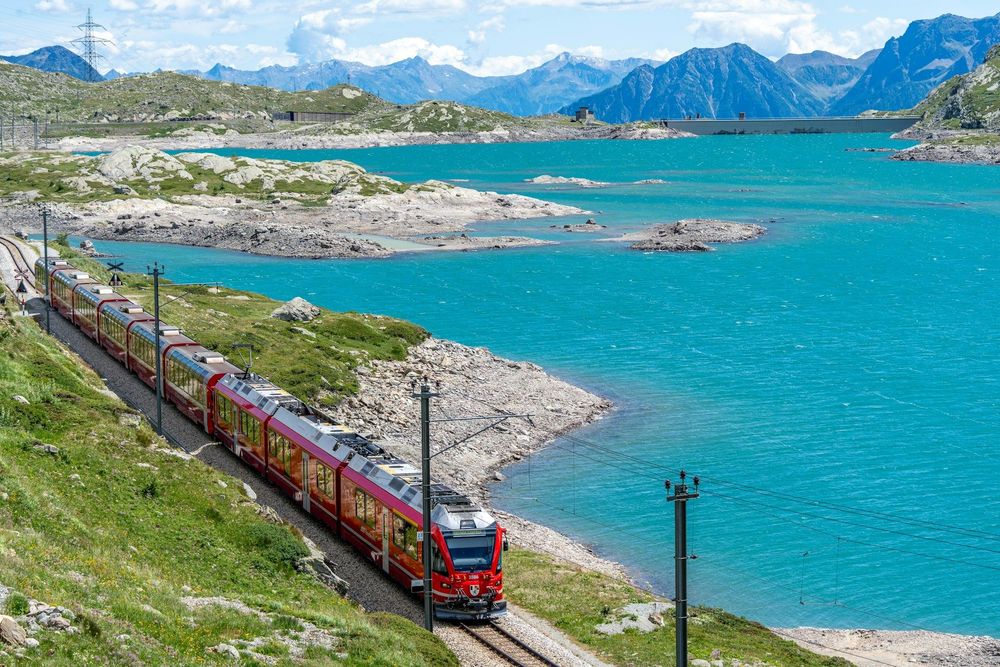
Bernina Express beside Lago Bianco near Ospizio Bernina. Photo: Alessandro Prato / Unsplash.
Frequently Asked Questions
Do regional trains follow the Bernina route?
Yes. They provide a different travel product on the Bernina railway. Select the actual itinerary and intermediate stations; a regional ticket does not by itself authorise a reserved panoramic seat.
Can I reserve a regional seat?
RhB offers optional reservations on the St. Moritz–Tirano section for CHF 5 per person and journey. Reservable seats are limited; this is separate from the compulsory panoramic reservation.
Is a Milan day trip realistic?
It can be, but the Italian and Swiss return rail legs make a long day. Check the full dated timetable and return options before adding stops or booking a fixed activity.
Can I get off and take a later regional train?
Only within the conditions of your ticket. A standard route ticket and a train-specific supersaver fare have different flexibility; plan your stops before buying.
Will an autumn Bernina Express take the usual route?
Not always. RhB lists a Vereina diversion for trains 951/952 from 29 October to 13 November 2026. Check the train number and route if the Albula section is important to you.

Keep Exploring
Scenic Trains in Switzerland: Routes, Passes and Prices
Explore top Swiss scenic trains like Glacier Express and Bernina. Get 2026 prices, pass comparisons, reservation tips, and a sample 5-day itinerary.
ETIAS & EES Explained: EU Travel Requirements Guide
EES biometric checks already run at Schengen borders, and the €20 ETIAS authorisation for visa-exempt travellers is expected in late 2026. What each system does and how to prepare.
London to Amsterdam by Train: Complete Eurostar Guide
The complete guide to the London–Amsterdam Eurostar: 4h19 direct from £39, check-in at St Pancras and Amsterdam Centraal, booking windows, Interrail and alternatives.