
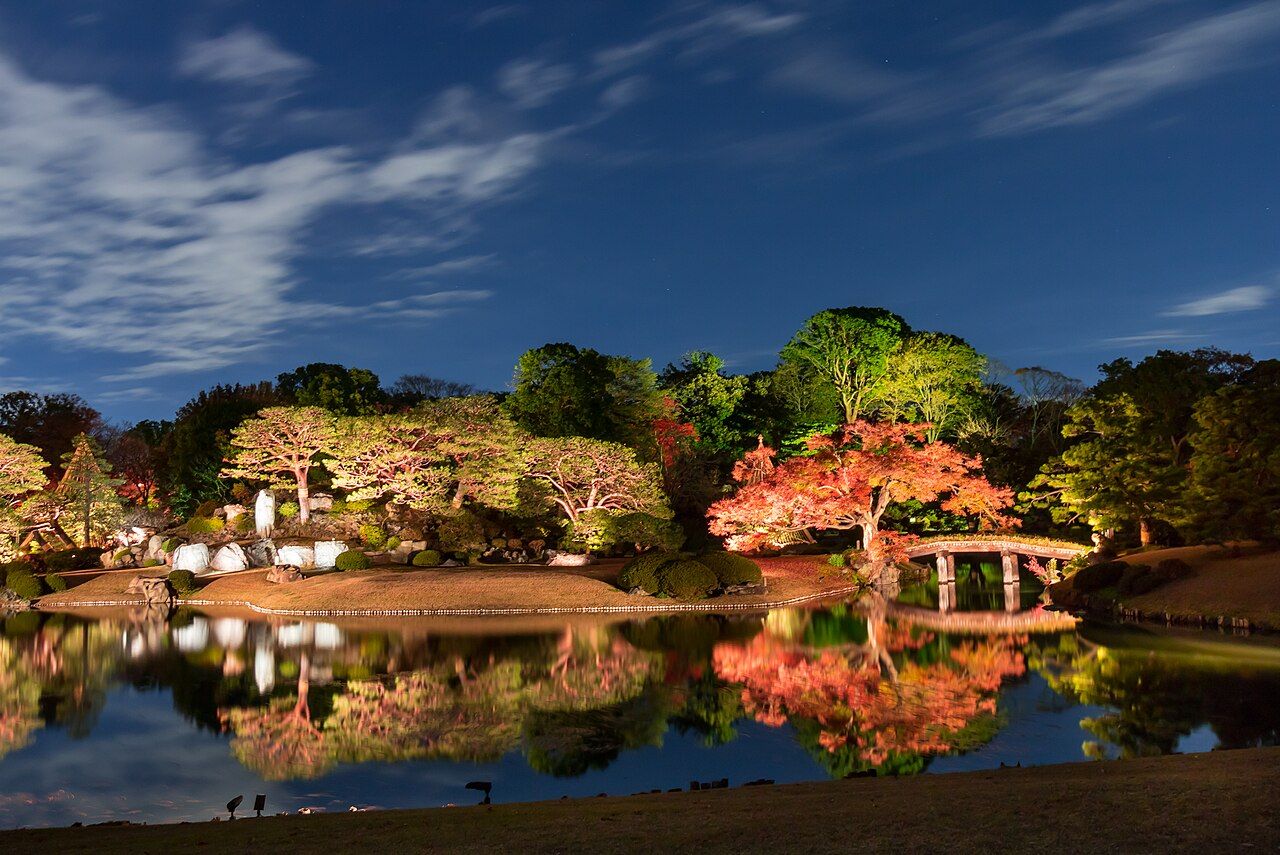
Rikugien Tokyo: Garden Walk or Evening Illumination?
Choose Rikugien by day or at night: pond views, garden paths, 2026 autumn tickets, gate rules and a realistic visit plan.
Choose Rikugien by day if you want to understand the garden's pond, hills and changing views; choose a seasonal evening opening for illuminated scenery and a more tightly managed route. They are different visits, with different tickets and entrance arrangements. A daytime admission does not let you remain inside for the autumn light-up.
Rikugien rewards looking carefully rather than collecting a long list of sights. The pond gives the garden its centre, while small changes of position reveal islands, stonework and wooded paths. Our Tokyo highlights guide helps decide where a garden fits into your trip; the choices below help you use the time once you have chosen this one.
Daytime or evening: the useful comparison
| Visit | Choose it for | Admission and timing checked 24 November 2026 |
|---|---|---|
| Ordinary daytime | Garden design, natural light and a flexible walk | ¥300 general admission; 09:00–17:00, last entry 16:30 |
| Autumn 2026 evening | Lit trees, reflections and seasonal installations | 25 November–6 December; 18:00–20:30, last entry 19:30 |
| Both on one date | Comparing the same landscape in different light | Leave at daytime closing and return with a separate evening ticket |
The official garden page lists ordinary hours and admission, with annual closure 29 December–1 January. The evening dates above belong specifically to 2026. They are not a recurring promise for the same dates next year, nor evidence that the garden stays open late throughout autumn.
Allow 60–90 minutes for a relaxed daytime walk and photographs, with more time if you want tea or detailed observation. This is our planning suggestion. The garden's own FAQ estimates around 30 minutes for the pond circuit and about an hour for a fuller visit or tea stop. A crowded seasonal evening needs extra margin for entry and slower movement.
Reach the entrance your ticket actually uses
Komagome Station is convenient on the JR Yamanote and Tokyo Metro Namboku lines. GO TOKYO's visitor page gives roughly 7 minutes on foot to the garden. Use the Main Gate as your default destination, rather than the nearest point on the garden boundary. The official access information also lists Sengoku Station on the Toei Mita Line as another approach.
Someimon Gate is closer to Komagome, but it does not operate as an everyday entrance. The specific autumn 2026 gate notice announces daytime opening 21 November–6 December and 12–13 December. For the autumn nighttime event, however, entry is through the Main Gate; Someimon is exit-only.
That distinction matters more than saving a few minutes on a map. If you walk straight from the station to Someimon with an evening ticket, you still need to reach the correct entrance. Leave room for the approach and any queue, especially if you have booked dinner afterwards. There is no garden carpark, so rail is the straightforward starting point for most visitors.
A daytime route that makes the garden legible
Begin with the broad pond view at Deshio-no-minato. The park association's English highlights page identifies this shoreline viewpoint and the islands visible from it. Spend a moment noticing how water separates and connects the planted areas. It is a useful introduction before taking the smaller paths.
Continue around the accessible pond-side route towards Togetsukyo, the stone bridge. Look at how its low form changes the view rather than treating it only as a place to stand for a photograph. Follow barriers and current signs: not every bridge or island seen across the water is an invitation to cross. Naka-no-shima is off limits, so enjoy its composition from the permitted paths.
If the climb suits your mobility, add Fujishiro-toge, the artificial hill viewpoint. The official English garden leaflet identifies it as a panoramic stop. The point of climbing is to compare the layout from above with the pond-level views you have just seen. Skip it without regret if steps, wet ground or fatigue make it unsuitable; the garden remains rewarding at lower level.
Then give the wooded side a little time. Tsutsuji-no-chaya and the paths around it offer a more enclosed setting than the open pond edge. Takimi-no-chaya, beside the stream, provides another change of scale and sound. These quieter-looking features are useful reasons to slow down, though seasonal crowds may still gather around them.
Finish with a pause rather than another complete lap. A bench or an available tea stop lets you look back at the landscape without constantly moving. The route is a suggestion, not a mandatory one-way circuit; follow the current map and staff directions if works or an event alter access.
Why the garden feels like a sequence of scenes
Rikugien is a strolling garden shaped around literary landscapes. The official historical outline connects its name and design with poetry and its development with Yanagisawa Yoshiyasu. You do not need to recognise every reference to enjoy the way the views unfold.
Try a simple exercise: choose a pine, an island or a bridge, then look at it again from the next public viewpoint. The foreground changes, the water opens or closes, and the same feature takes a different role. This is a more useful way to experience the design than trying to photograph every named place on the leaflet.
In spring, the weeping cherry is a separate seasonal focus; in autumn, leaves and reflections draw attention. Neither blooms nor peak colour follow an exact calendar. Use the garden's current notices for updates close to your visit, and treat older photographs as examples of a season rather than a promise of today's appearance.
The autumn 2026 evening ticket
The official event announcement confirms the evening period 25 November–6 December 2026. The garden closes at 17:00, then reopens at 18:00 for the special event. Visitors must leave between sessions. The final entry is 19:30, and the event ends at 20:30.
General evening admission is ¥1,000 online in advance or ¥1,200 on the day, online or at the Main Gate. These are advertised operator prices checked on 24 November, not a dated availability quote. Daily ticket quantities are limited. Buying the ordinary ¥300 daytime product is not a cheaper way into the illumination.
Read the dedicated event ticket page before purchase. Advance tickets are date-specific and sold until 23:59 the previous day. Gate sales during the evening admission window are cash-only. Online tickets must be displayed live on a smartphone for staff to operate; printouts and screenshots are not accepted. Keep your phone charged and ensure you can open the ticket page.
If visiting with children or using a concession, check the evening conditions separately from daytime admission. Primary-school-age children and younger are free with a ticket-holding guardian; other eligibility rules do not simply carry across. An annual pass or ordinary garden ticket also does not replace the special evening ticket.
What changes after dark
The evening is about light and reflections rather than seeing every detail of the planting. The announced programme includes lit foliage, photo areas and projections at the storehouse and bamboo grove. Some areas are restricted at night, so do not expect to repeat the entire daytime route or reach every viewpoint from the leaflet.
Decide whether this atmosphere is what you want. If you enjoy taking photographs slowly and comparing details in natural light, daytime may be the better single visit. If the illuminated pond is the main attraction, reserve the evening and accept that movement and stopping places are shaped by the event.
Walk with the flow, step aside only where there is room and avoid holding up a narrow path for repeated shots. You can leave with a good impression of the garden without recreating a particular photograph. Weather, foliage and the installations can differ from an image made in an earlier year; our cover photograph shows a historical evening scene, not a preview of the exact 2026 arrangement.
Tea, children and a route you can comfortably manage
Fukiage Chaya is the named tea stop to look for when you want a break by the garden. For the 2026 evening event, the organiser also lists Shinsentei among the tea venues. Check availability and the order cutoff on the day rather than timing the whole visit around a guaranteed empty table. A tea stop is optional; it should not cause you to rush the walk you came for.
For children, frame the visit around noticing bridges, tree shapes and reflections. This is a heritage garden for viewing, not an open lawn for running games. The FAQ says meals can be eaten on benches, but picnic sheets, entering the lawns and bringing alcohol are not permitted. It also asks visitors not to feed carp or birds. Choose a shorter visit if the children need active play more than another garden scene.
For mobility needs, request the accessible route at the entrance. The park provides wheelchair routes and a multipurpose toilet by the Main Gate, but some narrow paths and steps are unsuitable. The hill is optional, and the event also uses diversions around inaccessible sections. Do not equate a garden-wide accessibility listing with access to every feature; ask staff about the exact route for your visit.
Fit Rikugien into the rest of Tokyo
Keep the surrounding day geographically sensible. A garden visit can be a calm central element rather than a brief gap between distant districts. Leave lunch or dinner flexible enough to accommodate a slower walk, especially during the short autumn evening season. If you visit both sessions, plan where to spend the closure interval outside the garden.
For a different garden experience, compare our Shinjuku Gyoen guide. Choose around the landscape and location that suit your day rather than assuming every Tokyo garden is interchangeable. Rikugien's strongest reason to visit is the sequence of pond-side views; the evening event adds a distinct seasonal interpretation of that landscape.
Cover photograph: Illuminated trees and pond reflections at Rikugien in 2018 — Archive photograph Image adapted for publication. — Kakidai, CC BY-SA 4.0.
Frequently Asked Questions
Does a daytime ticket cover the autumn illumination?
No. The 2026 event requires its own evening ticket. The garden closes at 17:00 and reopens at 18:00; you cannot stay inside between the two sessions.
Which gate should evening visitors use?
Use the Main Gate. For the 2026 autumn event, Someimon is exit-only even when it opens as a daytime entrance during the announced seasonal dates.
When is the 2026 autumn evening opening?
25 November–6 December, 18:00–20:30, with final entry at 19:30. These are the specific 2026 dates; check new announcements for another year.
Can I enter with a screenshot of my online evening ticket?
No. The official event rules require the live ticket screen on a smartphone, operated by staff. Printouts and screenshots are not accepted.
How much time should I allow by day?
Around 60–90 minutes is a comfortable editorial allowance for a walk and photographs. Add tea, seasonal queues or detailed observation, and choose an accessible route if steps are difficult.


Keep Exploring
Buenos Aires Botanical Garden: Plan Your Walk
Choose a Carlos Thays Botanical Garden route, with seasonal hours, last entry, weather closures and the greenhouse access to check.
Royal Botanic Garden Sydney: Choose Your Walk
Choose a botanical walk, harbour route or Gadigal cultural experience, with useful gates, seasonal hours and Calyx closure checks.
Shinjuku Gyoen: Plan Your Tokyo Garden Visit
Choose your Shinjuku Gyoen gate, garden route and greenhouse stop, with seasonal hours, entry rules and practical accessibility checks.