
Choose Tokyo National Museum galleries and tickets, with a focused Honkan route, late-2026 closures, hours and suitcase rules.
For a first visit to Tokyo National Museum, make the Honkan your main stop and add one gallery that interests you. The museum is a campus of buildings, not a single exhibition to finish. A Japanese-art overview followed by Buddhist treasures, Asian art or archaeology gives a clearer visit than walking through every open room.
There is a particularly important practical issue for late 2026: several rooms and the Toyokan have announced closures, and the days before the year-end shutdown offer only a very limited visit. Check your date before choosing the route or buying a special-exhibition ticket. A museum that is technically open may not offer the collection you came to see.
Our Tokyo highlights guide compares this museum with temple districts, gardens and other cultural choices. This guide helps once you have chosen the museum: ticket type, buildings, current exceptions and a manageable route through the available displays.
Quick facts for your visit
| Item | Current planning information |
|---|---|
| Location | Northern part of Ueno Park; visitor access through the Main Gate |
| Collection admission | Adults ¥1,000; university students ¥500 |
| Standard hours | 09:30–17:00 |
| Longer evenings | Until 20:00 Friday, Saturday and Sundays before a Monday holiday |
| Last admission | 30 minutes before closing |
| Regular closure | Monday, normally shifting to the next day when Monday is a holiday |
| Suggested time | Two to three hours for a focused collection visit; editorial estimate |
| Luggage | Suitcases are not allowed inside |
Details checked on 4 November 2026 against the museum's visitor information. Special exhibitions, Kuroda Memorial Hall and other facilities can have different arrangements. The live calendar takes precedence over a generic weekly pattern.
Buy the ticket for the visit you want
The TNM Collection Exhibitions ticket is the starting choice for the museum's own displays. Adult admission is ¥1,000 and university admission ¥500; qualifying school-age, age-related and disability categories have separate conditions and documentation requirements. Check your category directly rather than assuming a discount applies to everyone in a group.
A special exhibition is a separate decision. The museum states that its special-exhibition tickets also permit access to the Collection Exhibitions on the same day. If you want a special show, check that show's ticket rules before buying an additional collection ticket. Conversely, the ordinary collection ticket should not be treated as entry to every temporary exhibition.
Choose a special exhibition because its subject interests you, not merely because it has a separate queue. Its own visit can absorb a substantial part of your available attention. For a short first visit, the collection alone may be enough; for a specialist interest, make the temporary show the anchor and reduce the rest accordingly.
The museum recommends online purchasing during busy periods, when its gate ticket queues can exceed 30 minutes. An online ticket does not remove security screening. Since September 2026 the Main Gate has metal-detector and baggage checks, and the museum's current notice prohibits suitcases. Arrange luggage storage before arriving between hotels.
Check the late-2026 closures first
The official visitor page lists the following exceptions. Dates here describe announced closures, not our estimates of when work will finish.
| Dates | What changes |
|---|---|
| 26 October 2026–25 April 2027 | Honkan Room 4 closed |
| 30 November–31 December 2026 | Honkan Rooms 17–20 and the Toyokan closed |
| 14 December 2026–25 April 2027 | Honkan Rooms 2–3 closed |
| 15 December 2026 | Whole museum closed for maintenance |
| 22–25 December 2026 | Only the Gallery of Horyuji Treasures and Kuroda Memorial Hall open |
| 26–31 December 2026 | Year-end closure |
| 1 January 2027 | Announced opening 12:00–20:00 |
These dates overlap with the museum's normal closure days. Do not interpret the partial-closure table as a promise that every other building opens every day. The Hyokeikan is generally closed unless an exhibition or event is taking place inside.
The consequence is practical: if you want a broad Honkan visit, 22–25 December is not an equivalent substitute for an ordinary opening day. If Asian art is your main interest, the Toyokan closure from 30 November changes the case for visiting. Select the date around your priority instead of accepting any open calendar square.
Start with the Honkan's Japanese-art overview
The official Honkan page distinguishes the second-floor historical overview from galleries organised around particular media and themes. Begin with the overview if you want context: how objects, materials and purposes change across periods. Do not try to memorise every date before allowing yourself to look at the works.
Use the current gallery map and room signs. Older guides and downloadable maps can show different room numbers, and temporary closures alter the sequence. A route based on “find the current Japanese-art overview” is more reliable than following a room-by-room itinerary copied from an older visit.
Choose a small number of objects to examine closely. With a painted screen, first look from enough distance to understand the composition, then approach for details where permitted. With a vessel or lacquer object, consider shape, surface and intended use. Read the label after forming your own first impression, then look again with that context.
The displays rotate. A celebrated print, sword or sculpture shown in an old article may not be on view for your date. The museum's exhibition schedule is the place to check an object or theme that matters particularly to you. Build a broad visit around a collection interest; build an object-specific visit only around a verified display period.
Add one contrasting gallery
Choose the Gallery of Horyuji Treasures for Buddhist art and a more concentrated collection. It gives you a different focus after the broad Honkan overview. The National Center for the Promotion of Cultural Properties explains the gallery's digital displays, updated in March 2026, including interactive ways to explore fragile works and reconstructed appearances.
That digital material is useful when you want to understand details that cannot always be shown continuously through original objects. It is interpretation alongside the collection, not a replacement for looking carefully at what is physically on display. Families or first-time art visitors may find the change of presentation useful without needing to turn the whole visit into a digital experience.
Choose the Toyokan for a wider Asian context, provided it is open on your date. Use the campus map to identify the building and its current displays before committing your remaining time. The late-November and December closure is a strong reason to revise a route that automatically combines Honkan and Toyokan.
Choose the Heiseikan's archaeology displays for material history, when available, rather than assuming the entire building is synonymous with a special exhibition. Confirm the accessible sections on the day. Pottery and archaeological objects can add a different way of thinking about making and use after a visit focused on painted or decorative works.
These are alternatives. Pick the one that answers your remaining curiosity, not all three simply because they share the same museum grounds.
A two-hour route and a longer version
For roughly two hours, an editorial plan is to give most of your attention to the open Honkan overview and selected rooms, then leave a shorter final section for one additional gallery. If the first part is absorbing, stay there and omit the second building. A museum visit is not incomplete because you understood one section well.
For three hours or more, add a break between Honkan and your chosen gallery. Look at the buildings and outdoor connections as you move across the campus. Check current food-service availability rather than basing the break on an old restaurant listing; the museum visit remains coherent if you eat afterwards in Ueno instead.
For a special-exhibition visit, reverse the emphasis. Attend the show first or at the time required by its ticket, then choose a modest collection addition. Buying two types of experience does not require giving both a full independent afternoon in the same visit.
All these allowances exclude travel, security and queues. They are editorial suggestions, not official tour lengths or a promise that you can cover every named display before closing.
Arrive at the correct gate and keep Ueno manageable
The official access page gives approximately ten minutes on foot from JR Ueno or Uguisudani stations, and about fifteen minutes from the listed Tokyo Metro and Keisei stations. Those are museum estimates; station exits and your walking pace affect the actual journey. Follow directions to the Main Gate, rather than merely to the nearest edge of the museum grounds.
Ueno Park itself is not the museum's ticketed interior. Arriving in the park still leaves a walk, entry procedures and the choice of a building. If you arrive late, compare the time remaining with the visit you want before purchasing an additional special-exhibition ticket.
Our Ueno park and museums guide helps connect the museum with a restrained outdoor walk. After two or three hours of looking closely at objects, a park break and a meal may be more enjoyable than immediately entering another large collection.
For visitors needing step-free routes, use the museum's current access information and ask staff about lifts and the open connections between buildings. A campus plan shows locations, but it does not by itself confirm every route's suitability during maintenance. Keep the visit focused enough that moving between buildings does not become its main activity.
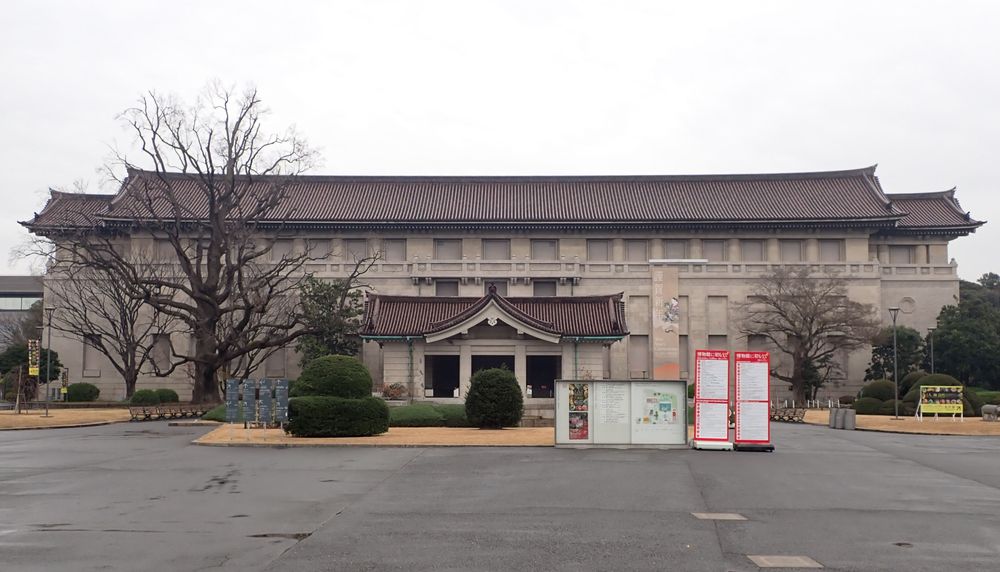
Cover photograph: Honkan façade and tiled roof at Tokyo National Museum — Archive photograph; no edits to the downloaded file — Ryan Sharpe / Wikimedia Commons, CC BY-SA 4.0.
Frequently Asked Questions
Which building should I visit first?
For a first overview of Japanese art, start with the Honkan's currently open displays. Then choose one addition: Horyuji treasures, Asian art in the Toyokan when open, or archaeology.
Does the ordinary ticket include special exhibitions?
Do not assume so. Special exhibitions have their own tickets. The museum states that a special-exhibition ticket also includes the Collection Exhibitions on the same day.
Is the museum fully open in December 2026?
No. Several rooms and the Toyokan close, 15 December is a full closure, only two galleries open on 22–25 December, and the museum closes on 26–31 December. Check your exact date.
Can I bring a suitcase?
No. The museum's current visitor notice prohibits suitcases. Arrange storage before arriving and allow time for the Main Gate security checks.


Keep Exploring
Guggenheim New York: Choose Your Museum Visit
Plan a Guggenheim visit around the spiral, current exhibitions and Thannhauser Collection, with ticket choices and November closure checks.
National Museum of Singapore: Plan Your Visit
Plan the National Museum of Singapore: the renewed history experience, admission checks, visit length, entrances and access needs.
ArtScience Museum Singapore: Choose Your Visit
Choose an ArtScience Museum exhibition, understand Future World tickets and plan a manageable Marina Bay visit.