
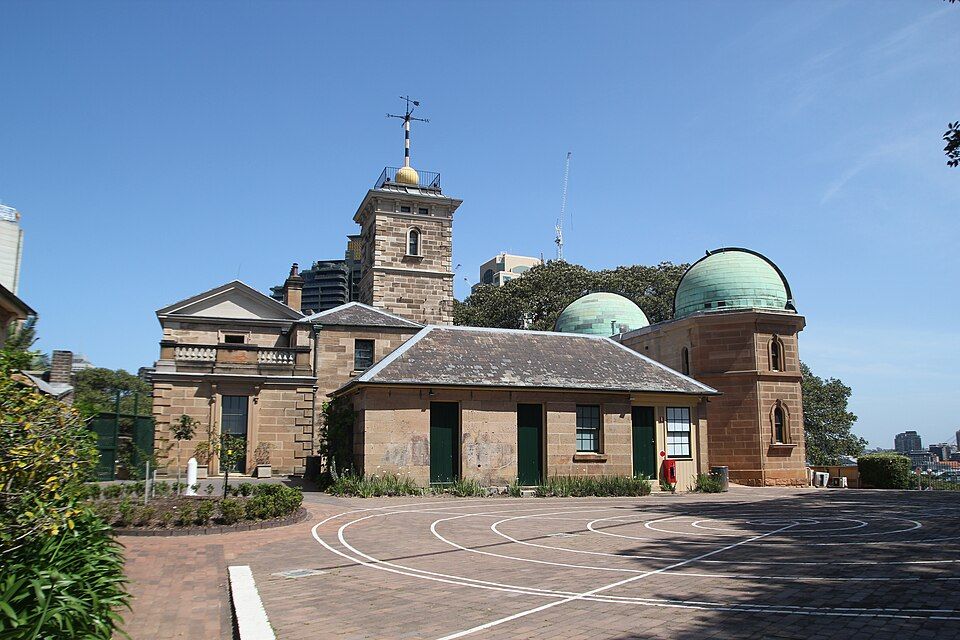
Sydney Observatory: Hill Walk or Telescope Tour?
Compare Observatory Hill, the free Sky Country exhibition and booked telescope tours, with stair limits, family ages and weather checks.
Sydney Observatory offers three different outings: a flexible walk on the public hill, a free exhibition about Sky Country and the site's history, or a booked tour that climbs into the telescope domes. Choose the experience you want before deciding when to arrive. A harbour view does not require a telescope booking, while reaching the hill does not give you access to the instruments.
The site is on Gadigal land in Millers Point, near The Rocks. Our Sydney cultural guide helps place it within a harbour-focused trip. For a short visit, protect one main interest: the view, the exhibition or the guided scientific history. Combining all three is possible, but the booked session and your ability to manage stairs should determine the plan.
Fast facts
| Experience | Main distinction |
|---|---|
| Observatory Park | Public outdoor setting with harbour views; separate from paid tours |
| Free exhibition | I put the stars on the ground, listed Thursday–Sunday, 12:00–18:00 |
| Guided tours | Approximately 1 hour; advance booking and payment required |
| Advertised tour prices | A$36 standard, A$32 concession, A$24 eligible child category |
| Physical demand | Tours involve more than 100 stairs and narrow historic staircases |
| Address for the Observatory | 1003 Upper Fort Street, Millers Point |
| Weather | Astronomical viewing depends on clouds, time and date |
Information was checked on 24 November 2026. The exhibition and tours have different schedules; confirm the actual session rather than treating one opening label as a timetable for everything.
Choose the public hill for an unbooked harbour pause
The City of Sydney's Observatory Park page identifies the public park on Upper Fort Street and its harbour views. Choose this when you want outdoor time without committing to a guided visit. An editorial allowance of 30–60 minutes, excluding the approach, suits a short walk and time to sit; photography or a longer rest can easily extend it.
Look at the relationship between the elevated ground, the harbour and the observatory buildings. The setting helps explain why this hill became useful for signalling and observation. The park's rotunda is another feature to notice, but it is also an event space: leave room for other users and do not assume a private ceremony can be treated as part of your sightseeing.
The walk is the most flexible choice for a mixed group or an uncertain arrival time. It is also a different experience from entering the Observatory. Keep public park access, the institution's own grounds and interior admission separate in your planning. A pleasant view outside cannot confirm that an exhibition is open or that a dome tour still has places.
The free exhibition is a real third option
Powerhouse currently lists I put the stars on the ground as a free walk-in exhibition, Thursday–Sunday from 12:00 to 18:00. This is useful if you want cultural and historical substance without the physical demands or fixed timing of a telescope tour. Allow roughly 45–75 minutes as an editorial estimate, adjusting to how closely you read and listen.
The exhibition foregrounds First Nations custodianship of Sky Country. Its named works include star maps by Gail Mabo, ceramics sharing Waŋupini cloud stories by Bulthirrirri Wunuŋmurra, and Songlines of Our Universe, a soundscape by William Barton and Veronique Serret. Give these distinct forms of knowledge their own attention, rather than treating them as a decorative introduction to European instruments.
The restored residential wing also explores domestic life and scientific work at the site through collection objects and images. That combination makes the Observatory more than a room of telescopes: people lived here, maintained instruments and worked within a changing institution. Choose a few objects or images and ask what they reveal about that daily work.
Wheelchair users can access the gardens and ground floor of the Astronomer's Residence, but the exhibition's first floor is not wheelchair accessible. The free exhibition is therefore a meaningful alternative to the tour, with its own limits; it is not a promise of access to the entire building.
What the guided tour adds
The standard guided-tour page advertises approximately 1 hour, covering the grounds, Fort Phillip and the Signal Station, collection objects and the site's role in surveying, astronomy and timekeeping. The route then climbs the narrow staircases into the domes to see historic and modern telescopes.
Choose this if you want someone to connect the instruments to the practical questions they helped answer. How did a port coordinate time? How were observations recorded? Why were weather measurements and astronomy part of the same institutional story? These questions give the visit depth even when the sky is not offering the celestial object you hoped for.
The tour page advertises Wednesday–Sunday sessions, while the general venue page says Thursday–Sunday and the free exhibition follows that latter pattern. These are not interchangeable promises of admission. Use the tour booking calendar for a specific paid session, and the exhibition page for a walk-in visit. Do not arrive on a Wednesday expecting every public area to be open because a tour is advertised that day.
Telescopes do not guarantee a particular sky
The operator makes clear that astronomical viewing depends on cloud cover, the time of day and the date. A daytime session can include terrestrial observations and the operation of instruments; it should not be bought with an expectation of a dark night sky. An evening booking likewise cannot guarantee the Moon, a particular planet or a clear view through cloud.
Before booking, decide whether the guided history and telescopes themselves would justify the visit if your preferred astronomical target is unavailable. If the answer is yes, the tour is a robust choice. If your only interest is one specific object, ask the operator about the relevant session and accept that weather can still intervene.
Read the booking conditions for the actual cancellation rules. Powerhouse says it aims to notify visitors approximately four hours before a cancelled tour, including weather cancellations, and describes refund, credit or alternative-session arrangements where applicable. Cloudy viewing conditions are not automatically the same as an operator cancellation. Check your email before travelling and follow the message for your booking.
Timekeeping makes the harbour view more meaningful
Powerhouse's history of the Observatory connects the 1858 building with maritime timekeeping, weather observations and later photographic star mapping. The time ball was a practical signal for the port, not merely an ornamental feature. This history explains why an observatory belongs above a working harbour rather than being understood only as a remote place for stargazing.
The same account describes women employed as astronomical “computers”, measuring photographic plates to record star positions. Their work is a useful counterpoint to a telescope-centred visit: a scientific result depended on careful analysis as well as the moment of looking through an instrument. Ask how observations became usable records, and whose labour made that possible.
Do not turn historical descriptions into a current demonstration schedule. This guide does not promise a time-ball drop, a particular instrument in operation or access to every collection item. The point is to arrive with questions that help you understand whatever is available in your chosen programme.
Families: choose the format and age category carefully
Guided Family Tours are designed for groups with children aged 6 and above. They explore flag signalling, weather measurement and scientific history before entering the domes. The page lists A$24 for ages 6–12, A$32 concession and A$36 standard, with an approximate one-hour duration.
The standard tour lists its child category as ages 12–16 and is recommended for older children. The age bands overlap at 12 because these are different products; choose the format that suits your group and use the category offered for that booking. Tours are not suitable for children under 6. All attending adults and children need tickets, and the terms require at least one responsible adult for every five children.
A child interested in space may enjoy the instruments but still find narrow stairs, waiting turns and listening for an hour demanding. Explain the format beforehand. The public park or an appropriate exhibition visit can be a better fit for a group that needs flexible stopping points, subject to the exhibition's own access and content.
Stairs, arrival and conservation work
The accessibility page states that the tour locations have no wheelchair access because of the narrow, steep historic staircases. More than 100 stairs is a substantial part of the experience. Do not interpret an accessible garden entrance as an accessible route to the domes. Contact Powerhouse before paying if a particular mobility requirement may affect participation.
There is no visitor parking on site; the operator identifies the south entrance at 1003 Upper Fort Street for drop-offs. Companion Card arrangements are handled through the contact centre. Choose the approach with your whole group in mind, including the hill and the return after an evening session, rather than relying on a straight-line distance from Circular Quay or Wynyard.
The venue page also warns of heritage conservation works that may affect access. Recheck before departure and allow time to find the correct entrance. Bring a layer for outdoor portions, but keep bags manageable for the stairs and follow the operator's current instructions for your session.
Give the rest of the day room to breathe
For a compact cultural outing, pair the free exhibition with a short park walk. For the paid tour, place a flexible meal or harbour stroll around the fixed booking and allow around two hours for your selected combination, excluding transport. That is an editorial planning allowance, not an official tour extension.
If your main priority is a longer outdoor harbour visit, compare our Royal Botanic Garden Sydney guide. It offers a different landscape and plant collections, with its own gates and guided activities. It is an alternative focus for the day, rather than a compulsory addition after climbing the Observatory stairs.
Cover photograph: Sandstone Sydney Observatory building and its telescope dome — Archive photograph Image adapted for publication. — Sgerbic, CC BY-SA 4.0.
Frequently Asked Questions
Can I visit Sydney Observatory without booking?
The public park is separate from the tours, and the current free exhibition offers walk-in entry Thursday–Sunday, 12:00–18:00. Telescope tours require booking and payment. Check the specific experience before travelling.
Will I definitely see stars or planets through a telescope?
No. What can be viewed depends on cloud, time of day and date. Choose a session for the history and instruments as well as possible astronomical viewing; no particular object is guaranteed.
How much do the tours cost?
At the November 2026 check, standard admission was A$36, concession A$32 and the relevant child category A$24. The family and standard tours use different child age bands; confirm the selected product before paying.
Are the telescope domes wheelchair accessible?
No. Tours involve more than 100 stairs, including narrow historic staircases. The gardens and ground floor of the Astronomer's Residence offer wheelchair access, but first-floor exhibition spaces do not.
Which tour should I choose with children?
Family Tours are designed for ages 6 and above; the standard format is recommended for ages 12 and above. Under-6s are not suitable for tours. All participants need tickets and children must be supervised.


Keep Exploring
Sydney Opera House: Tour, Show or Harbour Visit?
Choose an Opera House tour, performance or exterior walk: current prices, stairs, accessible options, arrival and what each ticket includes.
Hyde Park Barracks Sydney: Plan Your Museum Visit
Plan Hyde Park Barracks in Sydney: free entry, audio sessions, languages, access options and the history behind the museum.
Puerto Madero: Plan a Waterfront Walk
Explore Puerto Madero’s historic docks, Puente de la Mujer and two museum ships, with a short walking plan and current boarding caveats.