
Mohammed VI Museum Rabat: Art, Tickets and Visit
Plan a visit to Rabat’s Mohammed VI art museum: opening hours, visitor tariffs, exhibition checks and time for the galleries.
The Mohammed VI Museum of Modern and Contemporary Art is the Rabat stop to choose when you want Moroccan culture to include living artistic debates as well as monuments and historic streets. Its collection and changing exhibitions make it a different decision from visiting a royal memorial or an archaeological site. Allow a proper gallery visit rather than treating the facade as another landmark to photograph between transfers.
The practical starting point is simple: the museum's published opening is 10:00–18:00, with Tuesday closed. The Fondation Nationale des Musées visitor page lists different prices for Moroccan and foreign visitors. Information here was checked on 19 November 2026; exhibition availability and exceptional opening arrangements still need checking for your travel date.
Fast facts
| Detail | Published information or planning advice |
|---|---|
| Full name | Musée Mohammed VI d'art moderne et contemporain, often MMVI |
| Address | 2 Avenue Moulay Hassan, Rabat |
| Regular opening | 10:00–18:00; closed Tuesday |
| Moroccan adults | 30 DH |
| Moroccans under 18 | 15 DH |
| Foreign visitors | 60 DH |
| Visit allowance | Around 90 minutes–2 hours; editorial estimate, excluding travel and queues |
| Best reason to choose it | Modern and contemporary Moroccan art, plus the exhibition programme |
DH means Moroccan dirhams. These are published categories, not a promise that every discount or special event follows the same tariff. Transport and meals are additional. If you are deciding how much time Rabat deserves in a wider trip, our Morocco itinerary for one week compares the Rabat–Fez route with other options.
What this museum adds to a Rabat visit
The regional tourism board records the museum's inauguration in 2014 and its dedication to modern and contemporary art. This is not a royal biography museum despite the name, and it is not a general survey of archaeology. Come for artworks, curatorial choices and the relationships between artists, materials and ideas.
A useful first question is what you have already seen in Morocco. If your trip has mostly involved palaces, medinas and craft markets, MMVI offers a different way of meeting the country's culture. If you have spent several days in galleries, a particular exhibition may be the deciding reason to add it. Both approaches are more productive than assuming every major capital must have a museum you are obliged to complete.
The institution's own collection description names artists including Mohamed Melehi, Jilali Gharbaoui, Farid Belkahia and Malika Agueznay. A collection list is not a guarantee that a specific work will be hanging on your date. Loans, conservation and changes of display can alter what is visible. If one artist is your main reason for coming, ask about the actual galleries before paying or arranging a special journey.
Use the current exhibition as a starting point
At the research check, the FNM programme marked a Mohamed Melehi retrospective as ongoing, with an opening date of 29 April 2026. The official exhibition announcement did not display an end date in the consulted text. Treat that as a dated observation, not a promise that the exhibition will still be running when you arrive.
Before visiting, check the title, venue and dates together. The foundation operates several museums, so an interesting announcement on its website may concern another Moroccan city. Its exhibition listing distinguishes current and past programmes; do not turn a photograph of an earlier international show into an expectation of permanent display.
For a retrospective, follow the exhibition's own sequence before inventing a route. Ask what changes between earlier and later works: scale, rhythm, surface, colour or the relationship to a repeated form. You do not need specialist vocabulary. Naming one visible difference makes a useful connection between rooms and gives you something more precise to remember than simply liking the colours.
Plan a visit around three acts of looking
Start with a short orientation. Find out which rooms are open, which contain the main collection presentation and which belong to temporary exhibitions. Ask whether your ticket covers the areas you want to see. The published tariff does not by itself establish every exhibition inclusion, and a gallery closure can matter more to your visit than a small price difference.
Next, choose a few works to examine slowly. Spend a moment with the image or object before reading its label, then return to it after learning the artist, date and material. Notice whether the information changes your first interpretation. This is particularly useful when an unfamiliar artist initially seems difficult: the label can supply a question without dictating a single reaction.
Finally, compare rather than collect. Choose two works that use a similar colour or shape differently, or revisit one piece after seeing the rest of its room. A compact set of considered impressions is easier to retain than photographs of every label. If the museum permits photography, use it to support looking rather than replacing the time you wanted to spend with the work.
The suggested 90 minutes–2 hours is an editorial allowance, not a compulsory route or official tour duration. Readers who study labels closely may want longer. With an hour available, select one coherent exhibition or group of rooms after confirming what is open; do not rush through everything merely to say you saw the entire museum.
Understand the ticket categories before arrival
The current official page lists 30 DH for Moroccan adults, 15 DH for Moroccans under 18 and 60 DH for foreign visitors. It does not establish a general foreign-child rate in the tariff text checked. Families should therefore confirm the category that applies rather than applying the Moroccan youth price to every child.
Bring any identification needed for a concession you intend to claim and ask which evidence is accepted. Student status, residency and nationality are different concepts; an offer described using one should not be assumed to apply to the others. The same caution applies to free days quoted in older guides. No universal free-day promise is made here because the current museum page consulted does not establish one.
Keep the budget in dirhams until you pay. An approximate euro conversion can become less useful than the clear local amount, especially once exchange charges are involved. For a mixed group, calculate the relevant categories individually and leave room for transport or a meal outside the museum. Those costs are separate from admission and vary with your choices.
Give Tuesday and closing time proper weight
A Tuesday closure is easy to miss if you habitually expect museums to close on Monday. Check the weekday of your Rabat stay before fixing the rest of the route. If Tuesday is your only day, build the programme around another confirmed visit instead of arriving at MMVI hoping the regular rule will be different.
The published closing time is 18:00, but the checked visitor text does not specify a separate final admission deadline. Do not interpret that omission as permission to enter at 17:59. Arrive with enough time for the gallery visit you actually want, and ask about last admission if your train or other appointment forces a late arrival.
Exceptional closures, installation periods and holidays can change the practical choice. A general opening schedule describes normal operations; it does not certify that every room will be open on every day. Confirm closer to departure when a particular exhibition is essential to your trip, especially if the official announcement provides no end date.
Find the correct museum and keep the journey proportionate
Use the full museum name and the address at 2 Avenue Moulay Hassan when planning your journey or speaking to a driver. Rabat has several institutions and landmarks named after members of the royal family. A shortened request for “Mohammed museum” is less useful than showing the official name and address.
Choose transport from your actual accommodation or arrival station. This guide has not verified a current tram fare, a specific stop-to-door accessible route or a fixed taxi price. Check those details with the relevant operator or accommodation rather than treating a city-wide estimate as a guaranteed museum journey. Leave margin for crossings and finding the visitor entrance.
If you arrive in Rabat with luggage, arrange storage separately before committing to the galleries. The sources checked do not establish a museum suitcase service. Likewise, visitors who need step-free access, lifts, seating or an adapted toilet should ask about the precise facilities required. A modern building is not enough evidence to promise every part of the route is accessible.
Pair contemporary art with one historic contrast
MMVI can anchor a half-day with lunch and a modest walk. For a contrasting monumental visit, our Hassan Tower and mausoleum guide explains a different part of Rabat's history and the separate access arrangements. Check those hours independently and allow time to move between the sites; this is a pairing suggestion, not a walking-time guarantee.
The contrast is useful because it keeps the city from becoming a single story. UNESCO's Rabat listing recognises the relationship between the modern capital and historic city. A day that includes contemporary art and an older monument can make that relationship tangible without requiring every important attraction to fit into the same afternoon.
With children or companions who are less interested in art, agree on the visit length before entering. Choose a small observation task, such as finding two different uses of a shape, and leave time outside afterwards. Check before expecting a workshop or guided activity: a museum's educational role does not mean a session is available without booking on your date.
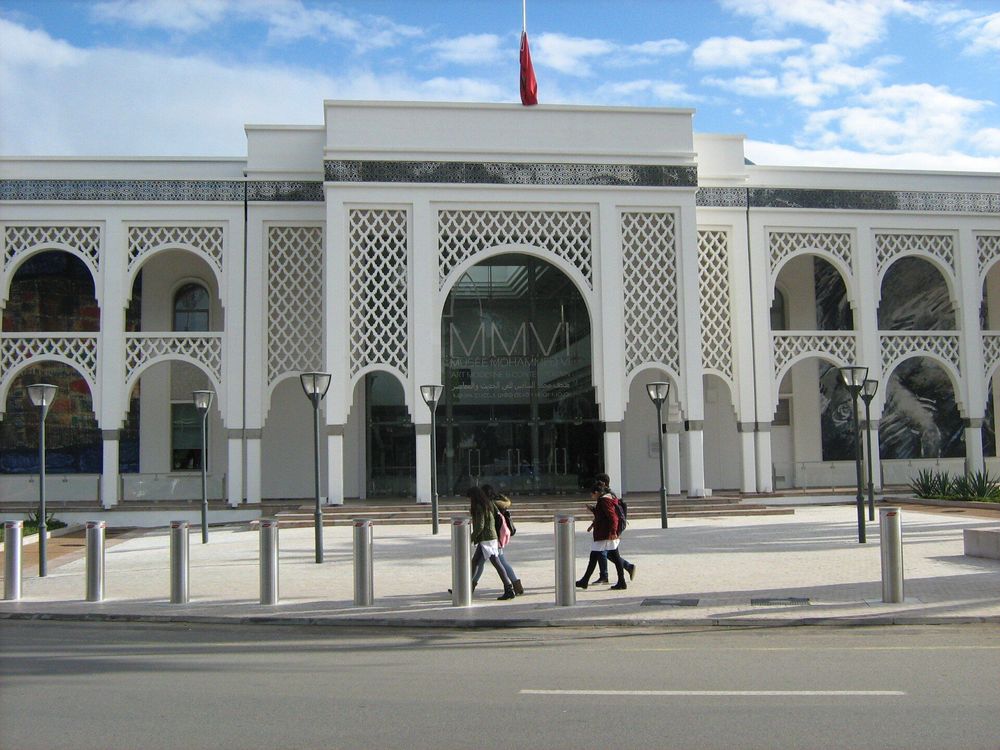
Cover photograph: Arched facade and entrance of the Mohammed VI art museum in Rabat — Archive photograph from January 2015; exhibition banners and entrance arrangements may have changed. — J. N'Demenye, CC BY-SA 4.0.
Frequently Asked Questions
Is the Mohammed VI Museum open on Tuesday?
The published regular schedule is 10:00–18:00 with Tuesday closed. Check exceptional notices for your date, but do not plan a Tuesday visit on the assumption that the normal closure will be waived.
How much does admission cost?
The official page lists 30 DH for Moroccan adults, 15 DH for Moroccans under 18 and 60 DH for foreign visitors. Confirm other concessions and foreign-child arrangements directly; the checked tariff does not establish them.
Is the Mohamed Melehi exhibition still running?
The FNM listed it as ongoing when checked on 19 November 2026, with an opening date of 29 April 2026 and no end date shown in the consulted text. Recheck the programme before travelling.
How much time should I spend inside?
Allow roughly 90 minutes–2 hours as an editorial estimate, excluding travel and waiting. Choose a smaller group of rooms if time is short, and ask which galleries and exhibitions are open before deciding your route.


Keep Exploring
Chellah Rabat: Tickets, Hours and Visit Planning
Plan Chellah in Rabat: compare entry and audioguides, understand the ruins, check Ramadan hours and choose a manageable route.
Academy Museum Los Angeles: Plan Your Visit
Plan an Academy Museum visit with gallery tickets, separate screenings and Oscars Experience, current closures and a realistic afternoon route.
Oaxaca Textile Museum: Plan Your Visit
Plan a thoughtful textile museum visit, with current hours, guided tours, workshop checks and a useful link to Oaxaca’s weaving communities.