
Chellah Rabat: Tickets, Hours and Visit Planning
Plan Chellah in Rabat: compare entry and audioguides, understand the ruins, check Ramadan hours and choose a manageable route.
Choose Chellah for a focused outdoor encounter with Rabat's ancient and medieval layers. Allow roughly 90–120 minutes inside, then leave room for the journey and a meal. That is our planning allowance, not an official tour duration or a promise that every part of the archaeological site will be accessible.
The useful decision is whether you want a quiet, self-directed look at ruins and landscape, or enough interpretation to understand what the surviving masonry represents. Make that choice before buying: ordinary admission, an audioguide and a reserved mediator are different products. Chellah becomes less rewarding when it is squeezed between several other paid visits and reduced to a photograph at the gate.
If Rabat is one stop in a longer journey, place this visit within the Rabat–Fez option in our Morocco itinerary for seven days. The guide below resolves the Chellah visit itself, rather than rebuilding the entire week around one monument.
Choose the right kind of visit
Official information was checked on 10 November 2026. Suggested durations, combinations and sequencing are editorial recommendations. Verify opening arrangements for your date, especially during Ramadan or a special event.
| Your priority | Best starting choice | What to allow for |
|---|---|---|
| An introduction to the ruins and setting | Ordinary entry and the site's interpretation panels | About 90 minutes, with a selective route |
| Understanding the different historical layers | Entry with audioguide | Around two hours and time to stop listening |
| Questions and discussion | Reserve the professional mediator | Confirm language, meeting time and separate admission |
| Limited walking capacity | Ask the site about the currently accessible circuit | A shorter visit with a clear turnaround point |
| A full day of Rabat heritage | Chellah, lunch, then one contrasting area | Separate transport and an unhurried afternoon |
These options describe how to spend your attention. A more expensive ticket does not oblige you to cover every stone, and a simple admission can be enough if you prefer reading a few panels and studying the layout yourself.
Tickets: compare the correct columns
The official admission page lists individual entry at 70 MAD for adults over 25, 50 MAD for ages 15–25 and 30 MAD for ages 7–14. The corresponding admission-with-audioguide prices are 120, 100 and 80 MAD. Children under seven enter free. These are published tariffs checked on the date above, not a booking quote for a particular day.
Moroccan citizens and foreign residents in Morocco receive a stated 50% reduction, with evidence of eligibility required. A foreign tourist is not a foreign resident merely because they are staying in a Moroccan hotel. Bring the relevant identification and confirm your category before paying. There is also a separate group tariff: do not apply it to an independent couple or family by mistake.
The French label “entrée libre” in the tariff table means visiting without an audioguide; it does not make the priced adult ticket free. This matters if you switch language versions while booking. Compare the visitor category, number of people and included interpretation, rather than matching only the first price you see.
For a mediator, the site advertises a 300 MAD group service for two hours, reserved for an agreed time. Admission and audio equipment are additional. Ask how your party's needs fit that service before making a reservation: a family looking for a short introduction and a group interested in architectural history may need different emphasis.
The operator also describes a Heritage Interpretation Centre ticket but marks that product unavailable. Do not build a rainy-day plan around an assumed indoor centre visit. Buy only the option actually offered for your date, and read cancellation terms before committing to a fixed arrival time.
Opening hours and the Ramadan discrepancy
The practical page publishes 09:00–18:00 from 1 October to 31 March and 09:00–20:00 from 1 April to 30 September. A closing time is not a sensible arrival target. For a two-hour visit, work backwards and add a margin for tickets and finding the entrance.
Ramadan needs a direct check. The practical page gives 09:00–15:00, while the site's footer and Rabat Région Patrimoine Historique's Chellah page give 09:00–16:00. These official pages disagree. Plan an earlier visit and confirm with Chellah before travelling; do not rely on the later closing time. The discrepancy is relevant to a future Ramadan trip, rather than an instruction that November currently follows Ramadan hours.
Morning is a useful default when you want the visit to set the pace of the day. An afternoon visit can work equally well if you protect its full duration. Weather, daylight and your tolerance for outdoor walking matter more than a supposedly universal perfect hour. Check conditions close to the visit, and move the outing if prolonged rain would make your group uncomfortable.
Understand what you are looking at
The site's own overview identifies ancient Sala Colonia and a later Marinid necropolis within the same enclosure. That distinction is the key to reading the place. You are not looking at one city built in a single period, nor at an intact palace whose rooms can all be understood from their present appearance.
Begin by looking at the enclosure and the relationship between the entrance, lower remains and surrounding landscape. Then use signs or the audio interpretation to separate the ancient urban remains from the medieval funerary and religious structures. Let those two layers organise the visit instead of trying to memorise a long sequence of rulers.
The official historical account describes public buildings in the ancient city and the site's later use as a royal burial place. It also treats a possible Phoenician presence as uncertain. There is no need to convert that hypothesis into a confident foundation story. A useful question while walking is how later occupants reused a place that already carried an earlier history.
Rabat's UNESCO inscription provides the broader urban context. Chellah contributes to a city whose heritage includes several different periods and forms of planning. UNESCO status explains significance; it does not establish today's ticket price, which paths are open or access to every structure.
A practical sequence inside
Spend the first part of your visit orienting yourself, even if you have booked interpretation. Locate the principal areas on the available plan and identify any restrictions before descending or choosing a circuit. This small pause prevents a late discovery that your preferred route requires more walking than you intended.
Give the ancient remains a sustained block of attention. Pick one or two clearly identified structures and consider their use and relationship to neighbouring spaces. A low wall can be difficult to interpret without context; reading a panel carefully is usually more useful than photographing several unidentified foundations.
Move on to the Marinid part as a change of subject. Look at the difference between an urban arrangement and a setting associated with burial and religious memory. Follow the visitor route and respect barriers. A view through an opening does not mean the structure beyond is open to enter, and old photographs are not evidence of current access.
Finish with the landscape and a pause before returning toward the exit. If you have extra time, revisit the area you understood least rather than extending the outing simply to fill the afternoon. The suggested sequence is flexible: staff instructions, temporary closures and your mobility take precedence over this editorial plan.
Getting there without wasting the visit
The operator identifies Rabat Ville as the nearest railway station and notes taxis and parking outside the site. Use the archaeological-site location in the official contact and practical information when arranging transport. Check that your driver understands the destination before leaving, particularly if a search result offers another place using the Chellah name.
There is no verified taxi fare or door-to-door journey time in this guide. Establish the fare arrangement locally and allow for traffic from your actual starting point. A centrally located hotel, a railway platform and a restaurant in another part of Rabat are different departure points; one generic travel estimate would conceal that distinction.
Decide how you will leave as well as how you will arrive. If meeting a driver, agree a recognisable meeting place and a realistic time. If continuing independently, keep the next reservation flexible. The archaeological visit should not become a hurried circuit because lunch is booked too tightly after it.
Walking, accessibility and families
The operator warns that some areas remain inaccessible because of conservation constraints. Free or reduced admission for a visitor category does not establish a fully step-free route. Before booking, ask specifically about the entrance, gradients, surfaces, accessible toilets and the distance between any usable resting places. Describe your actual needs rather than asking only whether the site is “accessible”.
Choose shoes suited to outdoor archaeological paths and carry water appropriate to the weather. A small bag leaves your hands free. In sunshine, plan protection and pauses; in wet conditions, be prepared to shorten the circuit. Do not assume that every shaded-looking area is a permitted place to sit or picnic.
With children, use the contrast between a former city and a later burial place as a simple theme. Choose a few stops where the whole group can look together. A shorter visit with a clear story is often more useful than asking children to follow every audio segment. Confirm any equipment arrangements before buying an audioguide for the entire family.
What to do after Chellah
Pair Chellah with lunch and one contrasting part of Rabat. Our Kasbah of the Udayas visit guide explains the choices between a lane walk, garden and optional museum. Treat that as another outing with its own approach, not an extension immediately outside Chellah's gate.
If you are already planning a substantial museum visit, keep the remainder of the day light. Chellah rewards looking and interpretation, even though it is outdoors; it is not automatically a rest between two demanding collections. Save an additional attraction for another day if preserving lunch, transport and a break would otherwise be impossible.
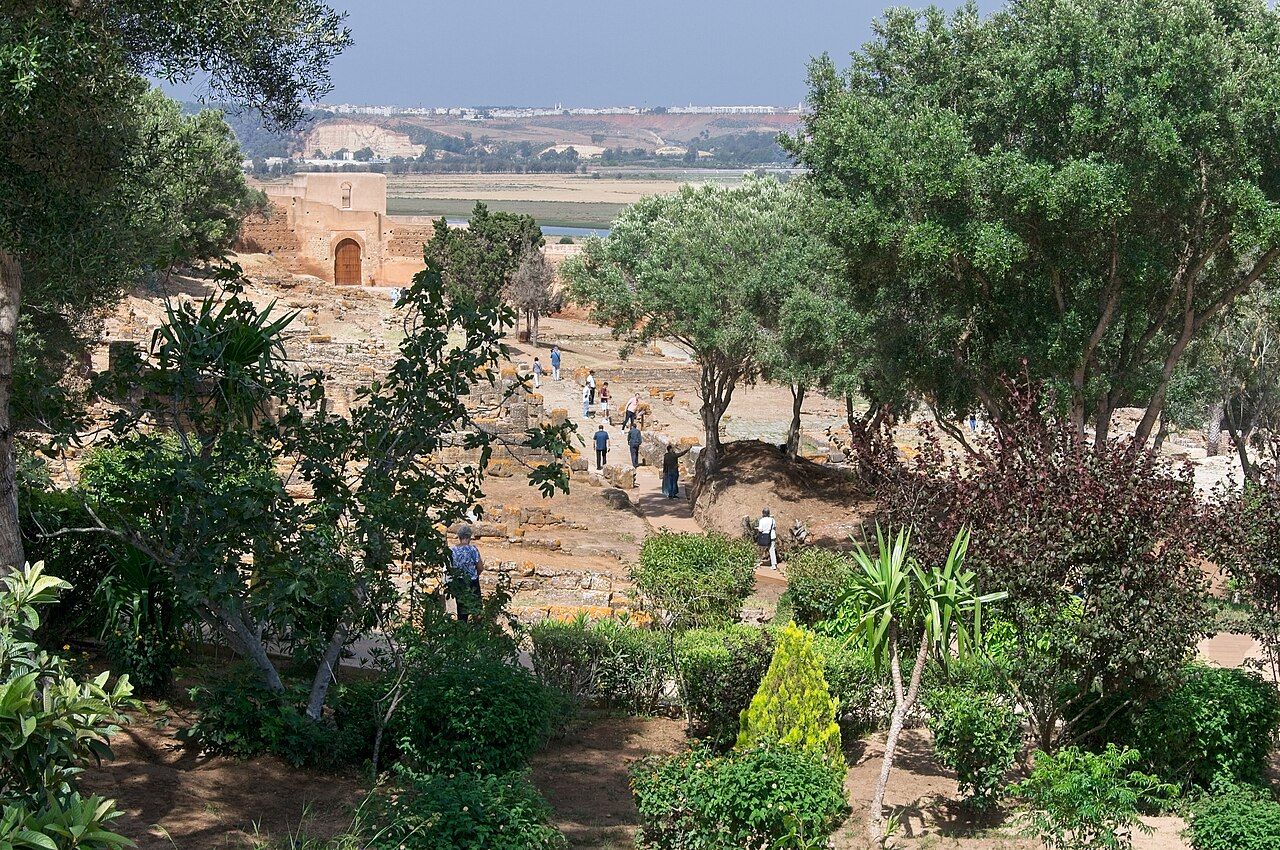
Cover photograph: Visitors among archaeological remains and trees inside Chellah in Rabat — Photographed on 2 June 2024; proportionally resized by Wikimedia Commons. Historical photograph, not a current access survey. — Bertrand SOUBEYRAND, CC BY-SA 4.0.
Frequently Asked Questions
How long should I allow for Chellah?
Start with 90–120 minutes inside, plus transport and ticket time. This is an editorial allowance; a reserved mediator is advertised as a two-hour service, and your accessible route may be shorter.
Do I need to buy an audioguide?
No. Ordinary admission supports an independent visit. Choose audio interpretation if understanding the remains is a priority, and check language and equipment availability before paying.
Is Chellah open until 16:00 during Ramadan?
Do not assume so. Official pages conflict between 15:00 and 16:00. Confirm directly and plan an earlier visit rather than relying on the later time.
Does the resident reduction apply to foreign tourists?
The stated reduction covers Moroccan citizens and foreign residents in Morocco, with proof. A temporary hotel stay alone does not establish eligibility as a resident.


Keep Exploring

Nijo Castle: Tickets and Visit Planning
Choose the right Nijo Castle ticket, understand the two palaces and their different calendars, and plan a visit with enough time for the gardens.
Jardin Majorelle: Tickets and Visit Planning
Plan Jardin Majorelle in Marrakech: choose garden or museum tickets, use the official booking site and fit the visit into a realistic day.
Yagul from Oaxaca: Tickets, Transport and Visit
Plan Yagul from Oaxaca: current admission categories, the access-road walk, courtyards and ballcourt, and why the UNESCO caves need a separate plan.