
Kasbah of the Udayas: Plan Your Rabat Visit
Choose a compact kasbah walk, the Andalusian Garden and estuary views, or add the National Museum of Adornment with its own hours and ticket.
Give the Kasbah of the Udayas a proper morning or afternoon if you want more than a photograph of its gate. The most useful first visit combines a short walk through the inhabited quarter, the Andalusian Garden when accessible and a viewpoint over the Bouregreg estuary. Add the National Museum of Adornment if jewellery, materials and Moroccan dress interest you. It is a separate visit with its own ticket and opening arrangements.
Allow around 90 minutes for a selective outdoor visit, or 2–3 hours with the museum and a pause. These are planning estimates, not official tour durations. The kasbah is compact enough to explore without filling every hour, but stairs, browsing, a museum and sitting over tea can turn a short map distance into a satisfying half-day.
Our seven-day Morocco itinerary places this visit within a Rabat-and-Fes week. Here the decision is narrower: how to spend time inside and around the kasbah without confusing it with Rabat’s medina, Chellah or the whole waterfront.
Choose what matters before entering
Udayas, Oudayas and Oudaïas are alternative spellings you may encounter for the same Rabat kasbah. Save its map location rather than relying on one spelling in a taxi conversation. A kasbah is a fortified quarter; this one contains homes as well as visitor sights. It should not be approached as a single museum building with one universal opening time.
| Your priority | Build the visit around | Allow as a starting estimate | What to verify |
|---|---|---|---|
| Architecture and streets | Gate exterior, a short lane walk and a viewpoint | Around 90 minutes | Accessible entrances and any local restrictions |
| A gentler pause | Garden and one nearby view | Around an hour, then reassess | Garden access and the actual walking surface |
| Jewellery and decorative arts | National Museum of Adornment plus a shorter outdoor walk | 2–3 hours overall | Museum day, hours and ticket category |
| A broader historic-city outing | Kasbah followed by a separate medina walk | Half a day or longer with lunch | Energy, return transport and which activity to shorten |
Do not make every row compulsory. If you have already spent the morning walking, the garden and a view may be the right visit. If the museum is the reason you came, protect its opening window and use the streets around it as an introduction rather than arriving at the ticket desk near closing.
Start with the gate and the setting
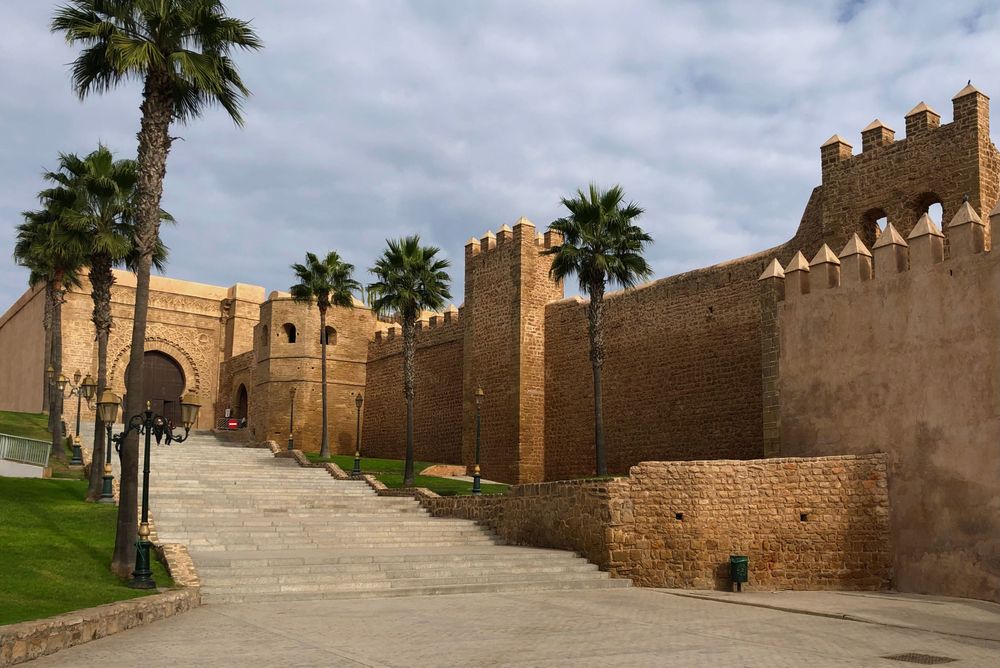
The monumental Bab Oudaia entrance and surrounding walls make a useful place to orient yourself. Look at the scale of the fortifications before moving into the smaller streets. Photographing the exterior does not require turning every doorway into a destination, and a closed monumental door does not by itself tell you that all access to the quarter is closed. Follow the entrance in use and local signs.
The kasbah overlooks the Bouregreg estuary where the river reaches the Atlantic. This explains why its setting matters as much as its individual buildings. UNESCO’s Rabat listing treats the city as a shared heritage of older quarters and modern urban planning, and specifically discusses views from the kasbah over the river. The designation is broader than a claim that one gate alone is the World Heritage site.
Use that context to choose two or three things to notice: the defensive exterior, the change in scale inside, and the relationship with the water. You do not need a long list of rulers to understand the contrast. If detailed history is your main interest, a guide can add value, but agree the duration, language and fee before starting.
Walk a small route through the inhabited quarter
After orienting yourself, take a limited walk through the lanes rather than trying to cover every turning. Keep the gate or another clear public landmark saved as your return reference. The most useful route is one you can comfortably reverse if someone gets tired or an access point is closed.
Let the streets provide the transition between the monumental entrance and the open view. Look at the relationship between walls, doors and small passages, but avoid treating private steps as photography platforms. Attractive paintwork does not turn a home into a public courtyard. Ask before photographing residents closely and move aside when people need to pass.
A self-guided visit suits travellers who want to choose their own pace and are comfortable navigating back to a known point. A guided walk suits those who want interpretation or help managing a group. Neither needs shopping stops unless you want them. Make that preference clear at the beginning rather than negotiating it after the route has changed.
Keep footwear and carrying needs in mind. A compact historic area can still include steps, slopes and uneven surfaces. Bring only what you need for the outing, and do not assume that a short distance on the map makes a stroller or wheelchair route straightforward. Ask specifically about the entrance, garden and museum you intend to use.
Give the Andalusian Garden its own pause
The Moroccan National Tourist Office identifies the kasbah and its Andalusian Garden among Rabat’s green spaces. Treat the garden as a change of pace within the visit, not as a large botanical excursion. Its value is the shift from streets and fortifications to a more enclosed planted setting.
Check access at the entrance and follow the paths currently open. Garden access should not be inferred from museum hours, and a photograph of lush planting does not establish the condition of every bed on your date. Leave the exact order flexible: if the museum has the tighter timetable, visit it first and return to the garden afterwards if access permits.
With children or companions who tire easily, this is a sensible point to reassess the rest of the outing. A pause only helps if it is genuinely a pause; avoid using it to search for four more compulsory attractions. Decide whether the next step is the viewpoint, the museum or simply leaving for lunch.
Do not promise yourself a particular café table or unobstructed view as part of the garden visit. Businesses have their own opening arrangements and available seating. If you want tea, choose an open place, check the price and enjoy it as a separate purchase rather than an entitlement attached to the location.
Decide whether the adornment museum belongs in your visit
The Oudayas National Museum of Adornment is the strongest addition for visitors interested in how objects are made and worn. The Fondation Nationale des Musées describes a permanent collection devoted to Moroccan adornment, including Amazigh jewellery. The attraction is the material culture inside, not simply another chance to photograph the kasbah.
The foundation currently lists 10:00–18:00, closed Tuesday, and a 60 MAD foreign-visitor tariff. Its other published categories are 30 MAD for Moroccan adults and 15 MAD for Moroccans under 18. These categories should not be silently rewritten as universal adult and child prices. Check the current page before visiting, especially for holiday changes or any exhibition arrangements.
The museum’s ticket does not turn the surrounding residential quarter into a ticketed museum route. Conversely, walking through the kasbah does not mean you have seen the collection. Choose the museum if you want to spend time looking closely at techniques, forms and cultural uses, and keep an outdoor-only visit if that subject does not appeal.
For a focused museum visit, pick a question to follow: how materials affect form, how pieces are worn, or how decorative techniques differ. Read labels before assigning an object to a community or period yourself. Follow current photography rules and ask staff about access needs; neither the historic building nor a general tourism description establishes a step-free interior.
Separate the viewpoint from a beach outing
A view across the estuary is an effective end to the kasbah walk because it restores the larger geography after the lanes. Stay within public areas and behind any barriers. The river mouth and ocean are the subject of the view; getting closer to the water is not necessary to complete the visit.
If you want to continue down toward the waterfront or beach, treat that as an additional outing with its own access, conditions and return climb or transport. A coastal panorama is not evidence of suitable swimming conditions. Wind can also change how pleasant an exposed stop feels, so carry a layer if the forecast suggests you may need one.
Avoid making sunset the only acceptable moment. It can be attractive, but a late arrival may remove the museum or garden from your options. For a first visit, completing the components you care about in comfortable daylight is usually more useful than waiting for a particular photograph while other spaces close.
Arrive and leave with a clear meeting point
Save the kasbah entrance and your accommodation separately on an offline map. If arriving by taxi, agree a public drop-off near the entrance rather than expecting a vehicle to reach every lane. Choose the return meeting point before entering, especially if travelling with a group or with someone who may finish early.
If walking from the medina, count the kasbah as the next part of the day rather than a two-minute addition. The official Rabat overview presents the kasbah, Chellah and other city sights as distinct attractions. Chellah is not a hidden section of this quarter, and adding it means another journey and another visit.
For a longer trip continuing to Fes, our Fes medina guide tackles a different navigational challenge. Do not use the relative compactness of this Rabat outing to estimate how much time every Moroccan old quarter needs.
Before leaving, check that the next commitment still fits your energy and time. A museum, short street walk and waterfront view already form a coherent visit. Keeping lunch or the following afternoon flexible lets the kasbah remain a place you explored rather than one more box on a citywide list.
Cover photograph: Bab Oudaia gate and ramparts above the exterior steps in Rabat — Aemazy, CC BY-SA 4.0.
Frequently Asked Questions
How long should I allow for the Kasbah of the Udayas?
Around 90 minutes is a useful estimate for a selective outdoor visit. Allow 2–3 hours with the National Museum of Adornment and a pause. These are planning suggestions; walking needs and interest in the collection can change them.
Is the Oudayas museum open every day?
The Fondation Nationale des Musées currently lists 10:00–18:00 and closure on Tuesday. Confirm current arrangements before travelling. These museum hours should not be applied automatically to the garden or residential streets.
How much does the National Museum of Adornment cost?
The current published foreign-visitor tariff is 60 MAD. The foundation separately lists 30 MAD for Moroccan adults and 15 MAD for Moroccans under 18. Verify the category and current price rather than assuming a universal child discount.
Can I combine the kasbah with Rabat’s medina?
Yes, as a broader outing with additional walking and time for a meal or rest. Keep the kasbah’s garden and museum choices distinct, and shorten one component if you are tired rather than treating every nearby sight as compulsory.


Keep Exploring
Tokyo Imperial Palace East Gardens: Plan Your Visit
Plan a free walk through Edo Castle remains and Ninomaru, with seasonal hours, gate choices and the difference from a palace tour.
Casa Luis Barragán: Plan Your Mexico City Visit
Compare guided and self-guided visits, booking windows, the minimum age and arrival details for the house and studio, distinct from Casa Gilardi.
American Museum of Natural History: Plan Your Visit
Choose AMNH halls, tickets and one timed extra, with dinosaur, ocean-life and access advice for a manageable New York museum day.