
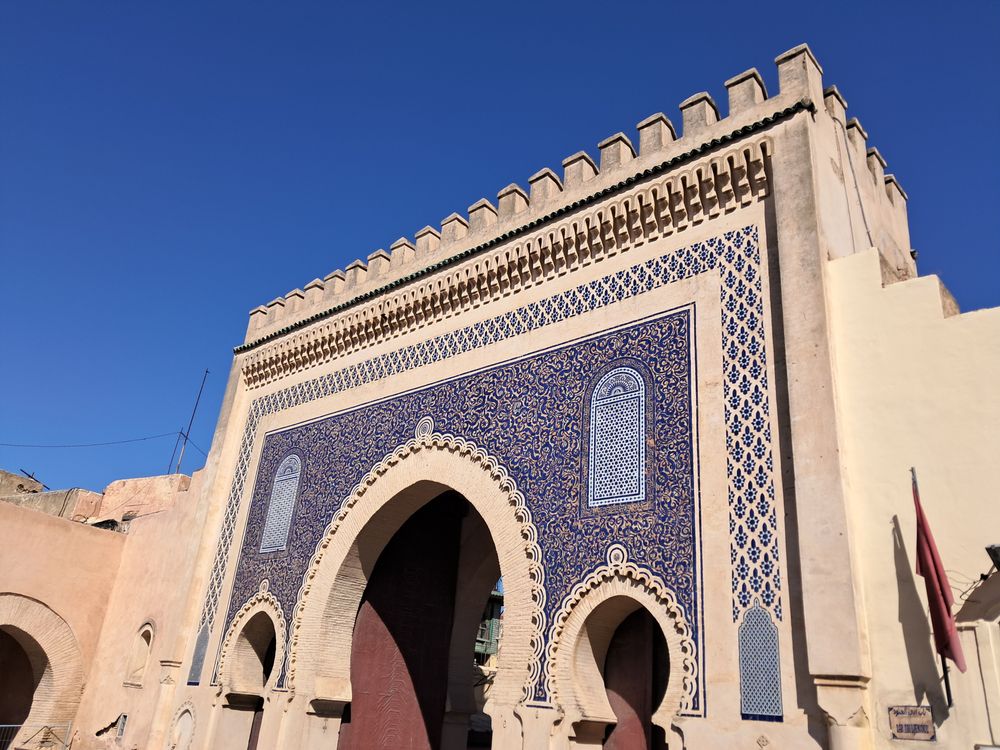
Plan a first Fes medina walk with Bab Boujloud, Nejjarine, craft streets and an optional tannery view, plus current Al Batha museum details.
Give your first visit to Fes medina one clear shape: enter around Bab Boujloud, follow the old city's commercial streets towards Nejjarine, and choose one interior or craft-focused stop before lunch. Leave the tanneries, another museum and the royal-city quarter as choices rather than obligations. Fes rewards attention to a doorway, a courtyard or a working craft more than a hurried attempt to collect every landmark.
This guide concentrates on Fes el-Bali, the older medina. It does not turn a stop in Fes into a circuit of northern Morocco. If you are still deciding how many nights to allocate, our seven-day Morocco route comparison gives Fes proper visiting days in a Rabat-and-Fes itinerary rather than treating it as an overnight after the desert.
First-visit choices
| Your priority | Build the visit around | Leave optional |
|---|---|---|
| Orientation and street life | Bab Boujloud, a main market route and Nejjarine | A long shopping session |
| Architecture and objects | One medina interior, followed by time to examine it | Every madrasa and monument |
| Living crafts | Nejjarine and Seffarine, with a pre-arranged workshop if wanted | Unplanned sales demonstrations |
| A collection with published visitor details | Al Batha Museum of Islamic Arts | A second long medina walk the same day |
| Limited stamina | A shorter sector near your accommodation and a seated break | Crossing the medina and climbing back in one outing |
Allow roughly three to four hours for a first walking outing with one interior and pauses. This is an editorial planning allowance, not a measured guided-tour duration. Two full days let you separate an introductory walk from a museum or another quarter; one day still works if you choose fewer stops.
Understand which Fes you are visiting
The UNESCO World Heritage description distinguishes Fes el-Bali from Fes Jedid, the later royal-city development. That distinction matters on a map: the old medina, the palace area and the modern city are not interchangeable hotel locations or a single compact sightseeing loop.
Start by identifying your accommodation, the nearest usable vehicle meeting point and the gate you intend to enter. A map pin inside the medina may describe the front door without explaining how you reach it with luggage. Ask the host for a simple arrival route and, where needed, a meeting arrangement outside the narrow lanes.
For an independent first walk, keep a few named anchors rather than memorising a long chain of turns. Bab Boujloud, Nejjarine and Seffarine give the outing a direction. Save an offline map, but use building names and advice from your host as well: a suggested shortcut can become less useful than returning to a street you recognise.
Begin at Bab Boujloud without rushing past it
The national tourist office's Fes guide identifies Bab Boujloud as an accessible starting point for the medina. Pause outside and then look back after passing through. The gate is a useful threshold between arrival logistics and the walking visit, as well as a recognisable place to arrange a meeting.
From this sector, Talaa Kebira and Talaa Sghira are the principal street names to discuss with your host or guide. Choose one for the first approach instead of repeatedly switching between lanes to chase the shortest route on your phone. Shops, deliveries and other pedestrians determine your pace; stand aside before stopping to study a map or take a photograph.
If Bou Inania Madrasa is your preferred architectural stop, ask about current visitor access before building the morning around it. A listed landmark is not proof that every room is open. Choose it as the main interior, not as a hurried extra before a museum that interests you more. This guide does not publish an unverified current admission price or timetable for the madrasa.
Use Nejjarine to slow the walk down
Nejjarine is a good point to change from moving through the medina to looking closely at one place. Notice the square and fountain before deciding whether to enter the museum. The tourist office includes Nejjarine among the city's principal visits; the museum's focus on wood makes it a useful choice if doors, carving and everyday objects interest you.
Allow about an hour for the museum as an initial planning estimate, with more time if you enjoy reading displays. Confirm opening, ticket arrangements and photography rules locally. Current first-party visitor hours were not established for this guide, so do not shape a tightly timed day around a third-party timetable.
An interior also changes the rhythm of a medina walk. You can examine materials and proportions away from the movement of a shopping street. Look for how a building is organised around its courtyard, then return outside and notice similar relationships between entrances, public lanes and private space. You do not need to buy a wooden object to make that observation worthwhile.
Follow a material, not every shop
The national tourist office's Morocco brochure connects Nejjarine with woodworking and Seffarine with metalworking. Use those associations to give the next part of the walk a subject. A short visit focused on how a material is shaped is more memorable than entering several shops with no particular interest.
At Seffarine, make space for people who are working and carrying goods. Watch from a public position and ask before photographing a person or approaching equipment. If you want a demonstration, arrange it explicitly: who will show the process, how long it lasts and whether there is a fee or expectation to purchase.
For shopping, decide first whether you want a small usable object, a decorative piece or simply an introduction to a craft. Ask where it was made, what material it uses and how it should be cared for. Inspect the actual item rather than relying on the example held during a demonstration. Agree the full price, packaging and delivery terms before committing, especially for something too large to carry home.
Keep Chouara tannery an informed choice
The tanneries are among Fes's best-known sights, but they need not be the centre of every first visit. A viewing terrace and access to the working tannery are different experiences. Ask exactly where you will stand, how you reach it and whether the visit is attached to a leather shop.
Before following someone upstairs, establish any charge and whether browsing or buying is expected. If you want only the view, say so at the beginning. Odours, stairs and a busy commercial setting may make the stop less suitable for some travellers; skipping it leaves more time for architecture or a museum rather than making the day incomplete.
Never enter working areas simply because another visitor does. Photograph people only with permission and keep the visit separate from claims about labour conditions or production methods that you cannot verify. A distant view of coloured vats cannot establish how every product in a nearby shop was made.
Choose Al Batha for a second, distinct visit
Al Batha offers a collection-led alternative to another long market walk. The Fondation Nationale des Musées page confirms that the palace reopened in February 2025 as the Museum of Islamic Arts. Its collections include ceramics, textiles, manuscripts and metal objects, providing a different context for materials encountered in the medina.
On 30 October 2026, the operator listed opening from 10:00 to 18:00, closed Tuesday, and a foreign-visitor tariff of MAD 60. Check the museum page again before travelling, including any applicable concession. These are the museum's published details, not a booking or a guarantee against an exceptional closure.
Allow around 90 minutes as a starting estimate for the collection and garden. If you are already tired after the medina, save it for another morning rather than arriving just before closing. The museum is at 5 Place Batha; plan its access separately from an itinerary deep inside the old city's lanes.
Agree the purpose of a guided walk
A guide can help you understand buildings and crafts while reducing the effort of navigation. Choose the service for that interpretation, not just because someone says you cannot enter a street alone. Arrange a professional guide through a channel you can verify, with a named meeting point, duration, language and price.
Tell the guide which interests matter: architecture, history, textiles, food or a particular workshop. Ask how commercial stops are handled and whether admission fees are included. A “medina tour” can mean very different things, from a focused historical walk to several shop visits. Written expectations make the choice clearer for both sides.
An independent walk remains reasonable if you are comfortable navigating and adapting the route. Start with a smaller area, keep a return landmark and allow time to retrace your steps. If you need directions, a business or your accommodation can be a more useful reference than accepting an unsolicited tour you never intended to buy.
Plan access, meals and a manageable return
Fes's medina is a lived-in religious and residential environment. Do not assume that a mosque or religious institution admits tourists because its name appears on a sightseeing map. Respect signs, staff instructions and worshippers' space; a view from an allowed public position is a valid part of the visit.
Choose shoes for uneven paving and repeated stops, and carry water without making the bag unnecessarily heavy. If stairs, slopes or long walks are difficult, request a route with exact entrance and exit points and a realistic place to sit. An accessible hotel room does not establish that the approach from the vehicle is equally accessible.
Keep lunch within the sector you have reached rather than adding a cross-city restaurant reservation. If you have dietary needs, ask about ingredients before ordering; a dish's name alone may not explain every component. Leave time to return to the accommodation before another evening outing. For a wider trip that also includes Marrakech, our Marrakech souks guide covers that separate city's shopping visit; it is not an extension of this walking route.
Cover photograph: Blue tilework and arches of Bab Boujloud gate in Fes — Ideophagous, CC BY-SA 4.0.
Frequently Asked Questions
How much time does a first Fes medina visit need?
Allow roughly three to four hours for an introductory walk with one interior and breaks. Two full days make it easier to add Al Batha or a different quarter without turning the first outing into a checklist.
Do you need a guide for Fes medina?
A guide is useful for interpretation and navigation, but choose a defined service with agreed interests, duration, price and shopping arrangements. An independent visit can work with a smaller route and clear return landmarks.
Is Al Batha Museum still closed for restoration?
No: the museum operator records its reopening in February 2025. The page checked on 30 October 2026 lists 10:00–18:00, closed Tuesday. Recheck before making a special journey.
Do you have to visit the tanneries?
No. Choose a tannery view if the setting interests you and the terrace access suits your needs. Clarify charges and shopping expectations first; architecture, craft streets and museums can fill a rewarding visit without it.


Keep Exploring
Art Gallery of New South Wales: Plan Your Visit
Choose between Naala Nura, Naala Badu and Yiribana, with free-entry rules, exhibition tickets, current access works and family planning advice.
The Broad Los Angeles: Plan Your Art Visit
Plan The Broad with free tickets, Kusama reservations, collection choices, construction access and practical advice for a Downtown art visit.
Templo Mayor: Plan Your Mexico City Museum Visit
Plan Templo Mayor with current admission categories, the archaeological remains, museum highlights and clear limits on special access.