
Little India Singapore: A Neighbourhood Visit
Plan a compact Little India visit with Tekka Centre, the Indian Heritage Centre, Tan Teng Niah's former house and temples, leaving time for a meal.
A useful first visit to Little India combines a market stop, time around Campbell Lane, the Indian Heritage Centre and a walk up Serangoon Road to Sri Veeramakaliamman Temple. Add a meal and you have a neighbourhood outing with distinct experiences, rather than a series of photographs taken on the way somewhere else.
Allow an editorial 3–4 hours for the core route with a museum visit and food. If you have only 2 hours, choose either the museum or a longer market-and-shopping circuit. The northern temple extension needs additional time and its own access check. These allowances exclude your journey from elsewhere in Singapore.
| Your main interest | Give more time to | What to shorten |
|---|---|---|
| Community history | Indian Heritage Centre and Tan Teng Niah's former house | Extended shopping |
| Market and food | Tekka Centre and a meal on Serangoon Road | Museum visit |
| Religious architecture | Sri Veeramakaliamman, with an optional northern extension | Browsing every shop |
| Textiles, gifts and sweets | Little India Arcade and surrounding streets | A second temple |
Visitor details were checked on 26 October 2026. For choosing between this neighbourhood and other Singapore outings, start with our city highlights guide. Here the focus is a single walk, with enough context to understand the places along it.
Start with the working neighbourhood
Little India is part of contemporary Singapore, with businesses, religious institutions and people going about ordinary routines. The Indian Heritage Centre's neighbourhood history describes an area shaped by cattle herding, brick kilns, lime pits, vegetable farming and small industries. It was not originally designated as an Indian enclave; its communities and trades developed over time.
That background gives the street walk something to look for beyond colour. Notice the different kinds of commerce: fabric, gold, provisions, garlands and food. A shop may serve a practical household or religious need even when its display attracts visitors. Leave doorways clear, ask before photographing people at work and buy only what you actually want.
Begin around Little India MRT and Tekka Centre, then take the short side trip to Kerbau Road before crossing towards Campbell Lane. The Heritage Centre's official directions recommend Exit E when heading directly to the museum. Choose your exit according to the first stop, rather than assuming every exit delivers you to the same side of a busy road.
Tekka Centre: make it a meal stop, not a food marathon
At Tekka, distinguish the market from the cooked-food stalls and shops. Walk through the part that interests you without blocking customers, then decide whether to eat now or after the museum. If you want to look at produce shopping, make Tekka the opening stop; do not postpone it on the assumption that every trader keeps evening hours.
Check the National Environment Agency's hawker-centre closure information for Tekka before travelling. Scheduled cleaning can interrupt a plan built around one food centre. Individual stalls also set their own hours, so an open building is not a guarantee that a particular cook is working.
For a straightforward lunch, inspect the available dishes and prices before joining a queue. Choose a rice meal if you want the main eating stop here, or a smaller snack if a sit-down restaurant later is the priority. Carry some Singapore-dollar cash as a fallback and confirm the payment method before ordering. A displayed payment logo does not tell you whether your own overseas wallet will work.
Our hawker-centre guide explains ordering and how Tekka differs from Maxwell, Chinatown Complex and Lau Pa Sat. For this walk, the useful decision is simpler: have one proper meal, then leave room for a drink or sweet instead of planning several full lunches.
Kerbau Road: Tan Teng Niah's former house
Turn towards the former house of Tan Teng Niah at 37 Kerbau Road, identified as a conserved building by the Urban Redevelopment Authority. Treat this as an exterior stop. A heritage listing does not establish public access to the interior, and any works or barriers take precedence over a photographic plan.
The tourism board's account of the house connects its former owner with factories in the district and identifies a mix of European and Chinese architectural features. Look for the relationship between the projecting upper storey, windows and entrance, where visible. The gilded calligraphy and roof details reward closer attention than the exterior colours alone.
This stop also broadens the neighbourhood's story. Chinese businesses operated alongside the cattle and other trades that shaped the area. The house makes sense as part of that mixed commercial history, rather than as an unexplained colourful backdrop. Allow an editorial 10–15 minutes, then continue instead of waiting for an empty street photograph.
Campbell Lane: give the museum a real place in the visit
The Indian Heritage Centre is at 5 Campbell Lane. Its regular hours are 10:00–18:00 Tuesday–Sunday, with last admission at 17:30. It closes Mondays, including public holidays that fall on Monday unless otherwise announced. If the museum is important, arrange the neighbourhood visit around that condition first.
Inside, the permanent galleries connect early interactions between South and Southeast Asia with migration and the contributions of Indian Singaporeans. Family photographs, diaries, heirlooms and jewellery bring the story down to individual lives. This is the strongest stop on the route for understanding communities and change, rather than simply identifying landmarks.
Allow an editorial 60–90 minutes for a focused museum visit. Choose a thread such as family memory, travel or work, then use it to connect the objects you encounter. Leave yourself time afterwards to return to the streets: the gallery context makes ordinary shops and institutions easier to read as part of a continuing neighbourhood.
The admission page lists S$10 for foreign adult visitors and free admission for Singapore citizens and permanent residents; other concession categories have their own conditions. Do not assume the museum is free for all because neighbourhood walking costs nothing. Confirm the applicable ticket before entering, especially if you are travelling as a family or group.
For the Deepavali Open House 2026, museum entry is free on weekends from 17 October to 8 November 2026. Saturdays extend to 20:00, with last admission at 19:30. These dated exceptions do not replace the regular timetable or ticket categories outside the event.
For visitors using a wheelchair or stroller, the facilities information identifies ramps at Campbell Lane and beside Clive Street, with a lift serving the galleries. Wheelchairs can be borrowed subject to availability. Those specific facilities help plan the museum portion; they do not establish that every shop entrance on the wider walk is step-free.
Browse Little India Arcade with a purpose
Near Campbell Lane, Little India Arcade is a useful browsing stop on the National Heritage Board’s shopping heritage trail. Choose the shops that interest you rather than treating every doorway as a required stop.
Individual business hours and services still need checking. If you want fabric or clothing, ask about sizing, material and any alteration time before buying. If you want a small edible purchase, ask what the sweet contains and how it should be stored for the rest of your day.
Give this section an editorial 20–30 minutes for a light browse, or expand it by shortening the northern part of the walk. A shop entrance can be worth visiting even when the surrounding lane is busy, but a narrow passage is not a place to assemble a large group for photographs. Move aside when stopping to compare purchases or look at your map.
Serangoon Road and Sri Veeramakaliamman Temple
Continue along Serangoon Road to Sri Veeramakaliamman Temple. The tourism board's temple description highlights the gopuram, the entrance tower with figures of Hindu deities, and the temple's association with Kali. Begin by looking at the tower from an appropriate public position without obstructing the entrance.
Plan interior access as conditional on the temple's current visitor arrangements and worship. A building can be central to the route even when entering is not appropriate at that moment. If you arrive during a closure or busy religious activity, keep the exterior stop and continue with your meal or shopping; do not wait in a doorway for a quieter photographic opportunity.
The Hindu Endowments Board's general temple etiquette advises covering shoulders and knees, removing footwear outside and staying out of shrines and sanctums. Follow the specific instructions at this temple too. Keep voices low and do not position yourself between worshippers and the activity they came for.
Ask before photographing people and follow posted photography restrictions. Clothing and behaviour should be prepared before entry, not negotiated after crossing the threshold. This is a place of worship with its own purpose, and observing that purpose is part of understanding the neighbourhood.
Choose a sit-down meal or a northern extension
For a vegetarian restaurant option, Komala Vilas lists its restaurant at 76–78 Serangoon Road. Its own menu descriptions include dosai, idli, vadai and thali meals. Choose it when you want a seated meal with a defined menu, and check the actual dishes and accompaniments available before ordering.
The restaurant also lists a separate sweets-and-savouries shop at 4 Upper Dickson Road. That distinction matters if you only want a small purchase: navigate to the relevant branch, rather than assuming the main restaurant and sweet shop are the same doorway. Vegetarian does not automatically mean vegan or suitable for a particular allergy; ask about the ingredients that matter to you.
If religious architecture is the main interest and you still have time, continue north to Sri Srinivasa Perumal Temple. It is dedicated to Vishnu in the form of Sri Srinivasa Perumal. Its official weekday opening is split into 05:00–11:00 and 18:00–20:30, so a midday extension should not assume interior access. Check the separate weekend and festival arrangements directly.
This is an extension, not an obligation after the core walk. If you have already spent a full museum hour and enjoyed lunch, returning towards your transport can be the better finish. If you continue north, plan your onward journey from the new endpoint instead of automatically retracing the whole route.
Adapt the walk without losing its focus
On a Monday, retain Tekka, the house exterior, the arcade and temple surroundings, and replace the museum with a longer meal or shopping visit. On an open museum day with heavy rain, place the gallery visit in the wettest part of your available time and shorten the exterior stops. Covered shopfronts do not make the entire route sheltered.
For a shorter outing, choose Tekka plus Campbell Lane and one cultural stop. For a deeper visit, use the museum as the anchor and reduce shopping. Avoid adding Chinatown and Kampong Gelam merely because all are described as heritage neighbourhoods: each deserves its own route, meal decision and time on foot.
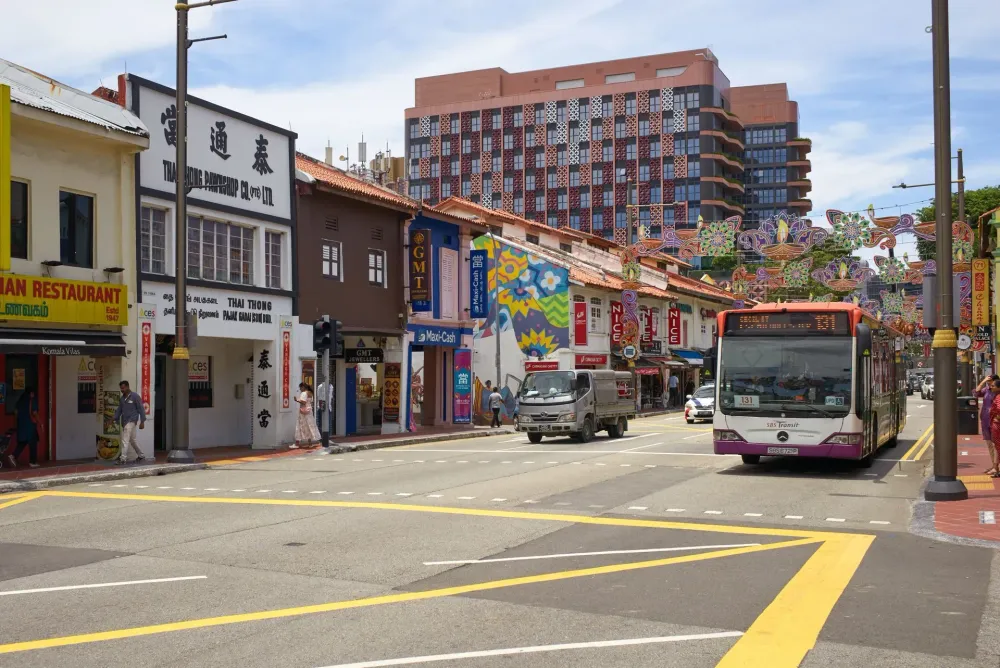
Cover photograph: Shophouses and a public bus in Little India, Singapore. Photo: CK Seng / Pexels.
Frequently Asked Questions
How much time should I allow for Little India?
Allow an editorial 3–4 hours for the core walk, museum and a meal. With 2 hours, choose between the museum and extended market-and-shopping time. A northern temple extension needs additional time and a separate opening check.
Is the Indian Heritage Centre open on Mondays?
Its regular schedule closes on Mondays, including Monday public holidays unless otherwise announced. Tuesday–Sunday hours are 10:00–18:00, with last admission at 17:30. You can still explore the neighbourhood when the museum is closed.
Can tourists enter the temples in Little India?
Visitor access depends on each temple's current arrangements and religious activities. Follow local instructions, cover shoulders and knees, remove footwear where required and stay out of restricted sanctums. An exterior visit is a useful alternative when entry is unavailable.
Is Little India a free outing?
An independent street walk does not require an attraction ticket, but meals, purchases and museum admission are separate. The Indian Heritage Centre lists S$10 for foreign adult visitors, while Singapore citizens and permanent residents have free admission. The regular adult tourist rate is S$10; the Deepavali Open House offers free weekend museum entry from 17 October to 8 November 2026.

Keep Exploring
National Gallery Singapore: Choose Your Visit
Plan a focused National Gallery Singapore visit around the open exhibitions, historic buildings and the ticket you need, with a clear note on the Southeast Asia Gallery closure.
Kampong Glam: A Neighbourhood Walk
Choose a compact Kampong Glam walk, understand mosque visiting arrangements and leave time for Malay heritage, independent shops and a meal.
Getty Center or Getty Villa: Which Should You Visit?
Compare the Getty Center's paintings and hilltop gardens with the Villa's ancient art and Roman setting, then plan the right visit for your dates.