
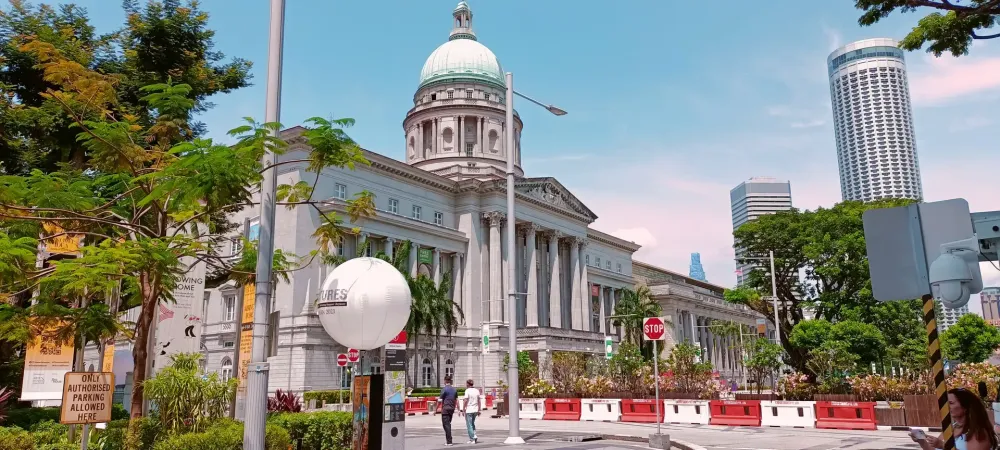
National Gallery Singapore: Choose Your Visit
Plan a focused National Gallery Singapore visit around the open exhibitions, historic buildings and the ticket you need, with a clear note on the Southeast Asia Gallery closure.
For a first visit to National Gallery Singapore, start with Singapore Stories, add time to understand the historic buildings, and buy access to extra exhibitions only if they interest you. The important qualification is the temporary closure of the UOB Southeast Asia Gallery: the museum remains open, but an older account of its full collection route is not a reliable plan for today.
This is a place to choose a focus, rather than count rooms. A visitor interested in Singapore's art history can build a substantial afternoon around one exhibition. Someone more interested in architecture can concentrate on how the former City Hall and Supreme Court became a museum. Combining those two interests works well; adding every temporary show may not.
If you are still deciding whether art deserves a place in the trip, compare it with the other things to do in Singapore. The guide below starts once the Gallery is on your shortlist.
The practical choices at a glance
Variable information was checked on 21 October 2026. Recheck the museum before purchasing. The visit lengths in this guide are editorial planning estimates, excluding travel and queues.
| Decision | Useful starting point |
|---|---|
| First art visit | Singapore Stories in the DBS Singapore Gallery |
| Suggested time | 2–3 hours for one exhibition and building context |
| Museum hours | Daily 10:00–19:00; last admission 18:30 |
| Standard General Admission | S$20 for other nationalities; general admission is free for Singapore citizens and permanent residents |
| Major closure | UOB Southeast Asia Gallery, scheduled to reopen in late 2027 |
| Straightforward MRT approach | City Hall, Exit B, then the Art Connector |
| Address | 1 St Andrew's Road |
The official visitor information is the reference for current hours, admission categories and closures. A ticket category and a building entrance are different things: an entrance remaining open for dining does not extend exhibition hours.
Start with Singapore Stories if you want art and context
Singapore Stories: Pathways and Detours in Art is in the City Hall Wing, Level 2, DBS Singapore Gallery. It gives a first-time visitor a clear place to begin without requiring an existing knowledge of regional art. The museum frames the exhibition around questions of home, who tells a story and what art is for, with artists including Georgette Chen, Liu Kang and Chen Wen Hsi.
Use that framing to slow the visit down. Choose a work that draws you in, look before reading, then use its label to reconsider what you noticed. Compare how another artist handles people, place or daily life. You will get more from those connections than from treating every room as something to finish.
A useful personal aim is to leave able to describe a few works and why they interested you. That aim also helps a mixed-interest group: one person may follow painting technique while another follows the places represented. You can discuss the same room without needing the same art background.
The exhibition is a sensible anchor, not a promise that every famous work from the museum's collection will be hanging on your date. If a particular painting is the reason for your visit, confirm its display status directly. Collection ownership and current exhibition are separate facts.
Understand what the Southeast Asia Gallery closure changes
The museum says the UOB Southeast Asia Gallery will reopen in late 2027, while works from the National Collection remain on display elsewhere. This is a closure of a major section, not the entire institution.
Its practical consequence depends on your motivation. If you want an introduction to Singapore's art alongside the buildings, the open displays still provide a clear plan. If you have travelled specifically for the former extensive Southeast Asian collection route, investigate the current exhibition list before committing your afternoon. A ticket will not make a closed gallery available.
The visitor page also advertises future exhibitions. At the check date, it lists Let's Imagine the World Together: Art in Southeast Asia as opening on 5 November 2026. That listing is useful for later travel, but does not mean it is already open on 21 October. Always match exhibition dates to your actual visit rather than reading every title under a ticket as available immediately.
Avoid trying to reconstruct the old route from an undated blog or an archived audio tour. Ask Visitor Services which open displays best match your interest in the wider region, then make that your route. This is especially useful when deciding whether to add a temporary exhibition or spend more time with Singapore Stories.
Buy the ticket for the exhibitions you will actually enter
Begin with General Admission if your aim is the open collection displays included in that category. The standard rate for visitors of other nationalities is S$20; Singapore citizens and permanent residents have free general admission. There are separate concessions and free-entry categories, so check eligibility and the evidence required before paying.
Special Exhibition and All Access are different products. The deciding question is not which sounds more complete, but which exhibition you want to see on your date and whether General Admission includes it. Read the exhibition's own entry conditions as well as the general ticket page. Future shows can already appear in the product descriptions.
For a couple with different interests, buying the broadest ticket for both people may add little. For an enthusiastic visitor planning a long afternoon, a broader ticket may be appropriate once the relevant shows are open. Neither choice can be judged from the ticket name alone.
Keep the booking confirmation accessible and resolve concession questions with Visitor Services. Do not interpret a ticket's validity period as permission for unlimited repeat visits: check its actual entry terms. If you are using a reseller or attraction pass, confirm which museum ticket it supplies and whether any separately ticketed exhibition needs an upgrade.
Give the buildings their own part of the visit
The Gallery occupies the former City Hall and Supreme Court, two national monuments connected within the museum. The museum's architecture and history guide is useful preparation because these were civic buildings before they were exhibition spaces.
Look at the relationship between old rooms and newer circulation spaces. Notice changes in scale as you move from an intimate gallery into the connecting atrium, and consider how a public institution has been adapted for a different public purpose. That makes the building visit more than a search for a photogenic staircase.
For an architecture-led visit, ask which heritage spaces are accessible that day and whether a suitable building tour is running. Do not assume that every courtroom, terrace or behind-the-scenes area is included in casual admission. A restaurant with a view also has its own access and spending arrangements.
The official audio-guide page offers Building History Highlights as well as art-focused material. Bring headphones and select the sections that match the spaces you can actually visit. Its catalogue includes older exhibitions, so an audio title is not evidence that the corresponding display remains open.
Choose a route that fits your available time
With about 90 minutes, choose one exhibition focus. Orient yourself at Visitor Services, go directly to the relevant wing and floor, and leave a short period for the connecting architecture. This is an editorial short-visit option; it cannot provide a comprehensive museum visit.
With 2–3 hours, use Singapore Stories as the centre of the afternoon, pause, then explore accessible building highlights or one other open display. This is our most useful starting plan for a first visitor. Leave the last part flexible: a room that catches your attention deserves more time than an arbitrary final stop.
With half a day, add another exhibition deliberately and allow for a meal or a substantial break. Check the restaurant separately if eating there is part of the plan. Spending longer in a large museum is easier when the day includes a point at which you can stop looking and sit down.
If booking a guided tour, arrange your route around its actual meeting point and time. The Gallery lists tours included with admission subject to schedule and availability; that does not guarantee a place on whichever departure you prefer. Check the programme before arrival and ask staff about the day's options.
Arrive at the entrance that suits you
From City Hall MRT, Exit B, the museum describes an approximately 7-minute walk via the Art Connector. Treat that as the operator's walking indication, with extra time for finding your way and entering. Coleman Street is a practical arrival point for Visitor Services and the start of your visit.
For a step-free approach, the accessibility guide directs visitors to the lift at City Hall Exit D, then towards Exit B and the sheltered Art Connector. Coleman Street also has a sheltered, step-free vehicle drop-off. These details are more useful than choosing the station purely by distance on a map.
All exhibition spaces are described as wheelchair accessible, and lifts serve all floors. Wheelchair loans are first come, first served; arrange any essential assistance in advance rather than assuming staff can accompany you around the museum. The accessibility page also describes a Calm Room and practical facilities, worth checking when sensory needs or rest breaks shape the visit.
Fit the Gallery into the rest of your day
An afternoon at the Gallery can stand on its own. After concentrating on art, a meal or a relaxed outdoor walk may be more appealing than another museum. Keep the next booking loose enough that you do not spend the final rooms watching the clock.
For wet weather, the Gallery is a strong option when its art or architecture interests you. Our Singapore rainy-day guide compares indoor outings by area, so you can avoid crossing the city repeatedly for shelter. Check the approach as well: an indoor attraction does not make every part of your journey indoors.
If you are allocating this visit across a longer stay, use the Singapore three-day itinerary to balance it with neighbourhoods and gardens. Give the Gallery a clear role in the trip—art, buildings or both—and the ticket and timing decisions become much simpler.
Cover photograph: The former Supreme Court wing of National Gallery Singapore, photographed in 2023. Photo: Uzoma Ozurumba, CC BY-SA 4.0; resized and converted to WebP, image remains under the same license. Source · License.
Frequently Asked Questions
Is National Gallery Singapore closed?
No. The UOB Southeast Asia Gallery is temporarily closed, with reopening scheduled for late 2027. Other exhibitions remain open; check the current programme for your date.
Which ticket should a first-time visitor buy?
Start by checking whether General Admission includes the displays you want. Singapore Stories is included. Buy a broader ticket only when a separately ticketed exhibition is open and interests you.
How long should I allow?
Our editorial suggestion is 2–3 hours for a focused exhibition visit and building context. About 90 minutes suits a narrower selection; half a day allows another exhibition and a break.
Is the Gallery accessible by wheelchair?
The museum says all exhibition spaces are wheelchair accessible and lifts serve all floors. The accessible MRT approach uses the lift at City Hall Exit D, then the Art Connector towards Coleman Street.


Keep Exploring
NGV Melbourne: Which Gallery Should You Visit?
Choose between NGV International and NGV Australia, with free-entry details, exhibition planning, access advice and realistic visit times.
Things to Do in Singapore: Choose Your Highlights
Choose Singapore highlights that earn their place: conservatories, neighbourhood meals, orchids, art and wildlife, with practical trade-offs and current access checks.
Griffith Observatory: Plan Your Visit
Choose between a free viewpoint visit and a fuller astronomy outing, with practical advice on planetarium tickets, getting uphill and returning after dark.