
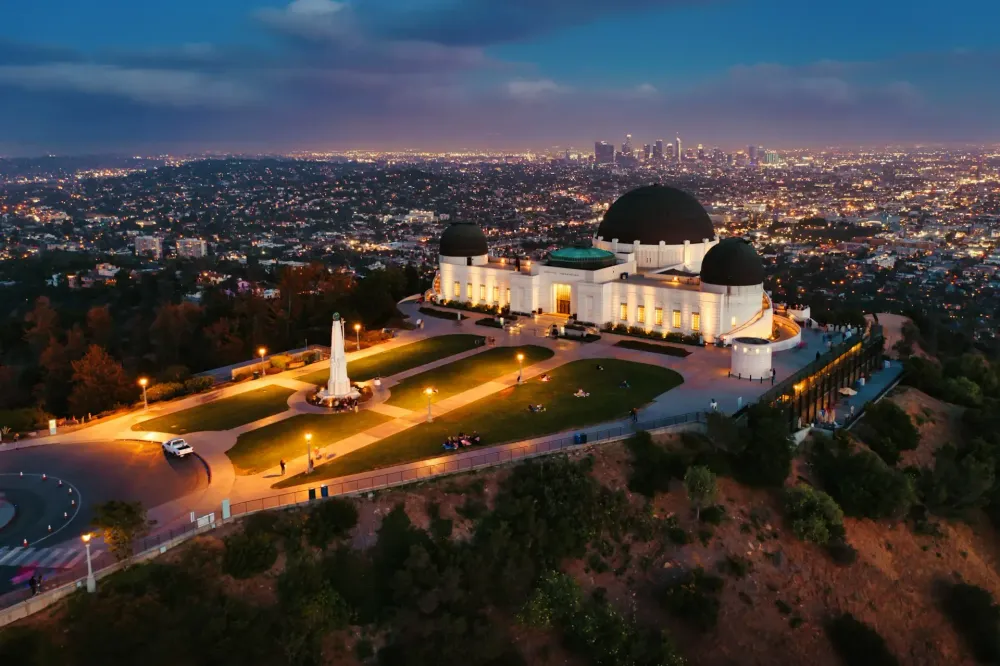
Choose between a free viewpoint visit and a fuller astronomy outing, with practical advice on planetarium tickets, getting uphill and returning after dark.
Griffith Observatory can be a free stop for Los Angeles views or a substantial astronomy visit. Decide which you want before choosing your arrival time: the grounds, building and public telescopes are free, while the Samuel Oschin Planetarium and nearby parking are separate expenses. A sunset arrival does not leave unlimited time for exhibits, a show and a telescope queue.
The observatory sits above Los Feliz in Griffith Park. Fit it into the broader city using our Los Angeles guide by area, then give the uphill journey its own space in the plan. Crossing the park is not the same thing as travelling between two neighbourhood streets.
Choose the visit you actually want
| Priority | Practical choice | Main constraint |
|---|---|---|
| City views and the building exterior | Grounds and terraces | Visibility, crowds and the return journey |
| Astronomy exhibits | Visit during building hours | Monday closure and special dates |
| Immersive astronomy show | Samuel Oschin Planetarium | Paid, same-day public ticket sales |
| Looking through a telescope | An open evening with clear skies | Queue closes before the building |
| Walking through Griffith Park | A planned trail approach | Daylight, terrain and a separate descent plan |
| Avoiding the parking search | DASH from Vermont/Sunset | Check the operator's timetable and return stop |
Operational details were checked on 21 October 2026. Allow 2–3 hours on site for exhibits, terraces and a possible show as an editorial planning estimate, excluding transport and extended queues. A short exterior visit can be simpler; adding a hike or evening observing deserves a larger block of time.
Free admission does not require a planetarium ticket
The official visit page confirms free admission to the building, grounds and public telescopes. You can enjoy the architecture, explore the exhibits and use the terraces without buying a show ticket. Ordinary building admission does not require a reservation, although busy periods can involve a wait to enter.
This makes the observatory flexible for a group with mixed interests. Someone keen on astronomy can spend longer inside while others focus on the views, provided you agree on a meeting point. Do not rely entirely on a last-minute message: the observatory warns that mobile reception can be weak around the site.
Treat free admission and a free outing as different budget questions. Your transport, parking, food and any planetarium show still need an allowance. Our free Los Angeles experiences guide helps compare those extra costs across the city. You do not need to buy a show simply to make this visit worthwhile.
Check the building calendar before choosing a day
Regular building hours are Tuesday–Friday, 12:00–22:00, and Saturday–Sunday, 10:00–22:00. The building is closed on Mondays. Grounds access and building access are different: a Monday exterior visit does not include the galleries or ordinary public astronomy programme.
Check the official calendar for your exact date. At the check date it lists a special closure on 26 November 2026. A separately ticketed event on an otherwise closed day does not mean the whole building has resumed normal public admission. Use the event's own conditions if that is what you intend to attend.
For exhibits, choose an arrival with useful indoor time before your preferred outdoor light. For views, visibility matters as much as the clock; a particular sunset cannot be guaranteed to produce a clear skyline. If the day is hazy, the indoor astronomy visit may still be worthwhile. Avoid making a single photograph the only reason for the climb.
Planetarium tickets: choose the show, then arrange the rest
The Samuel Oschin Planetarium page publishes the programme, sales windows and prices. Public tickets are sold on site for that day's performances, in timed sales blocks. You cannot assume that arriving when the building opens lets you buy every evening show immediately. Qualifying foundation members have a separate advance-reservation benefit.
Listed prices are US$12 for adults aged 13–54, US$10 for ages 55 and over, US$10 for students and teachers with identification, and US$8 for children aged 5–12. Children under 5 are admitted only to the first show of the day, free on an accompanying adult's lap. Check the first-show time before travelling with a younger child; an evening visit will not solve that restriction.
Current programmes run approximately 32–35 minutes. Once you have tickets, join the West Terrace line 15–20 minutes before the performance. Late admission and re-entry are not permitted. Keep a meal, a long photograph stop or the telescope queue outside that arrival window.
The show is a seated presentation in a dark theatre, not a live look through the telescope. Choose it for the astronomy storytelling. If you would rather spend your time with the exhibits and outdoors, skipping it leaves a complete free visit.
Public telescopes: arrive before the queue ends
Free observing depends on clear skies and the observatory being open. The Zeiss telescope information says observing usually starts around 19:00, with queues cut off at 21:30 or earlier so viewing finishes by 21:45. The building's 22:00 closing time is not a telescope admission deadline.
Ask staff about the evening's viewing when you arrive. Do not promise your group a particular planet or a telescope session regardless of weather. The queue is also a separate commitment from a planetarium performance: decide which matters more if the available timings compete.
If you are visiting with children, explain the difference beforehand. A telescope offers an observed object in the actual sky; the planetarium uses projection and a presenter to tell a larger story. Either can be the highlight, but choosing deliberately avoids paying for one experience while expecting the other.
DASH is a useful approach from Vermont/Sunset
The LADOT Observatory/Los Feliz route connects the Vermont/Sunset Metro area with the observatory. Use the operator's current route table for departure times: some early weekday trips serve Los Feliz without continuing to the observatory. A bus with the right route name is not enough unless that particular journey serves the hilltop.
The timetable effective January 2026 shows roughly 15-minute intervals for the hilltop service during its main operating period. Listed regular fares are US$0.50 cash or US$0.35 with TAP stored value. Check current alerts and payment information before departure; traffic and events can affect arrival times.
Save the return information before climbing. The observatory's southbound stop is 2019, while the northbound arrival stop is 2033. Check where to board for the trip downhill rather than assuming your arrival stop serves both directions. Plan to leave with a margin before the last usable service, especially when you also have a Metro connection.
DASH avoids searching for a parking space at the top, but it still uses the road. On a busy evening, leave flexibility around reservations elsewhere. A fixed dinner booking immediately after your intended departure can turn a relaxed visit into a race.
Driving and rideshare need a return plan too
The official getting-here guide explains the paid spaces near the observatory and along permitted roads. Availability is limited, and congestion can trigger road restrictions. Follow posted directions and the current rate at the payment point instead of counting on a fixed parking price from an older guide.
Free parking around the Greek Theatre can involve an uphill walk of up to 1 mile, and it is unavailable after 13:00 on concert evenings. Check the theatre calendar and posted restrictions before leaving your car. A cheaper space downhill is useful only if everyone can comfortably complete the approach and return.
Rideshare vehicles have a designated drop-off and pickup area just beyond the horseshoe driveway by the front lawn. Arrange the return before the final rush: inbound park gates close at 22:00, so a vehicle collecting you needs to enter before then. General Griffith Park hours are 05:00–22:30; neither those hours nor an app's estimated arrival guarantees road access.
If your party includes someone who cannot manage a substantial slope, solve the arrival point first. Do not park downhill and discover the walking requirement after unloading. The driver and passengers should agree on a meeting point that follows the site's directions.
Add a park walk only if you want a hiking outing
The official approach guide identifies trail options from the Greek Theatre area and Fern Dell. Choose the exact route on the park map, inspect current closures and calculate the return before starting. These approaches add terrain and exertion to a visit that can otherwise be reached by bus.
A daylight ascent followed by a sunset stay changes the descent. Decide whether you will walk back before dark or use transport, and carry what you need for your chosen route. Wear suitable shoes, bring water and avoid making an unfamiliar unlit trail your default exit. Follow current park restrictions, including any weather or fire-related closures.
Seeing the Hollywood Sign from the observatory is also different from hiking to a closer sign viewpoint. Do not add that separate walk merely because both places appear within Griffith Park. For a first visit focused on astronomy, the observatory itself gives you enough to do without combining every nearby trail.
Accessibility and family planning
The accessibility guide provides a map of ramps, lifts and usable entrances. The public levels and grounds have accessible routes, but parts of the historic structure have limitations. In particular, the interior of the Zeiss dome cannot accommodate wheelchairs; an equivalent viewing station is available in the Wilder Hall of the Eye rotunda.
DASH offers accessible transport, and accessible parking spaces are available on a first-come basis. Check the whole journey, including your starting station and arrival point. An accessible building does not make the hiking approaches suitable for every mobility device.
For the planetarium, accessible and companion seating is available. The experience includes darkness and potentially loud sounds or flashes, so review the sensory information if those affect your group. For younger children, the first-show-only rule remains important even when the rest of the building suits your plans.
Keep the final part of the outing straightforward: use the facilities before departure, confirm your return stop or pickup and leave enough time to reach it. The best visit is the one whose transport and optional extras support what you came to see.
Cover photograph: Griffith Observatory and its domes above Los Angeles at dusk. Photo: Venti Views / Unsplash. Source · License.
Frequently Asked Questions
Is Griffith Observatory free?
The building, grounds and public telescopes are free. Samuel Oschin Planetarium shows, nearby parking and your journey can cost extra. Ordinary building admission does not require a reservation.
Can I book planetarium tickets online?
Public tickets are sold on site for the same day, in designated sales windows. Qualifying foundation members have a separate advance-reservation benefit. Check the programme before choosing when to arrive.
Is the observatory open on Mondays?
The building normally closes on Mondays. Grounds access is separate, and special events have their own conditions. Check the official calendar, including the announced closure on 26 November 2026.
What is the easiest way to avoid the parking search?
Consider DASH Observatory/Los Feliz from Vermont/Sunset. Check that your journey continues to the observatory and save the return timetable. Traffic can still delay the bus.
Can I use a telescope until the building closes?
No. Queues close at 21:30 or earlier so viewing can finish by 21:45, before the building closes at 22:00. Observing also depends on clear skies and operating conditions.

Keep Exploring
Le Jardin Secret: Plan Your Marrakech Visit
Plan a focused Le Jardin Secret visit in Marrakech's medina: compare the two gardens, follow the historic water system and decide whether the tower adds enough to your visit.
Mitla from Oaxaca: Plan Your Visit
Visit Mitla for intricate stone mosaics and the relationship between archaeology and a living Zapotec town. Compare transport choices and protect time for the site.
Coyoacán and Frida Kahlo: Plan Your Visit
Choose a museum-led or neighbourhood-led Coyoacán outing, with Casa Azul booking advice, a practical walking sequence and clear limits on extra stops.