
Immigration Museum Melbourne: Plan Your Visit
Choose Melbourne’s Immigration Museum galleries, current exhibitions or a guided tour, with ticket eligibility, access and a thoughtful visiting plan.
Melbourne's Immigration Museum is a good choice when you want to understand the city through migration, identity and the decisions that shape belonging. Its setting in the Old Customs House matters: the building once helped regulate the movement of goods and people, and now invites visitors to examine those histories through personal stories, objects and images.
Give it a considered 2–3 hours rather than treating it as a quick stop between tram rides. That is an editorial estimate for selected galleries and a pause, not an official visit duration. Use our Melbourne cultural guide to decide where it fits alongside art, neighbourhoods and other museums; this visit has a distinct focus on people and their relationship to place.
Fast facts
| Decision | Useful information |
|---|---|
| Location | Old Customs House, 400 Flinders Street |
| Opening | 10:00–17:00 daily in the dedicated arrival information; closed Good Friday and Christmas Day |
| General admission | A$15 adult; A$12 eligible Australian Seniors Card holder |
| Children | General admission free through age 16 inclusive |
| Guided option | English Highlights Tour, advertised daily 14:30–15:15, with separate tour pricing |
| Core themes | Customs and borders, migration stories, identity and belonging |
| Planning allowance | About 2–3 hours; a shorter visit needs fewer galleries |
Details were checked on 24 November 2026. Individual gallery pages include current opening notices: Voices Across Time lists 24 November, while Identity: Yours, Mine, Ours lists 25 November. Confirm those spaces for your date rather than relying only on a general “daily” label.
Choose the museum for its questions, not just its location
The Immigration Museum suits visitors interested in how people build a life after moving, how communities preserve connections and how institutions decide who belongs. It asks for reading, listening and reflection. If your group mainly wants dinosaurs, live-animal displays or a broad natural-history collection, a different museum is likely to fit better.
Begin with one question you want to explore. You might be interested in the experience of leaving home, in the relationship between identity and language, or in how border controls have changed. A question gives objects and testimony a connection to each other; without one, it is easy to move between displays without allowing their details to register.
You do not need a migration story of your own to engage with the subject. Equally, visitors with family experiences of migration should not expect every display to mirror their circumstances. Look for differences as well as similarities, and give other people's accounts space without turning each one into a comparison with your own family.
Start with the Customs Gallery to understand the building
The Customs Gallery explains the Old Customs House's role in trade, shipping and controlling entry to Victoria. Customs officers collected duties, inspected for smuggling and regulated goods ranging from animal products to banned books and films. The building therefore introduces both economic history and questions of control.
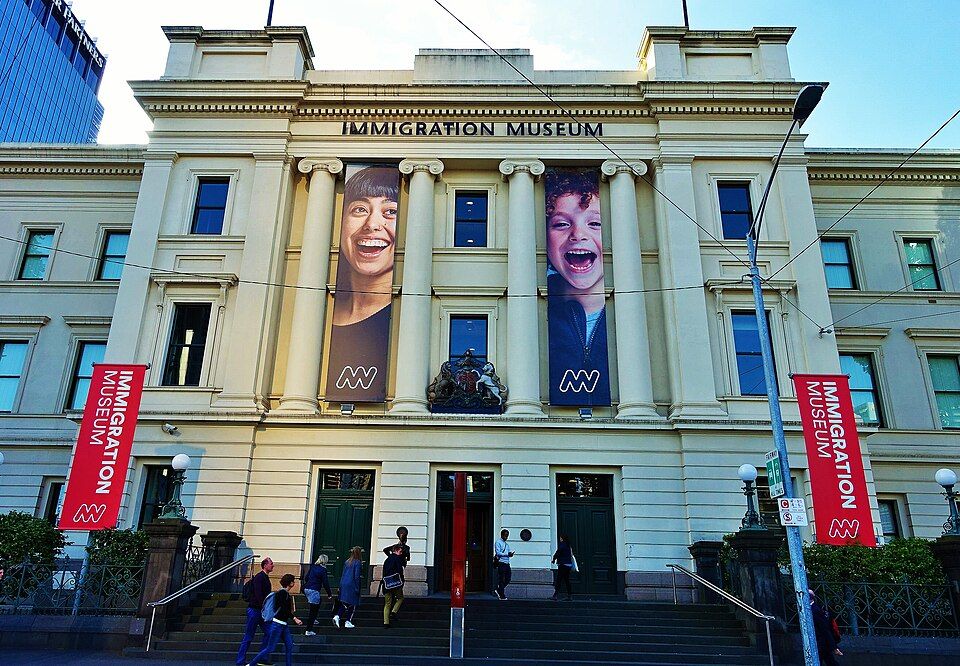
Look at the formal exterior before entering, then consider what that architecture communicated to someone arriving with documents, luggage or goods. Inside, connect an object or rule to a practical decision: who was allowed through, what was inspected and whose judgement counted? This makes the building an active part of the story rather than a decorative shell around the galleries.
The gallery is included in general admission. It is a useful opening stop for a self-guided visit because it gives the rest of the museum a physical setting. Do not attempt to memorise every policy or date; choose a few examples that show how the institution's responsibilities affected ordinary lives.
Voices Across Time connects histories rather than starting at arrival
Voices Across Time begins from First Peoples' continuing connections to Country and unceded sovereignty, then explores the intersecting histories of later arrivals. Its dedicated page lists an opening date of Tuesday 24 November 2026. Check access if you are visiting around that transition.
This is an important framing choice. Migration stories did not unfold on an empty landscape. Read the accounts of change, loss, resilience and community alongside the museum's recognition of First Peoples, rather than treating those histories as an introductory panel to be passed quickly.
The exhibition's supporting stories include the Senjov family, discussing Ukrainian cultural connection across generations, and Attache Case, a collective artwork involving people with refugee and asylum-seeking experiences. These offer different scales of attention: a family history and an artistic response shared by several contributors. Follow the actual gallery displays and current interpretation; an online story does not guarantee that every associated object is visible on the day.
Identity asks how we see ourselves and others
Identity: Yours, Mine, Ours explores heritage, language, beliefs and family connections through stories, objects, images and multimedia. At the November check, its own page said opens Wednesday 25 November, even though the museum's overview described it as daily. For a visit on or around that date, confirm availability before making it the main reason to go.
Once open, this is a useful choice for visitors who want the museum to connect historical migration with everyday judgements. Take time to notice which details lead you to make assumptions about a person, then read their account. The productive part is not finding a single approved answer to every question; it is recognising how limited a first impression can be.
With teenagers, choose one display to discuss afterwards rather than turning the entire room into a lesson. With a mixed group, allow people to read at different speeds and agree a meeting point. Personal stories can be emotionally demanding, so a quieter pause between galleries can help the visit remain attentive.
Add On Country for a photographic perspective
The current On Country: Photography from Australia exhibition is listed until 13 June 2027 and is included with museum entry. It brings Indigenous and non-Indigenous artists into a conversation about Country, colonialism, community and identity through contemporary images.
The official presentation includes Michael Cook's Majority Rule and Warakurna Superheroes by Tony Albert and David Charles Collins. Use these named works as starting points for looking at who appears in an image, how people occupy a setting and what familiar visual conventions are being changed. Photography here is part of an argument about place and representation, not simply a record of scenery.
Read the exhibition's content information before choosing it for children or anyone who would benefit from advance notice. The museum identifies images and names of deceased people, images of deceased animals and nudity. That does not determine whether your group should visit; it helps you decide the route and conversations that suit them.
If photography is your main interest, make this the longest stop and shorten another gallery. If migration history is the priority, treat it as an optional second perspective. Temporary exhibitions deserve a deliberate choice, not an automatic addition after your attention is already exhausted.
Use the Tribute Garden as a place to reflect
The Tribute Garden is a public artwork in the museum's northern garden. It records migrant names and acknowledges Kulin Nation peoples and Aboriginal languages. Its page states that garden entry is free, separate from the paid museum galleries.
Look at how individual names accumulate into a collective record. You do not need to locate a familiar surname for the work to have meaning. After galleries dealing with policy and personal identity, a few minutes here can shift the pace from interpreting displays to considering the people behind them.
Do not mistake the garden for a comprehensive genealogical register or assume every person who migrated to Victoria is represented. It is a particular commemorative artwork. Follow current access instructions at the museum, especially if you intend to visit only the garden rather than the galleries.
General admission and the guided tour have different prices
The visitor information lists A$15 adult general admission and A$12 for Australian Seniors Card holders where another concession does not apply. Children aged 16 and under enter the general galleries free. Free concession admission requires an eligible card; overseas age or student status should not be assumed to qualify without checking the accepted documentation.
Some temporary exhibitions and special events can have additional charges, even though the On Country exhibition currently states it is included. Decide what you want to see before purchasing extras. Keep proof of any concession with your ticket, and check the selected programme rather than assuming a free general-entry category also covers a guided activity.
The Guided Highlights Tour is advertised daily 14:30–15:15, in English, meeting at the foyer welcome desk. Listed prices are A$25 adult, A$22 senior, A$10 child aged 16 and under or concession, and A$8 member. General admission for that day is included; surcharged programmes are separate. The maximum group size is 20.
Choose the tour if you want an introduction linking the building, collection and community stories. Choose self-guided entry if you prefer to linger with particular accounts or need a flexible pace. A child who qualifies for free general entry still needs the relevant paid tour ticket; avoid confusing the two products.
Arrival, access and a manageable route
The dedicated arrival page places the museum at 400 Flinders Street and lists 10:00–17:00 daily, except Good Friday and Christmas Day. Use that confirmed arrival information and recheck before travel: one general-page heading showed a conflicting 09:00 start at the time of research, while its body and other museum pages said 10:00.
Flinders Street and Southern Cross are the named railway options. Use the current journey planner for the actual connection and stop; tram route lists on different museum pages are not fully consistent. There is no on-site visitor parking. A central address makes walking convenient for some visitors, but your entrance and mobility needs still matter.
The accessibility page identifies ramps from Market Street towards the main entrance and through the Festivals Courtyard, with automatic doors. Review the museum's own access resources and contact the team for a specific requirement. Avoid choosing a route solely from a photograph of the front steps.
For around 90 minutes, select Customs Gallery and one main exhibition. With 2–3 hours, add another gallery and the garden pause, or fit the Highlights Tour around independent looking. These are editorial suggestions, not a requirement to complete every space. Leave room afterwards for a meal or a short walk by the Birrarung rather than another demanding museum.
If you want a broader collection visit on another day, our Melbourne Museum guide covers a separate institution in Carlton, including First Peoples at Bunjilaka and natural-history collections. The two museums can complement each other, but they have different locations, tickets and emphases.
Cover photograph: Columned facade of Melbourne’s Immigration Museum in the Old Customs House — Archive photograph Image adapted for publication. — GordonMakryllos, CC BY-SA 4.0.
Frequently Asked Questions
How long should I spend at the Immigration Museum?
Allow about 2–3 hours for selected galleries and a pause. With 90 minutes, choose two focused sections. The optional Highlights Tour lasts 45 minutes and needs its own booking.
Is entry free for children and students?
General admission is free for children aged 16 and under. Concession entry requires accepted documentation; check student eligibility directly. Tours and surcharged programmes can still cost extra.
Does the Highlights Tour include museum admission?
Yes. The listed adult tour price of A$25 includes general entry on the same day. It does not include separately surcharged programmes, and children have a paid tour category despite free general admission.
Which exhibitions are available now?
Check the date-specific pages. At the 24 November 2026 check, Voices Across Time listed opening that day, Identity listed 25 November, and On Country was scheduled until 13 June 2027. Confirm the galleries you most want before travelling.
Is this the same as Melbourne Museum?
No. Immigration Museum is in the Old Customs House on Flinders Street, focused on migration and belonging. Melbourne Museum is in Carlton and has broader cultural and natural-history collections.


Keep Exploring
Hyde Park Barracks Sydney: Plan Your Museum Visit
Plan Hyde Park Barracks in Sydney: free entry, audio sessions, languages, access options and the history behind the museum.
Academy Museum Los Angeles: Plan Your Visit
Plan an Academy Museum visit with gallery tickets, separate screenings and Oscars Experience, current closures and a realistic afternoon route.
Oaxaca Textile Museum: Plan Your Visit
Plan a thoughtful textile museum visit, with current hours, guided tours, workshop checks and a useful link to Oaxaca’s weaving communities.