
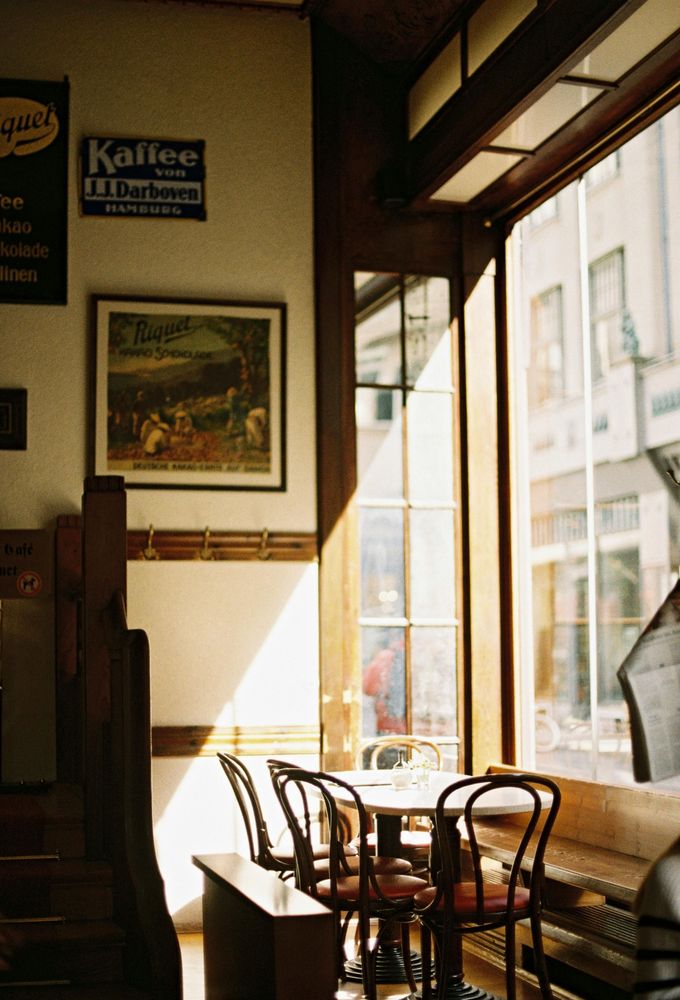
European Coffee Culture: Vienna to Lisbon
From Vienna's UNESCO coffeehouses to Lisbon's bicas and Italian espresso bars: named cafes, opening hours, prices, and the etiquette that locals expect at the counter.
Order a coffee in Vienna and you've bought a seat at a marble table for as long as you want it. Order one in Rome and you'll drink it standing up in ninety seconds. Order one in Lisbon and they'll bring it with a pastel de nata before you ask. European coffee is not one drink — it's a half-dozen national rituals, each with its own vocabulary, price tier and unwritten rules. This guide maps the named cafes worth crossing a continent for, the words to use at the counter, and the gap between a €1 espresso in a Naples bar and a €7 melange in a Viennese palace.
Fast Facts
| Detail | Info |
|---|---|
| Best time to visit | Year-round — coffeehouses are indoor institutions; September–November and March–May avoid summer cruise crowds in Lisbon, Vienna and Italy |
| Price range (EUR) | €1 espresso at an Italian bar standing • €0.80–€1.20 Lisbon bica • €2–€3 French express • €4–€7 Viennese melange seated • €3–€5 Swedish fika set |
| Heritage status | Viennese coffeehouse culture inscribed on UNESCO's Representative List of the Intangible Cultural Heritage of Humanity in 2011 |
| Oldest cafe | Caffè Florian, Piazza San Marco Venice — opened 1720, the oldest continuously operating cafe in Italy and one of the oldest in the world |
| Don't miss | Café Central in Vienna (Freud's table); Sant'Eustachio in Rome (gran caffè); A Brasileira in Lisbon (Pessoa's bronze); Café de Flore in Paris (Sartre's banquette) |
Vienna: the UNESCO coffeehouse
Vienna's coffeehouses are the only European cafe tradition formally protected by UNESCO. The Viennese coffee house culture was inscribed on the Representative List of the Intangible Cultural Heritage of Humanity in 2011, with the official description naming it "a place where time and space are consumed, but only the coffee is found on the bill." That phrase is the operating manual for the whole city: you buy a coffee, you sit as long as you want, and waiters in tails (called Herr Ober) bring water refills indefinitely.
The genre crystallised in the 19th century when the cafes became extensions of cramped Habsburg apartments — newspapers on wooden racks, marble-topped Thonet tables, billiard rooms in the back, and chess sets on request. The classical Viennese cafe is open daily from roughly 08:00 to midnight, takes credit cards now (though cash is still appreciated), and quietly expects you to dress one notch above the street.
Named cafes worth a detour
- Café Central, Herrengasse 14 — opened 1876 inside the Palais Ferstel, with a vaulted neo-Renaissance hall and a wax statue of regular Peter Altenberg at the entrance. Trotsky, Freud and Adler all drank here. Mon–Sat 07:30–22:00, Sun 10:00–22:00. Melange around €6.50, Apfelstrudel €6.
- Café Sacher, Philharmoniker Strasse 4 — behind the Vienna State Opera since 1876, official home of the Original Sacher-Torte (Franz Sacher invented it in 1832; the recipe is locked in a hotel safe). Daily 08:00–22:00. A slice with whipped cream and a coffee runs €13–€16.
- Café Hawelka, Dorotheergasse 6 — opened 1939, a survivor of the post-war literary scene, walls heavy with smoke-stained Klimt-era posters. Famous for Buchteln (sweet yeast buns with plum jam) served warm from 22:00. Tue–Sun 08:00–24:00, closed Mondays.
- Café Demel, Kohlmarkt 14 — k.u.k. Hofzuckerbäcker (Imperial and Royal court bakery) since 1786, with white-aproned bakers visible through glass making the rival Demel-Torte. Daily 10:00–19:00. Coffees €5–€6, cakes €8–€10.
- Café Landtmann, Universitätsring 4 — opened 1873, near the Burgtheater, traditional haunt of actors, politicians and writers (Freud's frequent stop). Daily 07:30–22:00.
The Viennese coffee menu
Do not ask for "a coffee" — the waiters will need a name. The essential vocabulary:
- Kleiner Schwarzer / Großer Schwarzer: single or double espresso (small black, large black).
- Melange: roughly half espresso, half steamed milk with milk foam — the classic Viennese drink, closest to a cappuccino but lighter. €4.50–€7 depending on the cafe.
- Verlängerter: an espresso "lengthened" with hot water (similar to an Americano), often served with a small jug of cold milk.
- Einspänner: a double espresso in a tall glass topped with thick whipped cream — named after the one-horse carriage drivers who needed a coffee that wouldn't spill.
- Kapuziner: small black with a few drops of cream, the brown colour of a Capuchin monk's robe.
- Fiaker: a Großer Schwarzer with a generous shot of rum or kirsch, also named after the carriage drivers.
- Mélange mit Schlag: melange with extra whipped cream on top — €0.50–€1 supplement.
Every coffee arrives on a small silver tray with a glass of tap water (a quiet test of the cafe: the water should be refilled without you asking) and a tiny biscuit. For a deeper local food framing pair this with our Vienna food guide on coffee, cake and schnitzel.
Italy: the bar, the standing counter, espresso in 90 seconds
Italy does not have coffeehouses in the Viennese sense. It has bars — counter-driven neighbourhood institutions where the espresso is pulled in under 30 seconds, drunk standing in under 60, and paid for in cash on the way out. The Italian Coffee Consortium estimates Italians drink around 30 million espressi per day across roughly 150,000 bars. The price is regulated by tradition more than law: €1.00 to €1.50 for an espresso at the counter (al banco) in most cities, €4 to €7 if you sit at a table (al tavolo), with the gap widening to €10+ on tourist piazzas in Venice or Rome.
The etiquette has rules. Order at the cashier first (la cassa), get the receipt (scontrino), then slide the receipt across the counter to the barista. Drink the espresso in one or two sips. Cappuccino is breakfast-only — ordering one after 11:00 marks you as a tourist (it won't be refused, but a waiter may raise an eyebrow). After lunch the right call is an espresso or a caffè macchiato (espresso with a dab of milk foam).
Named cafes by city
- Caffè Florian, Piazza San Marco 57 Venice — opened on 29 December 1720, the oldest continuously operating cafe in Italy and one of the oldest in the world. Six rooms decorated in 18th-century frescoes; the orchestra plays on the terrace from spring through autumn. Daily 09:00–23:00. Espresso at the counter (rarely available — most service is table seating) around €4, espresso at the terrace €11–€14 plus a €6 music supplement when the orchestra plays. It is theatre, not a deal.
- Caffè Greco, Via dei Condotti 86 Rome — opened 1760, declared a national monument; Casanova, Stendhal, Goethe, Liszt and Keats all signed the book. Daily 09:00–21:00. Same two-tier system as Florian: counter €2.50, sit-down €9 espresso.
- Caffè Gambrinus, Via Chiaia 1–2 Naples — opened 1860, Liberty-style mirrors and gilt ceilings facing Piazza del Plebiscito. Daily 07:00–01:00. Espresso at the counter €1.20; their caffè sospeso ritual (paying for an extra coffee that a stranger can claim) was reportedly born here.
- Sant'Eustachio Il Caffè, Piazza Sant'Eustachio 82 Rome — operating since 1938, roasts its own beans over wood fire and keeps the technique a guarded secret (baristas crouch behind a steel screen when pulling the gran caffè). Daily 07:30–01:00. Espresso €1.50 at the counter; the gran caffè with cream-topped foam is the signature.
- Caffè Pedrocchi, Piazzetta Pedrocchi Padua — opened 1831, famous for the Caffè Pedrocchi drink: espresso with cocoa, fresh cream and mint. Tue–Sun 08:00–24:00.
Regional drinks beyond espresso
- Marocchino (Turin, Piedmont): espresso, cocoa powder and milk foam in a small glass cup — €1.50–€2.50.
- Espressino freddo (Puglia and Naples in summer): cold espresso shaken with milk and cocoa.
- Caffè in ghiaccio leccese (Lecce, Puglia): espresso poured over an ice cube of almond milk syrup — the local July afternoon drink.
- Caffè shakerato: espresso shaken with ice and sugar in a cocktail shaker, served in a martini glass — €3–€5.
- Caffè corretto: espresso "corrected" with grappa, sambuca or brandy — the after-lunch professional's coffee.
For where to drink the best regional espressi on a working trip, see our companion guide to the best coffee cities in Europe.
Portugal: bicas, pastel de nata, and the tiled corner cafe
In Lisbon you don't order an espresso — you order a bica. The word reportedly comes from the spout (bica) of an early espresso machine, or from the acronym Beba Isto Com Açúcar ("drink this with sugar") that a pioneering Chiado cafe printed on its saucers in the early 1900s. Either way, a bica is a small, intense, slightly bitter shot pulled in any of the city's tiled corner pastelarias. Prices are the kindest in Western Europe: €0.80–€1.20 at the counter in most of Lisbon and Porto, €1.50–€2 in central tourist zones, and almost always paired with a pastel de nata for under €3 total.
The defining ritual is the bica-e-pastel breakfast or mid-morning break, eaten standing at the marble counter. North of the country, in Porto, the same drink is sometimes called a cimbalino (after the La Cimbali espresso machines that were dominant in the 1950s); ask for either word and you'll get the same coffee.
Named cafes
- A Brasileira, Rua Garrett 120 Lisbon — opened 1905 in Chiado, an Art Nouveau landmark with a bronze statue of poet Fernando Pessoa seated outside (the bronze was installed in 1988; tourists queue to sit beside him for photos). Daily 08:00–02:00. Bica €1.50 at the counter (more on the terrace).
- Café Majestic, Rua Santa Catarina 112 Porto — opened 1921, the city's Art Nouveau cathedral of coffee, with carved wooden mirrors, leather banquettes and a glass roof. J.K. Rowling reportedly drafted part of Harry Potter here. Mon–Sat 09:30–23:30, closed Sundays. Coffees €3–€5 at table service — a sit-down place, not a counter dash.
- Manteigaria, Rua do Loreto 2 Lisbon (Chiado) and four other branches — opened 2014 but already a national institution for the freshest pastel de nata (the kitchen is glass-fronted; you can watch each tart get its 280°C blistered top). Bica + pastel de nata €2.20. No seating to speak of — it is a marble counter and a queue.
- Pastéis de Belém, Rua de Belém 84–92 Lisbon — the original 1837 bakery selling the only "Pastéis de Belém" (the name is trademarked); the recipe descended from Jerónimos Monastery monks. Daily 08:00–22:00. A pastel + bica runs about €2.50; the queue is famously brutal but moves in 10–20 minutes.
- Café Nicola, Praça Dom Pedro IV (Rossio) Lisbon — opened 1779 (current Art Deco interior from a 1929 refit), a literary hangout for the poet Bocage and an early democracy meeting point. Daily 08:00–24:00.
France: the terrace, the noisette, and Saint-Germain literary cafes
French cafe culture is built around the terrasse — the sidewalk extension that turns the cafe into an outdoor reading room. The pricing logic everywhere in France is three-tiered: au comptoir (at the bar, cheapest, €1.50–€2 for an express), en salle (sitting indoors), and en terrasse (sitting outside, most expensive, often €4–€6 in Paris and tourist towns). The same coffee, three prices — the gap reflects the rent for your sidewalk square metre.
The French coffee vocabulary is short:
- Un café / un express: a single espresso.
- Une noisette: an espresso with a drop of warm milk (named for the hazelnut colour). The Parisian after-lunch drink.
- Un café crème: large coffee with steamed milk — the closest local equivalent to a cappuccino.
- Un café allongé: an espresso lengthened with hot water (the French Americano).
- Un déca: decaf.
- Un café gourmand: an espresso served with three small desserts — usually €7–€10, the post-meal sweet tooth's answer.
Named Saint-Germain literary cafes
- Café de Flore, 172 boulevard Saint-Germain Paris — opened 1887, became the daily office of Jean-Paul Sartre and Simone de Beauvoir in the 1940s. Daily 07:30–01:30. Espresso on the terrace €5; the upstairs room is quieter.
- Les Deux Magots, 6 place Saint-Germain-des-Prés — opened 1885 across the square from Flore; Hemingway, Picasso and James Joyce all worked here. Daily 07:30–01:00. Espresso €4.80 on the terrace.
- La Closerie des Lilas, 171 boulevard du Montparnasse — opened 1847; brass plaques on the tables mark seats once occupied by Hemingway (he wrote much of The Sun Also Rises here), Verlaine, Apollinaire and Beckett. Daily 09:00–01:30.
- Le Procope, 13 rue de l'Ancienne-Comédie — opened 1686, calls itself the oldest cafe in Paris (and arguably in continuous operation in the world), once a meeting place for Voltaire, Rousseau and Diderot. Now primarily a restaurant; coffee in the upstairs salon €4–€6.
Scandinavia: fika as a daily institution
In Sweden, coffee is not a drink so much as a scheduled appointment. Fika is the daily coffee-and-cake break, taken once mid-morning and again mid-afternoon, traditionally with a colleague or friend. The word covers both the act and the food: a kanelbulle (cinnamon bun) or a kardemummabulle (cardamom bun), eaten with filter coffee or a small latte. Swedes drink among the highest per-capita coffee volumes in the world, and the fika ritual is so ingrained that most offices, government agencies and even hospitals build it into the working day.
Named places
- Vete-Katten, Kungsgatan 55 Stockholm — opened 1928, a converted apartment building with parquet floors and 1930s sitting rooms, the Stockholm fika cathedral. Daily 07:30–20:00 (Sun from 09:30). Cinnamon bun + filter coffee SEK 70–95 (€6–€8.50).
- Drop Coffee Roasters, Wollmar Yxkullsgatan 10 Stockholm — a third-wave specialty roastery and cafe, World Barista Championship hardware on the shelf; the place to drink a single-origin filter for SEK 45–60 (€4–€5).
- Johan & Nyström, Swedenborgsgatan 7 Stockholm — another reference specialty roaster, with a roastery cafe at Södermalm.
- Café Husaren, Haga Nygata 28 Gothenburg — famous for the hagabulle, a cinnamon bun the size of a face. Daily 09:00–18:00.
Denmark adopts the same logic but calls it hygge with coffee; Norway and Finland (the world's highest per-capita coffee drinker by some measures) run their own near-identical breaks. Across Scandinavia plan €3–€5 per fika including a pastry; specialty single-origin filters run €4–€6.
Greece, Spain and the Balkans: freddo, cortado, Turkish coffee
Greece: freddo espresso and freddo cappuccino
From April to October the Greek default coffee is cold. The freddo espresso — espresso shaken with ice and sugar then strained into a glass — and the freddo cappuccino — same base topped with cold milk foam — are drunk on every Athens and Thessaloniki terrace from breakfast onward. Prices: €2–€3.50 at neighbourhood cafes, €4–€5 on tourist squares. Order sketo (no sugar), metrio (medium-sweet) or glyko (sweet) when you order, not after.
The traditional Greek coffee — finely ground beans simmered with sugar in a long-handled copper briki and served unfiltered in a small cup — is the slow-morning option, drunk especially in older kafeneía where men play backgammon. Always served with a glass of cold water.
Spain: cortado, café con leche, carajillo
Spain's morning coffee is the café con leche — espresso with steamed milk in a small glass, €1.50–€2.50, eaten with a slice of tortilla or churros. The afternoon move is the cortado: espresso "cut" with a splash of warm milk, €1.20–€1.80, served in a small glass. Later, the carajillo (espresso with brandy, rum or licor 43) is the after-lunch professional drink. Spanish bars charge less than half what Italian counters charge in tourist zones, and the espresso is generally pulled longer (closer to a lungo). In Barcelona the corner café doubles as a tapas counter, so it is worth pairing your cortado with the tapas bars and markets in our Barcelona food guide.
The Balkans: Bosnian and Turkish coffee
In Sarajevo, Mostar and across Bosnia, coffee is served Ottoman-style: ground in a brass mill, brewed in a long-handled džezva, poured into a small fildžan cup and accompanied by a sugar cube (the šećerlema, dipped in the coffee then bitten) and a square of rahat lokum (Turkish delight). The historic spot in Sarajevo is Kahvedžinica Džirlo, Kovači 16 in Baščaršija — a tiny three-table shop where the owner roasts the beans himself. Bosnian coffee BAM 2–3 (€1–€1.50). Allow 20 minutes — drinking it quickly is bad form.
Istanbul and Greek-Cypriot Nicosia run similar rituals with the same Ottoman pedigree. The whole genre was inscribed on UNESCO's Intangible Cultural Heritage list (Turkish coffee culture, 2013) two years after the Viennese coffeehouse.
Where locals go vs tourist traps: the simple tests
The gap between a working cafe and a postcard cafe is wider than it looks. A few quick filters:
- Check the price of an espresso at the counter. In Italy anything above €1.50 al banco in a non-resort city is a markup. In Lisbon anything above €1 for a bica is a tell. In Vienna there is no "counter" tradition — coffee is meant to be sat with — so judge by the menu in the window: if it's only in English, walk on.
- Is the menu only in English (or in five languages)? Real local cafes price for residents in the local language first.
- Is the espresso machine visible and working? In Italy and Portugal the bar should be in constant motion. A quiet machine in a busy area suggests a tourist-only operation that doesn't move beans.
- Are locals reading newspapers or scrolling phones? Vienna's coffeehouses still rack newspapers on wooden poles — and locals still read them. If everyone in a Viennese cafe is photographing cake, it's the tourist room.
- Where do the office workers go? Italian bars peak 07:30–09:00 (breakfast) and 12:30–14:00 (lunch espresso); Viennese cafes peak 10:00–12:00 and 15:00–17:00; French cafes peak around the lunch express at 14:00. A cafe empty at peak local hours is not the local choice.
Which Italian city for the best espresso?
The argument has no consensus answer, but the strongest case is for Naples. Neapolitan baristas pull short, thick, syrupy espressi pre-sweetened with sugar (the local default — say amaro if you don't want it sweet), and the city's coffee culture treats the bar as a public utility — high turnover, low prices (€1.10–€1.30 in 2026), no pretension. Caffè Gambrinus, Mexico (Piazza Dante), and Caffè del Professore (under Piazza Trieste e Trento) are the named institutions; any neighborhood bar in the Quartieri Spagnoli will pull a competitive shot.
Trieste is the technical counter-argument — Italy's coffee capital by green-bean import volume, home to Illy, three working coffee roasting plants, and a Habsburg-era cafe scene (Caffè San Marco from 1914, Caffè Tommaseo from 1830) that bridges Italian and Viennese traditions. Rome has the named monuments (Sant'Eustachio, Tazza d'Oro near the Pantheon). Turin invented the bicerin and the marocchino. But for the city most committed to the daily ritual of espresso as a working-class right, Naples wins.
For the wider European city ranking and how to plan a coffee-tasting trip, our European street food guide covers the bar-and-cafe overlap, and our best food markets in Europe guide flags the market cafes that anchor each city's morning routine.
How to plan a coffee-focused trip across Europe
One city per long weekend works best. Vienna's coffeehouse loop (Central → Hawelka → Demel → Landtmann → Sacher) is a full day if you sit properly at each. Lisbon's Chiado–Rossio loop (A Brasileira → Café Nicola → Manteigaria → Pastéis de Belém by tram 15) is half a day plus the Belém trip. Rome's Sant'Eustachio → Tazza d'Oro → Caffè Greco walk is 90 minutes for three coffees and a slow piazza sit between each. Paris's Saint-Germain loop (Flore → Deux Magots → Procope → Closerie des Lilas) is best done as a late afternoon plus dinner.
If you have a week and want a coffee-themed itinerary, the natural pairing is Vienna + Trieste + Venice + Padua + Bologna + Florence: a north-Italian and Habsburg circuit linked by direct trains, total time roughly 6–7 days, total budget €1,200–€2,000 mid-range including hotels.
A few practical notes on payment and tipping. In Italy and Portugal coffee at the counter is paid in cash at most independent bars — bring small notes. In Vienna a 5–10% tip is rounded up to the next euro on the saucer when paying ("stimmt so" means "keep the change"). In France a coffee bill rarely needs a tip beyond the small change of the round-up. In Sweden no tip is expected (service is included). In Bosnia leave the change of a coffee round-up; staff are usually paid below European averages.
Frequently Asked Questions
What's the right way to order coffee in Italy without sounding like a tourist?
First, decide whether you're standing (al banco) or sitting (al tavolo) — the price doubles or triples if you sit. Pay at the cashier (la cassa) first, get the receipt, then slide it across the counter to the barista. Order un caffè (default: an espresso), un macchiato (espresso with milk foam), or un caffè lungo (longer pull). Never order a cappuccino after 11:00 — it's a breakfast drink. After lunch the right call is an espresso or a caffè corretto (with a shot of liquor). Standing counter prices in 2026 sit around €1.10–€1.50 in most cities, €2 in Venice and Rome tourist piazzas.
How much should I budget per day for coffee in Europe?
It varies wildly by country. In Italy and Portugal €4–€8 per day covers three to four espressos plus a pastry. In France and Vienna, where you'll sit longer, plan €15–€30 per day for two seated cafes including cake. In Scandinavia a single fika with a kanelbulle is €6–€8, so a full day of two fikas plus a specialty filter runs €20–€30. Tourist piazzas (Piazza San Marco in Venice, Place Saint-Germain in Paris) add a sit-down premium of €8–€15 per coffee — worth it once for the room, less so as a habit.
Where do locals actually drink coffee vs the tourist cafes?
In Vienna, locals still fill Café Hawelka, Café Bräunerhof and Café Sperl alongside the famous Central and Landtmann; the tourist density is concentrated in the Inner City "loop" cafes. In Lisbon, the working bicas are in any neighbourhood pastelaria in Alfama, Mouraria or Graça — €0.80–€1 at the counter — while Chiado prices climb to €1.50–€2. In Rome, Sant'Eustachio and Tazza d'Oro are local favorites that happen to also be famous; the truly local choice is any bar in Trastevere or Testaccio away from the main piazza. In Paris, the literary cafes (Flore, Deux Magots) are 80% tourist; the cafes one block off the boulevard are where locals actually sit.
What's the proper etiquette in a Viennese coffeehouse?
The shorthand: order one coffee and stay as long as you like. Waiters in tails are called Herr Ober ("Mr Head Waiter") regardless of age — never "garçon". Coffee arrives on a small silver tray with a glass of tap water; the water should be refilled without asking, and a good waiter knows when you want a top-up. Newspapers on wooden racks are free to use but return them to the rack. Tip 5–10% rounded up to the next euro on the saucer when paying; say "stimmt so" ("keep the change") if the round-up is close enough. Pay at the table — you don't go to a counter. Dress one notch above the street; jeans and a clean jacket are fine, sportswear less so. The Viennese coffeehouse culture has been on the UNESCO Intangible Heritage list since 2011 — treat it accordingly.
Which Italian city pulls the best espresso?
The arguments for Naples, Trieste and Rome are all defensible. Naples has the strongest case for daily-life coffee culture: short, sweet, syrupy espressi pulled fast in high-volume bars like Caffè Gambrinus, Caffè Mexico and Caffè del Professore at €1.10–€1.30, with the highest density of working bars in Italy. Trieste is the technical capital — Italy's busiest coffee port, home to Illy, with Habsburg-era cafes like San Marco (1914) that bridge Italian and Viennese traditions. Rome has the named monuments (Sant'Eustachio with its wood-fire roasting; Tazza d'Oro near the Pantheon). If you have to pick one, Naples wins on consistency at street level and Trieste wins on technical depth — but the truthful answer is that any working Italian bar in a non-tourist neighborhood will out-pour 90% of cafes in the rest of Europe.

Keep Exploring
Vienna Food Guide: Coffee, Cake & Schnitzel
A foodie primer to Vienna's iconic coffee houses, legendary cakes and where to find the best Wiener schnitzel — plus local tips, etiquette and a day plan.
Best Coffee Cities in Europe
From imperial coffeehouses to third-wave roasteries, explore Europe's best coffee cities with local tips, signature drinks, café picks and practical advice for the traveling caffeine lover.
Lisbon Food Guide: Bacalhau, Pastéis & More
A comprehensive Lisbon food guide to bacalhau, pastéis de nata and bacalhau, petiscos, markets and where locals eat — with practical tips, sample food crawls and neighborhood picks.