
Choose a Kyoto base around your evenings, train journeys and room needs. Compare the station, downtown, Gion and Arashiyama before booking.
Deciding where to stay in Kyoto is easier when you separate your arrival from the days that follow. A room beside Kyoto Station can simplify a late arrival or repeated train journeys. A downtown address can make dinner and a return to your room easier. A stay in the eastern temple districts or Arashiyama puts a particular part of Kyoto at the centre of your trip.
For a first visit with mixed interests, start your search around Shijo-Karasuma and Shijo-Kawaramachi, then compare a station-area option. Choose Gion or Arashiyama because you want to spend time in that setting, after checking the actual route to the property. These are editorial recommendations based on geography and travel needs, not hotel reviews or guarantees about every street.
Information checked on 3 October 2026. Accommodation prices and availability require a quote for your dates and party.
| Base | Strong reason to choose it | Main tradeoff | Check before booking |
|---|---|---|---|
| Kyoto Station | Arrival, departure and repeated JR journeys | Separate trips to downtown and eastern districts | Which station exit and actual hotel entrance |
| Shijo-Karasuma | Downtown stay with access to the Karasuma subway | Less immediate proximity to the river and Gion | Walking route from Shijo station |
| Shijo-Kawaramachi | Central dining, shopping and walks towards Gion | Not the same location as Shijo subway station | Correct railway operator and nearest station |
| Gion / southern Higashiyama | Eastern streets and temple district as your focus | Address-dependent access and walking demands | Final approach, luggage and room access |
| Saga / Arashiyama | A stay centred on western Kyoto's landscape | Repeated cross-city journeys if your plans are elsewhere | Arrival station and dinner arrangements |
Kyoto Station: make the transport advantage specific
Choose the station area when your accommodation needs to support the wider journey. If Kyoto is a stop between other destinations, reducing the transfer between train and room has real value. It matters even more when you must handle luggage or when members of your party arrive separately.
The airport connection is a concrete advantage: JR-WEST advertises HARUKA services between Kansai Airport and Kyoto. That does not make every property described as “Kyoto Station area” equally convenient. Save its street entrance, identify the exit it recommends and assess the whole walk from the platform. A distance measured from the station building can conceal a less convenient approach from your arriving train.
Do not dismiss this base as somewhere with nothing beyond transport. The official station-area guide places Higashi Hongan-ji and Nishi Hongwan-ji to the north and Umekoji to the west. Those give the area a context beyond its concourse, although a station address is not a substitute for staying in Gion.
Count how often the station advantage will actually help. If you arrive once, leave once and otherwise concentrate on central and eastern Kyoto, a downtown base may serve more of your waking hours. If your plans repeatedly begin with a JR train, the station can be the more coherent choice. Compare complete journeys to your intended destinations rather than assuming one transport hub wins every route.
For a short overnight stop, prioritise reliable check-in and straightforward departure over a broad neighbourhood label. Confirm luggage storage separately: arriving before room access and leaving after checkout are different requests, and neither should be assumed from the presence of a reception desk.
Downtown: distinguish Karasuma from Kawaramachi
“Downtown Kyoto” is useful as a search starting point, but too broad as a booking decision. The practical comparison is often between the Karasuma side and the Kawaramachi side of Shijo. Kyoto's central-area guide identifies Shijo's shopping corridor and the Nishiki dining and shopping area. Staying here suits travellers who want the surroundings of their accommodation to remain useful between sightseeing outings.
Shijo-Karasuma: favour the subway connection
The municipal subway station guide lists Kyoto and Shijo on the Karasuma Line. A room with a manageable walk to Shijo therefore offers a useful compromise: access from the main station without making the station area your base.
This is a sensible starting point if you expect to return to the room during the day, or if different people in your group want to go out independently. Assess the address against both the station and the streets where you expect to eat. A property can satisfy the first requirement while leaving the second less convenient than you hoped.
The name needs care. Shijo subway station is not Gion-shijo station. Do not transfer a quoted walking time from one to the other, and do not read “near Shijo” as a complete arrival instruction. Ask for the station, operator and exit together.
Shijo-Kawaramachi: favour your time outside the room
Search towards Kawaramachi if you want central shopping and dining to shape your evenings, with Gion across the river as another part of your walking plans. This is a good editorial default for someone who values going out for dinner without first making a trip back into the centre.
The tradeoff is that the convenient direct subway relationship described for Shijo-Karasuma should not be applied to every Kawaramachi address. Look at the particular connection you will use on arrival. Keihan's Gion-shijo station information identifies its position at the eastern end of Shijo Bridge and its connection with the Hankyu Kyoto Line. Nearby stations can belong to different networks; the booking map needs to be read alongside your route.
If sleep is the deciding factor, investigate the room rather than labelling all downtown accommodation noisy. Ask whether the offered room faces a main street, what floor it occupies and whether another orientation can be confirmed. A request is not a guarantee, so keep any essential condition in the booking correspondence.
Gion and southern Higashiyama: choose the exact setting
A Gion or Higashiyama address can make sense when the eastern part of Kyoto is the reason for your visit. The official Gion and Kiyomizu guide describes temple streets, ceramics shops, teahouses and restaurants. The appeal is spending time in that environment, including the ordinary walk back to your accommodation.
However, Gion near the river and accommodation farther into the temple district are not interchangeable bases. Compare the actual approach from transport, rather than treating “traditional Kyoto” as a single compact place. Ask whether the final stretch includes a slope or steps and where a taxi can set you down. These questions matter more than an attractive map thumbnail when you have a pushchair, limited walking tolerance or bulky bags.
Choose an address nearer your usable rail connection if you want an eastern base with frequent trips elsewhere. Keihan's network overview shows its role linking Kyoto, Osaka and Shiga. That is a reason to examine a Keihan route, not to assume it takes you directly to Kyoto Station or to every destination in Osaka.
A property farther into the district may still be the right choice if its room, meals or surroundings are central to your stay. Make that a deliberate exchange: accept a more involved arrival in return for something you will actually use. Do not pay for a setting you only see briefly while leaving early and returning exhausted.
Gion also needs considerate arrival habits. Keep voices down near homes, follow property instructions and respect signs on lanes and entrances. Staying in the district does not confer access to private streets or create an entitlement to photograph people working there.
Arashiyama: stay for the area, not just its name
Saga and Arashiyama sit towards Kyoto's northwest, with the bamboo grove and Togetsukyo Bridge among the landmarks described by the official area guide. An overnight stay is most persuasive when you want time in this part of the city and value returning to the same landscape after an outing.
The important question is where the rest of your trip happens. If most of your chosen visits and dinners are central or eastern, count the repeated journeys before booking in the west. If the accommodation itself is part of the experience, protect time to enjoy it instead of using it merely as a distant place to sleep.
Kyoto's accommodation-area comparison notes that Arashiyama restaurants and cafés tend to close early. Confirm dinner with your host: whether it is included, requires a reservation or must be arranged elsewhere. Do not arrive expecting a central-city pattern of spontaneous evening choices.
Check the arrival station named by the property, not just “Arashiyama” on a search map. Use the city's access guidance for Saga and Arashiyama as a starting point, then obtain the final directions from your host. A pleasant sightseeing walk is not automatically the right luggage route.
Splitting a stay can work if you specifically want an Arashiyama overnight alongside a central base. Balance that against packing, luggage transfer and the interval between checkout and check-in. Moving hotels solely to shorten one sightseeing journey may cost more useful time than it saves.
Choose the room after the neighbourhood
A suitable district cannot fix an unsuitable room. Kyoto's official lodging-type guide distinguishes hotels, ryokan and vacation houses. Use the category to form questions, then judge the actual room and rate plan.
For a ryokan, confirm the sleeping arrangement and meal schedule before booking. Ask whether the room uses futons or beds, whether the bath and toilet are private, and what the quoted stay includes. If dinner is part of the plan, establish the latest arrival that allows you to receive it. A late flight and a fixed dinner arrangement can be a poor match even when the location is ideal.
For a townhouse or other rental, ask about stairs between sleeping and bathroom areas, who handles check-in and where luggage can go before access. Confirm whether the photos represent the unit you are booking. A whole-house listing should not be interpreted as a promise that every room is on the same level or that a staffed reception is nearby.
For families, enter the children's actual ages and confirm beds or futons for everyone. “Sleeps the party” and “provides the sleeping arrangement we need” are separate tests. For anyone needing step-free access, request details from street to room and bathroom; an elevator symbol alone does not resolve the full route.
Finally, compare total quotes on equal terms: same dates, occupancy, meals, cancellation conditions and included or separately payable charges. This guide does not assign a price band to a neighbourhood because the room and booking conditions can change the comparison substantially.
Make the final choice with your arrival and evenings
Shortlist a downtown address and one genuine alternative: the station for rail logistics, Gion for the eastern setting or Arashiyama for a western stay. Map the arrival, the return from your likely dinner area and the departure. Then check the room conditions that would rule a property out.
The strongest choice is the one that supports repeated parts of your trip. A slightly more involved arrival can be worthwhile for several convenient evenings; an easy station departure can matter more on a brief stop. Choose the compromise consciously, with the property entrance and room plan in view.
Plan the next part of your trip
Use these related guides to compare where to stay, what to visit or another destination in the same region. Each guide covers a separate decision; this is not a combined itinerary.
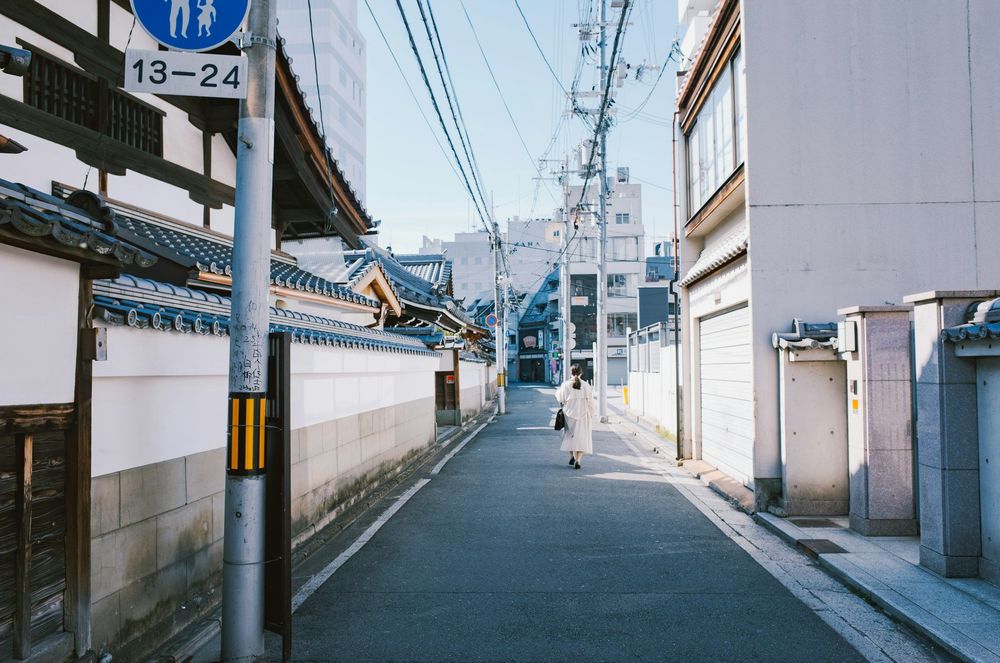
Cover photograph: A person walking along a quiet street with tiled walls in Kyoto. Photo by PJH on Unsplash (Unsplash).
Frequently Asked Questions
Where should I stay in Kyoto for a first visit?
Start by comparing Shijo-Karasuma and Shijo-Kawaramachi for a mixed sightseeing and dining stay. Compare Kyoto Station if arrival, departure or repeated JR journeys are a larger part of your plans.
Is Kyoto Station the same as downtown Kyoto?
No. Treat the station area and the Shijo-Karasuma / Shijo-Kawaramachi area as separate booking choices. The former prioritises rail logistics; the latter can better support central dining and shopping.
Is Gion convenient without a car?
It can be, but the exact address matters. Check its walking connection to usable transport, the final approach and the route for your luggage; a Gion label alone does not settle those questions.
Should I stay in Arashiyama for the whole trip?
Consider it if western Kyoto and the accommodation itself are central to your visit. If most outings and dinners are elsewhere, compare the repeated journeys with staying centrally or adding a separate overnight.
What should I confirm before booking a ryokan?
Confirm beds or futons, bathroom arrangements, meal inclusions and arrival deadlines. Make sure any included dinner is compatible with your transport plans and that the room works for every member of your party.

Keep Exploring

Where to Stay in Rio de Janeiro: Neighborhood Guide
Choose between Copacabana, Ipanema, Leblon, Botafogo, Flamengo, Santa Teresa and Barra by the journeys you will make each day.

Where to Stay in Buenos Aires: Neighborhood Guide
Choose a Buenos Aires base around the evenings you want, the sights you will revisit and the routes you will actually use. Compare neighborhoods and inspect the exact address before booking.

Where to Stay in New York: Neighborhood Guide
Choose a New York base by the journeys you will repeat. Compare specific station areas, waterfront trade-offs, family needs and the total accommodation cost.